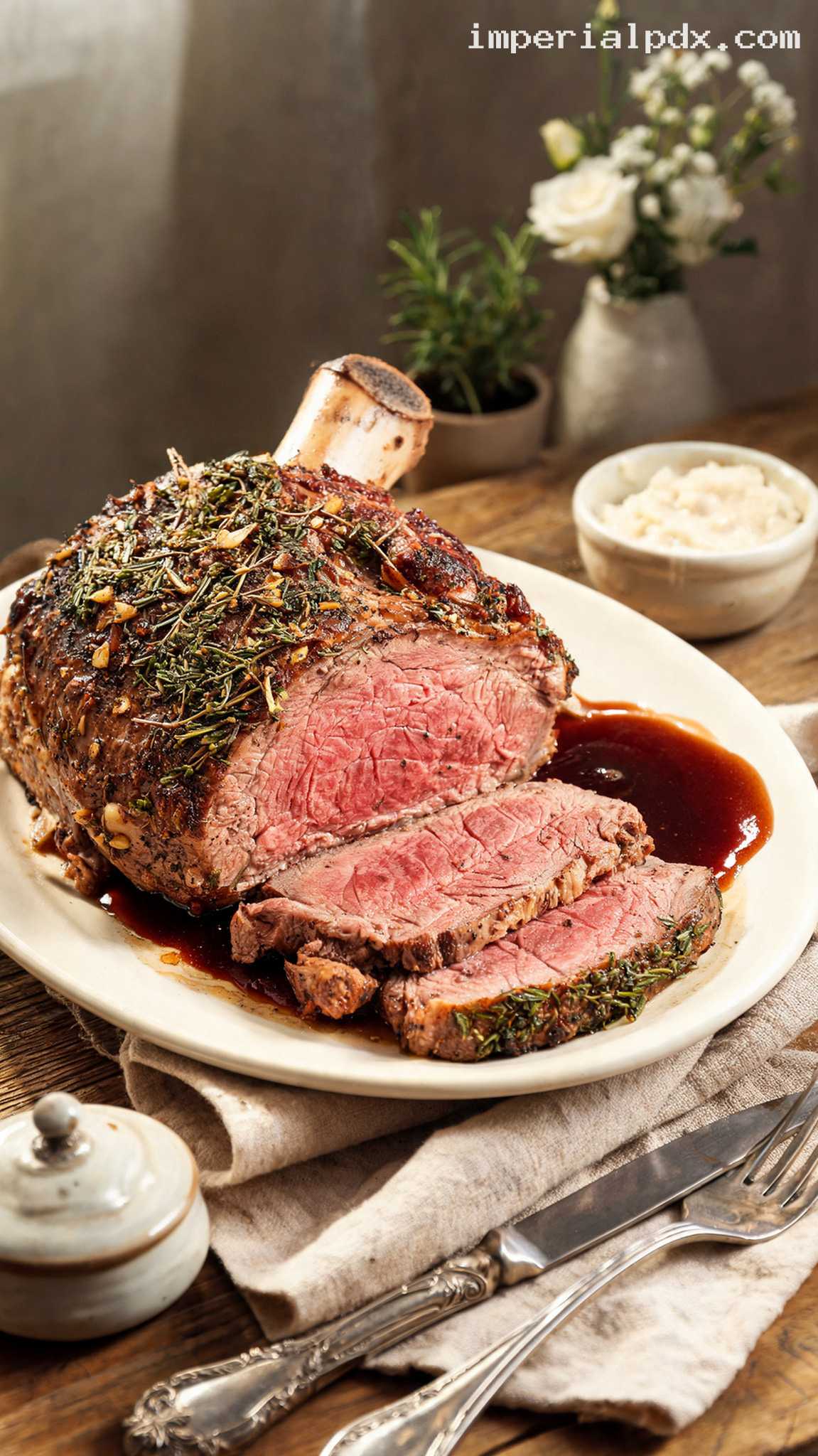
Quick Recipe Version (TL;DR)
Quick Ingredients
- Roast: One 6-pound (2.7 kg), 3-rib bone-in prime rib roast; 18 g kosher salt; 1 tablespoon coarsely cracked black pepper.
- Garlic-herb coating: 10 garlic cloves, minced; 2 tablespoons finely chopped fresh rosemary; 1 tablespoon fresh thyme leaves; 2 tablespoons olive oil; 2 tablespoons Dijon mustard.
- Red-wine gravy: 3 tablespoons rendered beef fat or unsalted butter; 1 finely chopped shallot; 3 tablespoons all-purpose flour; 1 cup dry red wine; 2 cups low-sodium beef stock; 2 tablespoons defatted pan juices or additional stock; 1/4 teaspoon black pepper.
- Optional horseradish sauce: 1/2 cup sour cream; 3 tablespoons drained prepared horseradish; 1 teaspoon lemon juice; 1 teaspoon Dijon mustard; 1/8 teaspoon fine sea salt; 1/8 teaspoon black pepper.
Do This
- 1. Heat the oven to 450°F (232°C), conventional setting. Pat the roast dry and season with the kosher salt.
- 2. Mix the garlic, rosemary, thyme, olive oil, Dijon, and cracked pepper. Press over the top and sides of the roast.
- 3. Place bone-side down in a roasting pan fitted with a rack. Roast for 20 minutes, then reduce the oven to 325°F (163°C).
- 4. Continue roasting approximately 1 hour 55 minutes to 2 hours 10 minutes, checking early. For a medium-rare presentation, remove at 125°F (52°C); the temperature typically rises during resting. See the food-safety guidance below.
- 5. Transfer to a carving board and rest for 30 minutes, loosely tented with foil.
- 6. Meanwhile, make the red-wine gravy in about 20 minutes, or stir together the horseradish sauce.
- 7. Remove the twine and rib bones, slice the roast across the grain into 1/2- to 3/4-inch slices, and serve with sauce alongside.
Why You’ll Love This Recipe
- A true centerpiece: A deeply browned, peppery herb crust gives way to tender, juicy beef.
- Simple ingredients, impressive results: Garlic, rosemary, thyme, and Dijon bring out the roast’s rich flavor without overpowering it.
- Two delicious sauce options: Choose savory red-wine gravy, cool and creamy horseradish sauce, or offer both.
- A manageable cooking plan: The roast rests while you finish the sauce, leaving time to warm your serving platter and gather everyone at the table.
Grocery List
- Meat: One 6-pound, 3-rib bone-in prime rib roast.
- Produce: Garlic, fresh rosemary, fresh thyme, 1 medium shallot, and 1 lemon if making horseradish sauce.
- Dairy: Unsalted butter if needed for the gravy; sour cream if making horseradish sauce.
- Pantry: Olive oil, Dijon mustard, kosher salt, black peppercorns, all-purpose flour, low-sodium beef stock, and dry red wine.
- Optional Sauce Ingredients: Prepared horseradish and fine sea salt.
Full Ingredients
For the Prime Rib and Garlic-Herb Crust
- 1 bone-in prime rib roast, 6 pounds (2.7 kg), approximately 3 ribs, tied with kitchen twine
- 18 g kosher salt, weighed because kosher salt crystal sizes vary considerably by brand
- 1 tablespoon coarsely cracked black pepper, approximately 7 g
- 10 medium garlic cloves, finely minced, approximately 30 g
- 2 tablespoons finely chopped fresh rosemary, approximately 6 g
- 1 tablespoon fresh thyme leaves, approximately 3 g
- 2 tablespoons olive oil, 30 ml
- 2 tablespoons Dijon mustard, 30 g
For the Red-Wine Gravy
- 3 tablespoons rendered beef fat from the roasting pan, 45 ml, or 3 tablespoons unsalted butter, 43 g
- 1 medium shallot, finely chopped, approximately 40 g
- 3 tablespoons all-purpose flour, 24 g
- 1 cup dry red wine, 240 ml, such as Cabernet Sauvignon or Merlot
- 2 cups low-sodium beef stock, 480 ml
- 2 tablespoons defatted roasting-pan juices, 30 ml, or additional low-sodium beef stock
- 1/4 teaspoon ground black pepper
For the Creamy Horseradish Sauce, Optional
- 1/2 cup sour cream, 120 g
- 3 tablespoons prepared horseradish, drained, approximately 45 g; use prepared horseradish, not premade creamy horseradish sauce
- 1 teaspoon fresh lemon juice, 5 ml
- 1 teaspoon Dijon mustard, 5 g
- 1/8 teaspoon fine sea salt
- 1/8 teaspoon ground black pepper
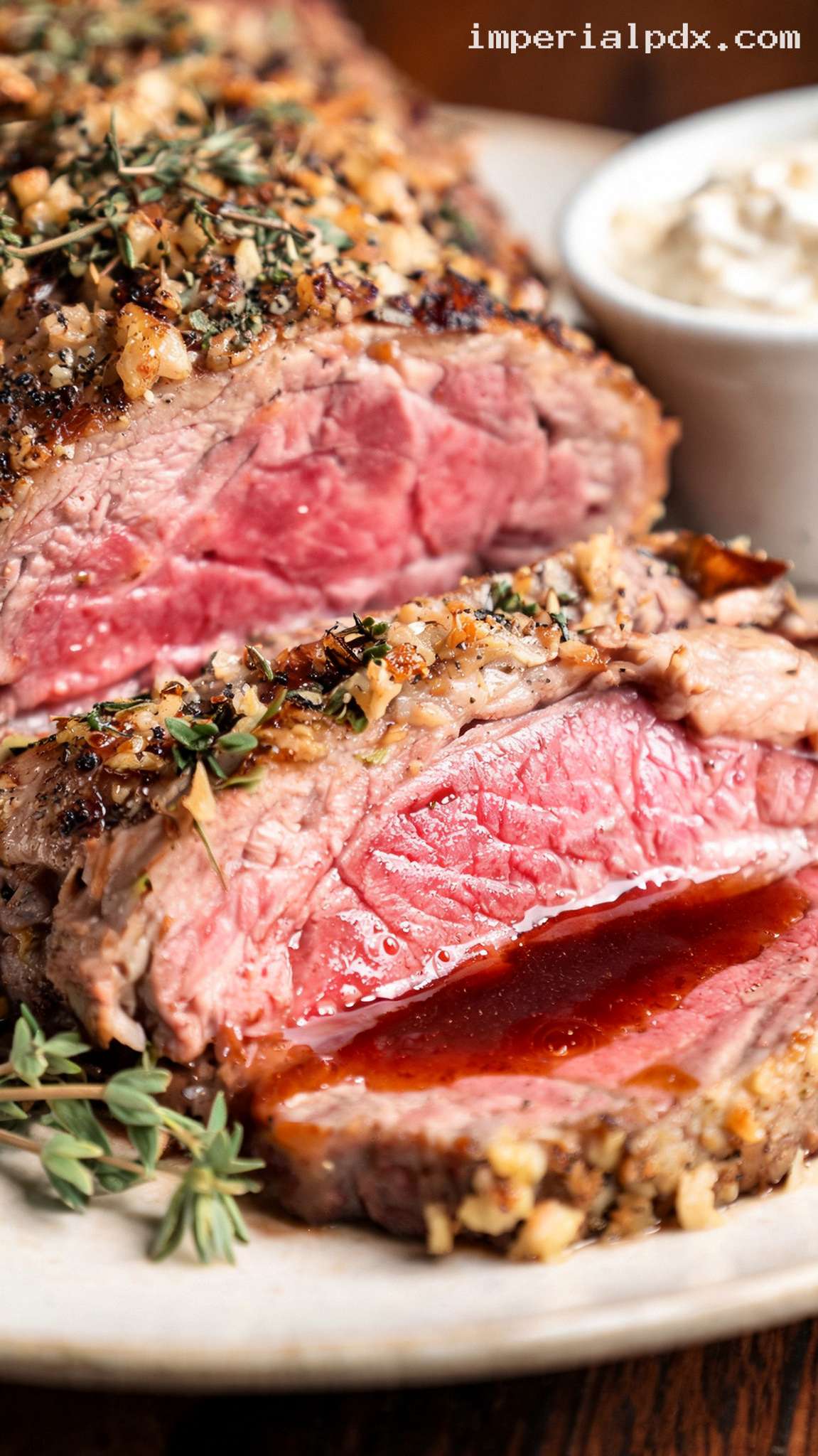
Step-by-Step Instructions
Step 1: Prepare the Oven and Roast
Position an oven rack in the lower third of the oven and heat to 450°F (232°C), conventional setting. Set a roasting rack inside a sturdy, shallow roasting pan. A pan that fits the roast with a little space around it will help keep the drippings from scorching.
Pat the beef very dry with paper towels. Leave a fat cap approximately 1/4 inch thick, trimming only thick, hard excess fat. If the roast is not already tied, secure it with kitchen twine between the ribs to help it keep an even shape. Season all over with the 18 g kosher salt, including the ends and underside.
Optional advance preparation: Salt the roast 12–24 hours ahead and refrigerate it uncovered on a rack set over a tray. This seasons the beef more deeply and dries the surface for better browning. Do not add another full measure of salt before roasting.
Step 2: Apply the Garlic, Rosemary, and Thyme Coating
In a small bowl, combine the cracked pepper, minced garlic, rosemary, thyme, olive oil, and Dijon mustard. Stir into a thick, spreadable paste.
Place the roast bone-side down and fat-side up on the roasting rack. Press the paste evenly over the top and exposed sides, keeping it in a thin, even layer rather than thick clumps. Insert an oven-safe probe thermometer into the center of the thickest part of the beef, avoiding bone and large pockets of fat.
Step 3: Brown, Then Roast Gently
Roast at 450°F (232°C) for 20 minutes to begin browning the crust. Without removing the roast, reduce the oven temperature to 325°F (163°C).
Continue roasting for approximately 1 hour 55 minutes to 2 hours 10 minutes. Begin checking the internal temperature after 1 hour 30 minutes at the lower temperature, since the roast’s shape, starting temperature, and your oven can change the timing. Use temperature—not the clock—as your final guide.
For a rosy, medium-rare presentation, remove the roast when the center reaches 125°F (52°C). It will typically rise to approximately 130–135°F (54–57°C) during resting, although carryover varies. If the garlic crust becomes very dark before the center is ready, loosely shield the top with foil.
Food-safety note: Medium-rare beef is below USDA guidance. USDA recommends cooking beef roasts to at least 145°F (63°C) before removing them from the oven, followed by a rest of at least 3 minutes. Choose that endpoint for a more fully cooked roast, especially when serving pregnant people, young children, older adults, or anyone with a weakened immune system.
Step 4: Rest the Roast and Collect the Drippings
Transfer the roast to a carving board with a juice groove. Tent it loosely with foil and rest for 30 minutes. Do not wrap it tightly; trapped steam can soften the crust.
Pour the roasting-pan drippings through a fine-mesh strainer into a heatproof measuring jug or fat separator. Reserve 3 tablespoons of the rendered fat and 2 tablespoons of the defatted juices for the gravy. If you have too little fat, make up the difference with unsalted butter. If there are not enough juices, use additional stock. Discard blackened, bitter drippings rather than adding them to the sauce.
Step 5: Make the Red-Wine Gravy
While the beef rests, heat the reserved 3 tablespoons beef fat or butter in a medium saucepan over medium heat. Add the shallot and cook for 3 minutes, stirring, until softened. Sprinkle in the flour and cook, stirring constantly, for 1 minute.
Gradually whisk in the red wine until smooth. Bring to a gentle simmer and cook for 4 minutes, whisking frequently. Slowly add the beef stock and the 2 tablespoons defatted pan juices, then stir in the black pepper.
Simmer gently for 7–10 minutes, stirring occasionally, until the gravy lightly coats the back of a spoon. Keep warm over very low heat. For an especially smooth finish, strain into a warmed gravy boat. The finished yield is approximately 2 1/2 cups. Note that simmering does not remove all the alcohol from wine.
Step 6: Stir Together the Horseradish Sauce
If serving the creamy sauce, combine the sour cream, drained prepared horseradish, lemon juice, Dijon, fine sea salt, and black pepper in a small bowl. Stir until smooth, cover, and refrigerate until serving.
This takes about 5 minutes and can be done while the roast cooks. The sauce becomes more rounded after at least 30 minutes in the refrigerator. It makes approximately 3/4 cup.
Step 7: Carve and Serve
Remove the kitchen twine. Using a long, sharp carving knife, follow the curve of the rib bones to separate the roast from the bones in one piece. If your butcher cut and retied the bones beforehand, simply lift the beef away after removing the twine.
Slice across the grain into 1/2- to 3/4-inch-thick slices. Arrange on a warmed platter, keeping some of the herb crust visible on each portion. Spoon a little red-wine gravy beside the beef rather than over the entire crust, and pass the remaining gravy or chilled horseradish sauce at the table.
Pro Tips
- Ask your butcher for an easy-carve roast: Have the rib bones cut away and tied back on. You still get the bone-in presentation, but carving is much simpler.
- Check more than one spot: Before taking the roast out, confirm the center temperature with an instant-read thermometer in two places, avoiding bone.
- Keep the garlic fine and the coating thin: Small, evenly distributed pieces brown more evenly than large chunks.
- Do not baste: Opening the oven repeatedly slows cooking, and pouring drippings over the beef can disturb the crust.
- Save the end slices for guests who prefer more-done beef: The center slices will usually be pinker than the ends.
Variations
- Alcohol-free gravy: Replace the 1 cup red wine with 1 cup additional low-sodium beef stock. Stir in 2 teaspoons balsamic vinegar during the final 2 minutes of simmering.
- Gluten-free gravy: Omit the flour. Cook the shallot in the fat, add the wine, and simmer for 4 minutes before adding the stock and pan juices. Mix 2 tablespoons cornstarch with 2 tablespoons cold water, whisk into the simmering liquid, and cook for 2–3 minutes until thickened. Check that your stock and mustard are gluten-free.
- Gentler horseradish sauce: Reduce the prepared horseradish from 3 tablespoons to 1 tablespoon, keeping the remaining sauce ingredients unchanged.
Storage & Make-Ahead
Make ahead: Salt the raw roast and refrigerate uncovered for 12–24 hours before cooking. Mix the garlic-herb paste up to 24 hours ahead and refrigerate in a covered container. Make the horseradish sauce up to 2 days ahead and keep refrigerated.
Refrigerate: Within 2 hours of serving, refrigerate leftover beef and gravy in separate shallow, covered containers at 40°F (4°C) or below. Use within 3–4 days. Keep horseradish sauce refrigerated and use within 3–4 days of preparation.
Freeze: Wrap cooked beef tightly and freeze for up to 2–3 months for best quality. Freeze gravy separately for up to 3 months. Thaw overnight in the refrigerator; sour-cream sauce does not freeze well.
Reheat: Place sliced beef in a covered baking dish with 2 tablespoons beef stock per serving. Warm in a 300°F (149°C) oven until the center reaches 165°F (74°C), checking after 15 minutes. Reheating to this safe leftover temperature will make the beef more done. Bring leftover gravy to a rolling boil on the stovetop, stirring frequently.
Nutrition (per serving)
Estimated for one-eighth of the roast with red-wine gravy, excluding horseradish sauce. Values vary with trimming, portion size, and the amount of rendered fat retained.
Calories: 760 kcal | Carbs: 8g | Protein: 48g | Fat: 59g | Saturated Fat: 23g | Fiber: 1g | Sugar: 2g | Sodium: 850mg | Cholesterol: 170mg


