Quick Recipe Version (TL;DR)
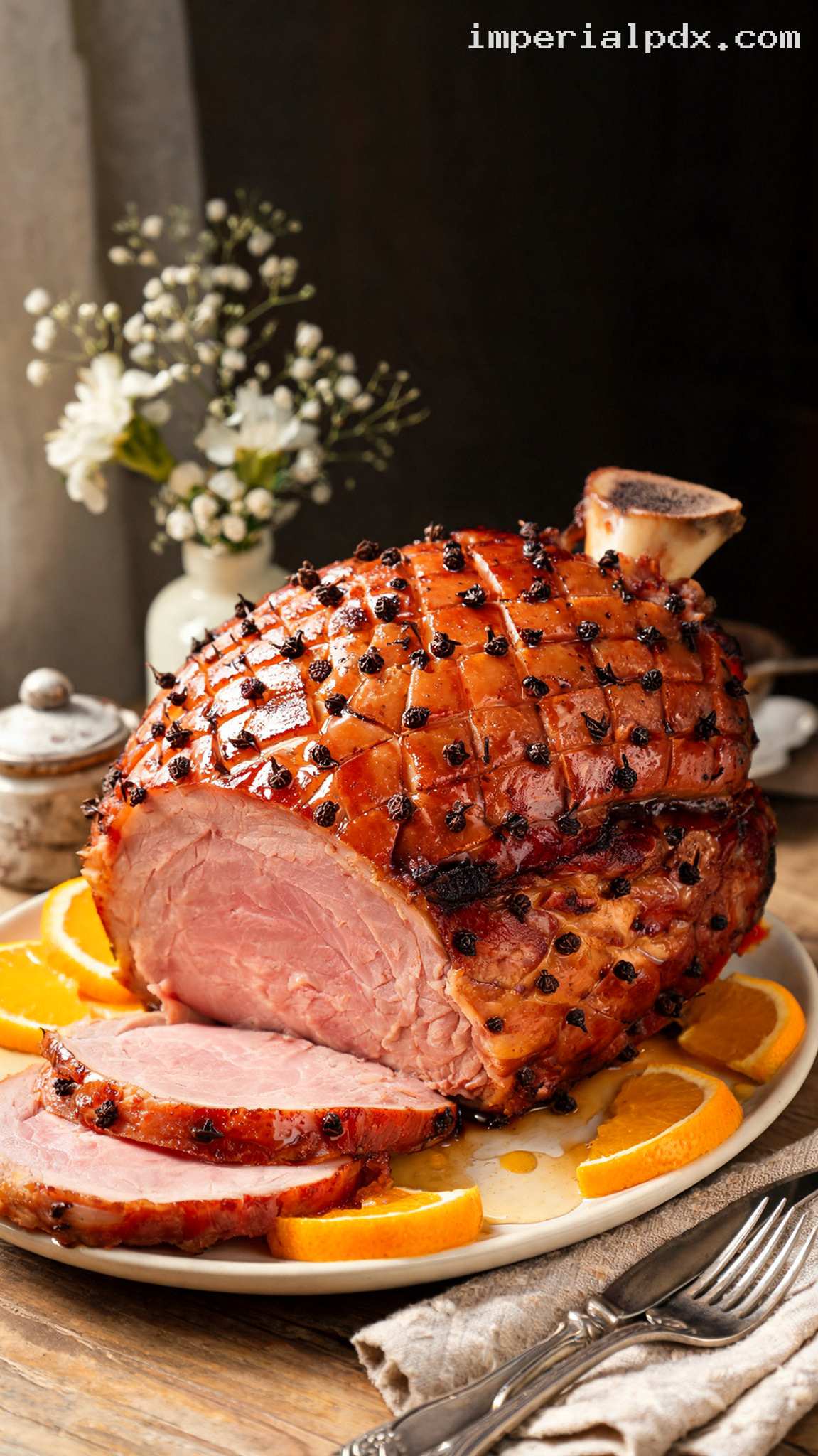
Honey-Glazed Baked Ham with Cloves and Orange is a festive centerpiece with a glossy, sweet-savory crust, fragrant whole cloves, and a bright orange glaze. This recipe starts with a fully cooked, bone-in ham, so the goal is to warm it gently before caramelizing the glaze.
Quick Ingredients
- 1 fully cooked, bone-in, skinless, non-spiral-cut ham, 8 pounds (3.6 kg), packaged at a USDA-inspected plant
- 40 whole cloves
- 1 cup (240 ml) water, plus up to 1/2 cup (120 ml) more if the roasting pan becomes dry
- 3/4 cup (255 g) honey
- 1/2 cup (110 g) packed light brown sugar
- 1/4 cup (60 g) Dijon mustard
- 1/2 cup (120 ml) freshly squeezed orange juice
- 1 tablespoon finely grated orange zest
- 2 tablespoons (30 ml) apple cider vinegar
- 2 tablespoons (28 g) unsalted butter
- 1/2 teaspoon ground cinnamon, 1/4 teaspoon ground ginger, and 1/8 teaspoon ground nutmeg
- 1 orange, thinly sliced, for serving
Do This
- 1. Heat the oven to 325°F (163°C). Place a rack in a roasting pan and add 1 cup water beneath it.
- 2. Pat the ham dry, score the fat in a 1-inch diamond pattern, and press the cloves into the intersections. Set the ham cut-side down on the rack and cover tightly with foil.
- 3. Bake for approximately 2 hours, until the center reaches 120°F (49°C). Start checking after 90 minutes.
- 4. Meanwhile, combine the honey, brown sugar, Dijon, orange juice, zest, vinegar, butter, and ground spices. Simmer for 5 minutes; reserve 1/3 cup separately for serving.
- 5. Uncover the ham and increase the oven to 400°F (204°C). Brush with one-third of the remaining glaze, then bake for approximately 30 minutes, brushing again after 10 and 20 minutes.
- 6. Remove when the glaze is glossy and the center reaches 140°F (60°C). Rest for 20 minutes, loosely tented with foil.
- 7. Remove the whole cloves before carving. Serve with orange slices and the gently reheated reserved glaze.
Why You’ll Love This Recipe
- A beautiful holiday centerpiece: The diamond-scored surface and amber glaze make an impressive presentation without complicated decorating.
- Balanced sweet-savory flavor: Honey and brown sugar bring sweetness, while Dijon, orange, and cider vinegar keep the glaze lively.
- Warm Christmas fragrance: Whole cloves, cinnamon, ginger, and nutmeg give the ham a cozy, festive aroma.
- A practical entertaining recipe: The glaze can be made ahead, and the leftovers are wonderful in sandwiches, soups, and breakfast dishes.
Grocery List
- Meat: One 8-pound fully cooked, bone-in, skinless, non-spiral-cut ham, packaged at a USDA-inspected plant.
- Produce: 3 medium oranges for the juice, zest, and sliced garnish.
- Dairy: Unsalted butter.
- Pantry: Honey, light brown sugar, Dijon mustard, apple cider vinegar, whole cloves, ground cinnamon, ground ginger, and ground nutmeg.
Full Ingredients
For the Ham
- 1 fully cooked, bone-in, skinless, non-spiral-cut ham, 8 pounds (3.6 kg), with a thin layer of exterior fat, packaged at a USDA-inspected plant
- 40 whole cloves
- 1 cup (240 ml) water, plus up to 1/2 cup (120 ml) more if needed during roasting
For the Honey-Orange Glaze
- 3/4 cup (255 g) honey
- 1/2 cup (110 g) packed light brown sugar
- 1/4 cup (60 g) Dijon mustard
- 1/2 cup (120 ml) freshly squeezed orange juice, from approximately 2 medium oranges
- 1 tablespoon finely grated orange zest, taken from the oranges before juicing
- 2 tablespoons (30 ml) apple cider vinegar
- 2 tablespoons (28 g) unsalted butter
- 1/2 teaspoon ground cinnamon
- 1/4 teaspoon ground ginger
- 1/8 teaspoon ground nutmeg
For Serving
- 1 medium orange, thinly sliced into rounds or half-moons
- 1/3 cup of the prepared glaze, reserved before brushing the ham
Before you begin: You will need a roasting pan with a rack, heavy-duty foil, a small saucepan, a pastry brush, and an instant-read or oven-safe meat thermometer. This recipe is not intended for fresh, uncooked ham or country ham. Spiral-cut ham heats differently and can dry out more easily.
Step-by-Step Instructions
Step 1: Prepare the oven and roasting pan
Position an oven rack in the lower third of the oven and preheat to 325°F (163°C). Place a roasting rack in a large roasting pan and pour 1 cup (240 ml) water into the bottom. The water should sit below the ham, not touch it.
Remove the ham from its packaging and discard any included glaze packet. Remove any plastic bone guard or other nonedible packaging. Pat the surface thoroughly dry with paper towels so the glaze will cling well later.
Step 2: Score the fat and add the cloves
Using a sharp knife, lightly score the exterior fat in diagonal lines spaced 1 inch apart. Turn the ham and score in the opposite direction to create diamonds. Cut only through the fat, no deeper than 1/4 inch, and avoid cutting into the meat. If the fat layer is very thin, make shallower cuts.
Press 40 whole cloves into evenly spaced intersections of the diamond pattern, inserting the pointed stems into the fat and leaving the rounded heads visible. Set the ham on the rack, with its broad cut side facing down. Cover the roasting pan tightly with foil.
Step 3: Warm the ham gently
Bake the covered ham for approximately 2 hours, until the thickest part reaches 120°F (49°C). Begin checking after 90 minutes, inserting the thermometer into the meat without touching the bone.
The covered stage warms the ham without drying its surface. If the pan becomes dry, carefully add up to 1/2 cup (120 ml) hot water. Ham shape, starting temperature, and oven accuracy affect heating time, so use the thermometer rather than the clock to decide when to begin glazing.
Step 4: Make the honey-orange glaze
While the ham bakes, combine the honey, brown sugar, Dijon mustard, orange juice, orange zest, apple cider vinegar, butter, cinnamon, ginger, and nutmeg in a small saucepan.
Bring to a gentle simmer over medium heat, stirring until the sugar dissolves and the butter melts. Reduce the heat to medium-low and simmer gently for 5 minutes, stirring frequently. The glaze should look smooth and lightly syrupy; it will thicken further as it cools.
Transfer 1/3 cup to a separate clean container for serving. Keep this portion away from the pastry brush used on the ham. Set the remaining glaze aside for brushing; warm it briefly over low heat if it becomes too thick to spread.
Step 5: Glaze and caramelize the surface
When the ham reaches 120°F (49°C), remove the pan from the oven and carefully uncover it, directing the hot steam away from your face and hands. Increase the oven temperature to 400°F (204°C).
Brush approximately one-third of the brushing glaze over the exposed surface, working it into the scored lines. Return the uncovered ham to the oven and roast for approximately 30 minutes. Brush with another third after 10 minutes and the final third after 20 minutes.
Start checking the internal temperature after 20 minutes of glazing. Remove the ham when the thickest part reaches 140°F (60°C) and the glaze is glossy and deep amber. If an area darkens too quickly, shield that spot loosely with foil. Do not broil; the honey and sugar can burn quickly.
Temperature note: The 140°F target applies to the fully cooked ham packaged at a USDA-inspected plant specified in this recipe. Reheat repackaged cooked ham and leftover ham to 165°F (74°C). Follow any higher reheating temperature required by the package instructions.
Step 6: Rest the ham and warm the serving glaze
Transfer the ham to a carving board or heatproof platter and tent loosely with foil. Rest for 20 minutes. Keep the foil loose so it does not stick to the glaze or trap enough steam to soften the crust.
Meanwhile, gently reheat the reserved 1/3 cup glaze in a clean saucepan over low heat for 2 minutes, stirring until warm and pourable.
Step 7: Remove the cloves, carve, and serve
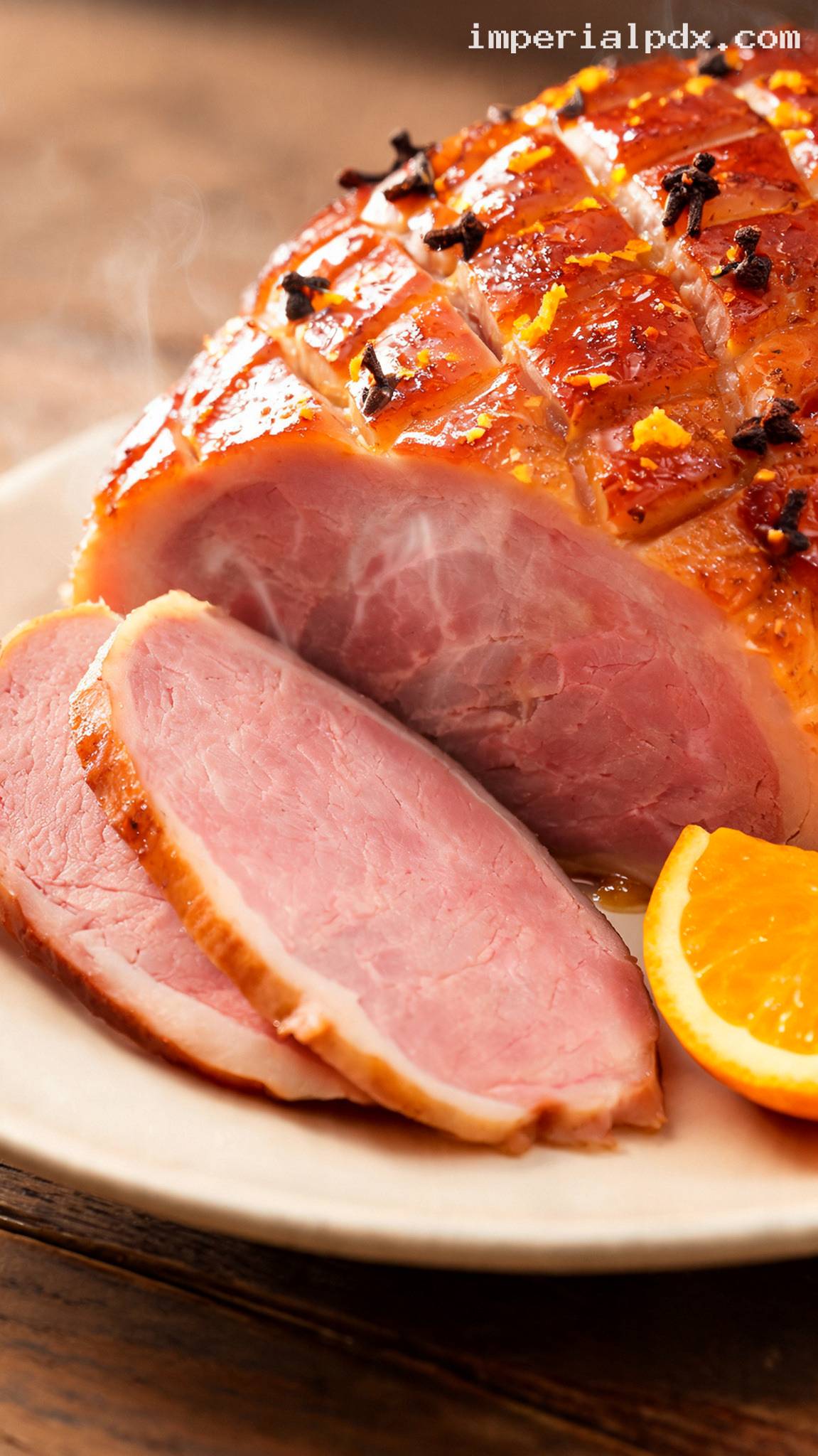
Present the ham on a large platter with the orange slices arranged around its base. Before carving or serving, carefully remove and discard all 40 whole cloves; they provide fragrance but are not intended to be eaten.
To carve, cut a few thin slices from the underside if needed to create a stable base. Turn the ham onto that flat side, slice down toward the bone, then run the knife along the bone to release the slices. Aim for slices approximately 1/4 inch thick. Arrange them beside the remaining ham and offer the warm reserved glaze at the table.
Pro Tips
- Buy the right ham: Look for “fully cooked” on the label. A non-spiral-cut ham holds its moisture well and gives you a smooth surface for scoring and clove-studding.
- Let temperature lead: The 2-hour-30-minute cooking time is an estimate for an 8-pound ham. Begin checking early and stop heating once the appropriate internal temperature is reached.
- Keep the scoring shallow: Deep cuts into the meat let moisture escape. The diamond pattern belongs in the exterior fat.
- Build thin layers of glaze: Three applications create a glossy coating that clings better than one heavy layer. Avoid pooling glaze in the pan.
- Skip extra salt: The ham and Dijon already provide plenty. Orange juice and vinegar balance the sweetness without adding more salt.
Variations
- Maple-honey glaze: Replace 1/4 cup of the honey with 1/4 cup (60 ml) pure maple syrup, using 1/2 cup honey in total.
- Extra-warming spice: Add 1/4 teaspoon ground allspice to the glaze for a slightly deeper holiday flavor.
- Gentler clove flavor: Use 20 whole cloves instead of 40, spacing them farther apart. Remove every clove before serving.
Storage & Make-Ahead
Make the glaze ahead: Prepare it up to 3 days in advance, cool, and refrigerate in an airtight container. Rewarm over low heat, stirring, before dividing it into the brushing and serving portions.
Prepare the ham ahead: Score and stud the ham up to 1 day in advance. Cover and refrigerate until ready to bake. Do not partially heat the ham in advance.
Refrigerate leftovers: Within 2 hours of serving, remove leftover meat from the bone, divide it into shallow containers, and refrigerate at 40°F (4°C) or below. Use within 3 to 4 days.
Freeze: Wrap sliced ham tightly and place in freezer-safe containers with a little leftover glaze. Freeze for up to 2 months for best quality. Thaw overnight in the refrigerator.
Reheat: Place slices in a covered baking dish with 2 tablespoons water per 1 pound of ham. Heat at 325°F (163°C) until the center reaches 165°F (74°C), approximately 20 to 30 minutes, depending on the thickness and quantity.
Nutrition (per serving)
Calories: 395 kcal | Carbs: 27g | Protein: 33g | Fat: 17g | Saturated Fat: 6g | Fiber: 0g | Sugar: 25g | Sodium: 1700mg | Cholesterol: 95mg
Estimated for 1 of 16 servings, including glaze and excluding the bone, whole cloves, and orange garnish. Actual values vary with the ham brand, edible yield, and amount of glaze served.