Quick Recipe Version (TL;DR)
Quick Ingredients
- 1 whole chicken (4–4.5 lb / 1.8–2 kg), skin on
- 1 lb (450 g) boneless, skinless chicken thighs (or breasts)
- 1 large egg white
- 3/4 cup (180 ml) cold heavy cream
- 1/2 cup (60 g) shelled unsalted pistachios
- 1 medium carrot, diced and blanched
- 1/2 cup (60 g) thin green beans, cut and blanched
- 1/4 cup (10 g) chopped fresh parsley
- 2 tbsp chopped fresh tarragon or chives
- 2 1/2 tsp fine sea salt (divided)
- 1 tsp ground white or black pepper
- 1/4 tsp ground nutmeg (optional)
- 6 cups (1.5 L) chicken stock + 1 cup (240 ml) dry white wine or water
- 1 onion, 1 carrot, 1 celery stalk, bay leaf, peppercorns (for poaching)
Do This
- 1. Chill a metal bowl and food processor blade; pat chicken dry.
- 2. Carefully debone chicken, keeping skin and meat in one large sheet; trim tendons, reserve scraps.
- 3. Make forcemeat: pulse chicken thighs with salt, pepper, egg white; slowly blend in cold cream, herbs, pistachios, and blanched vegetables.
- 4. Lay chicken skin-side down, season, spread forcemeat in an even log, and roll tightly into a cylinder.
- 5. Wrap in cheesecloth or foil, tie firmly with kitchen twine, and place into barely simmering stock with aromatics.
- 6. Poach 60–75 minutes at about 180°F / 82°C, until center reaches 165°F / 74°C; cool in liquid, then chill well under light weight.
- 7. Unwrap, trim ends, slice into 1/2 inch (1.25 cm) rounds, and serve chilled with salad greens, Dijon mustard, and crusty bread.
Why You’ll Love This Recipe
- It looks incredibly fancy, but everything is done with basic tools: a knife, pot, and food processor.
- Perfect make-ahead centerpiece for holidays, dinner parties, or buffets; it must be served cold.
- Delicate, tender slices packed with herbs, pistachios, and colorful vegetables make every plate look restaurant-worthy.
- Leftovers keep beautifully and make luxurious sandwiches, salads, or picnic plates.
Grocery List
- Produce: 2 carrots, 1 onion, 2 celery stalks, thin green beans, fresh parsley, fresh tarragon or chives, salad greens (for serving), lemons (optional, for serving)
- Dairy: Heavy cream, 1 large egg
- Pantry: Whole chicken, boneless skinless chicken thighs or breasts, unsalted pistachios, chicken stock, dry white wine (optional), bay leaves, whole peppercorns, fine sea salt, ground white or black pepper, ground nutmeg, Dijon mustard, olive oil (for serving), kitchen twine, cheesecloth or heavy-duty foil
Full Ingredients
For the Galantine
- 1 whole chicken, about 4–4.5 lb (1.8–2 kg), skin on, giblets removed
For the Forcemeat Filling
- 1 lb (450 g) boneless, skinless chicken thighs (or breasts), cut into 1-inch (2.5 cm) pieces and well chilled
- 2 tsp fine sea salt
- 1/2 tsp ground white pepper (or black pepper)
- 1/4 tsp ground nutmeg (optional, traditional but subtle)
- 1 large egg white
- 3/4 cup (180 ml) very cold heavy cream
- 1/2 cup (60 g) shelled unsalted pistachios, roughly chopped
- 1 medium carrot, finely diced (about 1/3 cup / 50 g)
- 1/2 cup (60 g) thin green beans, cut into 1/2 inch (1.25 cm) pieces
- 1/4 cup (10 g) finely chopped fresh flat-leaf parsley
- 2 tbsp finely chopped fresh tarragon or chives (or a mix)
For Poaching
- 6 cups (1.5 L) chicken stock (store-bought or homemade)
- 1 cup (240 ml) dry white wine or water
- 1 medium onion, roughly chopped
- 1 carrot, roughly chopped
- 1 celery stalk, roughly chopped
- 2 bay leaves
- 1 tsp whole black peppercorns
- 1 tsp fine sea salt (or to taste, depending on stock)
For Serving (Optional but Recommended)
- Mixed salad greens or frisée
- Dijon mustard
- Cornichons or small pickles
- Extra pistachios and chopped herbs, for garnish
- Lemon wedges
- Crusty bread or baguette
Step-by-Step Instructions
Step 1: Chill Tools and Prep the Vegetables
Place the bowl of your food processor and its metal blade in the refrigerator or freezer for at least 20 minutes. A chilled bowl helps keep the forcemeat smooth and safe by staying cold while you process it.
Bring a small pot of salted water to a boil. Finely dice 1 carrot and cut the green beans into 1/2 inch (1.25 cm) pieces. Blanch the carrot and green beans for 2–3 minutes until just tender but still bright. Drain and immediately run under cold water or plunge into ice water to stop the cooking. Pat very dry with a clean towel and set aside. Excess moisture can make the filling loose.
Chop the parsley and tarragon (or chives), measure out the pistachios, and keep everything chilled until needed.
Step 2: Debone the Chicken While Keeping It in One Piece
Pat the whole chicken dry with paper towels and place it breast-side up on a large cutting board. You will remove the bones while keeping the skin and meat in one large sheet, which will later be rolled.
Using a sharp boning or chef’s knife, cut along one side of the breastbone from the neck to the tail to open the chicken like a book. Gently work the meat away from the rib cage, using short strokes and your fingers. Keep the knife close to the bones so you do not tear the skin. Repeat on the other side until the rib cage can be lifted out in one piece; set the carcass aside for stock if you like.
Carefully free the leg and thigh bones by scraping the meat away and popping the joints. Remove the wing bones in the same way, leaving the wing tips if you like for shape. You should now have a mostly flat, boneless chicken with the skin intact. Trim away thick tendons or large pockets of fat. If there are very thick areas of meat, butterfly them so the layer is reasonably even. Lightly season the inner surface with 1/2 tsp salt and a pinch of pepper. Keep refrigerated while you make the filling.
Step 3: Make the Herb, Pistachio, and Vegetable Forcemeat
Place the chilled chicken thigh pieces in the cold food processor bowl. Add 2 tsp salt, 1/2 tsp pepper, and the nutmeg (if using). Pulse several times, then process for about 20–30 seconds until the meat becomes a smooth paste, scraping down the sides as needed.
Add the egg white and process again until fully incorporated. With the machine running, gradually pour in the very cold heavy cream in a thin stream. Process just until the mixture is smooth, thick, and uniform; over-processing can make it greasy. The forcemeat should look like a firm, sticky mousse.
Transfer the mixture to a bowl. Fold in the blanched carrot and green beans, chopped pistachios, parsley, and tarragon (or chives) until evenly distributed. Cover and keep in the refrigerator until you are ready to assemble. The filling should be cold and slightly firm when you spread it.
Step 4: Assemble, Stuff, and Roll the Galantine
Lay the deboned chicken skin-side down on a large piece of parchment or plastic wrap on your work surface. Arrange it so that the breasts are in the center, legs and thighs to the sides, and the meat layer is as even as possible. If there are gaps, patch them with trimmed bits of chicken.
Spoon the forcemeat down the center in a wide log running from top to bottom, leaving about 1–1.5 inches (2.5–4 cm) of clear space at each end so the filling does not squeeze out. You want an even thickness so the slices will have a pretty, uniform pattern.
Using the parchment or plastic wrap to help, roll one long side of the chicken up and over the filling, then bring the other side up, overlapping slightly so the skin completely encloses the forcemeat. Tuck in the ends like a burrito, stretching the skin gently if needed. Shape into a firm cylinder.
Wrap the chicken tightly in two layers of cheesecloth or heavy-duty aluminum foil, rolling and tightening as you go. Twist the ends and tie them securely with kitchen twine. Then tie loops of twine around the length of the roll every 1.5–2 inches (4–5 cm) to help it keep a uniform shape during poaching.
Step 5: Prepare the Poaching Liquid and Cook Gently
In a large, wide pot, combine the chicken stock, white wine (or water), chopped onion, carrot, celery, bay leaves, peppercorns, and 1 tsp salt. Bring to a gentle simmer over medium heat. Taste the liquid; it should be pleasantly seasoned but not too salty, as some will soak into the galantine.
Carefully lower the wrapped chicken into the pot. The liquid should cover the galantine; if not, add a bit more stock or water. Adjust the heat so the liquid stays at a bare simmer, about 180°F / 82°C. You should see just an occasional bubble, not a full boil, which can toughen the meat and break the roll.
Poach gently for 60–75 minutes, turning the galantine halfway through, until an instant-read thermometer inserted into the very center reads 165°F / 74°C. Start checking after 60 minutes to avoid overcooking.
Step 6: Cool, Press, and Chill for Clean Slices
Once cooked, turn off the heat and let the galantine cool in the poaching liquid for 20–30 minutes. This gradual cooling helps it stay juicy. Then carefully lift it out with tongs and transfer to a tray.
Remove the outer foil or cheesecloth layer if it is soaked and loose, and rewrap lightly with a clean layer of plastic wrap if needed to maintain a smooth surface. Place the wrapped roll on a baking sheet or shallow dish. Set another tray or cutting board on top and add a light weight (such as a few cans) to gently press it. This helps create a compact, round shape and makes very neat slices.
Refrigerate for at least 4 hours, preferably overnight, until thoroughly chilled and firm all the way through. Do not skip this step; galantine is meant to be eaten cold and slices best when very cold.
Step 7: Slice and Serve
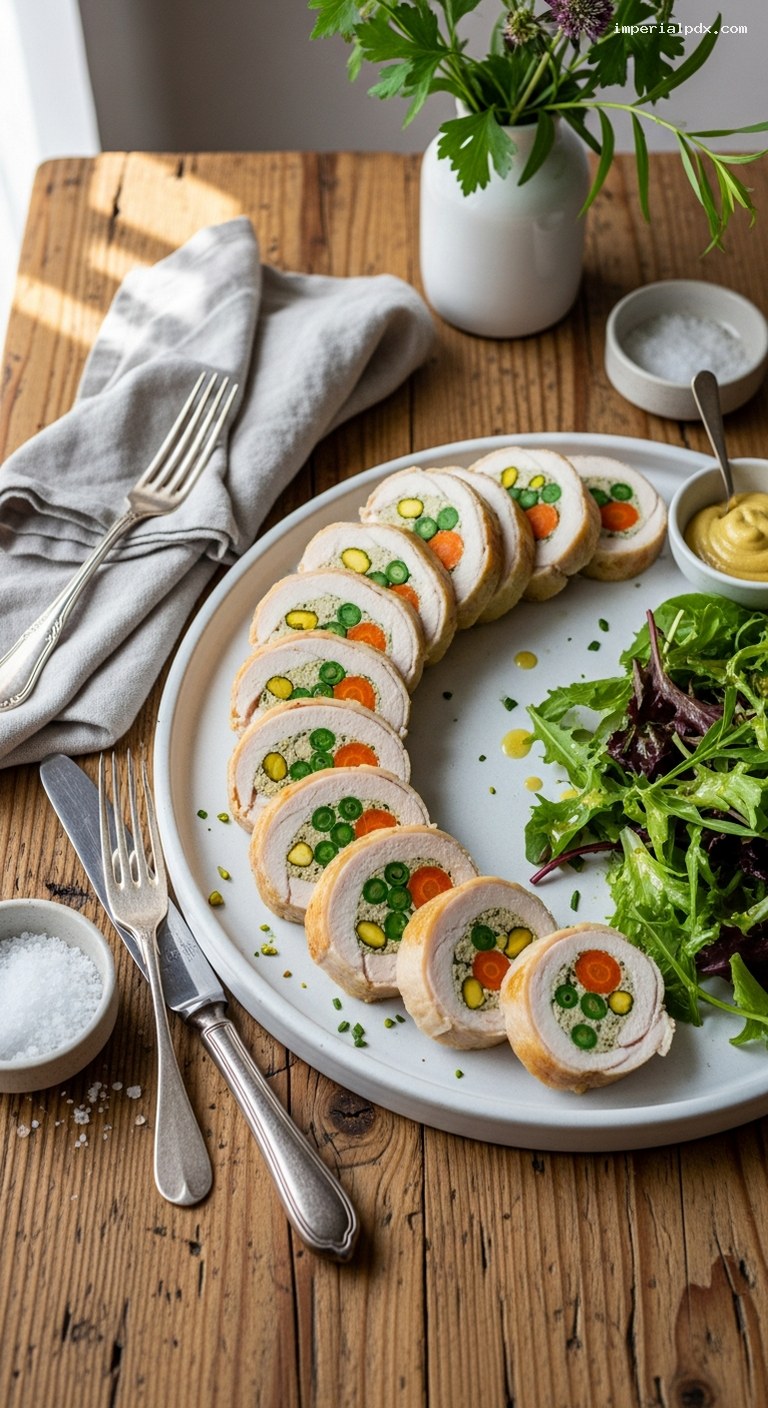
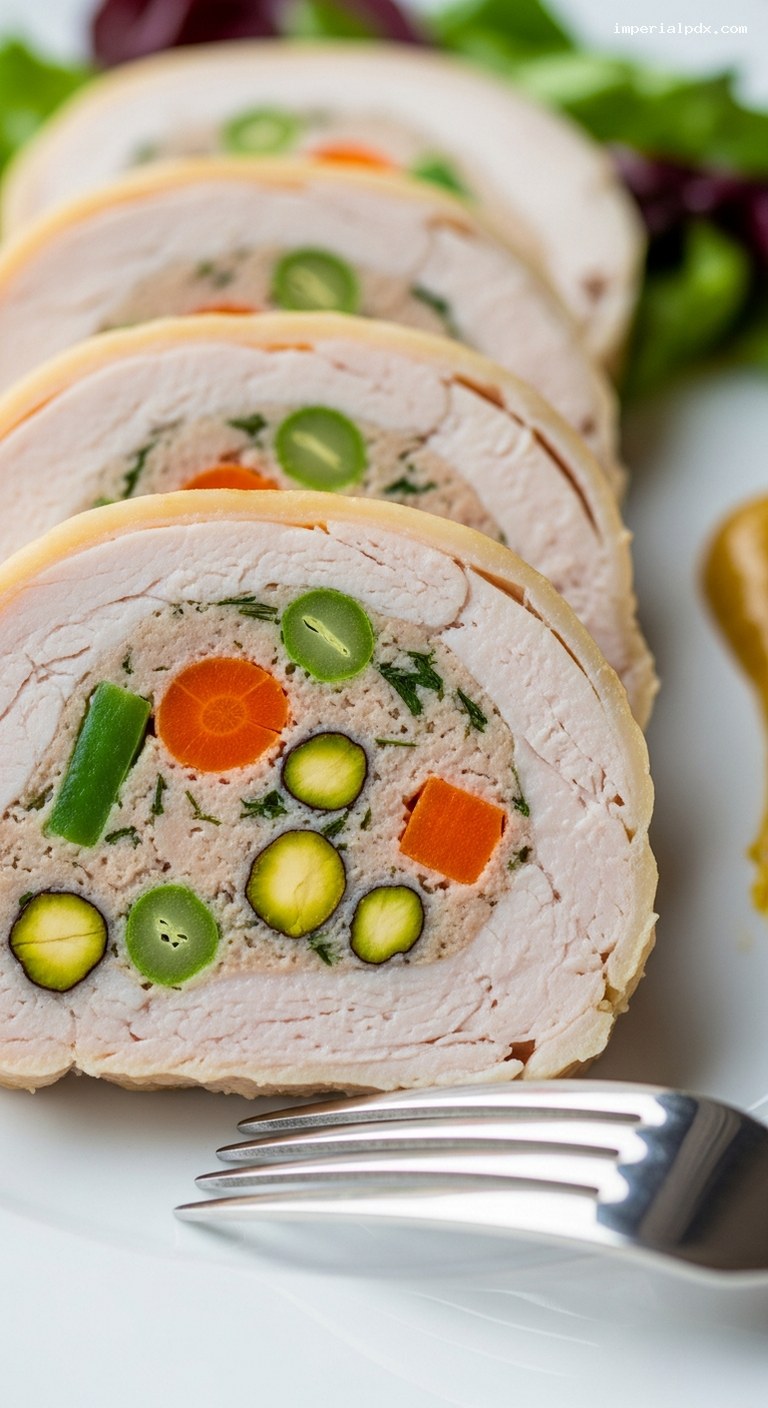
When ready to serve, remove the weights and unwrap the galantine. Trim a thin slice from each end to reveal the colorful interior. Using a long, sharp slicing knife, cut the galantine into 1/2 inch (1.25 cm) thick rounds, wiping the blade clean between cuts for the neatest slices.
Arrange slices slightly overlapping on a platter. Garnish with extra chopped herbs and a few scattered pistachios. Serve chilled or cool room temperature with salad greens lightly dressed with olive oil and lemon, cornichons, Dijon mustard, and crusty bread. The contrast between the delicate, tender chicken, creamy herbed filling, and bright pickles is what makes this dish so special.
Pro Tips
- Keep everything cold. Chill the meat, cream, and tools; if the forcemeat warms up, pop it in the fridge for 10–15 minutes before using. This ensures a smooth, bouncy texture rather than grainy.
- Do not rush the poach. Maintain a bare simmer, not a boil. Gentle cooking keeps the roll tight and the meat moist.
- Pressing is worth it. A little weight during chilling makes the galantine perfectly cylindrical and easier to slice thinly.
- Practice your knife skills on paper first. If deboning a whole chicken feels intimidating, watch a quick video and take your time; small tears in the skin can usually be patched with extra meat.
- Season boldly but thoughtfully. The dish is served cold, so flavors are slightly muted; do not skimp on salt, pepper, and herbs in the filling.
Variations
- Mushroom and Herb Galantine: Sauté 1 cup (70 g) finely chopped mushrooms in a little butter until dry and golden, cool completely, and fold into the forcemeat in place of the green beans.
- Ham and Olive: Replace half the pistachios with finely diced cooked ham and add 1/4 cup (40 g) chopped pitted green olives for a more robust, charcuterie-style flavor.
- Turkey Galantine: Use a small turkey or large chicken and increase the forcemeat quantities by 50 percent; poach a bit longer, checking temperature carefully.
Storage & Make-Ahead
Chicken galantine is ideal for making ahead. Once fully cooked, pressed, and chilled, keep it tightly wrapped in the refrigerator for up to 4 days. Slice only what you plan to serve; unsliced portions stay fresher. Arrange slices on a platter, cover, and chill until serving time, up to several hours in advance. Leftover slices make excellent sandwiches, charcuterie boards, or salad toppers. For food safety, do not freeze the galantine before cooking (it can affect texture), but you may freeze tightly wrapped cooked slices for up to 2 months; thaw overnight in the refrigerator and serve well chilled.
Nutrition (per serving)
Approximate values per serving (based on 8 servings, without bread or salad): 340 calories; 23 g protein; 24 g fat; 5 g carbohydrates; 2 g fiber; 2 g sugar; 620 mg sodium. Actual values will vary with specific ingredients and portion sizes.