Quick Recipe Version (TL;DR)
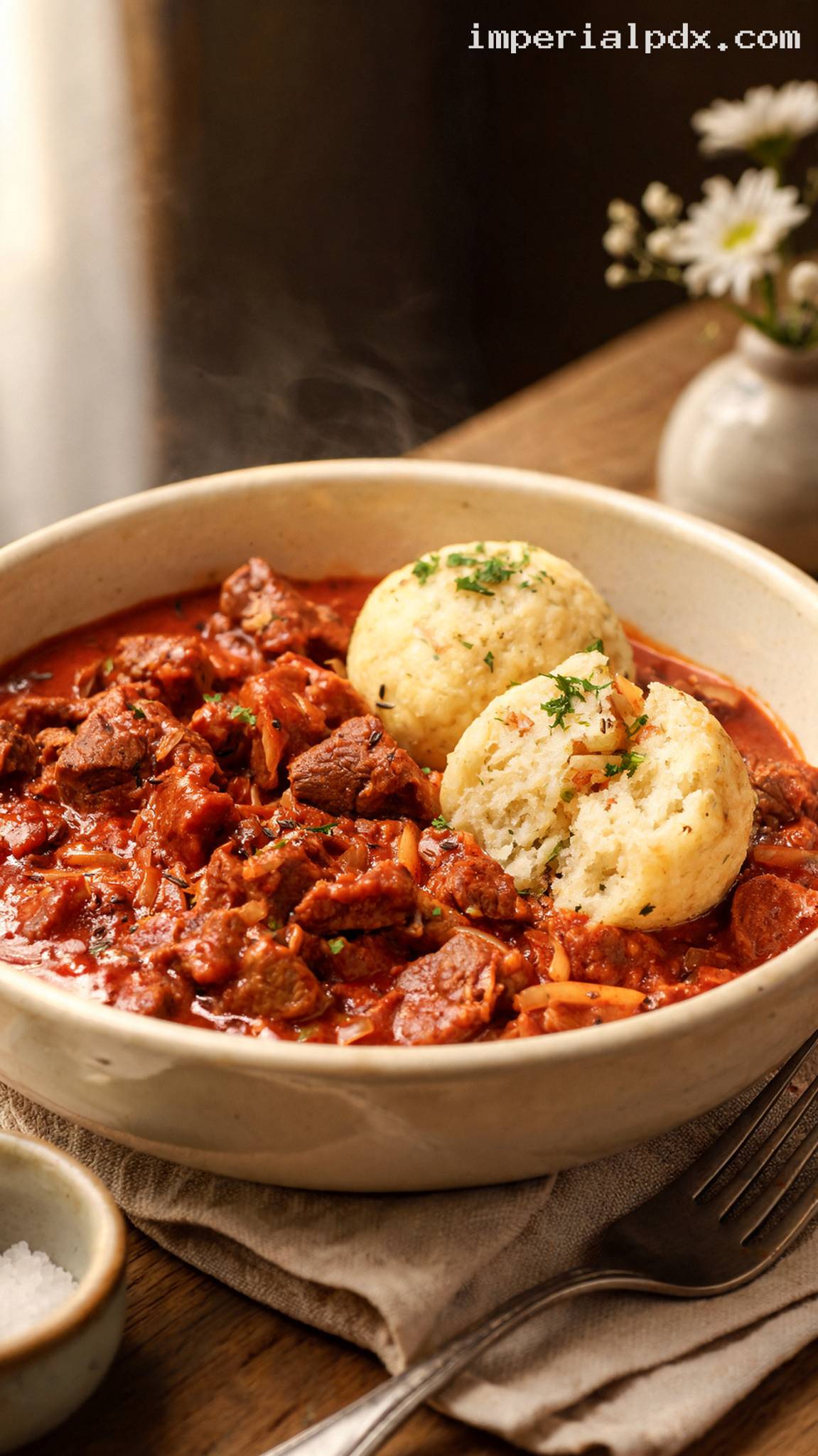
Viennese Goulash with Soft Bread Dumplings pairs slow-braised beef with a rich, paprika-red onion gravy and tender dumplings made for soaking it up.
Quick Ingredients
- Beef and onion base: 1.2 kg boneless beef chuck, cut into 4 cm cubes; 1 kg yellow onions, finely chopped; 40 g lard; 4 garlic cloves, minced.
- Goulash seasonings: 4 tablespoons sweet Hungarian paprika (28 g), 2 tablespoons tomato paste (30 g), 1 tablespoon red wine vinegar (15 ml), 2 teaspoons caraway seeds (4 g), 2 teaspoons dried marjoram (2 g), 1 teaspoon fine salt (6 g), and ½ teaspoon ground black pepper.
- Braising liquid: 600 ml low-sodium beef stock.
- Bread dumplings: 300 g day-old white bread rolls, diced; 250 ml whole milk; 3 large eggs; 150 g yellow onion, finely chopped; 30 g unsalted butter; 30 g all-purpose flour; 15 g flat-leaf parsley, chopped; ½ teaspoon fine salt (3 g); ¼ teaspoon ground nutmeg; and ¼ teaspoon ground black pepper.
- For poaching: 3 liters water and 1 tablespoon fine salt (18 g).
Do This
- 1. Heat the oven to 160°C / 320°F, or 140°C fan. Cook the 1 kg chopped onions in the lard over medium-low heat for 40 minutes, stirring frequently, until deeply golden.
- 2. Add garlic, tomato paste, and crushed caraway; cook for 1 minute. Remove from the heat, stir in paprika for 30 seconds, then add vinegar and stir for another 30 seconds.
- 3. Add stock, beef, marjoram, salt, and pepper. Bring to a gentle simmer over medium heat, about 8 minutes. Cover and braise in the oven for 2 hours 20 minutes, or until fork-tender.
- 4. During the final 45 minutes of braising, soften the dumpling onion in butter for 8 minutes. Warm the milk to 40°C / 104°F, pour over the bread, and let stand for 10 minutes.
- 5. Mix the soaked bread with the cooked onion, eggs, flour, parsley, salt, nutmeg, and pepper. Rest for 10 minutes, then shape into 12 dumplings.
- 6. Once the beef is tender, gently poach the dumplings in salted water for 18 minutes. Meanwhile, simmer the goulash uncovered for up to 20 minutes to thicken, or keep it covered over low heat if already thick. Serve two dumplings per person with plenty of gravy.
Why You’ll Love This Recipe
- A deeply flavorful gravy: Slowly cooked onions, sweet paprika, caraway, and marjoram give this Viennese-style goulash its distinctive richness.
- No fiddly beef-searing batches: The flavor starts with the onions, and the beef becomes wonderfully tender during its gentle braise.
- Comforting homemade dumplings: These soft bread dumplings, known as Semmelknödel, turn leftover rolls into the perfect gravy-catching side.
- Excellent for making ahead: The goulash tastes even better the next day, making it a lovely choice for relaxed entertaining.
Grocery List
- Produce: 1.15 kg yellow onions, 4 garlic cloves, and 15 g flat-leaf parsley.
- Meat: 1.2 kg boneless beef chuck.
- Dairy: 250 ml whole milk and 30 g unsalted butter.
- Eggs: 3 large eggs.
- Bakery: 300 g plain white bread rolls, preferably bought a day ahead.
- Pantry: Lard, low-sodium beef stock, sweet Hungarian paprika, tomato paste, red wine vinegar, caraway seeds, dried marjoram, all-purpose flour, fine salt, black pepper, and ground nutmeg.
Full Ingredients
For the Viennese Goulash
- 1.2 kg boneless beef chuck, trimmed of thick exterior fat and cut into 4 cm cubes
- 1 kg yellow onions, finely chopped into approximately 5 mm pieces
- 40 g lard
- 4 garlic cloves, finely minced
- 2 tablespoons tomato paste (30 g)
- 2 teaspoons caraway seeds (4 g), lightly crushed
- 4 tablespoons sweet Hungarian paprika (28 g), not smoked paprika
- 1 tablespoon red wine vinegar (15 ml)
- 600 ml low-sodium beef stock
- 2 teaspoons dried marjoram (2 g)
- 1 teaspoon fine salt (6 g), divided
- ½ teaspoon ground black pepper
For the Bread Dumplings
- 300 g day-old plain white bread rolls, including their crusts, cut into 1 cm cubes
- 250 ml whole milk
- 30 g unsalted butter
- 150 g yellow onion, finely chopped
- 3 large eggs
- 30 g all-purpose flour
- 15 g flat-leaf parsley, finely chopped, with 1 teaspoon reserved for serving
- ½ teaspoon fine salt (3 g)
- ¼ teaspoon ground nutmeg
- ¼ teaspoon ground black pepper
For Poaching
- 3 liters water
- 1 tablespoon fine salt (18 g)
Step-by-Step Instructions
Step 1: Prepare the beef, onions, and bread
Heat the oven to 160°C / 320°F, or 140°C fan, with a rack in the lower-middle position. Set out a heavy, oven-safe Dutch oven with a tight-fitting lid, approximately 5.5–6 liters in capacity.
Trim the beef of thick exterior fat, leaving its internal marbling, and cut it into 4 cm cubes. Pat dry. Finely chop the 1 kg onions for the goulash, keeping the separate 150 g onion portion for the dumplings. Mince the garlic and lightly crush the caraway seeds using a mortar or the flat side of a knife.
Cut the bread rolls into 1 cm cubes and place them in a large bowl. They should feel slightly dry but should not be hard croutons. If your bread is fresh, spread the cubes on a baking tray and dry them in the preheated oven for 10 minutes, without browning.
Step 2: Slowly cook the onions
Melt the lard in the Dutch oven over medium heat. Add the 1 kg chopped onions and ½ teaspoon of the goulash salt. Reduce the heat to medium-low and cook for 40 minutes, stirring every 3–4 minutes and more frequently toward the end.
The onions should become soft, reduced, and deeply golden, with no blackened edges. This is the foundation of the gravy, so give them time. If they begin sticking before they are ready, add 1 tablespoon water, scrape the bottom of the pot, and continue cooking. Repeat only as needed.
Step 3: Add the paprika and begin the braise
Stir the garlic, tomato paste, and crushed caraway into the onions. Cook for 1 minute, stirring constantly. Take the pot off the heat and stir in the sweet paprika for 30 seconds. Add the vinegar and stir for another 30 seconds. Keeping the paprika away from direct heat helps prevent bitterness.
Pour in the beef stock, scraping up any browned onion from the bottom. Add the beef, marjoram, remaining ½ teaspoon goulash salt, and black pepper. Return to medium heat and bring to a gentle simmer, allowing approximately 8 minutes. The liquid should reach roughly halfway to two-thirds up the beef; it does not need to cover it.
Cover tightly and transfer to the oven. Braise for 2 hours 20 minutes, stirring after 1 hour. Check the beef at the end: a fork should slide in easily, and the meat should yield with gentle pressure. If it is still firm, continue cooking in 15-minute intervals, usually up to 30 minutes longer. If the sauce becomes unusually thick before the meat is tender, stir in 60 ml hot water.
Step 4: Soften the bread and cook the dumpling onion
During the final 45 minutes of the braising time, melt the butter in a small skillet over medium-low heat. Add the reserved 150 g chopped onion and cook for 8 minutes, stirring occasionally, until soft and translucent rather than browned. Set aside to cool for 5 minutes.
Meanwhile, gently warm the milk to 40°C / 104°F; it should feel lukewarm, not hot. Pour it evenly over the bread cubes. Toss gently and leave for 10 minutes, turning the bread once halfway through so it moistens evenly.
Step 5: Mix and shape the bread dumplings
Lightly beat the eggs in a small bowl. Add them to the soaked bread along with the cooled onion and butter, flour, chopped parsley except the reserved teaspoon, salt, nutmeg, and pepper. Mix gently with your hands until everything holds together, leaving plenty of recognizable bread pieces rather than kneading it into a paste.
Let the mixture rest for 10 minutes. It should feel moist and soft but hold its shape when squeezed. If it crumbles because the bread is too dry, mix in 1 tablespoon milk. If it is loose and slumps, mix in 1 tablespoon flour, approximately 8 g, and rest for another 5 minutes.
With damp hands, divide into 12 equal portions and gently form balls approximately 5 cm across. Compress them just enough to hold together without packing them tightly.
Step 6: Finish the gravy and poach the dumplings
Once the beef is fork-tender, remove the Dutch oven from the oven. If the gravy is thin, simmer uncovered over medium-low heat for up to 20 minutes, stirring gently, until it coats a spoon. If it is already thick and glossy, keep it covered over the lowest heat while the dumplings cook. The softened onions provide the thickening; the goulash does not need added flour.
Bring the 3 liters water and 1 tablespoon salt to a boil in a wide pot, then lower the heat until the water barely simmers, approximately 90–95°C / 194–203°F. Gently lower in the dumplings. Use a pot wide enough for them to float freely, or cook in two batches.
Poach for 18 minutes, maintaining a very gentle simmer and turning the dumplings once after 9 minutes. Floating alone is not a reliable sign that they are done: the centers should be set, with no wet egg mixture, and reach at least 74°C / 165°F. Lift them out with a slotted spoon and drain for 2 minutes.
Step 7: Serve with plenty of gravy
Stir the goulash gently and taste the sauce. If it has reduced more than you like, loosen it with 30–60 ml hot water. Spoon the beef and a generous helping of gravy into warm shallow bowls.
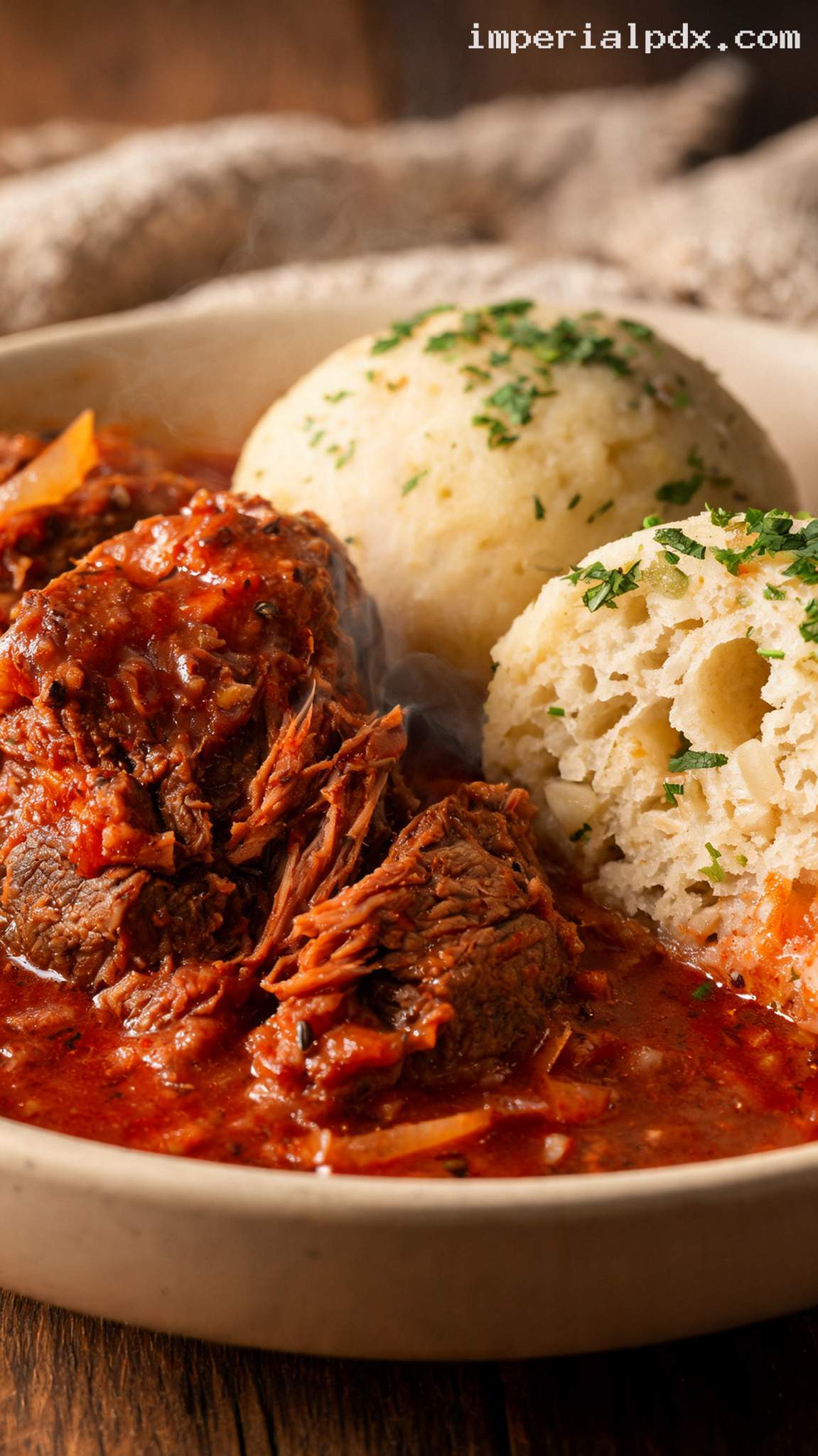
Add two bread dumplings per serving and scatter the reserved parsley over the dumplings. Serve immediately. Cutting a dumpling open at the table lets its soft, bread-filled center soak up the paprika gravy.
Pro Tips
- Use fresh, sweet paprika: Paprika supplies much of the flavor here. A newly opened tin of sweet Hungarian paprika gives a rounder flavor and richer color than an old jar.
- Do not rush the onions: They should be golden and sweet, not merely softened. Their slow breakdown creates the body of the sauce.
- Judge the beef by tenderness: Chuck varies from piece to piece. If it feels chewy, it usually needs more gentle cooking rather than a higher temperature.
- Keep the dumpling water quiet: A rolling boil can break the dumplings apart. If you are unsure about the mixture, poach a small test dumpling for 8 minutes and check that it holds together before shaping the rest.
- Keep the bread texture: Light mixing produces tender dumplings with little pockets of bread. Heavy kneading makes them dense.
Variations
- A little heat: Replace 1 teaspoon of the sweet paprika with 1 teaspoon hot Hungarian paprika. Keep the total paprika quantity the same.
- No lard: Replace the 40 g lard with 3 tablespoons neutral oil, such as sunflower oil.
- Stovetop braise: Instead of using the oven, cook the covered goulash over the lowest heat for 2 hours 20 minutes, checking every 30 minutes. Maintain only an occasional bubble and add 60 ml hot water if needed to prevent sticking. Continue in 15-minute intervals until tender.
Storage & Make-Ahead
Refrigerate: Cool the goulash and cooked dumplings promptly in separate shallow containers and refrigerate within 2 hours. Keep at 4°C / 40°F or below for up to 3 days. The goulash is especially good when made 1 day ahead.
Reheat: Warm the goulash in a covered saucepan over medium-low heat for 15–20 minutes, stirring occasionally and adding 30–60 ml water if needed. Steam refrigerated dumplings over gently simmering water for 10–12 minutes. Both should reach 74°C / 165°F throughout before serving.
Freeze: Freeze cooled goulash for up to 3 months. Freeze cooked dumplings separately on a tray, then transfer to a freezer container and keep for up to 2 months. Thaw both overnight in the refrigerator before reheating. For the best texture, mix and shape uncooked dumplings on the day you plan to cook them.
Nutrition (per serving)
Calories: 845 kcal | Carbs: 57g | Protein: 54g | Fat: 45g | Saturated Fat: 18g | Fiber: 7g | Sugar: 14g | Sodium: 1120mg | Cholesterol: 240mg
Estimated for one-sixth of the goulash and two bread dumplings. Values vary with the beef, bread, stock, and amount of salt absorbed during poaching.


