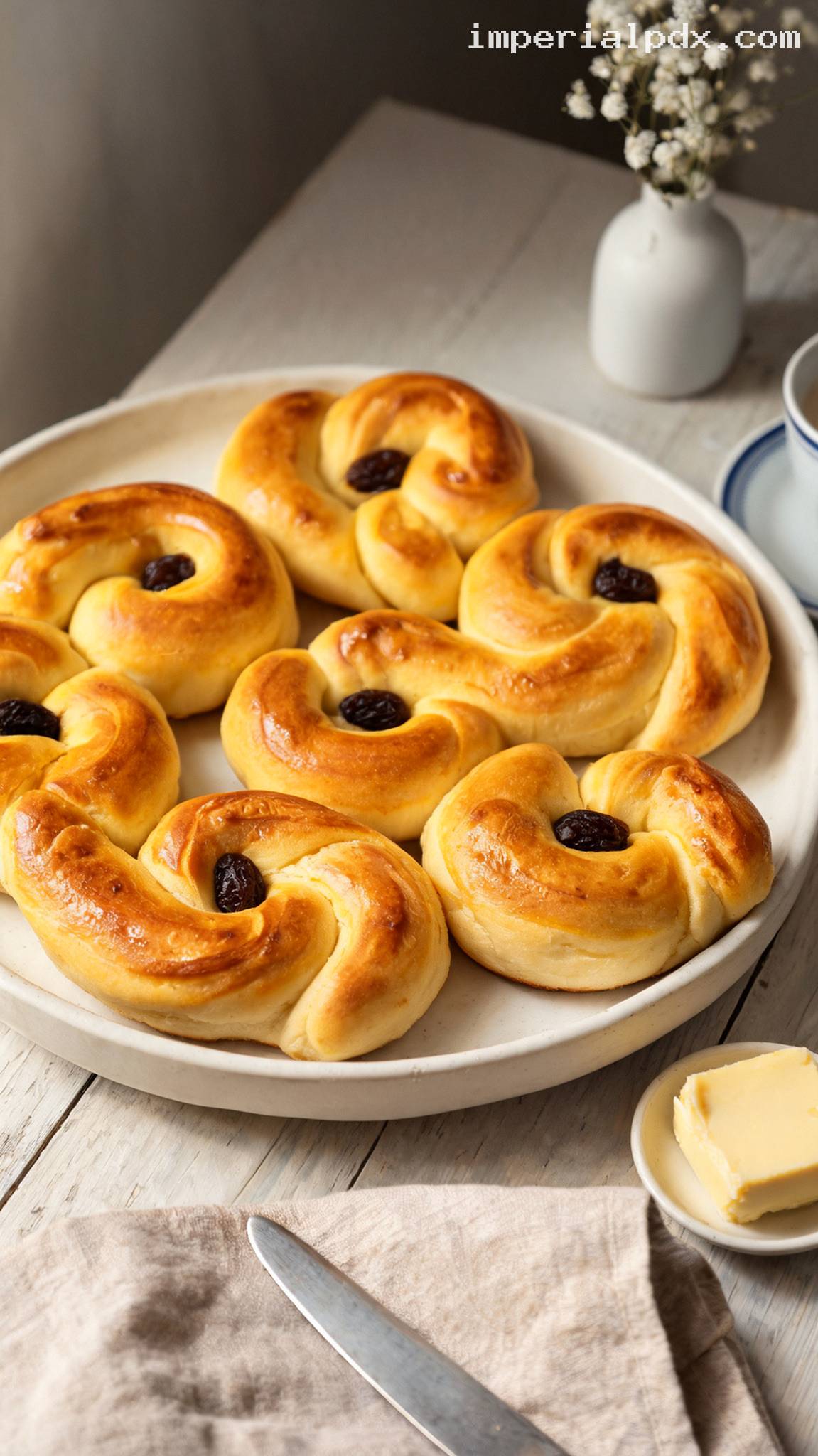
Quick Recipe Version (TL;DR)
Quick Ingredients
- 0.5 g saffron threads
- 300 ml whole milk, divided into two 150 ml portions
- 100 g granulated sugar
- 550 g all-purpose flour, plus up to 15 g for shaping
- 7 g instant yeast
- 1 g ground cardamom, about 1/2 teaspoon
- 6 g fine salt, about 1 teaspoon
- 1 large egg, at room temperature
- 100 g unsalted butter, softened
- 40 raisins, about 30 g
- Egg wash: 1 large egg beaten with 15 ml whole milk
Do This
- 1. Crush the saffron with 1 teaspoon of the measured sugar. Warm 150 ml milk to 60°C (140°F), stir in the saffron mixture, and steep for 10 minutes. Add the remaining 150 ml milk; bring the mixture to 35–38°C (95–100°F) before using.
- 2. Mix the flour, yeast, remaining sugar, cardamom, and salt. Add the saffron milk and dough egg. Knead in the softened butter gradually, then continue kneading until smooth and elastic.
- 3. Cover and let rise in a warm place for 75 minutes, or until approximately doubled.
- 4. Divide into 20 pieces. Roll each into a 30 cm (12-inch) rope, curl the ends in opposite directions into an S, and place on two parchment-lined baking sheets.
- 5. Press one raisin into each spiral center. Cover and let rise for 45 minutes, until noticeably puffy. Preheat the oven to 190°C (375°F).
- 6. Brush with egg wash and bake for 15 minutes, swapping and rotating the sheets after 8 minutes. Cool on a rack for 10 minutes before serving.
Why You’ll Love This Recipe
- A Swedish Christmas classic: Lussekatter are especially associated with St. Lucia’s Day on December 13 and are lovely throughout the holiday season.
- Beautiful color and fragrance: Real saffron gives the dough its golden hue, while a little cardamom adds gentle warmth.
- Soft, buttery texture: Milk, butter, and egg create tender buns with a delicate, pull-apart crumb.
- Easy, distinctive shaping: The traditional S-shaped spirals look impressive but need no special equipment.
Grocery List
- Produce: None required.
- Dairy: Whole milk and unsalted butter.
- Eggs: 2 large eggs.
- Pantry: All-purpose flour, granulated sugar, instant yeast, saffron threads, ground cardamom, fine salt, and raisins.
Full Ingredients
For the Saffron Dough
- 0.5 g saffron threads
- 300 ml whole milk (about 1 1/4 cups), divided into two 150 ml portions; keep the second portion at room temperature
- 100 g granulated sugar (1/2 cup), divided
- 550 g all-purpose flour (about 4 1/2 cups plus 1 tablespoon, spooned and leveled); weighing is recommended
- 7 g instant yeast (2 1/4 teaspoons; one standard packet)
- 1 g ground cardamom (about 1/2 teaspoon)
- 6 g fine salt (about 1 teaspoon)
- 1 large egg (about 50 g without the shell), at room temperature
- 100 g unsalted butter (about 7 tablespoons), softened to 20–22°C (68–72°F) and cut into small pieces
For Shaping and Decorating
- Up to 15 g all-purpose flour (2 tablespoons), for lightly dusting the work surface
- 40 raisins (about 30 g), one for the center of each spiral
- 1 large egg, for the egg wash
- 15 ml whole milk (1 tablespoon), for the egg wash
Step-by-Step Instructions
Step 1: Steep the saffron
Crush the saffron threads with 1 teaspoon taken from the measured sugar, using a mortar and pestle or the back of a spoon in a small bowl. Heat 150 ml of the milk in a small saucepan to 60°C (140°F); do not boil. Remove from the heat, stir in the saffron mixture, cover, and steep for 10 minutes.
Stir in the remaining 150 ml room-temperature milk. Check the temperature: the mixture should be 35–38°C (95–100°F) before it meets the yeast. Let it cool briefly if necessary, or warm it very gently if it is cooler than this range.
Step 2: Mix and knead the dough
In the bowl of a stand mixer, combine the 550 g flour, instant yeast, remaining sugar, cardamom, and salt. Add the saffron milk, including all the saffron threads, and the egg designated for the dough. Mix with the dough hook on low speed for 3 minutes, until a rough dough forms.
Add the softened butter a few pieces at a time, mixing on low until incorporated, about 3 minutes. Continue kneading on medium-low for 7 minutes, until the dough is smooth, elastic, and slightly tacky. It should pull mostly away from the sides of the bowl, although a little may cling to the bottom.
To knead by hand, bring the ingredients together in a large bowl, then work in the butter on a clean surface and knead for 15–20 minutes. The dough will feel sticky at first; keep kneading rather than adding handfuls of flour.
Step 3: Let the dough rise
Shape the dough into a ball and place it back in the mixing bowl. Cover with a lid or reusable cover and leave in a warm, draft-free place, ideally 24–26°C (75–79°F), for 75 minutes. It is ready when approximately doubled in size. A cooler kitchen may require additional time, so use the dough’s appearance as your final guide.
Step 4: Divide and roll the dough
Line two large baking sheets with parchment paper. Gently press the risen dough to release large air bubbles, then turn it onto a clean work surface. Use only a light dusting of the extra flour if needed; a little grip helps the dough roll evenly.
Divide into 20 equal pieces, approximately 56 g each. Roll each piece into a smooth rope about 30 cm (12 inches) long, keeping the thickness even. If a rope springs back, cover it and let it rest for 5 minutes while you work on the others, then finish rolling.
Step 5: Shape the S spirals
Lay a dough rope in front of you. Curl one end inward into a small spiral, then curl the opposite end inward in the opposite direction to form an S. Keep the coils snug without squeezing them tightly together; they need room to expand.
Transfer to the prepared sheets, placing 10 buns on each with at least 5 cm (2 inches) between them. Press one raisin firmly into the center of each coil, using two raisins per bun. Push them into the dough rather than simply resting them on top.
Step 6: Give the buns their final rise
Cover the buns loosely with lightly floured clean towels or reusable covers that will not stick to the dough. Let rise for 45 minutes at 24–26°C (75–79°F), until visibly puffy. A light fingertip indentation at the edge should spring back slowly rather than immediately.
During the final 20 minutes of this rise, preheat a conventional oven to 190°C (375°F). Position racks in the upper and lower thirds of the oven so both sheets can bake at the same time.
Step 7: Brush and bake
Beat the remaining egg with 15 ml milk until smooth. Gently brush a thin, even coating over the exposed dough, avoiding puddles around the bases. Do not press down on the risen buns.
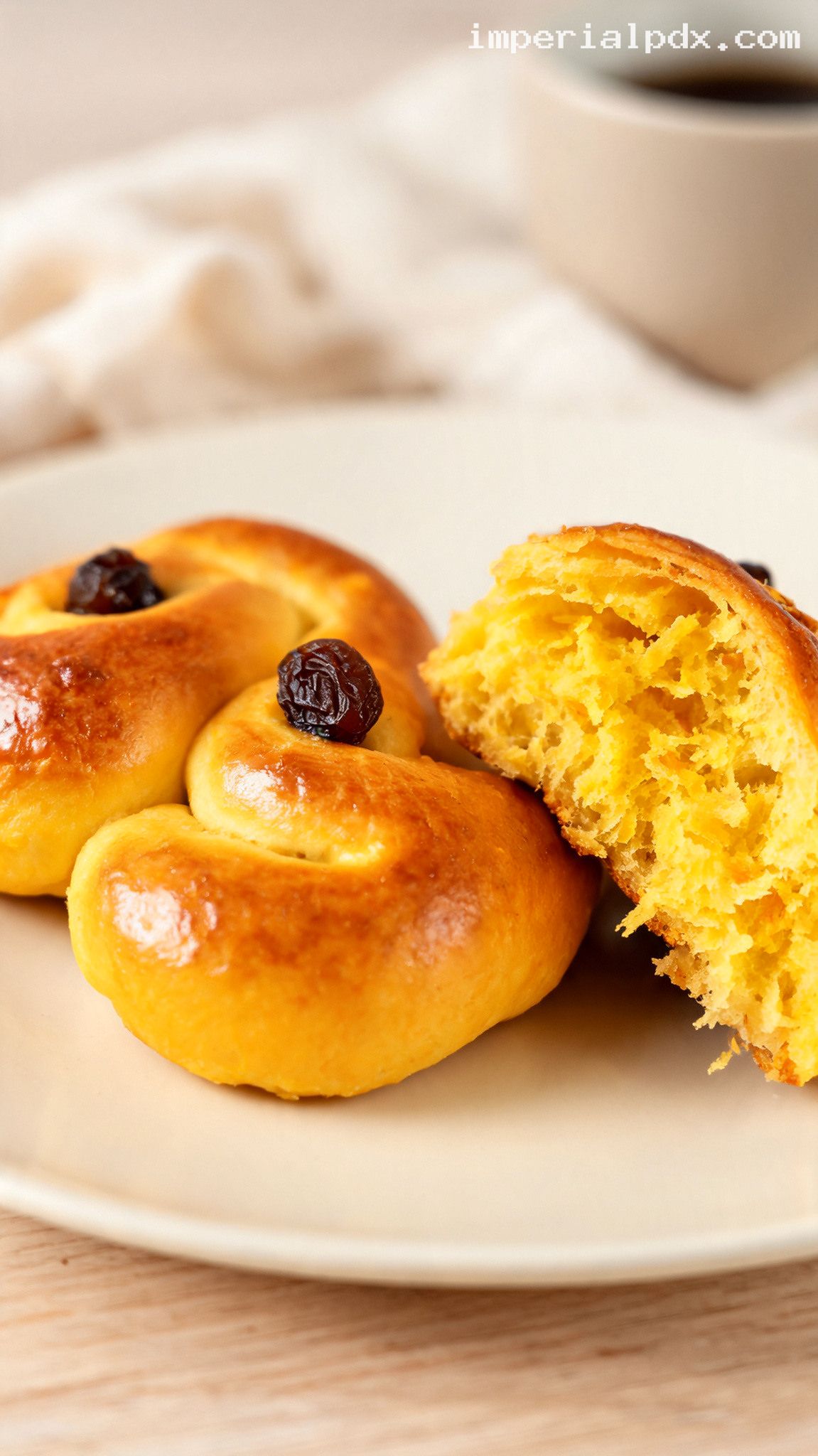
Bake both sheets for 15 minutes, swapping the upper and lower sheets and rotating each front to back after 8 minutes. The buns should be glossy and golden, with lightly browned ridges and yellow-gold sides. A bun tested in its thickest part should reach approximately 90°C (194°F). If needed, bake in additional 1-minute increments until done; avoid letting the tops become deeply brown.
Step 8: Cool and serve
Transfer the buns to a wire rack and cool for 10 minutes. They are especially good slightly warm, when their saffron fragrance is most noticeable. Serve plain or with a little butter, alongside coffee, tea, or warm Swedish glögg.
Pro Tips
- Measure the saffron by weight: Thread volume varies considerably. Crushing and steeping the full 0.5 g gives dependable color and flavor without needing food coloring.
- Keep the dough soft: Slight tackiness is normal. Too much extra flour makes the buns dry and harder to shape.
- Use softened, not melted, butter: Butter that holds its shape but yields easily to a fingertip incorporates smoothly without making the dough greasy.
- Rescue very dry raisins: Soak them in warm water for 10 minutes during the first rise, then drain and pat completely dry before pressing them into the dough.
- Trust the rise cues: The timing assumes a warm kitchen. Give the dough more time if it has not doubled or the shaped buns still feel dense.
Variations
- Saffron-only buns: Omit the cardamom to let the saffron take center stage; no other changes are needed.
- Orange-scented buns: Add 2 teaspoons finely grated orange zest with the flour for a citrus variation.
- Golden raisin spirals: Replace the dark raisins with 40 golden raisins, keeping one in the center of each coil.
Storage & Make-Ahead
Room temperature: Once completely cool, store in an airtight container for up to 2 days. These buns are best on the day they are baked. Avoid refrigerating baked buns, which can make them stale more quickly.
Freeze: Wrap cooled buns individually and freeze in an airtight freezer bag for up to 2 months. Thaw, still wrapped, at room temperature for about 1 hour. To refresh, wrap loosely in foil and warm at 150°C (300°F) for 8 minutes.
Make ahead overnight: After shaping and adding the raisins, cover the baking sheets well and refrigerate immediately for 8–12 hours instead of completing the room-temperature second rise. The next day, uncover and loosely cover again, then let stand at room temperature for 60–90 minutes, until puffy. Brush with egg wash just before baking as directed.
Nutrition (per serving)
Calories: 183 kcal | Carbs: 28g | Protein: 4g | Fat: 5g | Saturated Fat: 3g | Fiber: 1g | Sugar: 7g | Sodium: 133mg | Cholesterol: 31mg
Estimated per bun, based on 20 buns and the full amount of egg wash. Actual values will vary slightly with ingredient brands and how much egg wash is used.