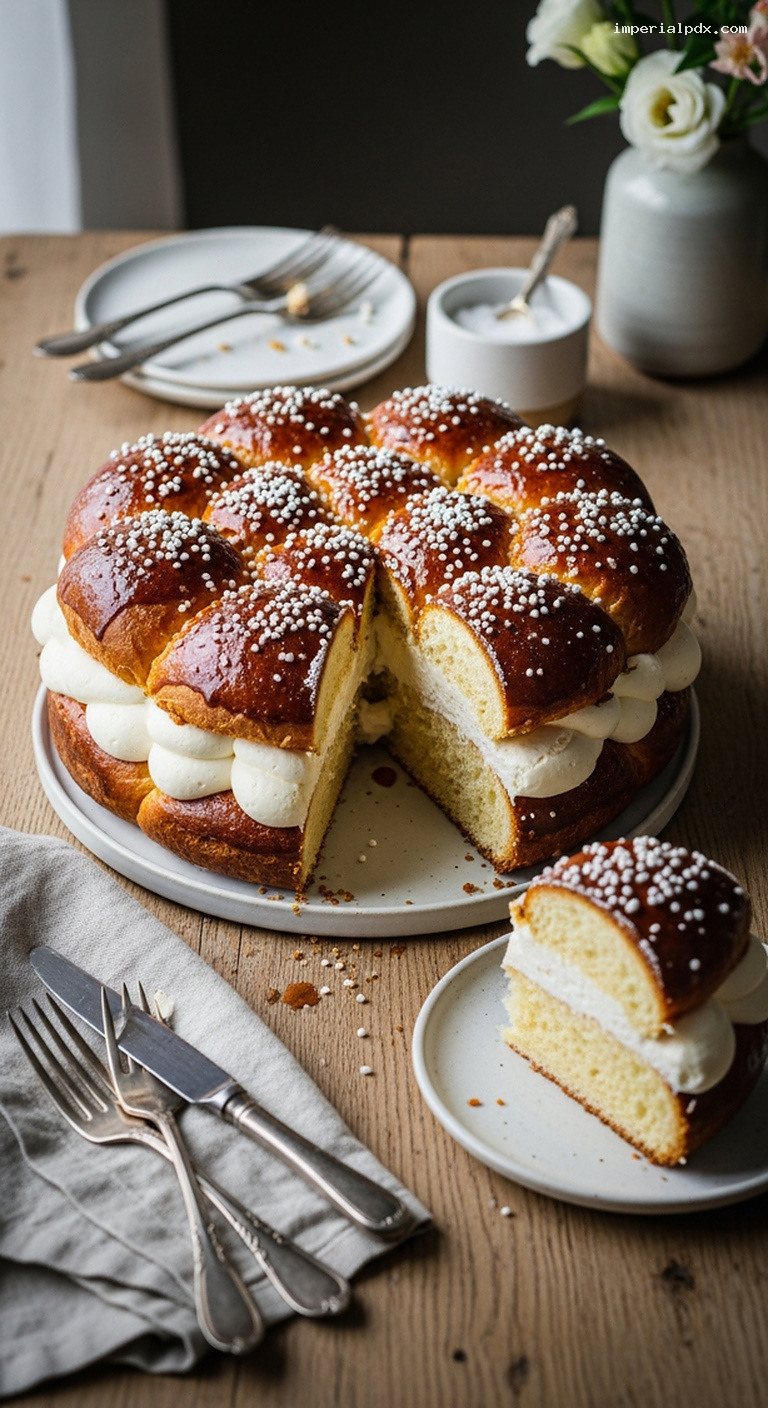
Quick Recipe Version (TL;DR)
Quick Ingredients
- 3 1/4 cups (390 g) all-purpose flour
- 1/4 cup (50 g) sugar + extra for pastry cream
- 2 1/4 tsp (7 g) instant or active dry yeast
- 1 tsp fine salt
- 4 large eggs + 1 egg for egg wash
- 2 1/2 cups (600 ml) whole milk, divided
- 10 tbsp (140 g) unsalted butter for brioche + 2 tbsp (28 g) for cream
- 2 cups (480 ml) heavy cream, well chilled
- 4 large egg yolks
- 1/4 cup (30 g) cornstarch
- 2–4 tbsp orange blossom water
- 1–2 tsp vanilla extract
- 1/4 cup (40 g) pearl sugar + powdered sugar for dusting
- Optional: 1 tsp powdered gelatin + 2 tbsp cold water
Do This
- 1. Make brioche dough: mix flour, sugar, yeast, salt, eggs, warm milk and vanilla, then knead in soft butter until smooth and elastic.
- 2. Let rise until doubled (about 1–1 1/2 hours), chill 1 hour, then shape into a 9 in (23–24 cm) round in a buttered pan; proof again until puffy.
- 3. Brush with egg wash, sprinkle generously with pearl sugar and bake at 350°F (175°C) for 20–25 minutes; cool completely.
- 4. Meanwhile, cook a thick vanilla pastry cream with milk, egg yolks, sugar and cornstarch; stir in butter and orange blossom water, then chill.
- 5. Optional: bloom gelatin in water and melt, then whisk into chilled pastry cream for a firmer filling.
- 6. Whip heavy cream with a little sugar to soft peaks and gently fold into the cold pastry cream to make a light, lush orange-blossom cream.
- 7. Slice brioche horizontally, pipe or spread the cream over the base, top with the brioche lid, chill 1 hour to set, dust with powdered sugar and serve.
Why You’ll Love This Recipe
- A bakery-level French showstopper that is absolutely achievable in a home kitchen.
- Soft, buttery brioche contrasts with a cloud-light orange-blossom cream for incredible texture.
- Crunchy pearl sugar topping adds sweetness and sparkle without needing any frosting.
- Perfect for celebrations, brunches or whenever you want something special that can be made ahead.
Grocery List
- Produce: None (this is a rich bakery-style dessert built from dairy, eggs and pantry staples).
- Dairy: Whole milk, heavy cream, unsalted butter.
- Pantry: All-purpose flour, granulated sugar, powdered sugar, cornstarch, active dry or instant yeast, fine salt, vanilla extract, orange blossom water, pearl sugar, powdered gelatin (optional).
Full Ingredients
Brioche Dough
- 3 1/4 cups (390 g) all-purpose flour, plus extra for dusting
- 1/4 cup (50 g) granulated sugar
- 2 1/4 tsp (7 g) instant or active dry yeast (1 standard packet)
- 1 tsp fine sea salt
- 4 large eggs, at room temperature
- 1/2 cup (120 ml) whole milk, lukewarm (100–105°F / 38–40°C)
- 1 tsp vanilla extract
- 10 tbsp (140 g) unsalted butter, very soft but not melted, cut into small pieces
Egg Wash & Topping
- 1 large egg
- 1 tbsp (15 ml) milk or cream
- 1/4 cup (40 g) pearl sugar (also sold as nib sugar)
- 2–3 tbsp powdered sugar, for dusting after baking
Orange-Blossom Pastry Cream (Base)
- 2 cups (480 ml) whole milk
- 1 vanilla bean, split and scraped or 2 tsp vanilla extract
- 4 large egg yolks
- 1/2 cup (100 g) granulated sugar
- 1/4 cup (30 g) cornstarch
- 1/8 tsp fine salt
- 2 tbsp (28 g) unsalted butter, cut into pieces
- 2–3 tbsp orange blossom water (to taste; start with 2 tbsp)
To Finish the Orange-Blossom Cream
- 1 tsp powdered gelatin (optional but recommended for clean slices)
- 2 tbsp (30 ml) cold water (for blooming gelatin)
- 1 cup (240 ml) heavy cream, very cold
- 2 tbsp (15 g) powdered sugar
- Optional: 1 additional tbsp orange blossom water, if you like a stronger aroma
Step-by-Step Instructions
Step 1: Make the brioche dough
In the bowl of a stand mixer (or a large mixing bowl), whisk together the flour, sugar, yeast and salt. If using active dry yeast, there is no need to proof separately as long as your milk is correctly warmed.
In a separate bowl or jug, whisk the eggs, lukewarm milk and vanilla. Pour this wet mixture into the dry ingredients. Using the dough hook (or a sturdy wooden spoon), mix on low speed until a shaggy dough forms, about 1–2 minutes. Increase to medium speed and knead for 4–5 minutes, until the dough is starting to look smoother.
With the mixer running on medium-low, add the very soft butter a few pieces at a time, letting each addition blend in before adding more. Scrape the bowl as needed. Continue kneading for 8–10 minutes, until the dough is very smooth, elastic and slightly tacky but not sticky. It should pull away from the sides of the bowl and form a soft ball. If it is extremely sticky, add 1–2 tbsp more flour, just enough to help it come together.
Step 2: First rise and chill the dough
Lightly oil a large bowl. Transfer the brioche dough to the bowl, turning it once so it is lightly coated in oil. Cover tightly with plastic wrap or a reusable cover and leave to rise at warm room temperature (75–80°F / 24–27°C) until doubled in size, about 1–1 1/2 hours.
Once doubled, gently deflate the dough by pressing it down with your fist. Re-cover and refrigerate for at least 1 hour and up to 8 hours. Chilling makes the dough much easier to shape and helps develop flavor. While the dough chills, you can start the pastry cream in the next steps.
Step 3: Make the orange-blossom pastry cream base
In a medium saucepan, combine the milk and vanilla bean (seeds and pod) if using. Heat over medium until steaming and just starting to bubble around the edges; do not let it boil. If using vanilla extract instead, you will add it later, off the heat.
While the milk heats, whisk the egg yolks, sugar, cornstarch and salt in a medium heatproof bowl until very smooth and slightly thickened. Once the milk is hot, remove the vanilla pod (if using). Slowly pour about one-third of the hot milk into the yolk mixture, whisking constantly to temper and prevent curdling. Then pour the tempered yolk mixture back into the saucepan with the remaining milk, whisking constantly.
Cook over medium heat, whisking continuously, until the mixture thickens and starts to bubble, 2–4 minutes. Once it bubbles, continue cooking for 30–60 seconds to fully cook the starch. Remove from the heat and immediately whisk in the butter, orange blossom water and vanilla extract (if using instead of vanilla bean). Taste and add a little more orange blossom water if you like, remembering the flavor will soften once the cream is chilled and folded with whipped cream.
Press the pastry cream through a fine-mesh sieve into a clean bowl to remove any lumps. Press plastic wrap directly onto the surface to prevent a skin from forming. Chill in the refrigerator until completely cold, at least 2 hours. You can make this up to 2 days ahead.
Step 4: Shape and proof the brioche
Butter and line the base of a 9 in (23–24 cm) round springform pan or a deep cake pan with parchment paper. Remove the chilled dough from the fridge and gently turn it out onto a lightly floured surface.
Shape the dough into a smooth ball by folding the edges into the center, then flipping it seam-side down and cupping your hands around it, pulling gently toward you to create surface tension. Place the dough ball in the prepared pan and gently press it out so it fills the base evenly.
Cover loosely with lightly oiled plastic wrap or a clean kitchen towel and let rise at warm room temperature until puffy and nearly doubled, 45–75 minutes. It should spring back slowly when lightly pressed with a fingertip.
Step 5: Top with pearl sugar and bake
About 20 minutes before baking, preheat your oven to 350°F (175°C) with a rack in the middle.
In a small bowl, whisk together the egg and 1 tbsp milk to make an egg wash. Gently brush the top of the risen brioche with a thin, even layer of egg wash, being careful not to deflate it. Sprinkle the entire surface generously with pearl sugar.
Bake for 20–25 minutes, until the brioche is a deep golden brown and sounds hollow when tapped. If it is browning too quickly, tent loosely with foil for the last 5 minutes. An instant-read thermometer inserted into the center should read about 190°F (88°C).
Let the brioche cool in the pan for 10 minutes, then carefully remove the ring and transfer to a wire rack to cool completely, at least 1 1/2 hours. The cake must be fully cool before filling.
Step 6: (Optional but recommended) Stabilize the cream with gelatin
If you want very clean, bakery-style slices, use gelatin to help the filling hold its shape. If you are happy with a slightly softer cream, you can skip this step and go straight to whipping the cream in the next step.
Place the powdered gelatin in a small heatproof bowl and sprinkle the cold water over the top. Let stand for 5 minutes to bloom (the granules will absorb the water and swell).
Once the pastry cream is completely cold, place the bloomed gelatin over a small pan of barely simmering water or microwave in short 5-second bursts just until melted and liquid; do not let it boil. Whisk a spoonful of cold pastry cream into the warm gelatin to cool it slightly, then whisk this mixture back into the bowl of pastry cream until fully combined. Return the pastry cream to the refrigerator while you whip the cream.
Step 7: Finish the orange-blossom cream
In a chilled mixing bowl, add the heavy cream and powdered sugar. Whip with a hand mixer or whisk until soft peaks form (the cream should hold gentle peaks that just barely stand up). Avoid whipping to stiff peaks; you want it smooth and silky so it folds well.
Remove the pastry cream from the refrigerator and whisk briefly to loosen it. Gently fold about one-third of the whipped cream into the pastry cream to lighten the texture. Then fold in the remaining whipped cream in two additions, using a spatula and broad, gentle strokes to avoid deflating it.
Taste the finished cream. If you would like a more pronounced floral note, fold in up to 1 additional tbsp orange blossom water, a little at a time. The cream should be thick, billowy and able to hold soft swirls. If it feels very loose, chill it for 20–30 minutes to firm up slightly before assembling.
Step 8: Assemble, chill and serve the Tarte Tropézienne
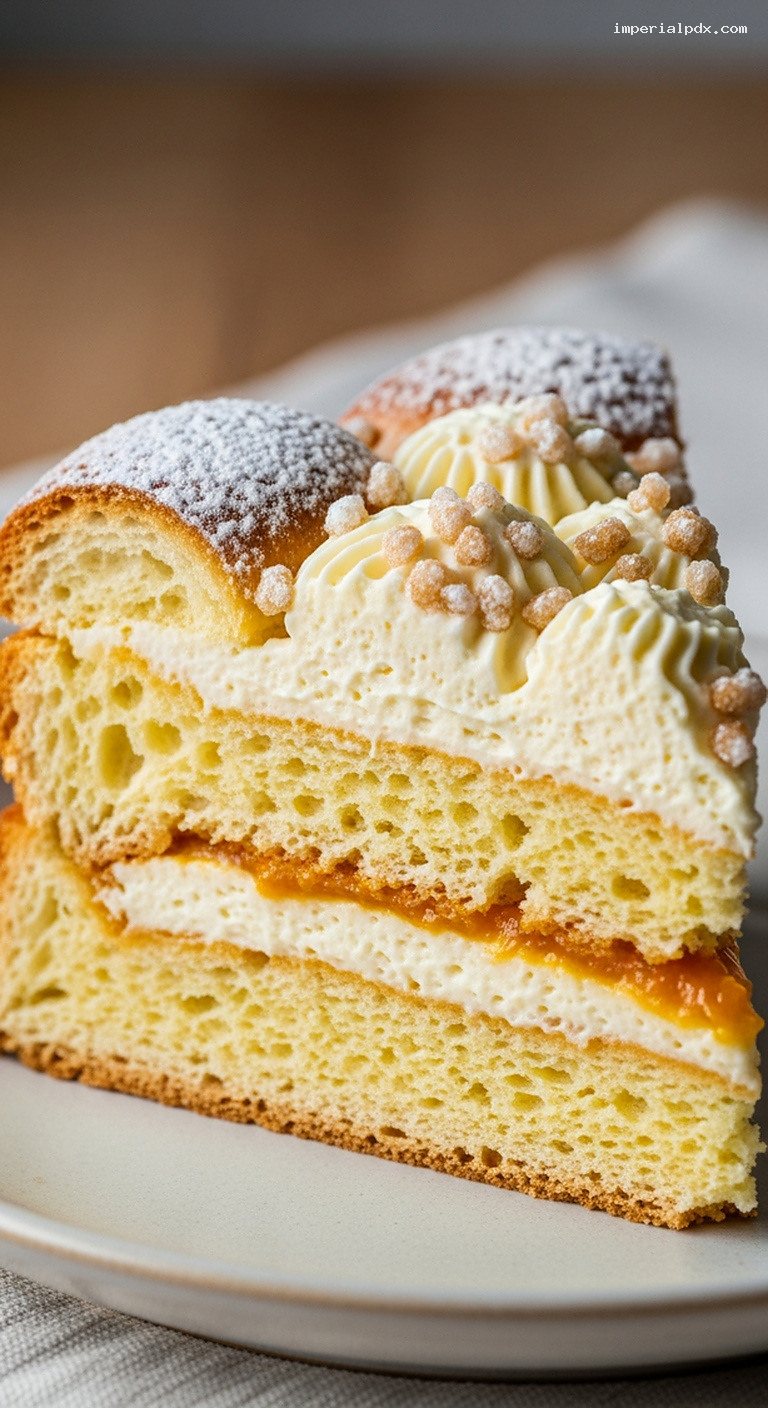
Once the brioche is completely cool, use a long serrated bread knife to carefully slice it horizontally into two even layers, like a giant burger bun. Gently lift off the top layer and set it aside.
Place the bottom layer on your serving plate or cake stand. Spoon the orange-blossom cream into a piping bag fitted with a large round or star tip (or simply use a spatula). Pipe or spread the cream evenly over the brioche base, going right up to the edges and aiming for a thick layer about 1–1 1/2 in (2.5–4 cm) high. You can pipe decorative mounds or a simple, smooth layer, depending on your style.
Carefully place the top layer of brioche back on, aligning it with the bottom. Do not press down too firmly; let it rest gently on the cream. Cover loosely and refrigerate for at least 1 hour, or up to 8 hours, to allow the filling to set and the flavors to meld.
Just before serving, dust the top generously with powdered sugar. Slice with a sharp serrated knife, wiping the blade between cuts for the cleanest slices. Serve chilled or slightly cool.
Pro Tips
- Weigh your ingredients if possible. Using a kitchen scale for flour, sugar and butter makes the brioche texture more consistent and helps avoid dry or dense dough.
- Do not rush the cooling. Filling warm brioche with cold cream will cause the cream to soften and ooze out. Make sure the brioche is fully cool before assembly.
- Adjust orange blossom water to taste. It is quite potent. Start with the lower amount and add more gradually so the floral note is pleasant, not overpowering.
- Chill everything for the cream. Cold pastry cream and very cold heavy cream whip and fold together more easily and give a lighter texture.
- Use the gelatin for special occasions. If you want picture-perfect slices for a party, the small amount of gelatin makes a big difference in stability while still keeping the filling light.
Variations
- Lemon–Vanilla Tropézienne: Replace half the orange blossom water with fresh lemon zest (from 1 large lemon) added to the milk when heating, and add 1–2 tsp lemon juice to the finished cream.
- Berry-Filled Tropézienne: After spreading or piping the cream on the brioche base, scatter a single layer of sliced strawberries or raspberries over the cream, then add the brioche top.
- Mini Tropézienne Buns: Instead of one large cake, divide the dough into 10–12 balls, bake as individual brioche buns, then split and fill each with cream for individual servings.
Storage & Make-Ahead
The assembled Tarte Tropézienne is best eaten within 24 hours, stored in the refrigerator and well covered to prevent the cream from absorbing fridge odors. The brioche will gradually dry out after about a day, though the cream helps keep it moist.
For longer storage, prepare the components separately. The baked, unfilled brioche can be wrapped tightly in plastic and kept at room temperature for up to 2 days or frozen (well wrapped) for up to 1 month. Thaw at room temperature, then fill as directed. The pastry cream base can be made up to 2 days ahead and kept refrigerated; wait to fold in the whipped cream (and gelatin, if using) until the day you plan to assemble the tart.
Leftover slices should be refrigerated and consumed within 2 days. The cream should not be frozen once assembled.
Nutrition (per serving)
Approximate values for 1 of 12 servings: about 450 calories; 29 g fat; 18 g saturated fat; 31 g carbohydrates; 1 g fiber; 18 g sugars; 8 g protein; 220 mg sodium. These values are estimates and will vary based on exact ingredients and portion sizes.