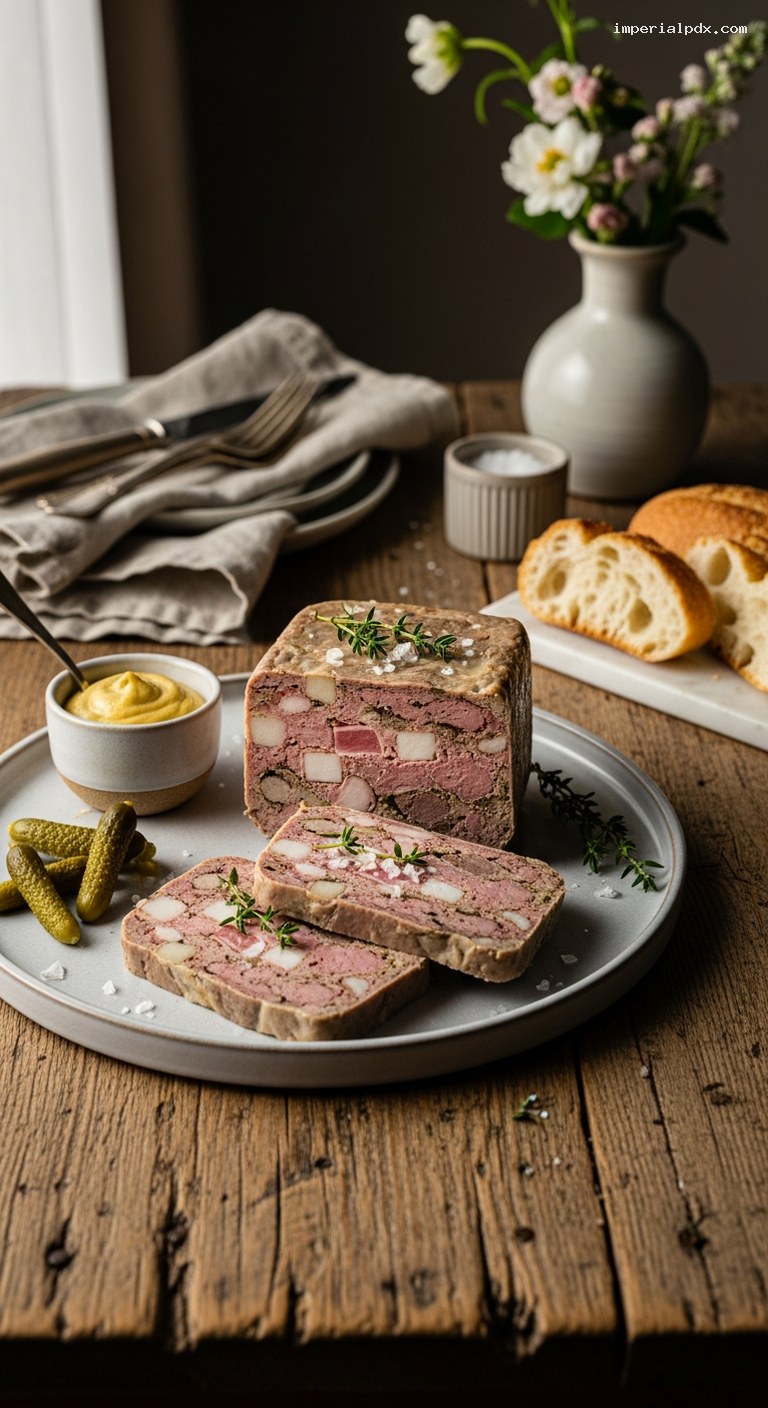
Quick Recipe Version (TL;DR)
Quick Ingredients
- 450 g (1 lb) boneless pork shoulder, half diced, half for grinding
- 225 g (1/2 lb) thick-cut bacon, diced (plus 4–6 extra slices for lining, optional)
- 225 g (1/2 lb) ground pork
- 225 g (1/2 lb) chicken or pork liver, roughly chopped
- 2 tsp kosher salt (about 12 g) + 1/2 tsp fine sea salt for onion mix
- 2 tsp coarsely ground black pepper
- 1 tsp dried thyme (or 2 tsp fresh, minced)
- 2 cloves garlic, minced
- 1 small shallot or 1/2 small onion, finely minced
- 60 ml (1/4 cup) brandy or cognac
- 2 large eggs
- 80 ml (1/3 cup) heavy cream
- 60 g (1/2 cup) fresh breadcrumbs
- 2 bay leaves
- Cornichons, Dijon mustard, and crusty bread for serving
Do This
- 1. Chill all meats, a large mixing bowl, and (if using) grinder parts until very cold.
- 2. Gently cook shallot/onion and garlic until soft; cool, then mix with cream and breadcrumbs.
- 3. Combine diced and ground pork, bacon, liver, salt, pepper, thyme, brandy, and breadcrumb mixture; marinate 4–12 hours in the fridge.
- 4. Grind or pulse about two-thirds of the mixture into a coarse paste; fold in remaining diced meat for a chunky texture.
- 5. Pack into a lined terrine or loaf pan, press well, top with bay leaves and bacon strips, cover tightly.
- 6. Bake in a water bath at 160°C / 325°F for 1 hour 20–40 minutes, until internal temperature reaches 65–68°C / 150–155°F.
- 7. Weight and chill the pâté at least 8–24 hours before slicing; serve at cool room temperature with mustard and cornichons.
Why You’ll Love This Recipe
- A classic French country pâté: rustic, deeply savory, and studded with tender cubes of pork and bacon.
- Surprisingly doable for home cooks with just a loaf pan and basic kitchen tools.
- Perfect make-ahead centerpiece for dinner parties, picnics, and charcuterie boards.
- Improves as it rests, so you can cook once and enjoy over several days.
Grocery List
- Produce: 1 small shallot or 1 small onion, garlic, fresh thyme (optional but lovely), fresh parsley (for serving, optional), lemon (optional for serving)
- Dairy: Heavy cream, eggs, unsalted butter (or neutral oil) for sautéing
- Pantry: Kosher salt, fine sea salt, black pepper (coarsely ground if possible), dried thyme (if not using fresh), bay leaves, fresh breadcrumbs or bread for making crumbs, Dijon mustard, cornichons, crusty bread or baguette
- Meat & Alcohol: Pork shoulder, thick-cut bacon, ground pork, chicken or pork liver, brandy or cognac, optional dry white wine
Full Ingredients
For the Pâté
- 450 g (1 lb) boneless pork shoulder, well chilled
- 225 g (1/2 lb) cut into 1 cm (1/2 inch) dice
- 225 g (1/2 lb) left in strips/chunks for grinding or fine chopping
- 225 g (1/2 lb) thick-cut bacon, well chilled and cut into 1 cm (1/2 inch) dice
- 225 g (1/2 lb) ground pork (preferably 20–30% fat), well chilled
- 225 g (1/2 lb) chicken liver or pork liver, trimmed of sinew and roughly chopped
- 2 tsp kosher salt (about 12 g)
- 2 tsp coarsely ground black pepper
- 1 tsp dried thyme or 2 tsp fresh thyme leaves, finely chopped
- 1/4 tsp ground allspice or nutmeg (optional but traditional)
- 60 ml (1/4 cup) brandy or cognac
- 30 ml (2 tbsp) dry white wine (optional, for extra aroma)
- 2 large eggs
- 80 ml (1/3 cup) heavy cream
- 60 g (1/2 cup) fresh white breadcrumbs (from crustless bread)
- 2 cloves garlic, finely minced
- 1 small shallot or 1/2 small onion, very finely minced
- 1 tbsp unsalted butter or 1 tbsp neutral oil (for sautéing the shallot/onion)
- 1/2 tsp fine sea salt (for seasoning the onion mixture)
For Lining and Topping the Terrine (Optional but Recommended)
- 4–6 slices streaky bacon or 1 sheet pork caul fat, rinsed and patted dry
- 2 bay leaves
To Serve
- Cornichons (small French pickles)
- Dijon mustard and/or whole-grain mustard
- Crusty bread or baguette slices, lightly toasted if you like
- Fresh parsley leaves or thyme sprigs for garnish (optional)
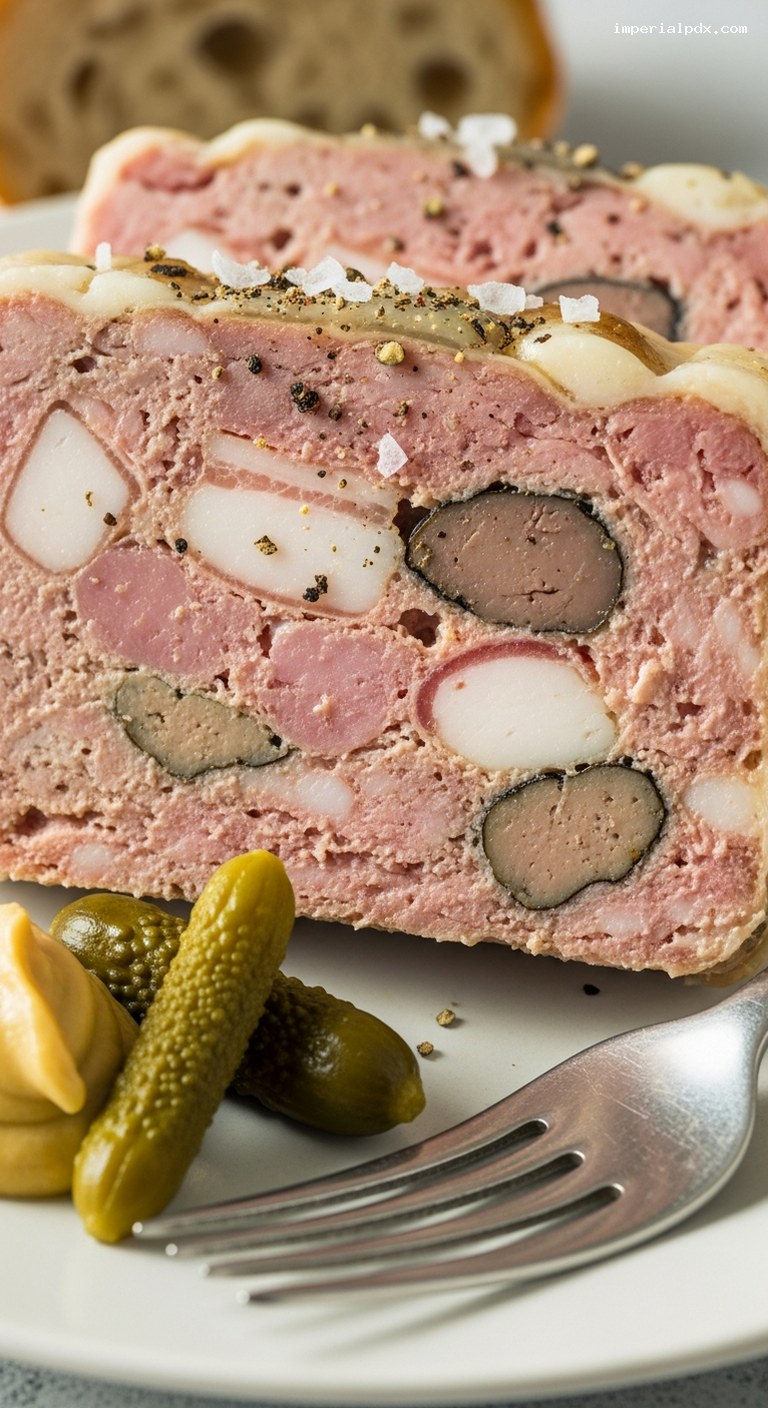
Step-by-Step Instructions
Step 1: Prepare Your Equipment and Chill the Meat
Line a 900 g (2 lb) loaf pan or terrine mold (about 22 x 12 cm / 9 x 5 inches) with parchment, leaving an overhang for easy removal. If you will line the terrine with bacon or caul fat, leave the parchment only on the long sides and bottom, so the lining can sit directly against the pan.
Place the pork shoulder, bacon, ground pork, and liver in the coldest part of your refrigerator (or briefly in the freezer for 15–20 minutes) so they are thoroughly chilled but not frozen. Cold meat is easier to cut and helps the pâté keep a pleasant, firm texture.
If you are using a meat grinder, chill the grinder parts and a large metal mixing bowl as well. If you will use a food processor, chill its bowl and blade if possible.
Step 2: Cook the Aromatics and Prepare the Breadcrumb Mixture
In a small skillet over medium-low heat, melt the butter (or warm the oil). Add the finely minced shallot or onion and the 1/2 teaspoon fine sea salt. Cook gently for 5–7 minutes, stirring often, until the onion is soft and translucent but not browned. Add the minced garlic and cook for 1 more minute, just until fragrant. Remove from the heat and let cool to room temperature.
In a small bowl, stir together the heavy cream and breadcrumbs. Let them sit for 5–10 minutes to soften and absorb the cream. When the onion mixture is cool, stir it into the breadcrumbs along with the dried or fresh thyme and the ground allspice or nutmeg (if using). Set aside.
Step 3: Season and Marinate the Meats
In a large chilled mixing bowl, combine the diced pork shoulder, diced bacon, ground pork, and chopped liver. Sprinkle over the kosher salt and coarsely ground black pepper. Add the brandy (and white wine, if using), then add the breadcrumb-onion mixture and crack in the 2 eggs.
Use clean hands or a sturdy spatula to mix everything together thoroughly, making sure the seasonings and liquids are evenly distributed. Cover the bowl tightly and refrigerate for at least 4 hours and up to 12 hours. This short cure lets the flavors mingle and improves both taste and texture.
Step 4: Grind or Pulse to Create a Rustic Texture
After marinating, remove the bowl from the fridge. Set aside about one-third of the mixture (making sure it includes a good amount of the diced pork shoulder and bacon); this portion will remain in small chunks to give the pâté its rustic, studded interior.
Pass the remaining two-thirds of the meat mixture through a meat grinder fitted with a coarse plate, directly into the chilled mixing bowl, or pulse in a food processor in short bursts until it forms a coarse paste. Do not over-process; you want a slightly chunky, sticky mixture, not a smooth purée.
Return the reserved chunky mixture to the bowl and use your hands to fold it evenly through the ground portion. Lift and slap the mixture against the bowl a few times; it should start to look slightly sticky and cohesive, which means it will slice cleanly once cooked.
Step 5: Assemble and Pack the Terrine
If using bacon or caul fat to line the pan, lay the slices of bacon across the bottom and up the sides of the loaf pan, slightly overlapping, or drape the caul fat to cover the bottom and sides with some overhang. If not using, lightly grease the parchment with a dab of butter or oil.
Spoon the meat mixture into the prepared pan in 2–3 layers. After each addition, firmly press it down with a spatula or the back of a spoon to eliminate air pockets. When the pan is full, smooth the top. Arrange the bay leaves on the surface. If you have overhanging bacon or caul fat, fold it over the top to enclose the pâté. Cover the pan tightly with a lid or a double layer of foil, crimping the edges to seal.
Step 6: Bake Gently in a Water Bath
Preheat your oven to 160°C / 325°F. Place a folded kitchen towel in the bottom of a deep roasting pan to keep the terrine from sliding. Set the covered terrine on top of the towel. Pour hot tap water into the roasting pan until it reaches about halfway up the sides of the terrine, creating a gentle water bath.
Carefully transfer the pan to the oven and bake for 1 hour 20 minutes to 1 hour 40 minutes, depending on the exact size and shape of your pan, until the pâté reaches an internal temperature of 65–68°C / 150–155°F in the very center when checked with an instant-read thermometer. Begin checking at around 1 hour 15 minutes.
When done, remove the terrine from the water bath and let it cool on a rack until just warm to the touch, about 45–60 minutes.
Step 7: Weight, Chill, and Rest the Pâté
To give the pâté its classic, compact sliceable texture, it should be gently weighted as it cools. Cut a piece of cardboard or a small cutting board to roughly match the size of the terrine’s interior (or use a foil-wrapped piece of cardboard). Wrap it in foil or plastic wrap and place it directly on top of the cooked pâté (remove the bay leaves first if they are on top and you prefer not to embed them).
Set a few cans or a small, clean weight (about 450–900 g / 1–2 lb) on top. Once the terrine is close to room temperature, cover the whole thing and refrigerate for at least 8 hours, and ideally 24 hours. This resting time is essential: the flavors blend, the fat firms, and the pâté will slice neatly.
Step 8: Slice and Serve
When ready to serve, remove the weights and foil or board. Run a thin knife around the edges if needed, then lift the pâté out using the parchment overhang, or invert it carefully onto a cutting board. Discard any bay leaves on the outside.
Use a sharp, thin knife to cut 1–1.5 cm (about 1/2 inch) slices. Wipe the blade between cuts for the cleanest slices. Serve the pâté slightly cooler than room temperature (take it out of the fridge 20–30 minutes before serving) with cornichons, a spoonful of Dijon or whole-grain mustard, and slices of crusty bread. Garnish the plate with fresh parsley or thyme if you like.
Pro Tips
- Keep everything cold: Chilled meat and equipment help the fat stay firm and give the pâté a silky yet sliceable texture. If the mixture ever feels warm, pop it back in the fridge for 15 minutes.
- Do not rush the resting time: The pâté is good on day one, but noticeably better on day two and even day three. Plan ahead if you are serving guests.
- Control the texture: For a more rustic pâté, reserve more diced meat to fold in at the end; for a finer pâté, grind or process a greater portion of the mixture.
- Taste the seasoning (safely): For perfect seasoning, fry a small spoonful of the mixture in a skillet, taste, and adjust salt, pepper, or thyme before packing the terrine.
- Use a thermometer: Because the pâté is dense, an instant-read thermometer is the best way to avoid under- or overcooking.
Variations
- Herb lovers’ pâté: Add 2 tbsp finely chopped fresh parsley and 1 tbsp chopped fresh thyme or tarragon to the mixture for a greener, more aromatic profile.
- Pistachio or hazelnut pâté: Fold 60–80 g (1/2–2/3 cup) shelled, toasted pistachios or hazelnuts into the mixture at the same time as the reserved diced meat for extra color and crunch.
- Game twist: Replace up to half of the pork shoulder with boneless duck legs or rabbit for a more gamey, traditional countryside flavor. Keep the fat content generous for best texture.
Storage & Make-Ahead
This pâté is an ideal make-ahead dish. Once fully cooled and weighted overnight, wrap it tightly in plastic wrap or foil and keep it refrigerated. It will keep well for 5–7 days, and the flavor often improves over the first few days. For longer storage, wrap the pâté (whole or in large chunks) in plastic and then foil, and freeze for up to 2 months. Thaw overnight in the refrigerator, remove wrapping, and let it sit at room temperature for 30 minutes before serving. Always use a clean knife for slicing and avoid leaving the pâté at room temperature for more than 2 hours at a time.
Nutrition (per serving)
Approximate values for 1 of 12 servings (without bread or accompaniments): about 380–420 calories; 32–35 g fat; 16–20 g protein; 2–4 g carbohydrates; 0–1 g fiber; 650–800 mg sodium. Actual values will vary depending on the specific cuts of pork, bacon, and brand of ingredients used.