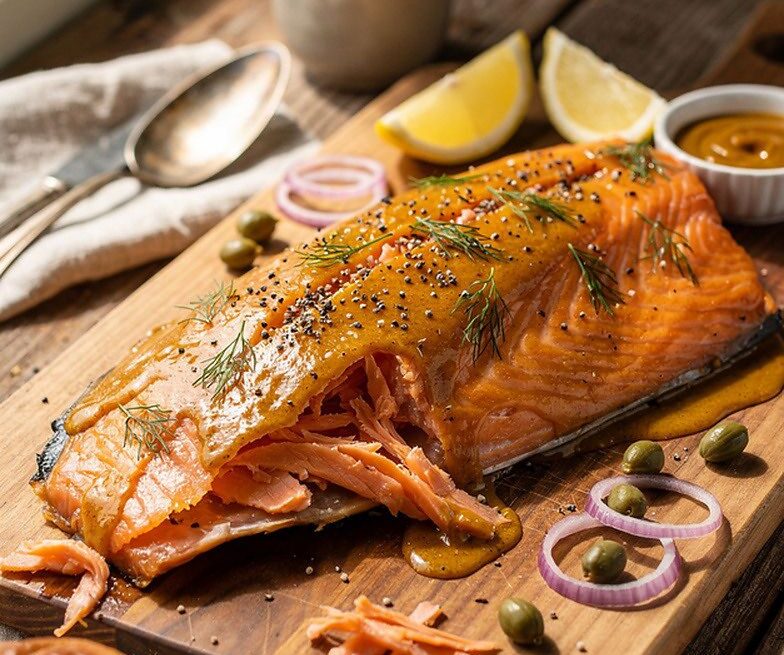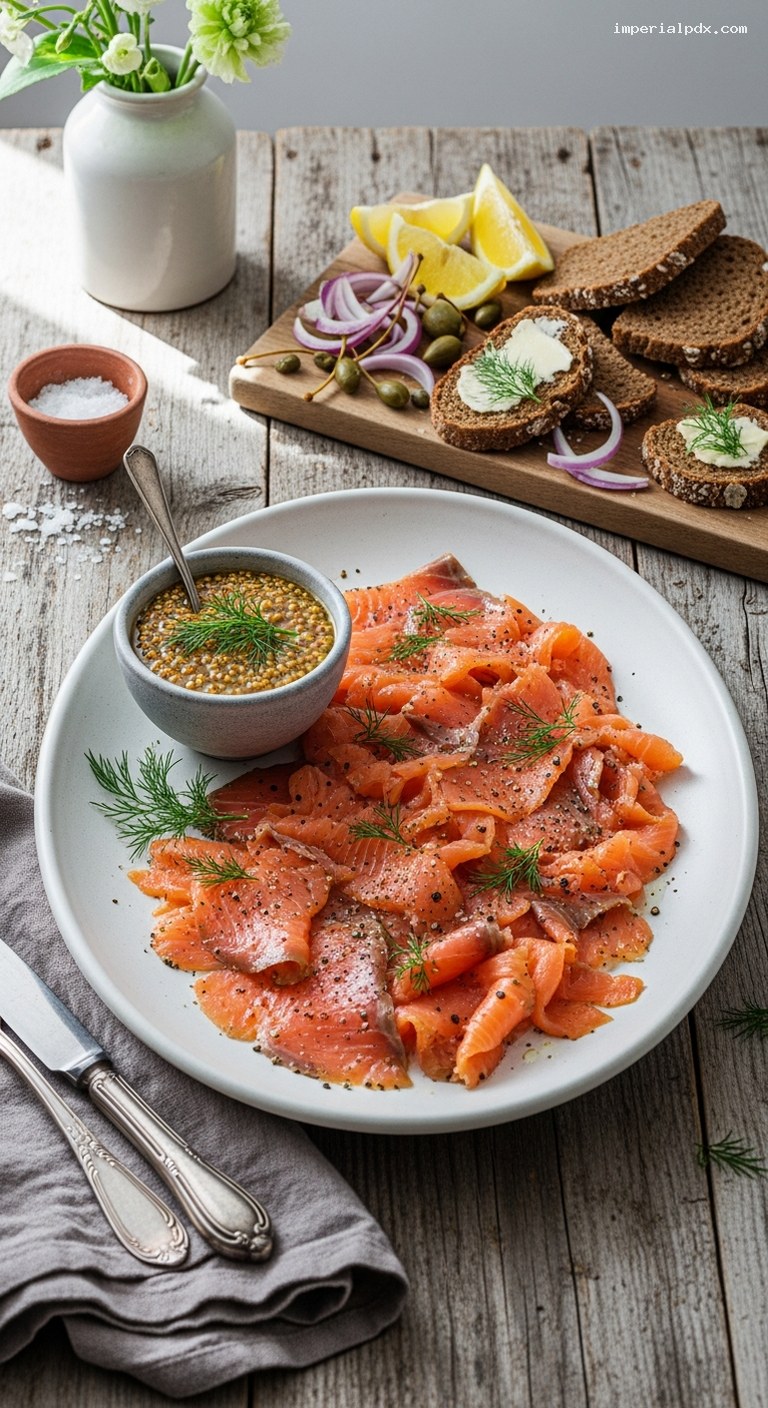
Quick Recipe Version (TL;DR)
Quick Ingredients
- 2 lb (900 g) skin-on salmon fillet, center-cut, pin bones removed
- 1/3 cup kosher salt + 1/3 cup granulated sugar + 2 tbsp light brown sugar
- Zest of 1 lemon and 1 orange
- 2 packed cups chopped fresh dill (plus extra for serving)
- 2 tsp coarsely crushed black peppercorns
- 1 tbsp vodka or gin (optional)
- Rye bread, lemon wedges, capers, thinly sliced red onion (for serving)
- For mustard-dill sauce: Dijon mustard, whole-grain mustard, honey, vinegar, neutral oil, fresh dill, salt, pepper
Do This
- 1. Check salmon for pin bones, trim ragged edges, and pat completely dry.
- 2. Mix salt, sugars, pepper, citrus zest, and most of the dill to make the cure.
- 3. Line a dish with plastic wrap, sprinkle some dill and cure, lay salmon skin-side down, cover with remaining cure and dill, then wrap tightly and weigh down.
- 4. Refrigerate 24–48 hours (about 36 hours is ideal), turning the package every 12 hours as a brine forms.
- 5. Unwrap, scrape or briefly rinse off the cure, and pat the salmon very dry; chill.
- 6. Whisk mustards, honey, vinegar, and oil into a thick sauce; stir in dill.
- 7. Slice salmon paper-thin on the bias and serve on rye with mustard-dill sauce, lemon, extra dill, and capers.
Why You’ll Love This Recipe
- Silky, luxurious salmon with bright citrus and dill, made entirely in your fridge.
- Looks restaurant-fancy but takes only about 20 minutes of actual hands-on time.
- Perfect make-ahead centerpiece for brunches, holidays, and cocktail parties.
- Classic Scandinavian flavors: buttery salmon, fragrant dill, tangy mustard, and sturdy rye.
Grocery List
- Produce: 1 large lemon, 1 large orange, 2 large bunches fresh dill, 1 small red onion (or shallot), fresh chives (optional), lemons for serving
- Dairy: Optional: unsalted butter or cream cheese for spreading on rye
- Pantry: 2 lb (900 g) skin-on salmon fillet, kosher salt, granulated sugar, light brown sugar, black peppercorns, Dijon mustard, whole-grain mustard, honey (or sugar), white wine or apple cider vinegar, neutral oil (such as canola or grapeseed), rye bread, capers (optional), vodka or gin (optional)
Full Ingredients
For the Gravlax (Cured Salmon)
- 2 lb (900 g) very fresh, skin-on salmon fillet, center-cut, pin bones removed
- 1/3 cup (70 g) kosher salt (do not use fine table salt)
- 1/3 cup (65 g) granulated sugar
- 2 tbsp (25 g) light brown sugar, packed
- 2 tsp black peppercorns, coarsely crushed
- Zest of 1 large lemon (about 1 tbsp finely grated)
- Zest of 1 large orange (about 1 tbsp finely grated)
- 2 packed cups (about 2 oz / 60 g) fresh dill, roughly chopped (stems and fronds)
- 1 tbsp (15 ml) vodka or gin (optional, for extra aroma and a cleaner cure)
For the Mustard-Dill Sauce
- 3 tbsp Dijon mustard
- 1 tbsp whole-grain mustard
- 1½ tbsp honey (or granulated sugar)
- 2 tbsp white wine vinegar or apple cider vinegar
- 1/4 cup (60 ml) neutral oil (canola, sunflower, or grapeseed)
- 2–3 tbsp finely chopped fresh dill
- 1–2 tbsp cold water, to thin as needed
- 1/4 tsp fine salt, or to taste
- 1/8 tsp freshly ground black pepper, or to taste
For Serving
- 1 loaf dense rye bread, thinly sliced (dark rye or pumpernickel both work)
- Lemon wedges
- Extra fresh dill sprigs
- 2–3 tbsp capers, drained (optional)
- 1 small red onion or shallot, very thinly sliced or pickled (optional)
- Unsalted butter or cream cheese, for spreading on rye (optional)
Step-by-Step Instructions
Step 1: Choose and prep the salmon
Pick a high-quality, very fresh salmon fillet, ideally a thick, even, center-cut piece with the skin still on. Ask your fishmonger to remove any pin bones, then run your fingertips along the flesh to double-check. Use tweezers or clean pliers to pull out any remaining bones in the direction they are lying.
For the best texture and safety, use salmon that has been previously frozen for sushi use, or freeze your fresh salmon for at least 24 hours at -4°F (-20°C) or colder, then thaw in the refrigerator before curing. Pat the salmon completely dry with paper towels. Trim off any very thin tail pieces or ragged edges so the fillet is a fairly even thickness; you can save the trimmings for another use.
Step 2: Mix the cure
In a medium bowl, combine the kosher salt, granulated sugar, brown sugar, and coarsely crushed black peppercorns. Add the finely grated zest of the lemon and orange and mix well with your fingers, rubbing to break up any clumps of zest so it is evenly distributed. This is your curing mixture.
Roughly chop the dill (stems are fine here) into 2 packed cups. You will use most of it in the cure and save a small handful for garnishing after curing if you like. If you are using vodka or gin, set it nearby to sprinkle over the salmon in the next step.
Step 3: Pack the salmon in the cure
Line a shallow baking dish or rimmed tray just large enough to hold the salmon with several overlapping sheets of plastic wrap, leaving plenty of overhang on all sides. Scatter about one-third of the chopped dill over the plastic where the salmon will sit, then sprinkle a couple of tablespoons of the cure mixture over the dill.
Lay the salmon, skin-side down, on top of the dill. Sprinkle the vodka or gin evenly over the flesh, if using. Spread all of the remaining cure mixture evenly over the flesh side of the salmon, pressing it on so it adheres and covers the fish from edge to edge. Top with the remaining chopped dill, pressing it gently into the cure.
Wrap the salmon tightly in the plastic wrap, folding from all sides to fully enclose it. Wrap in a second layer of plastic for good measure to prevent leaks. Place the wrapped salmon back in the dish, then set a small cutting board, plate, or another flat tray directly on top and weigh it down with a few cans or jars. This gentle pressure helps draw out moisture and gives a denser, silkier texture.
Step 4: Refrigerate and cure until firm
Refrigerate the weighted salmon for 24–48 hours at about 35–40°F (2–4°C). After 8–12 hours, you will see liquid (a brine) pooling in the dish. Carefully flip the wrapped salmon over so the other side sits in the brine, then re-position the weights. Repeat this flipping every 12 hours or so, giving the package a light massage to evenly distribute the cure.
The exact curing time depends on the thickness of your fillet and how firm and salty you like your gravlax. At around 24 hours, the salmon will be lightly cured and more delicate. At 36 hours (a great sweet spot for most home cooks), it will be firmer, slice beautifully, and be moderately salty. By 48 hours, it will be quite firm and more intensely flavored. To check, press the thickest part of the fillet through the plastic: it should feel firm but still slightly springy in the center.
Step 5: Unwrap and clean the cured salmon
When the salmon feels cured to your liking, remove it from the refrigerator and unwrap it over the sink or a large bowl, discarding the plastic and brine. You will see that the fillet is thinner, slightly translucent, and a deeper color than when you started.
Use the back of a knife or your fingertips to gently scrape off most of the cure and dill from the surface. You can either quickly rinse the salmon under very cold running water to remove the remaining cure or just wipe it well with damp paper towels if you prefer a slightly more intense flavor. Pat the salmon completely dry on all sides with clean paper towels.
Optional but helpful: sprinkle a little fresh chopped dill and a touch of freshly ground black pepper over the top of the dried fillet and press lightly so it adheres. Place the salmon, uncovered, on a board or plate and refrigerate for 20–30 minutes. This air-drying step helps firm up the surface for cleaner, thinner slices.
Step 6: Whisk together the mustard-dill sauce
While the salmon chills, make the sauce. In a small bowl, whisk together the Dijon mustard, whole-grain mustard, honey, and vinegar until smooth. Add the salt and pepper.
While whisking constantly, slowly drizzle in the neutral oil in a thin stream. The mixture should emulsify into a thick, glossy, pourable sauce, similar to a loose mayonnaise or salad dressing. If it becomes too thick, whisk in 1–2 tablespoons of cold water, a bit at a time, until it reaches your desired consistency.
Stir in the finely chopped dill. Taste and adjust with a touch more honey for sweetness, vinegar for tang, or salt and pepper as needed. Cover and refrigerate until ready to serve; the flavors improve after at least 30 minutes and the sauce will keep well for up to 3 days.
Step 7: Slice paper-thin and serve
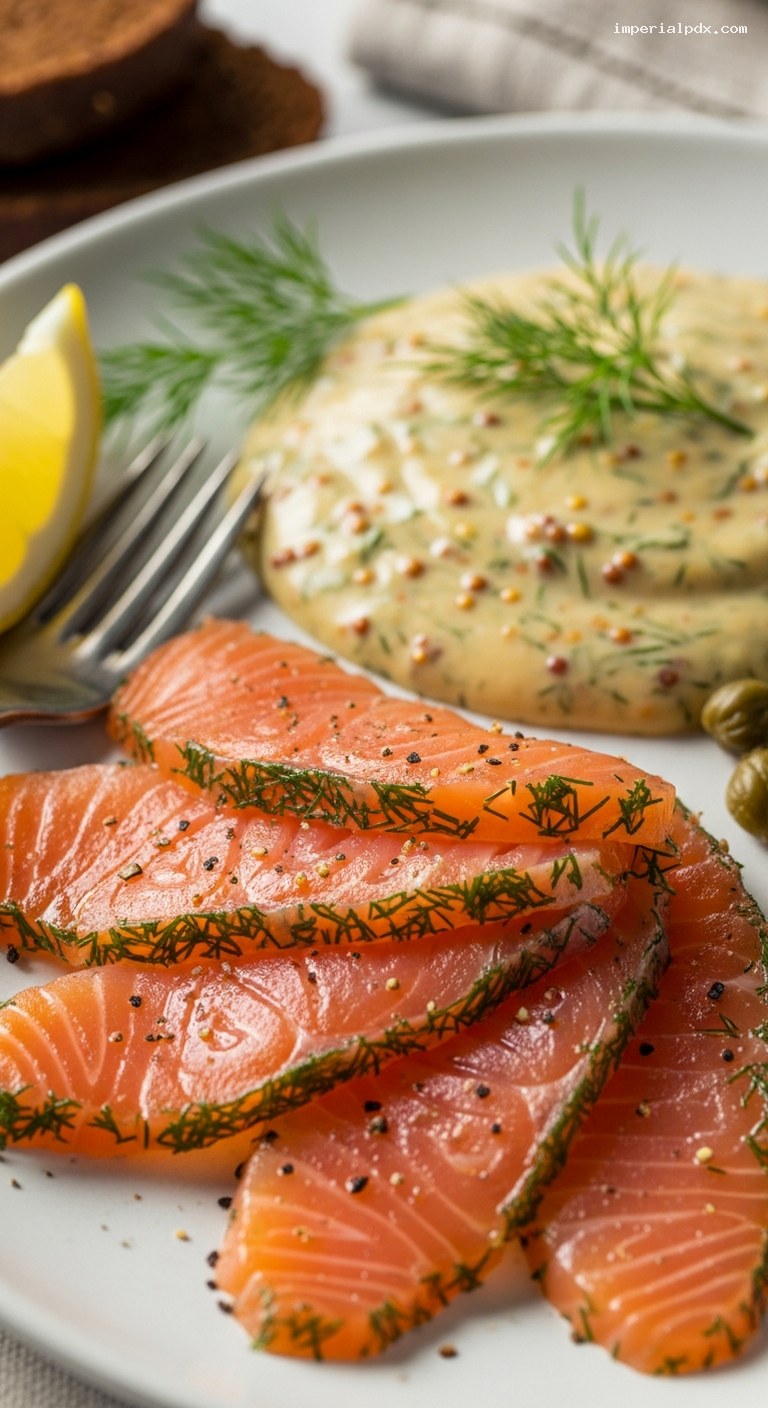
To slice, place the cured salmon skin-side down on a cutting board. Using a long, very sharp knife (a slicing or carving knife is ideal), start at the thinner tail end. Hold the blade at a shallow angle (about 15–20 degrees) to the surface of the fish and cut thin slices on the diagonal, working from the surface down towards the skin in long, smooth strokes. Aim for slices about 2–3 mm thick. Allow each slice to fall away from the skin and lay it on a platter in slightly overlapping layers.
Arrange the gravlax slices on a large serving platter. Garnish with additional fresh dill sprigs, a few capers, and thin slices of red onion if you like. Serve the mustard-dill sauce in a small bowl with a spoon. Offer rye bread (plain or lightly toasted), lemon wedges, and optional butter or cream cheese for spreading. To eat, pile a few slices of gravlax on rye, add a spoonful of mustard-dill sauce, a squeeze of lemon, and enjoy the silky, savory, slightly sweet salmon with its classic Nordic accompaniments.
Pro Tips
- Control the saltiness: For a milder cure, use slightly less salt (about 1/4 cup) and cure on the shorter side (24–30 hours). For a stronger, more traditional gravlax, keep the full salt amount and cure up to 48 hours.
- Use the right cut: A thick, center-cut fillet with the skin on cures more evenly and is much easier to slice thinly than a thin tail piece.
- Keep everything cold: Gravlax is a cured, not cooked, product. Keep the salmon refrigerated the entire time and do not leave it at room temperature for more than 2 hours when serving.
- Chill before slicing: For ultra-neat, translucent slices, place the cured salmon in the coldest part of your fridge for an hour, or briefly in the freezer for 10–15 minutes, before slicing.
- Ask your fishmonger: If possible, buy salmon labeled “sushi-grade” or ask your fishmonger for fish suitable for raw preparations; this gives you the best texture and safety for gravlax.
Variations
- Beet Gravlax: Add 1 medium raw beet, coarsely grated, to the curing mixture and pack it around the salmon. It will stain the outside a stunning deep magenta while leaving the center orange, creating a beautiful two-tone effect.
- Gin and Juniper Gravlax: Replace the orange zest with lime zest, increase the vodka/gin to 2 tbsp, and add 1 tbsp lightly crushed juniper berries to the cure. This leans into classic Scandinavian gin botanicals.
- Spiced Gravlax: Add 1–2 tsp crushed red pepper flakes or 1 tsp ground white pepper to the cure for a gentle heat, and stir a little extra whole-grain mustard and a pinch of chili into the sauce to match.
Storage & Make-Ahead
Gravlax is an ideal make-ahead dish. The whole cured fillet (unsliced) keeps well in the refrigerator for up to 5 days, tightly wrapped in plastic wrap and then in foil or a sealed container. Once you start slicing, try to keep the remaining chunk wrapped and chilled, and aim to finish it within 3 days for the best flavor and texture. The mustard-dill sauce can be made up to 3 days ahead and stored in an airtight container in the refrigerator; whisk briefly before serving if it has separated. For longer storage, you can wrap a piece of cured, unsliced salmon very tightly in plastic and then foil and freeze it for up to 1 month. Thaw overnight in the refrigerator before slicing. Always keep gravlax cold and discard any that develops an off smell or slimy texture.
Nutrition (per serving)
Approximate values per serving (1 of 8, including a modest amount of sauce but not including bread or butter): about 230 calories; 17 g protein; 16 g fat (3 g saturated); 4 g carbohydrates; 3 g sugars; 0 g fiber; approximately 1000–1200 mg sodium (gravlax is naturally quite salty). These numbers are estimates and will vary with exact curing time, salmon fattiness, and how much sauce you use.