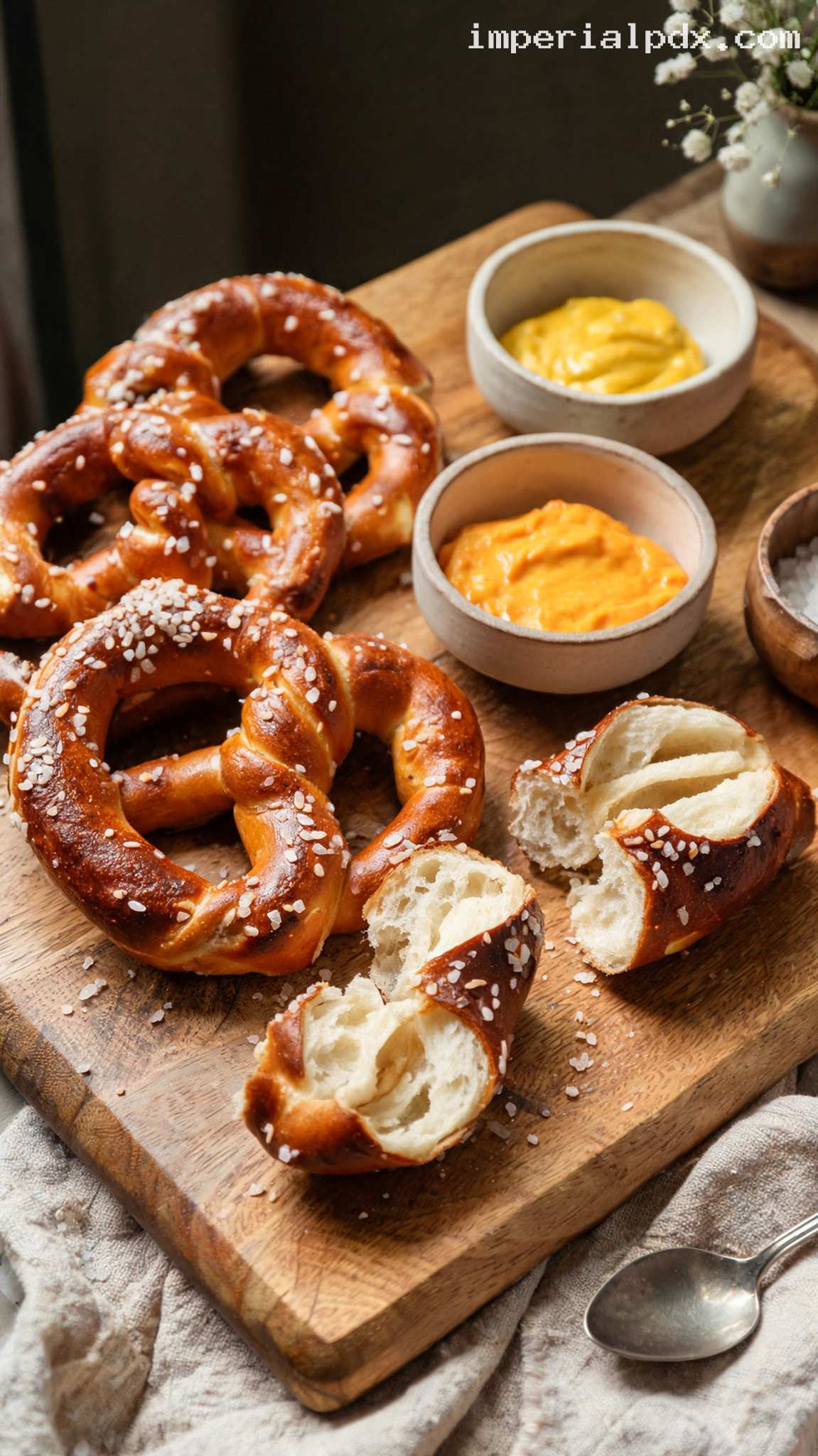
Quick Recipe Version (TL;DR)
Quick Ingredients
- Dough: 1 1/4 cups (300 ml) warm water, 2 1/4 teaspoons (7 g) active dry yeast, 1 tablespoon (13 g) granulated sugar, 4 cups (500 g) bread flour, 1 1/2 teaspoons (9 g) fine salt, and 2 tablespoons (28 g) unsalted butter, melted and cooled.
- For handling: Up to 2 tablespoons (16 g) additional bread flour for kneading and 1 teaspoon (5 ml) neutral oil for greasing the parchment.
- Baking-soda bath: 8 cups (1.9 liters) water and 1/3 cup (75 g) baking soda.
- Finish: 1 large egg beaten with 1 tablespoon (15 ml) water, plus 2 teaspoons (8 g) coarse pretzel salt.
- Serve with: 1/4 cup (60 ml) yellow mustard, or the optional cheese dip below.
- Optional cheese dip: 1/2 cup (120 ml) whole milk, 1 teaspoon (3 g) cornstarch, 1 cup (113 g) freshly shredded sharp cheddar, and 1 teaspoon (5 ml) yellow mustard.
Do This
- 1. Stir the warm water, yeast, and sugar together; let stand for 5 minutes. Mix in the flour, fine salt, and melted butter, then knead for 8 minutes.
- 2. Cover and let rise in a warm spot for 60 minutes, or until doubled.
- 3. Heat the oven to 425°F (220°C). Line two baking sheets with lightly oiled parchment. Dissolve the baking soda in the bath water and bring to a gentle boil.
- 4. Divide the dough into 8 pieces. Roll each into a 24-inch (61 cm) rope and form a traditional pretzel twist.
- 5. Dip each pretzel in the bath for 20 seconds, turning after 10 seconds. Drain and place on the prepared sheets.
- 6. Brush with egg wash, sprinkle with coarse salt, and bake for 16 minutes, rotating and swapping the sheets after 8 minutes.
- 7. Cool for 5 minutes, then serve warm with yellow mustard or creamy cheddar dip.
Why You’ll Love This Recipe
- Classic pretzel-shop texture: A deeply browned crust gives way to a soft, chewy center.
- No specialty equipment or lye: A simple baking-soda bath creates the distinctive pretzel flavor and color.
- Easy, satisfying shaping: A few twists turn a basic yeast dough into a Pennsylvania Dutch-style snack.
- Two delicious dipping options: Keep it classic with yellow mustard, or make a quick, creamy cheddar dip.
Grocery List
- Produce: None needed.
- Dairy: Unsalted butter; whole milk and sharp cheddar if making the optional cheese dip.
- Eggs: 1 large egg.
- Pantry: Bread flour, active dry yeast, granulated sugar, fine salt, baking soda, coarse pretzel salt, neutral oil, and yellow mustard; cornstarch if making the optional cheese dip.
Full Ingredients
For the Yeast Dough
- 1 1/4 cups (300 ml) water, warmed to 105–110°F (41–43°C)
- 2 1/4 teaspoons (7 g) active dry yeast, one standard packet
- 1 tablespoon (13 g) granulated sugar
- 4 cups (500 g) bread flour, plus up to 2 tablespoons (16 g) extra for kneading
- 1 1/2 teaspoons (9 g) fine salt
- 2 tablespoons (28 g) unsalted butter, melted and cooled until just warm
For the Baking-Soda Bath
- 8 cups (1.9 liters) water
- 1/3 cup (75 g) baking soda
For the Glossy, Salted Finish
- 1 teaspoon (5 ml) neutral oil, such as canola, for greasing the parchment
- 1 large egg
- 1 tablespoon (15 ml) water, for the egg wash
- 2 teaspoons (8 g) coarse pretzel salt, divided among the pretzels
For Serving
- 1/4 cup (60 ml) yellow mustard, optional
Optional Creamy Cheddar Dip
- 1/2 cup (120 ml) whole milk
- 1 teaspoon (3 g) cornstarch
- 1 cup (113 g) freshly shredded sharp cheddar cheese
- 1 teaspoon (5 ml) yellow mustard
The cheese dip makes approximately 3/4 cup. Prepare it while the pretzels bake; the listed recipe timing does not include separate preparation time for the optional dip.
Step-by-Step Instructions
Step 1: Wake up the yeast
Pour the warm water into a large mixing bowl or the bowl of a stand mixer. Stir in the yeast and sugar, then let the mixture stand for 5 minutes. It should develop a foamy layer on top. Keep the water between 105–110°F (41–43°C): comfortably warm, not hot.
If the mixture remains completely flat and the yeast does not appear active, start again with fresh yeast before adding the remaining ingredients.
Step 2: Mix and knead the dough
Add the 4 cups (500 g) bread flour, fine salt, and melted butter. Stir until a shaggy dough forms, then turn it onto a lightly floured work surface. Knead by hand for 8 minutes, folding the dough over itself and pushing it away with the heel of your hand. Alternatively, knead with a dough hook on low speed for 6 minutes.
The finished dough should feel smooth, supple, and slightly tacky, but should not stick heavily to your hands. If needed, add the extra flour 1 teaspoon at a time, using no more than 2 tablespoons (16 g). Avoid adding enough flour to make the dough stiff or dry.
Step 3: Let the dough rise
Shape the dough into a ball and return it to the bowl. Cover with a clean kitchen towel or reusable bowl cover. Let rise in a warm, draft-free spot, ideally 75–80°F (24–27°C), for 60 minutes, or until roughly doubled in size.
A cooler kitchen may require additional rising time. Judge the dough by its size and puffiness rather than the clock alone.
Step 4: Prepare the oven and baking-soda bath
Near the end of the rise, position oven racks in the upper and lower thirds of the oven and preheat to 425°F (220°C). Line two large baking sheets with parchment paper rated for this temperature. Brush the parchment with the 1 teaspoon neutral oil, dividing it between the sheets.
Pour 8 cups (1.9 liters) water into a wide, deep pot. Stir in the baking soda before heating, then bring the mixture to a gentle boil over medium-high heat. Reduce the heat as needed to maintain a steady, gentle boil rather than a vigorous bubbling boil. Use a pot with plenty of headroom to prevent splashes.
Step 5: Shape the traditional pretzel twists
Gently press down the risen dough to release excess air. Divide it into 8 equal pieces, approximately 106 g each. Keep the pieces covered while you work so they do not dry out.
Roll one piece into a 24-inch (61 cm) rope, leaving the middle slightly thicker than the ends. Arrange it in a wide U shape with the ends pointing away from you. Cross the two ends twice, then fold the twisted ends down toward the rounded bottom of the U. Press each tip firmly onto the bottom curve to secure it.
Repeat with the remaining dough. If a rope keeps shrinking back, cover it and let it rest for 5 minutes before continuing. Use very little flour on the shaping surface; a little friction helps the dough roll evenly.
Step 6: Give each pretzel its baking-soda dip
Carefully lower one pretzel at a time into the gently boiling bath using a wide slotted spatula. Dip for 20 seconds total, turning gently after 10 seconds. Keep the pretzel supported so its shape stays intact.
Lift it out, allow excess water to drain for about 5 seconds, and transfer it to a prepared baking sheet. Arrange 4 pretzels on each sheet, leaving at least 2 inches (5 cm) between them. Repeat with the remaining pretzels. This brief bath gives the crust its recognizable pretzel flavor and encourages deep browning; soaking longer can leave an unpleasant alkaline taste.
Step 7: Add the glossy finish and bake
Beat the egg with 1 tablespoon (15 ml) water until smooth. Brush a thin, even layer over the tops and sides of the dipped pretzels, avoiding puddles beneath them. Sprinkle each pretzel with 1/4 teaspoon of coarse pretzel salt, using the full 2 teaspoons across the batch.
Bake both sheets for 16 minutes. After 8 minutes, rotate each sheet front to back and swap their positions between the upper and lower racks. The finished pretzels should be deep golden brown to mahogany, with glossy tops and lightly browned bottoms. If needed, give a pale batch another 1–2 minutes, watching closely.
Step 8: Serve warm with your favorite dip
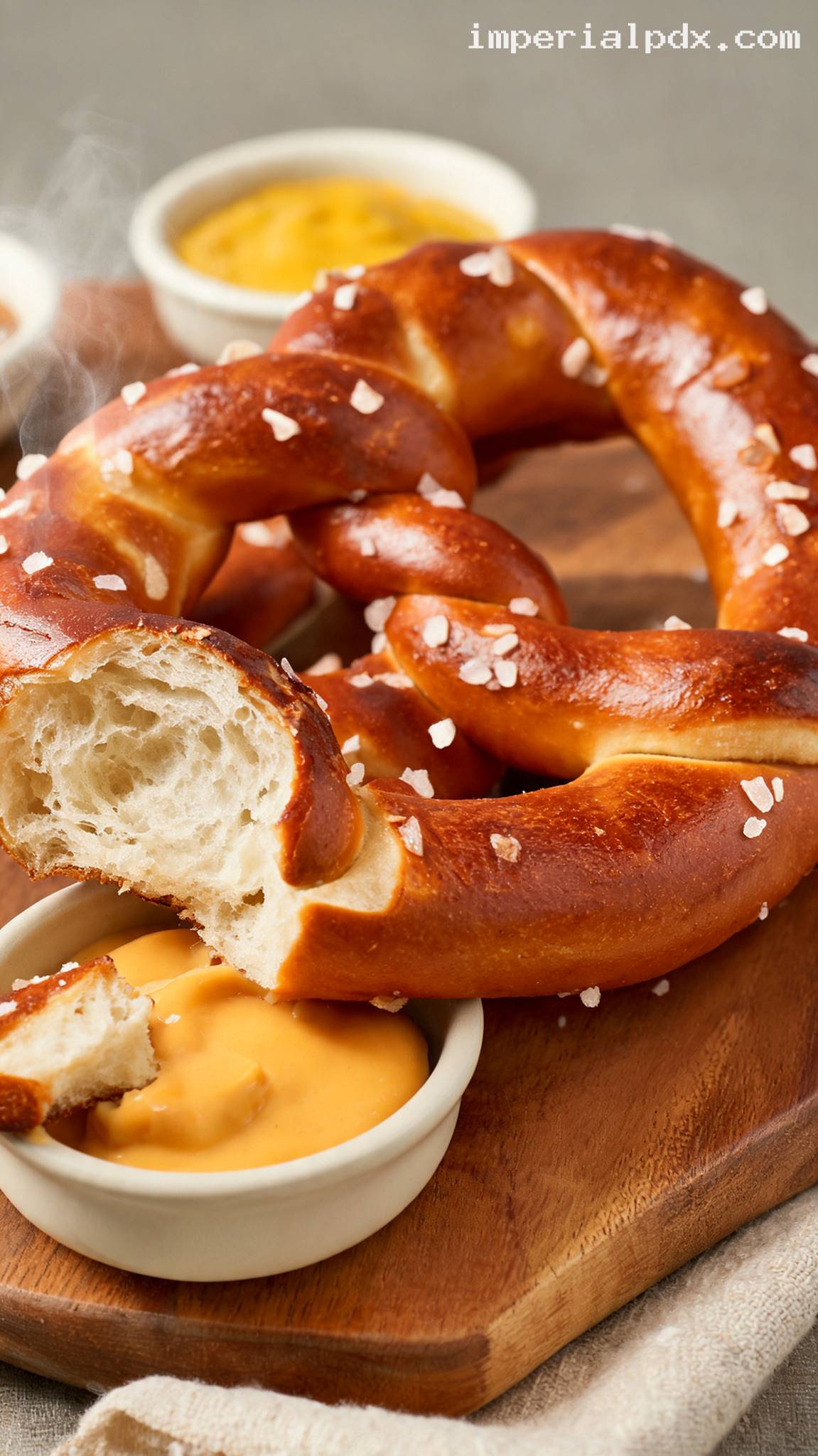
Transfer the pretzels to a wire rack and let them cool for 5 minutes. Serve while still warm with yellow mustard for a classic Pennsylvania Dutch-style snack.
For the optional cheese dip, whisk the cold milk and cornstarch together in a small saucepan. Heat over medium-low heat, whisking constantly, for 3–4 minutes, until the mixture lightly thickens and begins to steam. Remove from the heat and stir in the cheddar a handful at a time, followed by the mustard. Stir for 1 minute, until smooth. Do not boil after adding the cheese, which can make the dip grainy. Serve immediately in a small bowl alongside the pretzels.
Pro Tips
- Weigh the flour when possible: The 500 g measurement is the most reliable starting point. If using cups, spoon flour into the cup and level it rather than scooping and packing it.
- Choose bread flour for chew: Its higher protein content gives the pretzels a pleasantly chewy center while keeping them soft when served warm.
- Secure the ends: Press the dough tips firmly into the bottom curve so the twists stay together during dipping and baking.
- Use the right salt: Coarse pretzel salt stays visible on the crust. Coarse kosher salt also works; use 8 g by weight because crystal size changes teaspoon measurements.
- Keep the bath brief: More time in the baking-soda water does not mean a better crust. Stick to 20 seconds for balanced flavor and a tender exterior.
Variations
- Pretzel bites: Divide the dough into 8 ropes, each 16 inches (41 cm) long, then cut each rope into 8 pieces for 64 bites. Dip in small batches for 20 seconds, apply egg wash and salt, and bake at 425°F (220°C) for 12 minutes.
- Cinnamon-sugar pretzels: Omit the coarse salt but keep the egg wash. After baking, brush the warm pretzels with 2 tablespoons (28 g) melted unsalted butter and sprinkle with a mixture of 1/4 cup (50 g) granulated sugar and 1 teaspoon (3 g) ground cinnamon.
- Cheddar-topped pretzels: Reduce the coarse salt to 1 teaspoon (4 g). Bake the pretzels for 12 minutes, sprinkle with 1 cup (113 g) freshly shredded cheddar divided evenly over the tops, and bake for 4 more minutes.
Storage & Make-Ahead
Best fresh: These pretzels have the best contrast of glossy crust and chewy interior on the day they are baked. Cool completely before storing in an airtight container at room temperature for up to 1 day. Coarse salt may draw moisture from the crust during storage; if you plan to save some, bake those without salt and add a little after reheating.
Freeze: Wrap cooled pretzels individually and place in a freezer-safe bag for up to 2 months. Reheat thawed pretzels at 350°F (175°C) for 8 minutes, or frozen pretzels for 12 minutes, until warmed through. Lightly mist with water before reheating if they seem dry.
Make the dough ahead: After kneading, place the dough in a covered container with room to expand and refrigerate immediately for up to 24 hours instead of completing the room-temperature rise. The next day, let it stand at room temperature for approximately 60 minutes, until relaxed and puffy, then shape, dip, and bake. Allow extra time if the dough is still cold or has not expanded sufficiently.
Store the cheese dip: Refrigerate in a covered container for up to 3 days. Reheat gently over low heat, stirring in 1 tablespoon (15 ml) milk if needed to loosen it. Do not boil.
Nutrition (per serving)
Calories: 270 kcal | Carbs: 48g | Protein: 9g | Fat: 4g | Saturated Fat: 2g | Fiber: 2g | Sugar: 2g | Sodium: 1050mg | Cholesterol: 31mg
Estimated for 1 of 8 pretzels, including egg wash and coarse salt but excluding mustard, cheese dip, and variations. Sodium varies with the salt used and the amount of baking-soda bath retained.