Quick Recipe Version (TL;DR)
Quick Ingredients
- 2 large eggs, 75 g sugar, 40 g flour, 15 g cocoa, 15 g melted butter (biscuit base)
- 225 g dark chocolate (60–70%), 360 ml heavy cream, 3 egg yolks, 75 g sugar, 3 tbsp water/espresso, 8 g powdered gelatin + 3 tbsp cold water, 1 tsp vanilla, pinch salt (mousse)
- 150 g sugar, 80 ml water, 200 g sweetened condensed milk, 60 g cocoa powder, 150 g dark chocolate, 10 g powdered gelatin + 60 ml cold water (mirror glaze)
- Fresh berries, chocolate curls/shavings, cocoa nibs, mint leaves (garnish, optional)
Do This
- 1. Line a 20 cm / 8 in springform or ring with parchment. Make a thin chocolate sponge: whip eggs and sugar until thick, fold in sifted flour and cocoa, then butter. Bake at 180°C / 350°F for 10–12 minutes and cool.
- 2. For the mousse, bloom gelatin. Melt chocolate with some cream and cool to lukewarm. Cook yolks, sugar, and water/espresso over a bain-marie until thick and 71°C / 160°F, then whisk in gelatin.
- 3. Combine the warm yolk mixture with melted chocolate. Whip remaining cream to soft peaks and gently fold into the chocolate base to make an airy mousse.
- 4. Place the biscuit in the ring, pour mousse on top, smooth, and chill 1 hour. Then freeze 3–4 hours (or until very firm) to prepare for glazing.
- 5. For the mirror glaze, bloom gelatin. Simmer sugar and water, whisk in cocoa and condensed milk, then add gelatin and pour over chocolate. Blend, strain, and cool to 32–35°C / 90–95°F.
- 6. Unmold the frozen cake, set on a rack or bowl, and pour glaze in one smooth motion. Let drip, transfer to a platter, garnish, and chill 30–60 minutes before slicing.
Why You’ll Love This Recipe
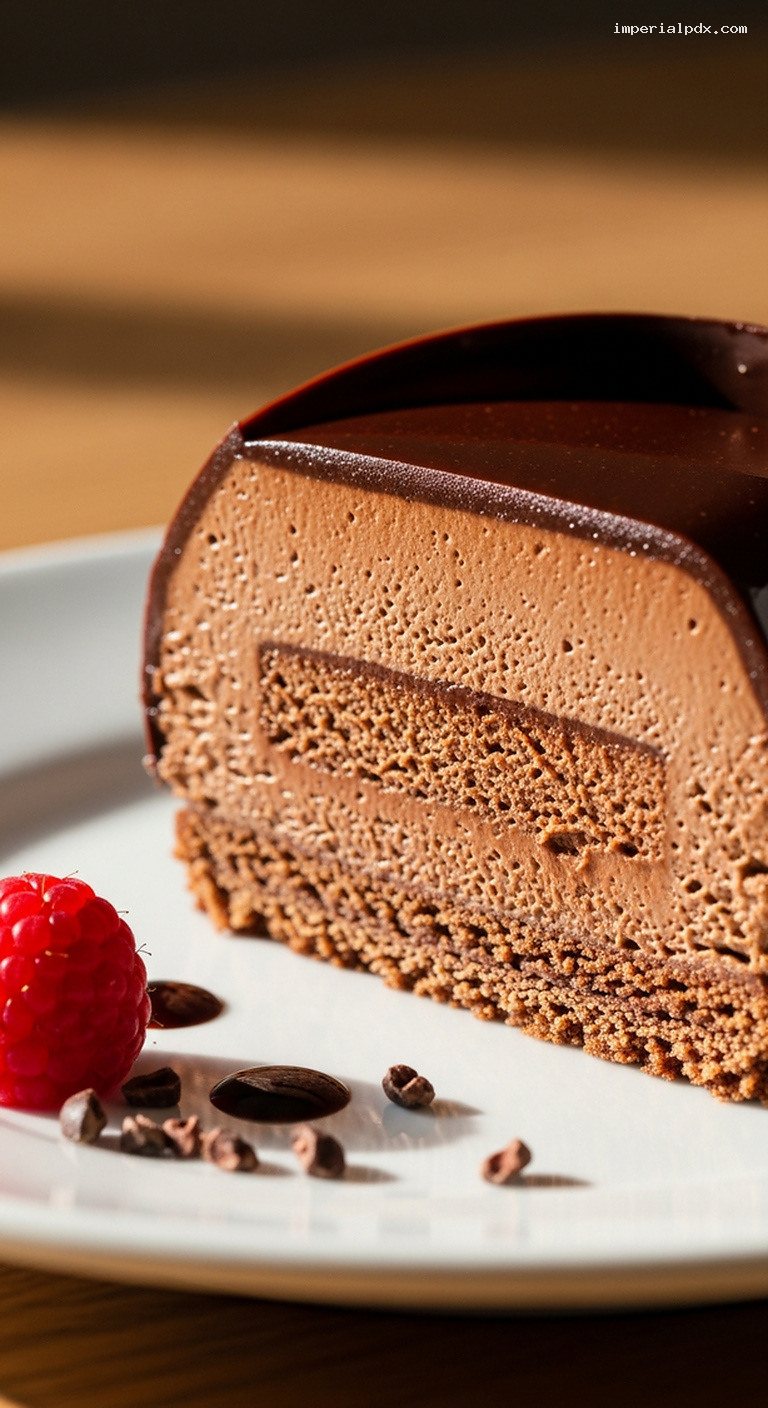
- Layers of texture: a delicate, thin chocolate biscuit base under a cloud-like dark chocolate mousse.
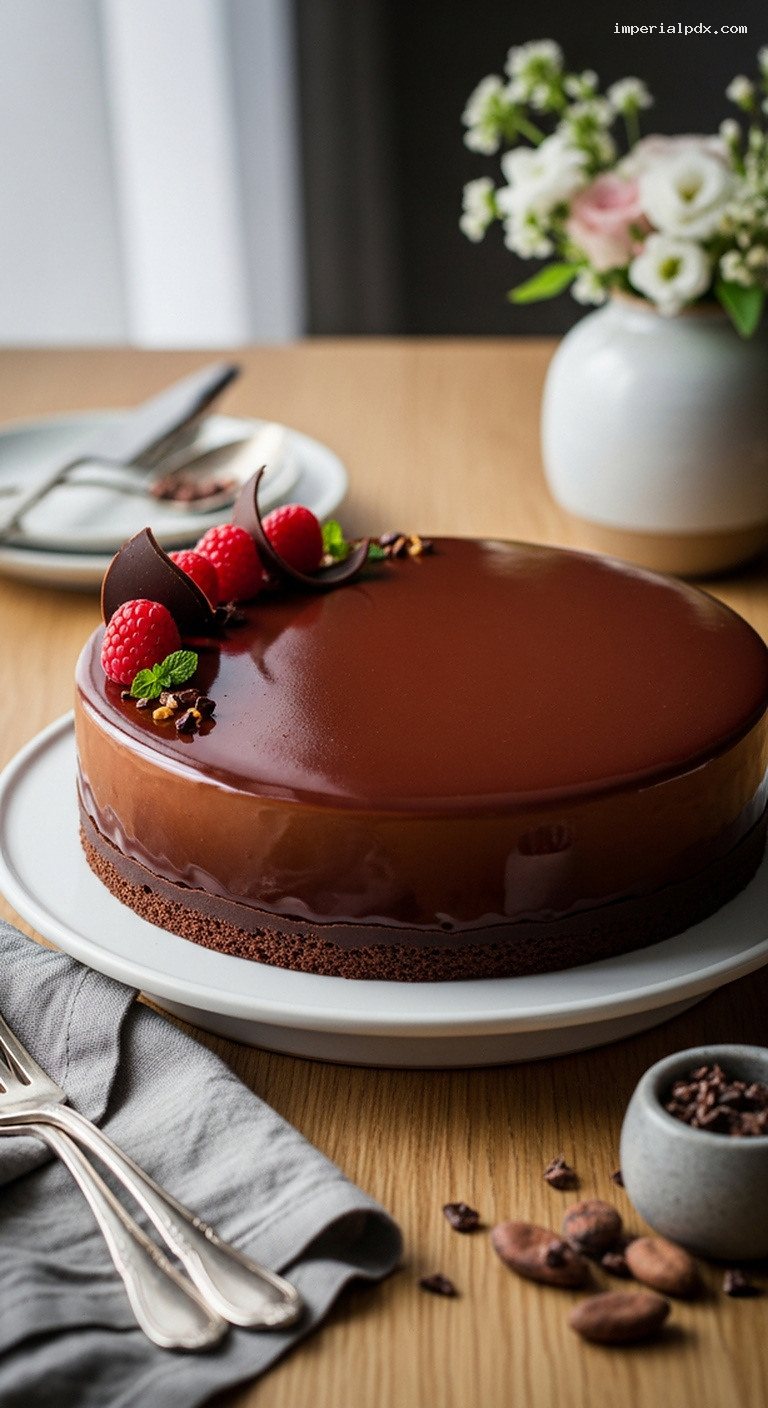
- A luxurious, ultra-glossy chocolate mirror glaze that looks bakery-perfect yet is achievable at home.
- Rich chocolate flavor that is still light enough to enjoy after a meal.
- Excellent for making ahead: assemble and freeze, then glaze on the day you plan to serve.
Grocery List
- Produce: Fresh raspberries or strawberries (for garnish), fresh mint (optional)
- Dairy: Heavy cream (whipping cream, 35%+ fat), unsalted butter, sweetened condensed milk
- Pantry: Dark chocolate (60–70%), granulated sugar, all-purpose flour, unsweetened cocoa powder, vanilla extract, powdered gelatin, espresso powder or coffee (optional), salt, parchment paper
Full Ingredients
Thin Chocolate Biscuit Base
- 2 large eggs, room temperature
- 75 g granulated sugar (about 1/3 cup + 1 tablespoon)
- 1 tsp pure vanilla extract
- 40 g all-purpose flour (about 1/3 cup, spooned and leveled)
- 15 g unsweetened cocoa powder (about 2 tablespoons), sifted
- 1 small pinch fine salt
- 15 g unsalted butter (1 tablespoon), melted and cooled slightly
Light Dark Chocolate Mousse
- 8 g powdered gelatin (about 2 1/2 teaspoons)
- 45 ml cold water (3 tablespoons) for blooming the gelatin
- 225 g dark chocolate (60–70% cocoa), finely chopped (about 8 oz)
- 360 ml heavy cream, divided (1 1/2 cups total)
- 3 large egg yolks
- 75 g granulated sugar (6 tablespoons)
- 45 ml water or strong espresso (3 tablespoons)
- 1 tsp pure vanilla extract
- 1 small pinch fine salt
Chocolate Mirror Glaze
- 10 g powdered gelatin (about 1 tablespoon)
- 60 ml cold water (1/4 cup) for blooming the gelatin
- 150 g granulated sugar (3/4 cup)
- 80 ml water (1/3 cup) for the syrup
- 200 g sweetened condensed milk (about 2/3 of a standard 300 g can; 3/4 cup)
- 60 g unsweetened cocoa powder (about 2/3 cup), sifted
- 150 g dark chocolate (about 5.3 oz), finely chopped or in callets
To Assemble & Garnish
- One 20 cm / 8 in round springform pan or pastry ring
- Acetate cake strip for the sides (optional but helpful for a smooth edge)
- Fresh raspberries or strawberries, for garnish
- Dark chocolate curls or shavings, cocoa nibs, or edible gold leaf (optional)
- Fresh mint leaves (optional)
Step-by-Step Instructions
Step 1: Prepare the pan and preheat the oven
Lightly grease the base of a 20 cm / 8 in springform pan (or set a 20 cm / 8 in pastry ring on a baking sheet). Line the bottom with a circle of parchment paper. If using a ring, also line the outside with foil so batter cannot escape. Preheat your oven to 180°C / 350°F, with a rack in the middle position. Make sure your eggs for the biscuit and mousse are at room temperature and your butter is melted and cooled slightly.
Step 2: Make the thin chocolate biscuit base
In a medium mixing bowl, whisk the eggs, sugar, and vanilla vigorously with a hand mixer (or stand mixer with whisk attachment) on high speed for 5–7 minutes, until the mixture is very pale, thick, and has tripled in volume. It should fall from the whisk in a thick ribbon.
In a separate bowl, sift together the flour, cocoa powder, and salt. Sift this mixture again directly over the whipped eggs. Using a large spatula, gently fold the dry ingredients into the egg mixture in three additions, turning the bowl as you go, until no dry pockets remain. Be gentle so you do not knock out too much air.
Drizzle the melted, cooled butter around the edge of the batter and fold it in just until incorporated. Immediately pour the batter into the prepared pan and spread it into an even, thin layer. Bake for 10–12 minutes, until the sponge springs back lightly when touched and a toothpick comes out clean.
Let the biscuit cool completely in the pan on a rack. Once cool, if the sponge has domed slightly, gently press it flat with your hand or trim the very top so you have an even, thin base.
Step 3: Make the light dark chocolate mousse
First, bloom the gelatin: in a small bowl, sprinkle the 8 g powdered gelatin over 45 ml (3 tablespoons) cold water. Stir just to moisten all the granules, then let sit for at least 5 minutes to absorb.
Place the chopped 225 g dark chocolate in a heatproof bowl. In a small saucepan, heat 120 ml (1/2 cup) of the heavy cream just to a simmer (small bubbles around the edges). Pour the hot cream over the chocolate, let sit for 1–2 minutes, then stir from the center outward until smooth and glossy. Set aside to cool to lukewarm (about 35–38°C / 95–100°F); it should feel warm but not hot to the touch.
In a separate heatproof bowl, whisk together the egg yolks, 75 g sugar, and 45 ml water or espresso. Set the bowl over a saucepan of gently simmering water (bain-marie), making sure the bottom of the bowl does not touch the water. Whisk constantly for 6–8 minutes, until the mixture is thick, pale, and reaches at least 71°C / 160°F (this cooks the yolks). Remove from the heat. Immediately add the bloomed gelatin (it will be a soft gel) to the warm yolk mixture and whisk until completely dissolved. Stir in the vanilla and a small pinch of salt.
Pour the warm yolk-gelatin mixture into the lukewarm chocolate ganache in 2–3 additions, whisking gently until smooth and fully combined. Let this chocolate base cool until just slightly warm to the touch (around 30–32°C / 86–90°F), stirring occasionally so it does not set.
In a cold bowl, whip the remaining 240 ml (1 cup) heavy cream to soft peaks (the cream should hold its shape but the peaks should gently flop over). Do not overwhip. Fold one-third of the whipped cream into the chocolate base to lighten it, then gently fold in the remaining cream in two additions until the mousse is smooth and airy with no streaks.
Step 4: Assemble the mousse cake and chill
If you have an acetate strip, line the inside wall of the springform pan with it to get very smooth sides. Make sure the cooled biscuit base is sitting flat at the bottom of the pan; if using a loose ring, keep it on a flat tray lined with parchment.
Pour the chocolate mousse over the biscuit base. Use an offset spatula to spread it evenly and smooth the surface. Gently tap the pan on the counter a few times to release any large air bubbles.
Refrigerate for 1 hour to allow the mousse to begin setting. Then transfer the pan to the freezer and freeze for at least 3–4 hours, or until the mousse cake is very firm. For the cleanest glazing and slicing, it can even be frozen overnight. The cake should be frozen solid or nearly so before you pour on the mirror glaze.
Step 5: Prepare the chocolate mirror glaze
Bloom the gelatin: in a small bowl, sprinkle the 10 g powdered gelatin over 60 ml (1/4 cup) cold water. Stir lightly and let stand for at least 5 minutes.
In a medium saucepan, combine the 150 g sugar and 80 ml water. Heat over medium heat, stirring just until the sugar dissolves. Bring to a gentle simmer. Reduce the heat to low and whisk in the sifted 60 g cocoa powder until smooth and glossy. Add the 200 g sweetened condensed milk and whisk until fully combined and hot but not boiling.
Remove the pan from the heat and add the bloomed gelatin, stirring until completely dissolved. Place the chopped 150 g dark chocolate in a large heatproof jug or bowl. Pour the hot cocoa-condensed milk mixture over the chocolate. Let sit without stirring for 1–2 minutes, then gently whisk or use an immersion blender to emulsify until perfectly smooth and shiny.
If using an immersion blender, keep the head fully submerged and tilted slightly to avoid incorporating air bubbles. Strain the glaze through a fine-mesh sieve into a clean jug. Let it cool, stirring occasionally, until it reaches 32–35°C / 90–95°F. At this temperature it will be fluid and glossy but thick enough to cling beautifully to the cake.
Step 6: Unmold and glaze the frozen cake
When the glaze is at the right temperature and the mousse cake is very firm, remove the cake from the freezer. Release the springform ring or lift off the pastry ring. If using acetate, peel it away carefully to reveal smooth sides.
Set the frozen cake on a small bowl or can placed on a rimmed baking sheet, so that any excess glaze can drip off. Make sure the top is level. Give the glaze a final gentle stir to remove any skin.
Starting in the center of the cake, pour the glaze in a steady, confident stream, working outward in circles so it flows over the edges and covers the sides completely. Do not spread it; let gravity create a smooth finish. If there are any small bare spots on the sides, you can lightly nudge glaze with a spatula, but avoid overworking.
Let the cake sit for 5–10 minutes, until the dripping slows and the glaze has set enough that it no longer runs. Using a long offset spatula, carefully scrape the excess glaze from the underside of the cake, then transfer the cake to a serving platter. Refrigerate for at least 30–60 minutes to allow the center to soften slightly before serving.
Step 7: Garnish, slice, and serve
Just before serving, decorate the top of the cake as simply or lavishly as you like. A minimalist approach works beautifully: arrange a small cluster of fresh raspberries or sliced strawberries slightly off-center, add a few chocolate curls or shavings, and tuck in a mint leaf or two for color. You can also sprinkle a few cocoa nibs along one edge for a modern look.
For the cleanest slices, dip a large, sharp knife into very hot water, wipe dry, and cut straight down through the cake, cleaning and warming the knife between each cut. Let slices sit at room temperature for about 10–15 minutes for the mousse to reach its ideal silky, airy texture. Serve and enjoy the contrast of the delicate biscuit base, cloud-like mousse, and shining chocolate shell.
Pro Tips
- Use good chocolate: Because the flavor is all about the chocolate, choose a smooth, not overly bitter dark chocolate in the 60–70% range.
- Mind the temperatures: The chocolate base for the mousse should be lukewarm (not hot) before you add whipped cream, and the mirror glaze should be around 32–35°C / 90–95°F before pouring for the best shine and coverage.
- Do not overwhip the cream: Soft peaks are key. Overwhipped cream will be grainy and harder to fold in, making the mousse dense instead of airy.
- Keep air bubbles out of the glaze: Blend the glaze with an immersion blender held at a slight angle and fully submerged. Strain it and, if you see bubbles on top, gently skim them with a spoon before pouring.
- Freeze firmly before glazing: A very cold, firm mousse cake gives you the smoothest, most mirror-like finish and sharp edges.
Variations
- Orange-chocolate délice: Add the finely grated zest of 1 orange to the mousse along with the vanilla, and replace the 45 ml water in the yolk mixture with orange juice. You can also brush the biscuit base lightly with orange liqueur (such as Grand Marnier) before adding the mousse.
- Mocha délice: Use strong espresso instead of water in the mousse yolk mixture and add 1–2 teaspoons instant espresso powder to the biscuit base for a deep coffee note. Garnish with chocolate-covered coffee beans.
- Hazelnut twist: Replace half of the flour in the biscuit base with finely ground hazelnuts, and spread a very thin layer of hazelnut praline paste or smooth hazelnut spread over the cooled biscuit before adding the mousse.
Storage & Make-Ahead
This dessert is ideal for making ahead. Once the mousse cake has frozen solid (before glazing), you can wrap it well in plastic wrap and then foil and freeze for up to 1 month. When ready to serve, unwrap, glaze the frozen cake as directed, and refrigerate until the center is soft enough to slice.
A fully glazed délice au chocolat will keep, covered, in the refrigerator for up to 3 days. The glaze may lose a little of its ultra-fresh shine over time but will still look and taste excellent. For the best texture, remove from the refrigerator about 20 minutes before serving so the mousse softens slightly. Avoid freezing the cake once it has been glazed, as this can dull the mirror finish and affect the texture.
Nutrition (per serving)
Approximate values per serving (1/10 of the cake): about 520 calories, 36 g fat (22 g saturated), 45 g carbohydrates (about 32 g sugars), 7 g protein, 2 g fiber, and 160 mg sodium. These numbers are estimates and will vary based on exact ingredients and portion sizes.