Quick Recipe Version (TL;DR)
Quick Ingredients
- 1 skin-on pork belly, 4–4.5 lb (1.8–2 kg), boneless
- 1 boneless pork loin, 2.5–3 lb (1.1–1.4 kg)
- 3 tbsp fennel seeds, toasted and crushed
- 2 tbsp kosher salt (plus 1 tsp for skin)
- 2 tsp black pepper
- 8 cloves garlic, minced
- 2 tbsp finely chopped fresh rosemary
- 2 tbsp finely chopped fresh sage (optional but traditional)
- Zest of 2 lemons
- 1 tsp–1 tbsp red pepper flakes (to taste)
- 2–3 tbsp extra-virgin olive oil (plus extra for skin)
- 1–2 tsp baking powder (optional, for extra-crisp skin)
- 2 onions and 2 carrots, sliced (for roasting bed)
- 1 cup (240 ml) dry white wine or water
Do This
- 1. Pat pork belly and loin dry. Score belly skin in a crosshatch pattern, taking care not to cut into the meat.
- 2. Mix fennel, salt, pepper, garlic, rosemary, sage, lemon zest, red pepper flakes, and olive oil into a paste.
- 3. Flip belly skin-side down. Spread seasoning paste over belly and loin. Place loin along one edge and roll belly tightly around it.
- 4. Tie roast with kitchen twine every 1–1.5 inches. Dry the skin well, rub with salt and (optional) baking powder. Chill uncovered 12–24 hours.
- 5. Bring to room temperature. Place on onions and carrots in a roasting pan with wine or water. Roast at 300°F (150°C) for 2.5–3 hours until internal temp is 145–150°F (63–66°C).
- 6. Increase oven to 450–475°F (230–245°C) for 15–20 minutes to blister the skin. Rest 20–30 minutes, then slice thinly for sandwiches or a serving board.
Why You’ll Love This Recipe
- Classic Italian-inspired porchetta flavor at home: fragrant fennel, garlic, rosemary, and lemon in every bite.
- Impressive centerpiece that is surprisingly do-able with basic kitchen tools and some simple tying.
- Ultra-crispy crackling on the outside, juicy pork belly and tender loin on the inside.
- Perfect for entertaining: slice thin for sandwiches, a grazing board, or serve hot as a roast dinner.
Grocery List
- Produce: Garlic, fresh rosemary, fresh sage (optional), lemons, onions, carrots, fresh parsley or arugula (optional for serving).
- Dairy: None required (unless serving with buttered rolls or cheese on the side).
- Pantry: Pork belly, pork loin, fennel seeds, kosher salt, black pepper, red pepper flakes, extra-virgin olive oil, baking powder (optional), dry white wine or chicken broth, crusty bread or rolls, mustard, pickles or pickled onions.
Full Ingredients
Porchetta-Style Rolled Roast
- 1 skin-on pork belly, boneless, about 4–4.5 lb (1.8–2 kg), trimmed into a fairly even rectangle
- 1 center-cut boneless pork loin, about 2.5–3 lb (1.1–1.4 kg), length roughly matching the short side of the belly
Herb & Fennel Seasoning Paste
- 3 tbsp fennel seeds
- 2 tbsp kosher salt (Diamond Crystal; if using Morton, use 1 tbsp + 2 tsp)
- 2 tsp freshly ground black pepper
- 1–2 tsp red pepper flakes (for mild–medium heat; up to 1 tbsp for spicy)
- 8 cloves garlic, very finely minced or grated
- 2 tbsp finely chopped fresh rosemary leaves
- 2 tbsp finely chopped fresh sage leaves (traditional but optional)
- 1 tbsp finely chopped fresh thyme leaves or 1 tsp dried thyme
- Zest of 2 lemons (about 2 tbsp, finely grated)
- 2–3 tbsp extra-virgin olive oil (enough to form a spreadable paste)
For the Skin and Roasting Pan
- 1–2 tsp baking powder (optional, helps super-crisp skin)
- 1 tsp kosher salt (for rubbing on skin, plus extra to taste)
- 1–2 tbsp extra-virgin olive oil (for rubbing on skin)
- 2 medium onions, peeled and thickly sliced into rounds
- 2 medium carrots, scrubbed and cut into large chunks
- 1 cup (240 ml) dry white wine, chicken broth, or water
To Serve (Optional but Recommended)
- Crusty ciabatta rolls or baguette, sliced
- Arugula or other peppery greens
- Whole-grain or Dijon mustard
- Pickled red onions or other pickles
- Fresh chopped parsley or extra rosemary for garnish
Step-by-Step Instructions
Step 1: Prep and Score the Pork Belly
Pat the pork belly and pork loin very dry with paper towels. This is important for both good browning and crisp skin later.
Place the pork belly skin-side up on a large cutting board. Using a very sharp knife or a clean utility razor, lightly score the skin in a crosshatch or parallel lines about 1 cm (1/4–1/2 inch) apart. Cut just through the skin and the thick surface fat, but stop before you reach the meat. Take your time; do not pierce all the way into the flesh or juices will escape and the roll will be harder to form.
If needed, trim the pork belly into a mostly even rectangle and trim any excessively thick or ragged edges of fat. The pork loin should be roughly the length of the short side of the belly so it can be rolled neatly inside.
Step 2: Toast Fennel Seeds and Make the Seasoning Paste
Place the fennel seeds in a small dry skillet over medium heat. Toast, shaking the pan frequently, for 2–3 minutes until fragrant and just starting to darken slightly. Immediately transfer to a plate to cool so they do not burn.
Once cool, crush the fennel seeds in a mortar and pestle or spice grinder until coarsely ground. In a medium bowl, combine the crushed fennel, kosher salt, black pepper, red pepper flakes, garlic, rosemary, sage, thyme, lemon zest, and 2 tbsp olive oil. Mix into a thick, spreadable paste. If it seems too dry, add up to 1 more tablespoon of olive oil.
Step 3: Season the Meat and Roll
Flip the pork belly so it is skin-side down. Use a knife to lightly score the meat side in a crosshatch pattern, about 1 cm (1/4–1/2 inch) deep. This helps the seasoning penetrate.
Spread all of the seasoning paste evenly over the meat side of the belly, pressing it into the cuts and all the way to the edges. Pat the pork loin dry and season lightly with salt and pepper. Place the loin along one short edge of the belly so that when you roll, the belly will wrap completely around it.
Starting from the side where the loin is sitting, roll the pork belly tightly around the loin into a firm cylinder, keeping the skin on the outside. Try to keep the roll even so it cooks uniformly.
Step 4: Tie the Roast and Dry the Skin
Cut several lengths of kitchen twine. Tie the rolled roast firmly at 1–1.5 inch (2.5–4 cm) intervals along its length. Each tie should be snug enough to hold the shape without cutting into the meat. This step is key for a tight spiral when you slice.
Once tied, pat the skin dry again with paper towels, getting into the scored grooves. Mix 1 tsp kosher salt with the baking powder (if using). Rub this mixture all over the skin, working it gently into the scores. Then rub 1–2 tbsp olive oil over the skin to lightly coat it.
Place the tied roast on a rack set over a rimmed baking sheet or in a roasting pan, skin-side up. Refrigerate uncovered for at least 12 hours, and up to 24–36 hours. This air-drying step is essential for blistered, glassy crackling.
Step 5: Bring to Room Temperature and Prepare the Roasting Pan
About 60–90 minutes before you plan to roast, take the pork out of the refrigerator so it can lose its chill. Leaving it too cold in the center can lead to uneven cooking.
Preheat your oven to 300°F (150°C) with a rack in the lower-middle position.
Scatter the onion slices and carrot chunks in the bottom of a large roasting pan to form a bed. Pour in the white wine, broth, or water. Place the porchetta on top of the vegetables, skin-side up. If you have a roasting rack that fits inside the pan, you can place the roast on the rack over the vegetables.
Step 6: Slow-Roast Until Tender and Juicy
Roast at 300°F (150°C) for 2.5–3 hours, basting with the pan juices once or twice if you like. The exact time will depend on the thickness of your roast and your oven.
Begin checking the internal temperature after about 2 hours. Insert an instant-read thermometer into the center of the pork loin (not touching the pan or twine). You are aiming for 145–150°F (63–66°C) for tender, juicy meat that slices well. If it is not there yet, keep roasting and check every 20–30 minutes.
If the pan seems dry at any point, add a splash more wine or water to prevent burning.
Step 7: Blast for Crackling Skin
Once the internal temperature is 145–150°F (63–66°C), increase the oven temperature to 450–475°F (230–245°C). If there is a lot of liquid in the pan, you can pour some off into a measuring cup to use later as a jus, leaving just enough to cover the vegetables.
Roast for 15–20 minutes more, watching closely. The skin should puff, blister, and turn deep golden-brown. Rotate the pan if needed for even browning. If any spots start to get too dark, you can tent just that area loosely with a small piece of foil.
When the skin is crisp all over and firmly crackling when tapped with a spoon, remove the pan from the oven.
Step 8: Rest, Slice, and Serve
Transfer the porchetta to a cutting board and let it rest, uncovered, for 20–30 minutes. This rest allows the juices to redistribute so the slices stay moist.
Meanwhile, if desired, strain the pan juices through a fine-mesh sieve into a small saucepan, pressing on the vegetables to extract flavor. Skim off excess fat and simmer briefly to reduce and concentrate, tasting and seasoning with a bit of salt or a squeeze of lemon if needed.
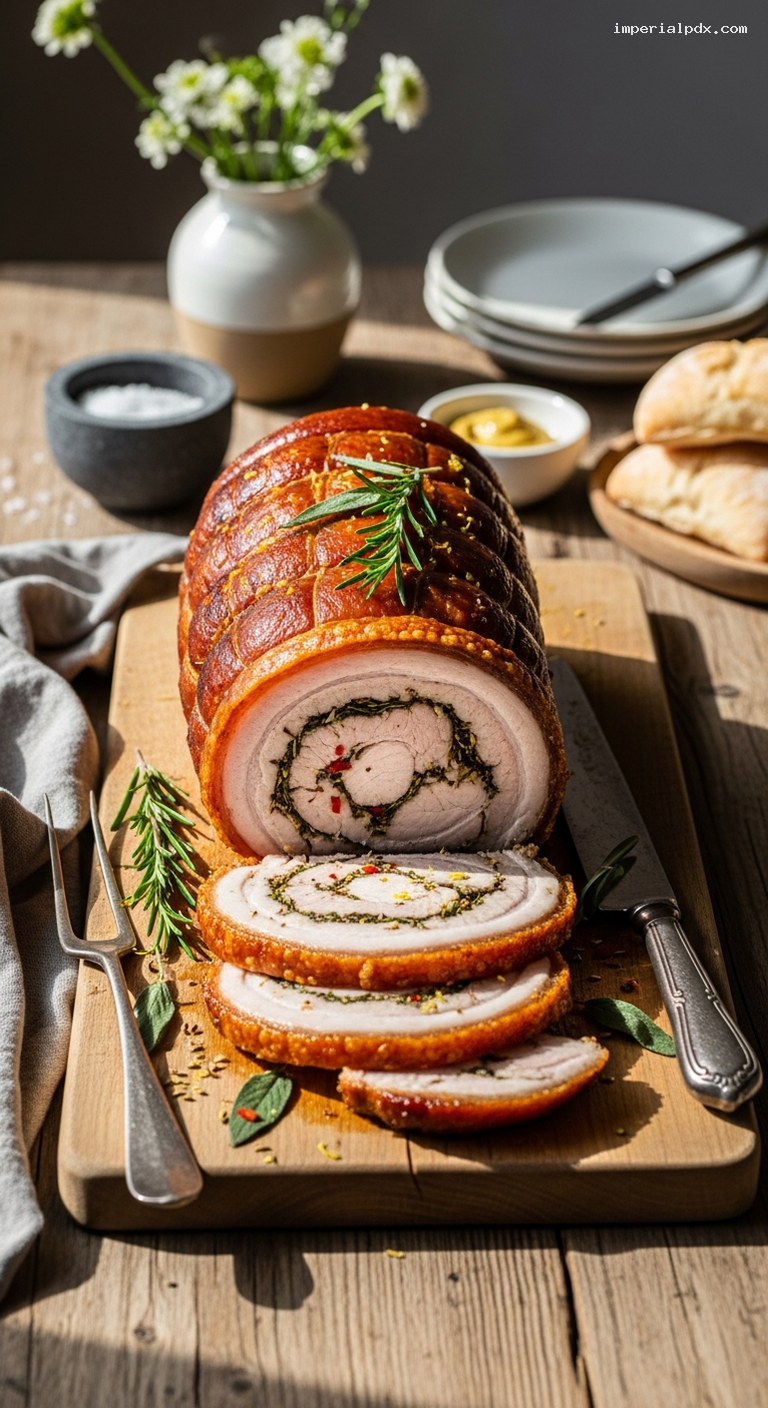
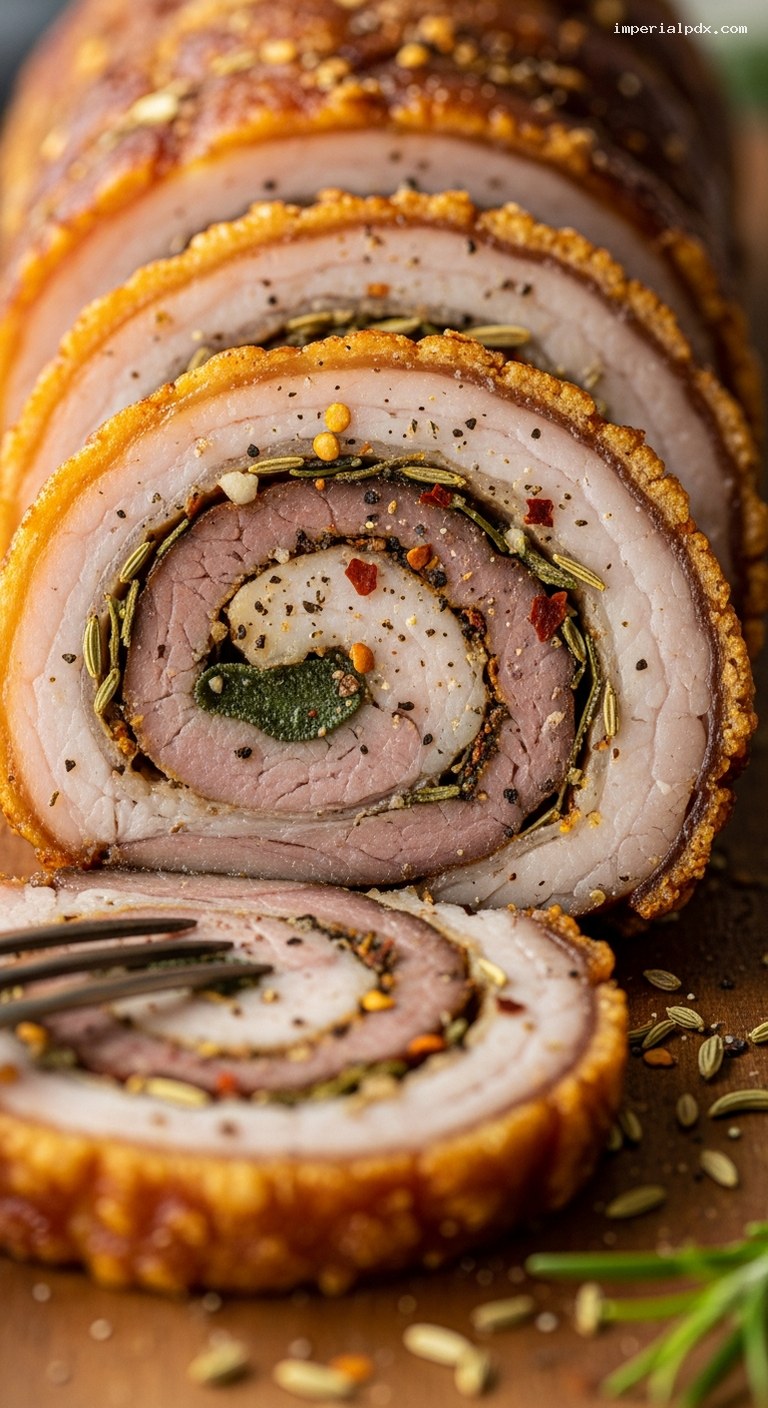
To serve, use a sharp serrated or carving knife to slice the porchetta crosswise into thin slices (about 1/4 inch / 6 mm thick) so you see the beautiful spiral of belly and loin. Serve on a platter or board with the jus on the side, or pile into crusty rolls with arugula, mustard, and pickles for sandwiches.
Pro Tips
- Dry the skin thoroughly: Moisture is the enemy of crackling. Pat the skin dry at each stage, and do not skip the uncovered fridge time.
- Use a sharp blade for scoring: A razor or very sharp paring knife gives clean cuts through the skin without tearing or cutting into the meat.
- Tie it tightly: Even spacing and firm twine ties give a neat cylinder and tight spiral when slicing, which looks impressive on a serving board.
- Let the thermometer guide you: Ovens vary. Use an instant-read thermometer to avoid overcooking the lean loin in the center.
- Rest before slicing: The 20–30 minute rest is crucial for juicy slices and easier cutting; the roast will stay hot inside.
Variations
- Citrus-herb porchetta: Add orange zest along with the lemon zest, and increase the fresh herbs (rosemary, sage, thyme) for a brighter, more aromatic flavor.
- Garlic and chili lovers’ version: Double the garlic and use a full tablespoon of red pepper flakes for a bold, spicy profile reminiscent of Calabrian flavors.
- Herb-only, no heat: Skip the red pepper flakes entirely and add extra rosemary and sage for a more delicate, kid-friendly herb-roasted version.
Storage & Make-Ahead
This porchetta is perfect for planning ahead. You can assemble, season, roll, and tie the roast up to 24–36 hours before cooking. Keep it uncovered in the refrigerator to dry the skin and deepen the flavor. After roasting and cooling, store leftovers tightly wrapped or in an airtight container in the refrigerator for up to 4 days.
To reheat slices, place them in a single layer on a baking sheet and warm in a 325°F (165°C) oven for 10–15 minutes, or until heated through. For extra-crisp edges, finish under the broiler for 1–2 minutes, watching closely. Slices are also excellent served cold or at room temperature for sandwiches and charcuterie boards.
For longer storage, you can freeze tightly wrapped slices for up to 2 months. Thaw overnight in the refrigerator, then reheat as above.
Nutrition (per serving)
Approximate values per serving (based on 12 servings, not including bread or condiments): about 520–580 calories; 40–45 g fat; 15–20 g saturated fat; 0–2 g carbohydrates; 0 g fiber; 0–1 g sugar; 38–42 g protein; 900–1100 mg sodium. Actual values will vary depending on the exact cut of pork, trimming, and how much skin and fat each person eats.