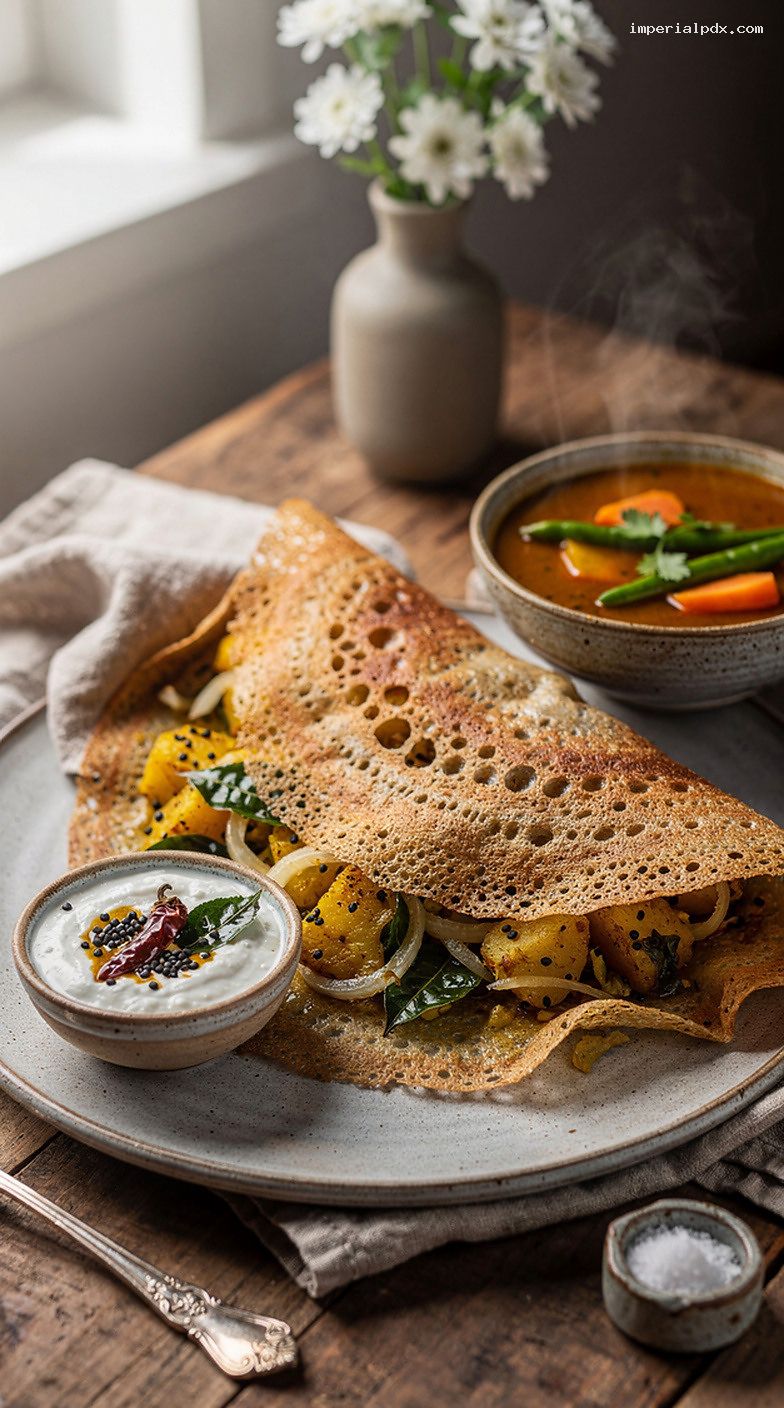
Quick Recipe Version (TL;DR)
Quick Ingredients
- Dosa batter: 2 cups (400 g) parboiled rice/idli rice, 1/2 cup (100 g) urad dal, 1/2 tsp fenugreek seeds, 1 1/2 tsp kosher salt, 1 to 1 1/4 cups (240 to 300 ml) water (as needed)
- Potato masala: 1 1/2 lb (680 g) potatoes, 2 tbsp vegetable oil, 1 tsp mustard seeds, 1 tsp cumin seeds, 10 to 12 curry leaves, 1 medium onion (200 g) sliced, 2 green chiles chopped, 1 tbsp grated ginger, 1/2 tsp ground turmeric, 1/2 tsp kosher salt, 1/2 cup (120 ml) water, 2 tbsp lemon juice, 1/4 cup (10 g) cilantro
- Coconut chutney: 1 1/2 cups (120 g) grated coconut, 2 tbsp (20 g) roasted chana dal, 1 green chile, 1/2 inch (5 g) ginger, 3/4 cup (180 ml) water, 1/2 tsp kosher salt; tempering: 2 tsp oil, 1/2 tsp mustard seeds, 1 dried red chile, 8 curry leaves
- Sambar (simple): 3/4 cup (150 g) toor dal, 1/4 tsp turmeric, 2 tbsp sambar powder, 1 tbsp tamarind concentrate, 1 tsp jaggery/brown sugar, mixed vegetables (about 3 cups), 1 1/2 tsp kosher salt; tempering: 1 tbsp oil, 1 tsp mustard seeds, 2 dried red chiles, curry leaves
- For cooking dosas: 8 tsp vegetable oil or ghee (about 2 1/2 tbsp total, or more as needed)
Do This
- 1. Soak rice, urad dal, and fenugreek in plenty of water for 6 hours.
- 2. Grind to a smooth batter, add salt, then ferment covered in a warm spot (80–90°F / 27–32°C) for 10–14 hours.
- 3. Boil potatoes; cook onion-spice tempering; mash potatoes in and season with lemon and cilantro.
- 4. Blend coconut chutney; finish with quick mustard-curry leaf tempering.
- 5. Cook toor dal; simmer with vegetables, sambar powder, tamarind, and salt; finish with tempering.
- 6. Heat a skillet to about 400°F / 200°C; spread 1/2 cup batter thin; drizzle oil; cook until crisp.
- 7. Add potato masala, fold, and serve hot with coconut chutney and sambar.
Why You’ll Love This Recipe
- Truly crisp: A well-fermented batter plus a hot skillet gives you that classic shattering dosa edge.
- Comforting filling: Warm potatoes, onions, curry leaves, and turmeric make every bite savory and satisfying.
- Complete breakfast: Coconut chutney for freshness and sambar for a hearty, spoonable side.
- Home-cook friendly: Clear temperatures, times, and make-ahead tips so you can nail it without guesswork.
Grocery List
- Produce: Potatoes (1 1/2 lb / 680 g), onion (1 medium), green chiles (3), ginger, cilantro, carrots, green beans, zucchini or okra, tomato, curry leaves (fresh preferred), lemon
- Dairy: Ghee (optional; you can use oil instead)
- Pantry: Parboiled rice/idli rice, urad dal (split black gram), fenugreek seeds, roasted chana dal (roasted gram), grated coconut (fresh or frozen), toor dal (pigeon peas), sambar powder, tamarind concentrate, mustard seeds, cumin seeds, dried red chiles, turmeric, asafoetida (optional), jaggery or brown sugar, vegetable oil, kosher salt
Full Ingredients
Dosa Batter (makes about 8 dosas)
- 2 cups (400 g) parboiled rice (idli rice). Substitute: 1 1/2 cups (300 g) parboiled rice + 1/2 cup (100 g) regular long-grain rice.
- 1/2 cup (100 g) urad dal (split, skinless)
- 1/2 tsp (2 g) fenugreek seeds
- 1 1/2 tsp (9 g) kosher salt
- 1 to 1 1/4 cups (240 to 300 ml) water (to adjust consistency after fermenting; amount varies)
- Neutral oil or ghee for cooking: 8 tsp (40 ml) minimum, more as needed
Spiced Potato Filling (Potato Masala)
- 1 1/2 lb (680 g) Yukon gold or red potatoes, peeled (optional) and cut into 2-inch chunks
- 1 tbsp (15 ml) vegetable oil
- 1 tbsp (15 ml) ghee (or use another 1 tbsp oil for vegan)
- 1 tsp mustard seeds
- 1 tsp cumin seeds
- 10 to 12 curry leaves
- 1 medium yellow onion (about 200 g), thinly sliced
- 2 green chiles, finely chopped
- 1 tbsp (10 g) fresh ginger, finely grated
- 1/2 tsp ground turmeric
- 1/8 tsp asafoetida (hing), optional but classic
- 1/2 tsp kosher salt, plus more to taste
- 1/2 cup (120 ml) water
- 2 tbsp (30 ml) fresh lemon juice
- 1/4 cup (10 g) chopped cilantro
Coconut Chutney
- 1 1/2 cups (120 g) grated coconut (fresh or frozen, thawed)
- 2 tbsp (20 g) roasted chana dal (roasted gram). Substitute: 2 tbsp unsalted roasted peanuts or 1 tbsp tahini for similar body.
- 1 green chile (use 1/2 for mild)
- 1/2 inch piece fresh ginger (about 5 g)
- 3/4 cup (180 ml) water, plus 1–2 tbsp (15–30 ml) as needed
- 1/2 tsp kosher salt
Chutney Tempering (Tadka)
- 2 tsp (10 ml) vegetable oil
- 1/2 tsp mustard seeds
- 1 dried red chile
- 8 curry leaves
- 1/8 tsp asafoetida (hing), optional
Simple Sambar (Vegetable Lentil Stew)
- 3/4 cup (150 g) toor dal (pigeon peas), rinsed
- 3 cups (720 ml) water (for cooking dal), plus 1 to 2 cups (240 to 480 ml) water to adjust consistency later
- 1/4 tsp ground turmeric
- 2 tbsp (18 g) sambar powder
- 1 tbsp (15 ml) tamarind concentrate (or 2 tbsp tamarind paste)
- 1 tsp (4 g) jaggery or brown sugar
- 1 1/2 tsp (9 g) kosher salt, plus more to taste
- 3 cups mixed vegetables (choose what you like), for example:
- 1 cup (130 g) carrots, diced
- 1 cup (100 g) green beans, chopped
- 1 cup (150 g) zucchini, diced (or okra, sliced)
- 10 small shallots (about 150 g) peeled, or 1 small onion (about 150 g) chopped
- 1 medium tomato (about 150 g), chopped
- 2 tbsp (8 g) chopped cilantro (to finish)
Sambar Tempering (Tadka)
- 1 tbsp (15 ml) vegetable oil or ghee
- 1 tsp mustard seeds
- 1/2 tsp cumin seeds
- 1/4 tsp fenugreek seeds (optional but traditional)
- 2 dried red chiles
- 10 curry leaves
Step-by-Step Instructions
Step 1: Soak the rice and lentils
In two separate bowls, add:
- Bowl 1: 2 cups (400 g) parboiled rice
- Bowl 2: 1/2 cup (100 g) urad dal + 1/2 tsp fenugreek seeds
Cover each with at least 2 inches (5 cm) of cool water. Soak for 6 hours at room temperature (70–75°F / 21–24°C). Drain both, reserving a little soaking water to help with grinding.
Step 2: Grind the dosa batter until smooth and airy
In a blender (or wet grinder), grind the urad dal + fenugreek first with 1/2 cup (120 ml) water (use soaking water if you like), adding 1–2 tbsp more as needed. Blend until very smooth, pale, and fluffy, about 3–5 minutes depending on your machine.
Transfer to a large mixing bowl (leave plenty of headspace for rising).
Next, grind the rice with 1/2 cup (120 ml) water, adding more as needed, until smooth to very slightly gritty (like fine semolina), about 3–5 minutes. Stir the rice batter into the urad batter until fully combined.
The mixed batter should be thick but pourable. If it feels like paste, add 2–4 tbsp (30–60 ml) water now.
Step 3: Ferment the batter (the key to flavor and crispness)
Stir 1 1/2 tsp (9 g) kosher salt into the batter. Cover loosely (a lid slightly ajar or a towel) so gases can escape.
Ferment in a warm spot at 80–90°F (27–32°C) for 10–14 hours, until the batter has risen noticeably, looks airy, and smells pleasantly tangy.
After fermenting, gently stir once. Adjust consistency with 1/4 to 3/4 cup (60 to 180 ml) water as needed so the batter pours easily and can be spread thin. Think: a little thinner than pancake batter.
Step 4: Cook the potatoes for the filling
Add the potatoes to a pot and cover with cool water by 1 inch (2.5 cm). Add 1 tsp kosher salt to the water.
Bring to a boil, then reduce to a steady simmer and cook until very tender, 12–15 minutes. Drain well.
Let the potatoes steam-dry in the colander for 5 minutes, then roughly mash (some small chunks are great for texture).
Step 5: Make the spiced potato masala
In a wide skillet over medium heat, heat 1 tbsp (15 ml) oil + 1 tbsp (15 ml) ghee (or all oil). Add 1 tsp mustard seeds and cook until they pop, 30–45 seconds.
Add 1 tsp cumin seeds and 10–12 curry leaves and stir for 15 seconds. Add the sliced onion and cook until soft and lightly golden, 6–8 minutes.
Stir in green chiles and ginger for 30 seconds, then add 1/2 tsp turmeric and optional 1/8 tsp hing.
Add the mashed potatoes, 1/2 tsp kosher salt, and 1/2 cup (120 ml) water. Stir and gently mash to combine. Cook until the mixture is hot and cohesive, 2–3 minutes. Turn off the heat and mix in 2 tbsp lemon juice and 1/4 cup chopped cilantro. Taste and add salt if needed.
Step 6: Blend the coconut chutney and add the tempering
In a blender, combine:
- 1 1/2 cups (120 g) grated coconut
- 2 tbsp (20 g) roasted chana dal
- 1 green chile
- 1/2 inch ginger (5 g)
- 3/4 cup (180 ml) water
- 1/2 tsp kosher salt
Blend until creamy (or slightly coarse, if you prefer), about 30–60 seconds. Add 1–2 tbsp (15–30 ml) extra water if you want a looser, pourable chutney.
For the tempering: heat 2 tsp oil in a small pan over medium heat. Add 1/2 tsp mustard seeds and cook until popping, 30–45 seconds. Add 1 dried red chile, 8 curry leaves, and optional 1/8 tsp hing; stir 10–15 seconds. Immediately pour the hot tempering over the chutney and stir.
Step 7: Cook the sambar (stovetop or pressure cooker)
Stovetop method: Add 3/4 cup toor dal, 3 cups (720 ml) water, and 1/4 tsp turmeric to a pot. Bring to a boil, then reduce to a simmer and cook, partially covered, until very soft, 35–45 minutes. Whisk or mash until creamy.
Pressure cooker / Instant Pot: Cook dal with water and turmeric on High Pressure for 10 minutes, then natural release 10 minutes. Whisk until creamy.
Add vegetables (about 3 cups), shallots/onion, tomato, 2 tbsp sambar powder, 1 tbsp tamarind concentrate, 1 tsp jaggery, and 1 1/2 tsp kosher salt. Simmer until vegetables are tender, 12–15 minutes, adding 1 to 2 cups (240 to 480 ml) water as needed for a stew-like consistency.
Finish with tempering: heat 1 tbsp oil over medium heat. Add 1 tsp mustard seeds and cook until popping, 30–45 seconds. Add 1/2 tsp cumin, optional 1/4 tsp fenugreek seeds, dried red chiles, and curry leaves; stir 15–20 seconds. Pour into the sambar and stir in 2 tbsp cilantro. Taste and adjust salt and tamarind.
Step 8: Cook crisp dosas and assemble
Heat a cast iron skillet/tawa or nonstick skillet over medium-high heat until a few drops of water sizzle and evaporate quickly; target surface temperature is about 400°F / 200°C.
Lightly rub the pan with a few drops of oil on a folded paper towel. Pour 1/2 cup (120 ml) batter into the center and quickly spread in outward spirals with the bottom of the ladle to a thin 10–12 inch (25–30 cm) circle.
Drizzle 1 tsp oil or ghee around the edges and a few drops over the top. Cook until the surface looks set, the edges lift, and the bottom is deep golden and crisp, 2 1/2 to 4 minutes.
For extra crispness, cook 30–60 seconds longer. (No flip is required, but you can flip for 15–30 seconds if you like.)
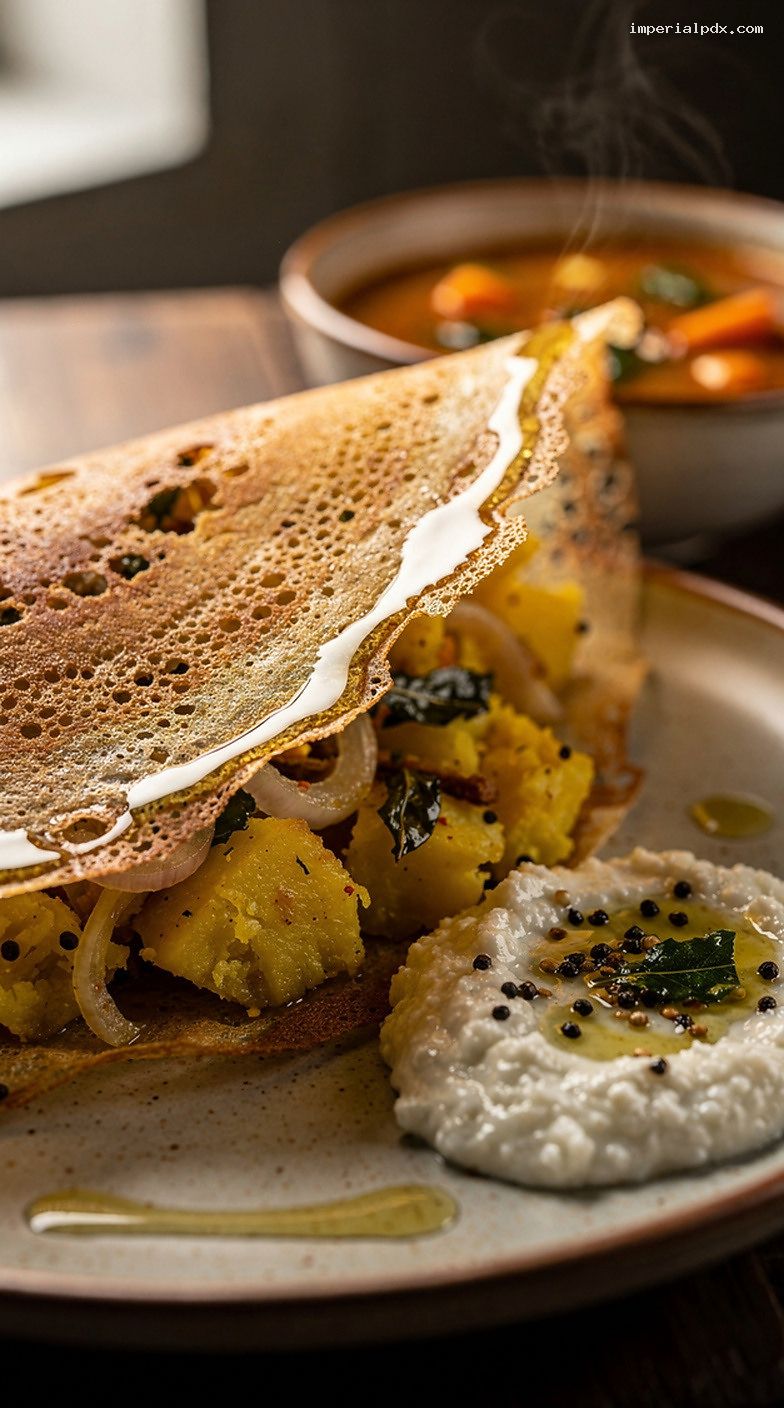
Spoon about 1/3 cup potato masala onto one side, fold the dosa over, and serve immediately with coconut chutney and hot sambar. Repeat with remaining batter, oiling the pan lightly between dosas as needed.
Pro Tips
- Fermentation cue: The batter should look airy with bubbles and smell pleasantly tangy, not harsh or “off.” If your kitchen is cool, ferment in the oven with the light on (check that it stays around 80–90°F / 27–32°C).
- Batter consistency = spreadability: After fermenting, thin the batter little by little. If it’s too thick, you’ll get pancake-dosas; too thin and it can tear. Aim for “heavy cream” flow.
- Pan heat matters: If the batter sticks, the pan is often too hot or under-seasoned (cast iron). If it turns pale and soft, the pan is too cool. Adjust in small increments.
- Spreading technique: Pour, then spread immediately. If you wait, the batter sets and won’t thin out. One confident spiral is better than many hesitant passes.
- Keep dosas crisp: Serve as you go. If you must hold them, place on a rack in a 200°F / 95°C oven for up to 20 minutes (not covered), but fresh off the pan is best.
Variations
- Mysore-style: Spread 1–2 tsp spicy red chutney (store-bought Mysore chutney or a quick chili-garlic paste) on the dosa before adding the potato filling.
- Cheese masala dosa: Sprinkle 1/4 cup (25 g) shredded cheddar or mozzarella over the dosa right after spreading the filling; fold once melted.
- Extra-veg filling: Add 1 cup (150 g) cooked peas or finely chopped sautéed spinach to the potato masala.
Storage & Make-Ahead
Batter: Refrigerate fermented batter in a covered container for up to 5 days. It will get tangier over time. Stir gently; if thickened, thin with 1–3 tbsp water at a time. For best rise, let it sit at room temperature for 30 minutes before cooking.
Potato masala: Refrigerate up to 3 days. Reheat with a splash of water over medium-low heat until steaming hot, about 6–8 minutes.
Coconut chutney: Refrigerate up to 2 days. Stir before serving; loosen with 1–2 tsp water if needed.
Sambar: Refrigerate up to 4 days. Reheat to a simmer over medium heat (about 6–10 minutes), adding water to loosen.
Nutrition (per serving)
Approximate, per serving (2 dosas with potato masala, coconut chutney, and sambar): 650 calories, 16 g protein, 110 g carbohydrates, 16 g fat, 12 g fiber, 1200 mg sodium. Values vary by exact oil/ghee use and portion sizes.