Quick Recipe Version (TL;DR)
Quick Ingredients
- 100 g egg whites (about 3 large), room temperature
- 100 g finely ground blanched almond flour (about 1 cup lightly packed)
- 100 g powdered sugar (about 3/4 cup + 2 tbsp)
- 100 g granulated sugar (about 1/2 cup)
- 1/4 tsp cream of tartar
- 1 tsp pure vanilla extract
- Gel food coloring (optional)
- Choose one filling (enough for the whole batch):
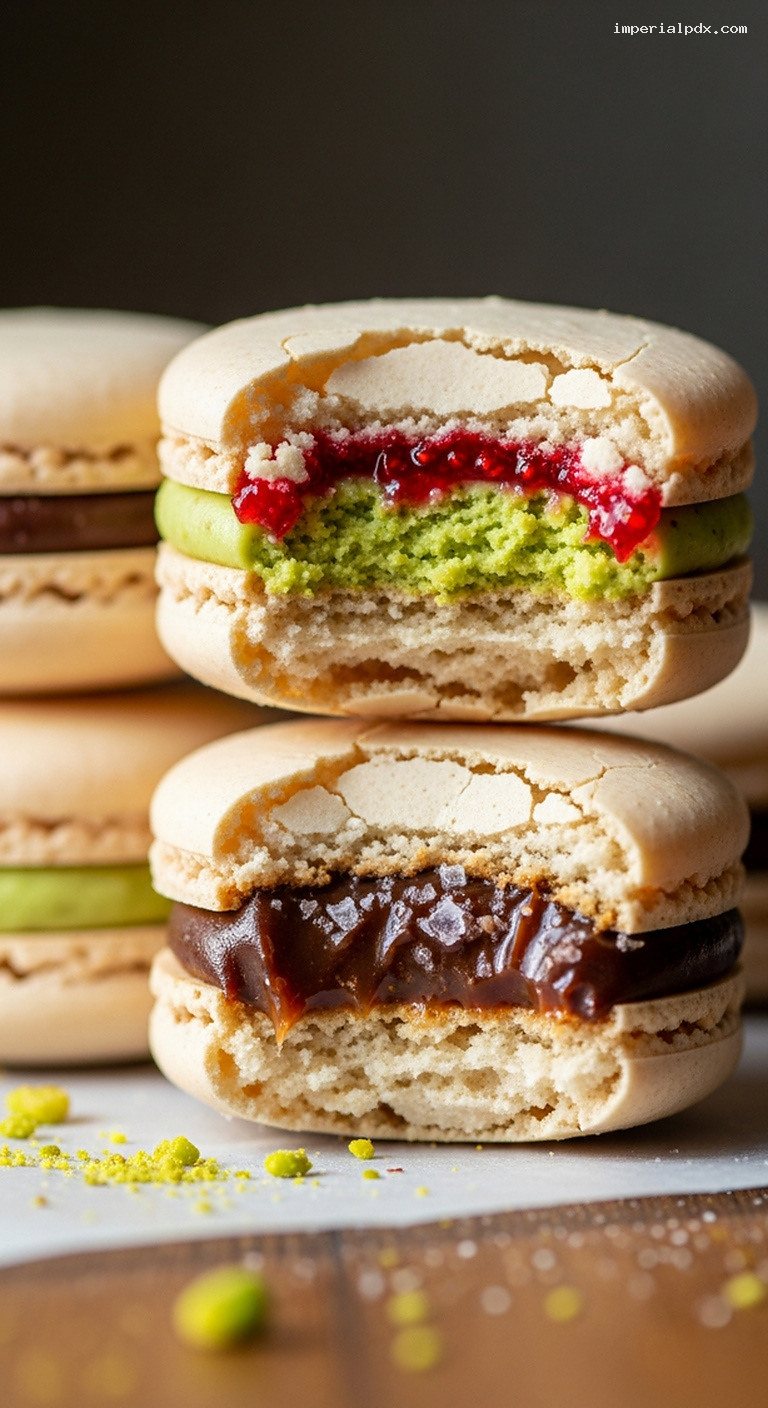
- – 180 g (about 1/2 cup) good-quality seedless raspberry jam, or
- – Pistachio buttercream (butter, pistachio paste, powdered sugar, milk), or
- – Salted-caramel ganache (dark chocolate, cream, soft caramels, salt)
Do This
- 1. Line 2 baking sheets with parchment or silicone mats. Weigh all ingredients. Preheat oven to 300°F (150°C).
- 2. Sift almond flour and powdered sugar together twice; discard any large bits.
- 3. Whip egg whites with cream of tartar to soft peaks, gradually add granulated sugar, then beat to stiff, glossy peaks. Beat in vanilla and gel coloring.
- 4. Fold dry ingredients into meringue until batter flows like thick lava and ribbons disappear in 10–20 seconds.
- 5. Pipe 1 1/4-inch rounds, tap pans firmly to release air bubbles, pop any visible bubbles, and rest until tops are dry (30–45 minutes).
- 6. Bake one tray at a time for 14–16 minutes. Cool completely before removing shells.
- 7. Prepare chosen filling, sandwich between paired shells, then mature in the fridge 12–24 hours for best texture.
Why You’ll Love This Recipe
- Classic French macarons with crisp, colorful shells and a soft, chewy interior.
- Step-by-step instructions designed for home ovens and basic equipment.
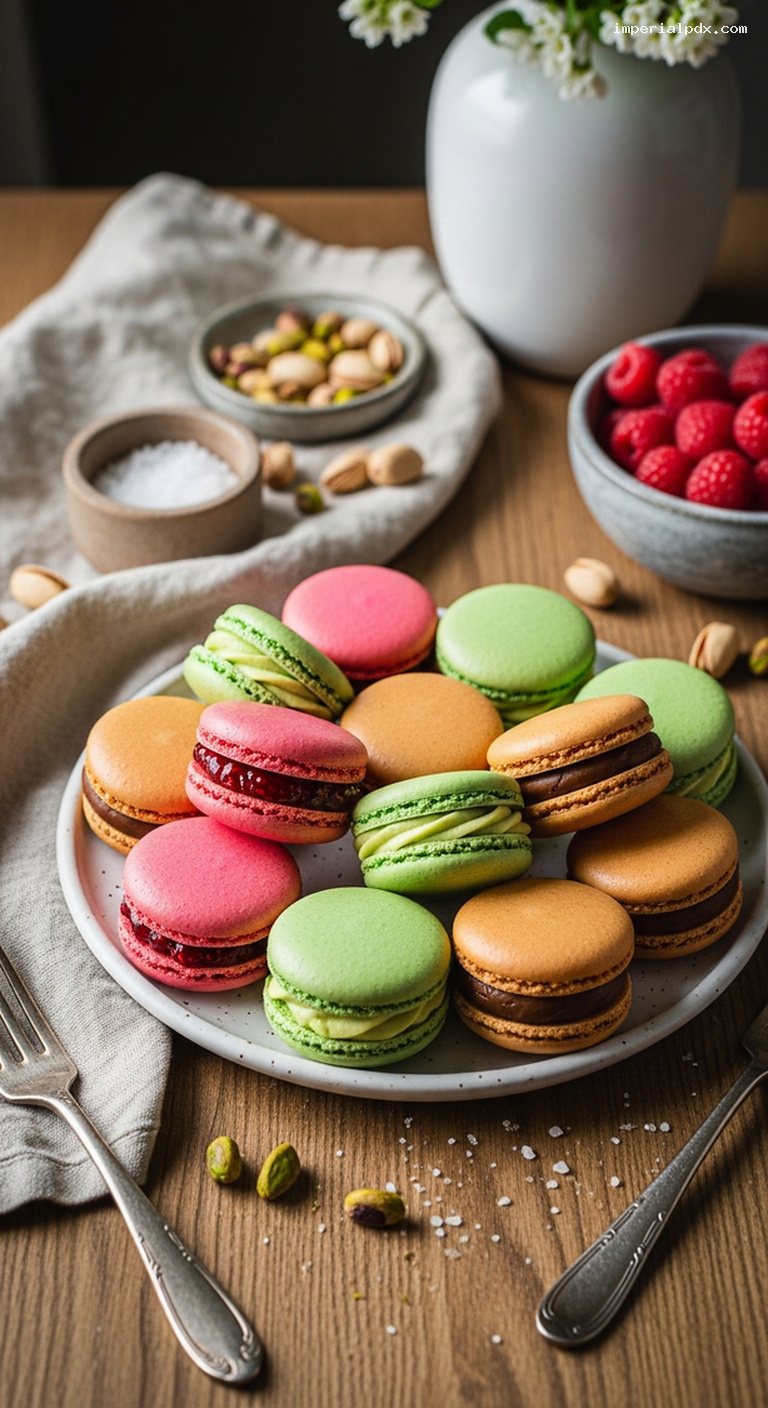
- Three versatile fillings: bright raspberry, nutty pistachio, and decadent salted caramel.
- Perfect for gifting, special occasions, or an impressive afternoon baking project.
Grocery List
- Produce: Optional: fresh raspberries for serving or garnish.
- Dairy: Unsalted butter, heavy cream, milk (or cream) for buttercream, large eggs (for egg whites only).
- Pantry: Fine blanched almond flour, powdered sugar, granulated sugar, cream of tartar, pure vanilla extract, gel food coloring, pistachio paste or very finely ground unsalted pistachios, good-quality seedless raspberry jam, soft caramels or thick caramel sauce, dark or semi-sweet chocolate (around 50–60% cacao), flaky sea salt.
Full Ingredients
Macaron Shells
- 100 g egg whites (from about 3 large eggs), at room temperature
- 100 g finely ground blanched almond flour (about 1 cup, lightly packed)
- 100 g powdered sugar (about 3/4 cup plus 2 tbsp)
- 100 g granulated sugar (about 1/2 cup)
- 1/4 tsp cream of tartar
- 1 tsp pure vanilla extract
- Gel food coloring as desired (use gel, not liquid, to avoid thinning the batter)
Option 1: Raspberry Jam Filling
- 180 g (about 1/2 cup) good-quality seedless raspberry jam
- Optional: 1–2 tbsp powdered sugar, to thicken if jam is very runny
Option 2: Pistachio Buttercream Filling
- 85 g (6 tbsp) unsalted butter, softened to room temperature
- 60 g (about 1/4 cup) smooth pistachio paste
- Or 60 g very finely ground unsalted, shelled pistachios
- 160 g powdered sugar (about 1 1/3 cups), sifted
- 1–2 tbsp milk or heavy cream, as needed for consistency
- 1/4 tsp fine sea salt
- 1/2 tsp vanilla extract (optional, for extra flavor)
Option 3: Salted-Caramel Ganache Filling
- 120 g dark or semi-sweet chocolate, finely chopped (about 3/4 cup)
- 120 ml heavy cream (1/2 cup)
- 90 g soft caramels or thick caramel sauce (about 1/3 cup), roughly chopped if needed
- 1/2 tsp flaky sea salt (or 1/4 tsp fine sea salt), plus a little extra for sprinkling
Step-by-Step Instructions
Step 1: Prepare your tools and ingredients
Line 2 large baking sheets with parchment paper or silicone baking mats. If you have a macaron template, you can place it under the parchment to help you pipe even circles, then slide it out before baking.
Fit a large piping bag (or sturdy zip-top bag) with a 1/2-inch (about 1.25 cm) round tip. Have a rubber spatula, 2 medium bowls, a fine-mesh sieve, and a hand mixer or stand mixer with a whisk attachment ready.
Weigh all ingredients with a kitchen scale for best accuracy. Separate the egg whites from the yolks (do not get any yolk in the whites), and let the whites come to room temperature for at least 30 minutes. Preheat the oven to 300°F (150°C), but only once your piped shells are close to finishing their resting time, so your kitchen does not get too warm too early.
Step 2: Sift the almond flour and powdered sugar
In a medium bowl, combine the 100 g almond flour and 100 g powdered sugar. Use a fine-mesh sieve to sift them together into a second bowl. Press gently with a spoon to help the finer bits pass through and discard any coarse pieces that remain in the sieve; this keeps your shells smooth.
For extra smooth shells, you can sift the mixture a second time. Set aside. This almond-sugar mixture is sometimes called the “tant pour tant” (equal parts) in classic French macaron recipes.
Step 3: Make the French meringue
Place the room-temperature 100 g egg whites into a clean, grease-free mixing bowl. Add the 1/4 tsp cream of tartar. Start beating on medium speed until the whites look foamy and opaque, about 1–2 minutes.
While continuing to beat, slowly rain in the 100 g granulated sugar over 2–3 minutes. Once all the sugar is added, increase the mixer to medium-high speed and whip until the meringue forms stiff, glossy peaks. When you lift the whisk, the peak should stand up straight without drooping, and the meringue should look thick and shiny. This usually takes another 4–6 minutes, depending on your mixer.
Beat in the 1 tsp vanilla extract and a few drops of gel food coloring, if using. Add coloring slightly darker than you want the final shells to be, because they will lighten a bit during baking.
Step 4: Fold in the dry ingredients (macaronage)
Tip about half of the sifted almond flour–powdered sugar mixture into the meringue. Use a rubber spatula to fold gently: cut down through the center, sweep around the sides, and lift the batter from the bottom, turning the bowl as you go. When the first half is mostly combined, add the remaining dry mixture and continue folding.
At first the batter will look thick and lumpy; keep folding gently until it loosens and becomes glossy and flowing. You are aiming for the classic “lava” consistency: when you lift the spatula, the batter should flow off in a thick ribbon that slowly melts back into itself within about 10–20 seconds, without holding a sharp line.
A useful test: try drawing a figure-eight in the air with batter falling from your spatula. If you can complete the figure-eight without the ribbon breaking, and it melts back into the batter within 10–20 seconds, you are ready. Do not overmix, or the batter will become runny and your shells will spread too much.
Step 5: Pipe, tap, and rest the shells
Transfer the batter to your prepared piping bag. Hold the bag vertically, about 1/4 inch above the baking sheet, and pipe rounds about 1 1/4 inches (3 cm) wide, spacing them about 1 inch apart. Stop squeezing before you lift the bag, then give a tiny twist to finish each round cleanly.
Firmly tap each baking sheet on the counter 4–6 times to knock out air bubbles. Use a toothpick to pop any visible bubbles on the surface and smooth the tops.
Let the piped shells sit at room temperature until they form a dry skin on top. When lightly touched with a clean finger, the batter should not stick, and the surface should look matte rather than glossy. This usually takes 30–45 minutes, but can be a bit longer in a very humid kitchen.
Step 6: Bake and cool the macaron shells
Once the shells are almost done drying, preheat your oven (if you have not already) to 300°F (150°C). Bake one tray at a time in the center of the oven for 14–16 minutes. Halfway through baking, you can rotate the pan to promote even cooking.
The shells are done when they have developed their classic “feet” (the ruffled edge at the bottom) and the tops do not wobble if you gently nudge one with a fingertip. The bottoms should be just set and lightly golden, but not browned.
Allow the shells to cool completely on the baking sheets, about 20–30 minutes. Once cool, gently peel them off the parchment or mats. If they stick badly, they may be slightly underbaked; you can return them to the oven for 2–3 more minutes (after removing any shells that are already released easily).
Step 7: Make the fillings and assemble
While the shells are cooling (or while they are resting before baking), prepare your chosen filling(s).
Raspberry jam: If your jam is quite thick, you can use it as-is. If it is runny, stir in 1–2 tbsp powdered sugar or simmer the jam in a small saucepan for 3–5 minutes to reduce slightly, then cool completely. Transfer to a small piping bag or spoon.
Pistachio buttercream: In a bowl, beat 85 g softened butter until creamy. Beat in the 60 g pistachio paste. Gradually add the 160 g powdered sugar, beating until light and fluffy. Add 1–2 tbsp milk or cream, a little at a time, until you have a smooth, pipeable consistency. Mix in the 1/4 tsp salt and vanilla, if using. Transfer to a piping bag fitted with a small round tip.
Salted-caramel ganache: Place the 120 g chopped chocolate in a heatproof bowl. In a small saucepan, heat the 120 ml cream and 90 g caramels or caramel sauce over medium-low heat, stirring until the caramel melts and the mixture just begins to simmer. Pour over the chocolate, let sit 2–3 minutes, then stir until smooth. Add the 1/2 tsp salt. Cool, then chill 20–30 minutes until thickened to a pipeable consistency, stirring occasionally.
To assemble, pair up macaron shells of similar size. Pipe or spoon a small mound of filling (about 1–1 1/2 tsp) onto the underside of one shell, then gently press a second shell on top, twisting slightly to spread the filling to the edges without cracking the shells.
For the best texture, place the filled macarons in an airtight container and refrigerate for 12–24 hours to “mature.” This allows the filling to gently soften the interior of the shells, giving that perfect chewy center. Bring to room temperature for 20–30 minutes before serving.
Pro Tips
- Weigh, do not scoop: Using a digital scale is one of the biggest keys to consistent, successful macarons.
- Use very clean equipment: Any trace of grease or egg yolk in the whites can prevent the meringue from whipping properly. Wipe your bowl and whisk with a little vinegar or lemon juice if you like.
- Do not rush the batter: Fold slowly and check often. Overmixing is hard to fix, but you can always give the batter one or two more folds if it is still too thick.
- Manage humidity: On very humid days, drying can take longer; avoid boiling pots of water nearby, and consider running a dehumidifier or air conditioning.
- One tray at a time: For even results, bake macarons on the middle rack, one sheet at a time, rather than crowding the oven.
Variations
- All-raspberry macarons: Tint the shells a soft pink, fill with raspberry jam, and tuck a tiny fresh raspberry in the center of each for a burst of fruit.
- Pistachio delight: Tint shells a pale green, fill with pistachio buttercream, and roll the edges in very finely chopped pistachios.
- Salted-caramel swirl: Keep the shells natural or add a light caramel-colored swirl with brown and ivory gel coloring, then fill with salted-caramel ganache and finish with a tiny sprinkle of flaky sea salt on top.
Storage & Make-Ahead
Unfilled macaron shells can be stored in an airtight container at room temperature for up to 2 days, or frozen for up to 1 month. Separate layers with parchment paper so they do not stick or crack.
Filled macarons should be kept in an airtight container in the refrigerator. They taste best after maturing for 12–24 hours and can be enjoyed for 4–5 days. Bring them to room temperature before serving for the best flavor and texture. You can also freeze filled macarons for up to 1 month; thaw in the refrigerator overnight, then let them sit at room temperature before serving.
Nutrition (per serving)
Approximate values for one macaron (assuming 30 macarons, pistachio or caramel filling): about 120–130 calories, 2–3 g protein, 15–18 g carbohydrates, 6–7 g fat, 11–13 g sugar, and 35–45 mg sodium. Raspberry jam fillings will be slightly lower in fat and slightly higher in sugar. These numbers are estimates and will vary with exact ingredients and portion sizes.