Quick Recipe Version (TL;DR)
Quick Ingredients
- 2 cups (260 g) all-purpose flour
- 3/4 cup (150 g) granulated sugar
- 10 tbsp (140 g) unsalted butter, softened
- 2 large eggs (for dough)
- 1 large egg yolk + 1 tsp milk (for egg wash)
- 1 tsp baking powder, 1/2 tsp fine salt
- Finely grated zest of 1 lemon, 1 tsp vanilla extract
- For pastry cream filling (option 1): 2 cups (480 ml) whole milk, 4 egg yolks, 1/3 cup (65 g) sugar, 3 tbsp (24 g) cornstarch, 1 tsp vanilla, 1 tbsp butter
- For cherry filling (option 2): 3/4 cup (240 g) thick black cherry jam or Basque black cherry preserves, 1 tsp lemon juice
Do This
- 1. If using pastry cream, heat milk; whisk yolks, sugar, and cornstarch; cook until thick, then chill completely.
- 2. Cream butter, sugar, and lemon zest; beat in eggs and vanilla. Mix in flour, baking powder, and salt just until a soft dough forms.
- 3. Divide dough into 2 discs (one slightly larger), wrap, and chill until firm, about 1 hour.
- 4. Preheat oven to 350°F (175°C). Butter and line a 9-inch (23 cm) round pan. Roll larger disc and line bottom and sides of pan.
- 5. Spread cold pastry cream or thick cherry jam inside, leaving a 1/2-inch border clear.
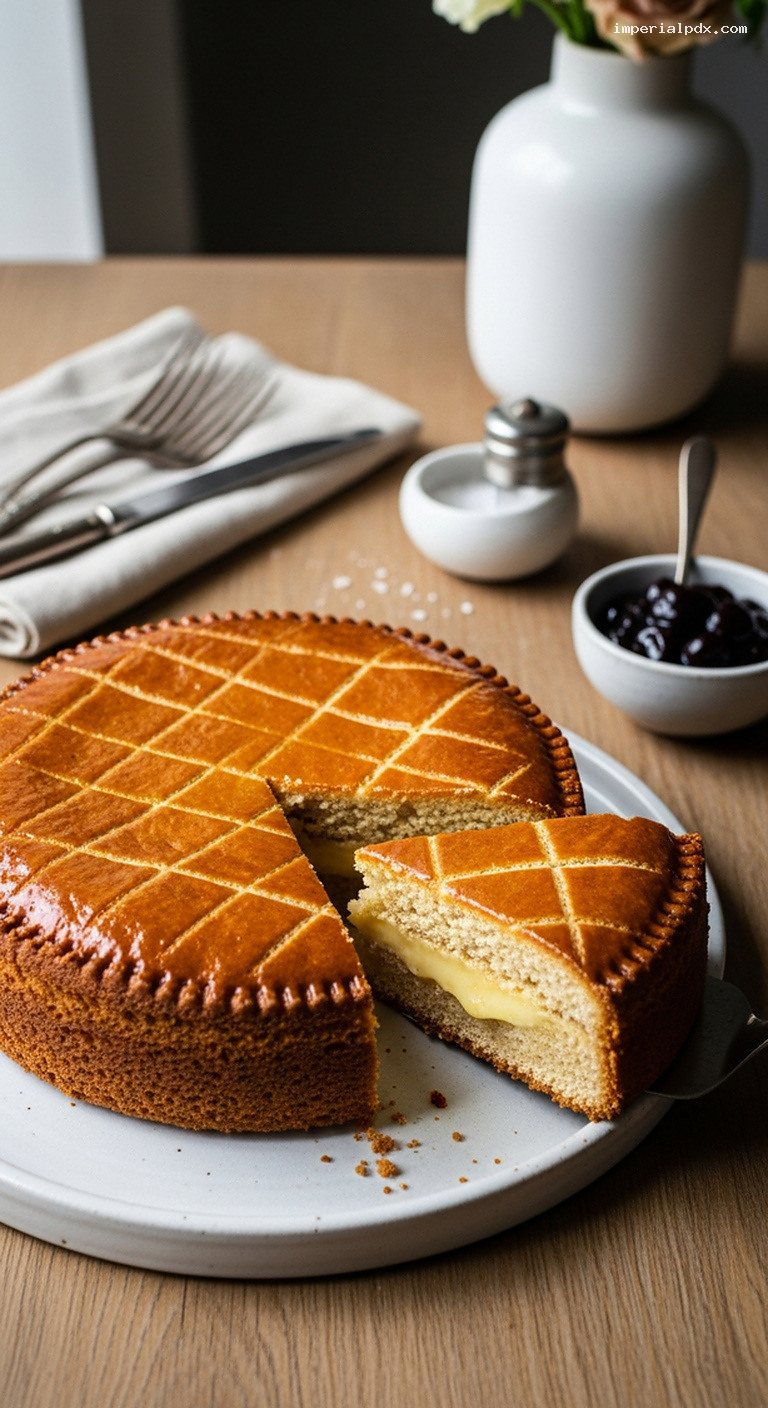
- 6. Roll remaining dough into a top, lay over filling, seal edges, brush with egg wash, and score a crisscross pattern.
- 7. Bake 35–40 minutes until deep golden. Cool completely before slicing.
Why You’ll Love This Recipe
- Classic Basque bakery flavor at home: a buttery, tender, cookie-like crust with a rich, custardy or jammy center.
- Choose your adventure: silky vanilla pastry cream or tangy black cherry jam, both deliciously traditional.
- Make-ahead friendly: the dough and filling can be prepared in advance for stress-free entertaining.
- Rustic yet elegant: simple to assemble, but impressive enough for dinner parties and holidays.
Grocery List
- Produce: 1 lemon (for zest and juice, optional but recommended)
- Dairy: Unsalted butter, whole milk, large eggs, (optional) heavy cream or milk for egg wash
- Pantry: All-purpose flour, granulated sugar, fine sea salt, baking powder, cornstarch, vanilla extract, black cherry jam or Basque black cherry preserves, (optional) dark rum or brandy
Full Ingredients
For the Sweet Pastry Dough
- 2 cups (260 g) all-purpose flour
- 3/4 cup (150 g) granulated sugar
- 1 tsp baking powder
- 1/2 tsp fine sea salt
- 10 tbsp (140 g) unsalted butter, softened but still cool
- 2 large eggs, at room temperature
- 1 tsp pure vanilla extract
- Finely grated zest of 1 small lemon (about 1–2 tsp; optional but traditional)
- 1 tsp dark rum or brandy (optional, for a more classic Basque flavor)
For the Pastry Cream Filling (Optional, Traditional Version)
- 2 cups (480 ml) whole milk
- 4 large egg yolks
- 1/3 cup (65 g) granulated sugar
- 3 tbsp (24 g) cornstarch
- 1/8 tsp fine salt
- 1 tsp pure vanilla extract (or 1/2 vanilla bean, seeds scraped)
- 1 tbsp (14 g) unsalted butter
- 1 tbsp dark rum or brandy (optional, or 1/2 tsp almond extract)
For the Black Cherry Jam Filling (Optional, Classic Basque Alternative)
- 3/4 cup (240 g) thick black cherry jam or Basque-style black cherry preserves
- 1 tsp freshly squeezed lemon juice
- 1 tsp cornstarch (optional, only if your jam is very loose)
For Assembly & Finish
- Butter, for greasing the pan
- 1 tbsp flour or granulated sugar, for dusting the pan
- 1 large egg yolk
- 1 tsp milk or heavy cream (to loosen the egg wash)
- (Optional) 1 tbsp coarse sugar, for a light crunch on top
Step-by-Step Instructions
Step 1: Make the Pastry Cream Filling (If Using)
If you plan to use the classic pastry cream filling, start with this step so it has time to chill. If you are making a cherry-filled Gâteau Basque only, you can skip to Step 2.
In a medium saucepan, heat the whole milk over medium heat until steaming and small bubbles form around the edges. Do not let it boil. Meanwhile, in a separate medium bowl, whisk together the egg yolks, sugar, cornstarch, and salt until thick, smooth, and slightly lighter in color.
Slowly pour about 1/2 cup of the hot milk into the yolk mixture while whisking constantly to temper the eggs. Then whisk this warmed mixture back into the saucepan with the remaining milk. Return the pan to medium heat and whisk constantly until the mixture thickens and begins to bubble, about 2–4 minutes. Let it bubble for 30–60 seconds to fully cook the starch.
Remove from heat and whisk in the vanilla, butter, and rum or brandy (if using). Pour the pastry cream into a shallow dish, press plastic wrap directly onto its surface to prevent a skin, and chill in the refrigerator until completely cold and firm, at least 2 hours.
Step 2: Mix the Gâteau Basque Dough
In a medium bowl, whisk together the flour, baking powder, and salt. Set aside.
In a large mixing bowl, using a hand mixer or stand mixer with the paddle attachment, beat the softened butter, sugar, and lemon zest together on medium speed until creamy and slightly lightened, about 2–3 minutes. Scrape down the bowl as needed.
Add the eggs one at a time, beating well after each addition. Mix in the vanilla and rum or brandy (if using). The mixture may look slightly curdled; that is fine.
On low speed, add the dry ingredients in two additions, mixing just until a soft, sticky dough comes together and no streaks of flour remain. Do not overmix; you want a tender, cookie-like crumb, not a tough cake.
Step 3: Chill the Dough (and Pastry Cream)
Scrape the dough out onto a lightly floured piece of parchment or plastic wrap. Divide it into two portions: one slightly larger (about 60 percent) for the base and sides, and one slightly smaller (about 40 percent) for the top crust.
Shape each portion into a flat disc, wrap tightly, and refrigerate until firm but still pliable, at least 1 hour or up to 24 hours. While the dough chills, make sure your pastry cream is cooling in the fridge (if using). It should be fully cold and thick by the time you assemble the cake.
Step 4: Prepare the Pan, Oven, and Bottom Crust
When you are ready to bake, preheat your oven to 350°F (175°C) with a rack in the center. Butter a 9-inch (23 cm) round cake pan with a removable bottom or a springform pan. Line the bottom with a circle of parchment paper and lightly dust the sides with flour or sugar, tapping out the excess.
Take the larger disc of dough out of the refrigerator and let it sit for a few minutes if it is very hard. Place it between two sheets of parchment paper and roll it into a circle roughly 11 inches (28 cm) wide and about 1/4 inch (6 mm) thick. Peel off the top sheet of parchment and carefully invert the dough into the prepared pan, easing it into the corners and up the sides. Patch any tears with extra dough; this dough is forgiving.
Trim the edge so that the dough comes to about 1 1/4 inches (3 cm) up the side of the pan. If it gets too soft, pop the pan into the refrigerator for 5–10 minutes to firm up before filling.
Step 5: Add Your Filling (Pastry Cream or Black Cherry Jam)
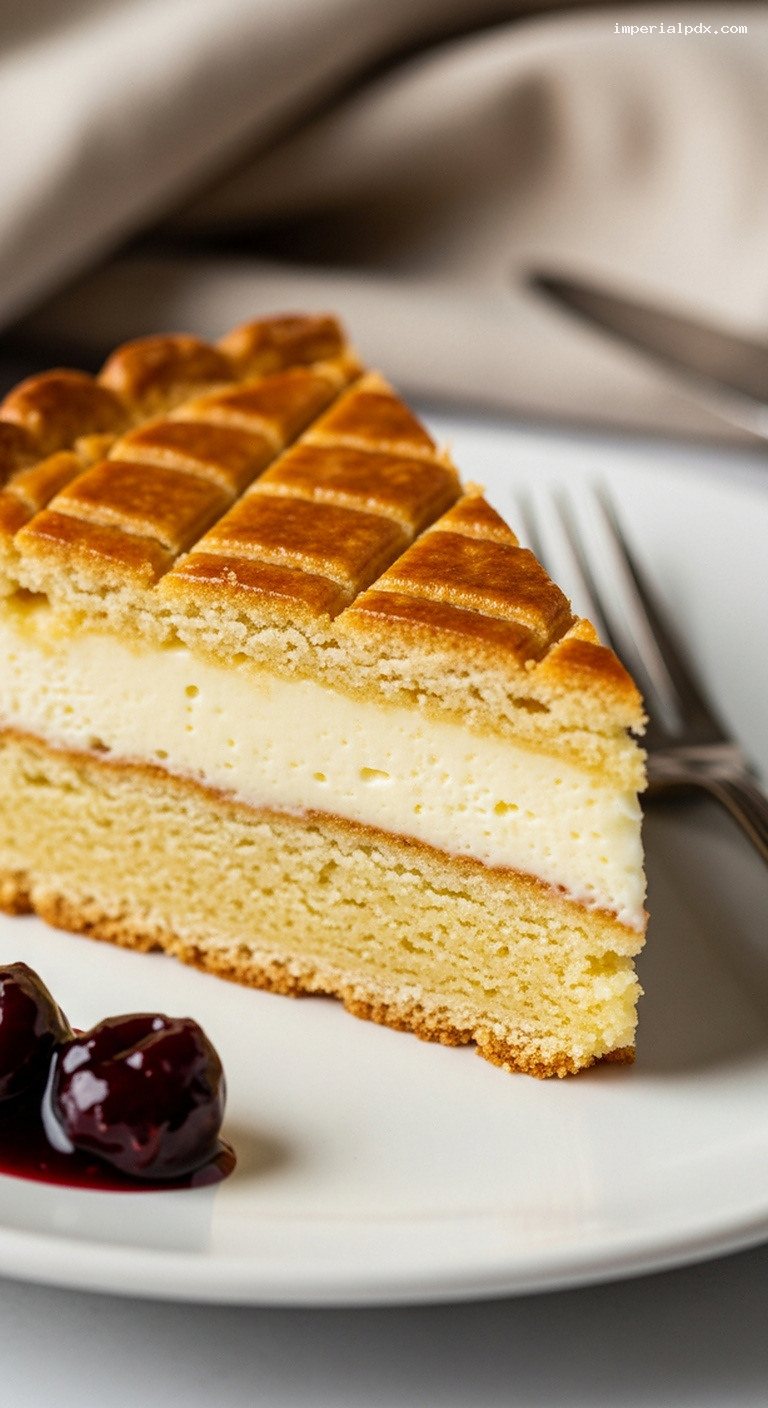
If using pastry cream, whisk it briefly to loosen, then spoon about 1 1/2 to 2 cups into the dough-lined pan. Smooth it into an even layer with an offset spatula or the back of a spoon, leaving a 1/2-inch (1.25 cm) border of exposed dough all around the edge. Avoid overfilling; any extra pastry cream can be enjoyed separately.
If using black cherry jam, stir the jam with the lemon juice (and cornstarch, if your jam is runny) until well combined. Spread it evenly over the bottom crust, again leaving a 1/2-inch border bare along the edge so the top crust can seal properly.
Keep the filled pan in the refrigerator while you prepare the top crust to keep the dough cool and easier to handle.
Step 6: Seal, Decorate, and Egg-Wash the Top
Roll the remaining disc of dough between two sheets of parchment into a circle just slightly larger than your pan, about 9 1/2 inches (24 cm) wide and 1/4 inch (6 mm) thick. Remove the top piece of parchment and gently invert the dough over the filled pan. Peel off the remaining parchment.
Press the top dough gently along the edges to meet the bottom crust, pinching or pressing to seal all the way around so the filling cannot leak. Trim any obvious excess dough, then smooth the edge with your fingers.
In a small bowl, whisk together the egg yolk and milk or cream to make an egg wash. Brush a thin, even layer over the top of the cake, avoiding drips down the sides if possible (they can darken quickly).
Using the tines of a fork or the tip of a small knife, lightly score a crisscross or sunburst pattern on the top. This traditional design is shallow and decorative; do not cut all the way through the dough.
Step 7: Bake, Cool, and Serve
Bake the Gâteau Basque at 350°F (175°C) for 35–40 minutes, or until the top is a deep, glossy golden brown and feels set in the center when gently tapped. If the edges are browning much faster than the center, tent loosely with foil for the last 5–10 minutes.
Remove the pan from the oven and cool on a wire rack for 15–20 minutes. Run a thin knife around the edge, then carefully remove the outer ring of the pan. Leave the cake on the base and let it cool completely, at least 1–2 hours. Gâteau Basque slices cleanest when fully cool and tastes best at cool room temperature.
Transfer to a serving plate. Slice into wedges with a sharp serrated knife, wiping the blade between cuts, especially if using cherry jam. Serve plain, or with a spoonful of extra cherry jam or a small dollop of whipped cream on the side.
Pro Tips
- Chill thoroughly for clean slices. Both the pastry cream and the assembled cake slice much more neatly when fully chilled or completely cooled, so do not rush this part.
- Keep the dough cool but workable. If it cracks, it is too cold; if it tears or stretches, it is too warm. A few minutes at room temperature or in the fridge usually fixes it.
- Do not overfill. Too much pastry cream or jam can cause the cake to leak or dome unevenly. Aim for a generous but level layer with a clear border.
- Score lightly. The top pattern should just mark the surface. Deep cuts can open during baking and let filling escape.
- Use good jam. For the cherry version, a thick, high-quality black cherry preserve makes a big difference in flavor and texture.
Variations
- Almond-Rum Pastry Cream: Add 1/2 tsp almond extract and 1–2 tbsp dark rum to the pastry cream after cooking for a more aromatic, bakery-style filling.
- All-Cherry with Citrus: Skip the pastry cream and use only black cherry jam, brightened with extra lemon zest in the dough for a tangier, fruit-forward cake.
- Mini Gâteaux Basques: Press the dough into small tartlet pans or a muffin tin and bake individual cakes, reducing the bake time to about 20–25 minutes.
Storage & Make-Ahead
For food safety, the pastry cream version should be stored in the refrigerator. Once the cake is completely cool, cover it loosely and refrigerate for up to 3 days. For the best flavor and texture, let slices sit at room temperature for 20–30 minutes before serving.
The cherry-jam-only version can be kept tightly wrapped at cool room temperature for up to 1 day, then refrigerated for up to 3 days. In both cases, the crust will soften slightly over time but remains delicious.
You can make the pastry cream up to 2 days ahead and store it in the refrigerator, well covered. The dough can be refrigerated for up to 24 hours or frozen for up to 1 month (thaw overnight in the fridge before using). This makes Gâteau Basque an excellent make-ahead dessert.
Nutrition (per serving)
Approximate values for one slice (1/8 of a 9-inch cake) made with the pastry cream filling: about 520 calories; 29 g fat; 20 g saturated fat; 57 g carbohydrates; 1 g fiber; 32 g sugars; 8 g protein; 260 mg cholesterol; 260 mg sodium. The cherry jam version will be slightly sweeter and a bit lower in fat and protein.