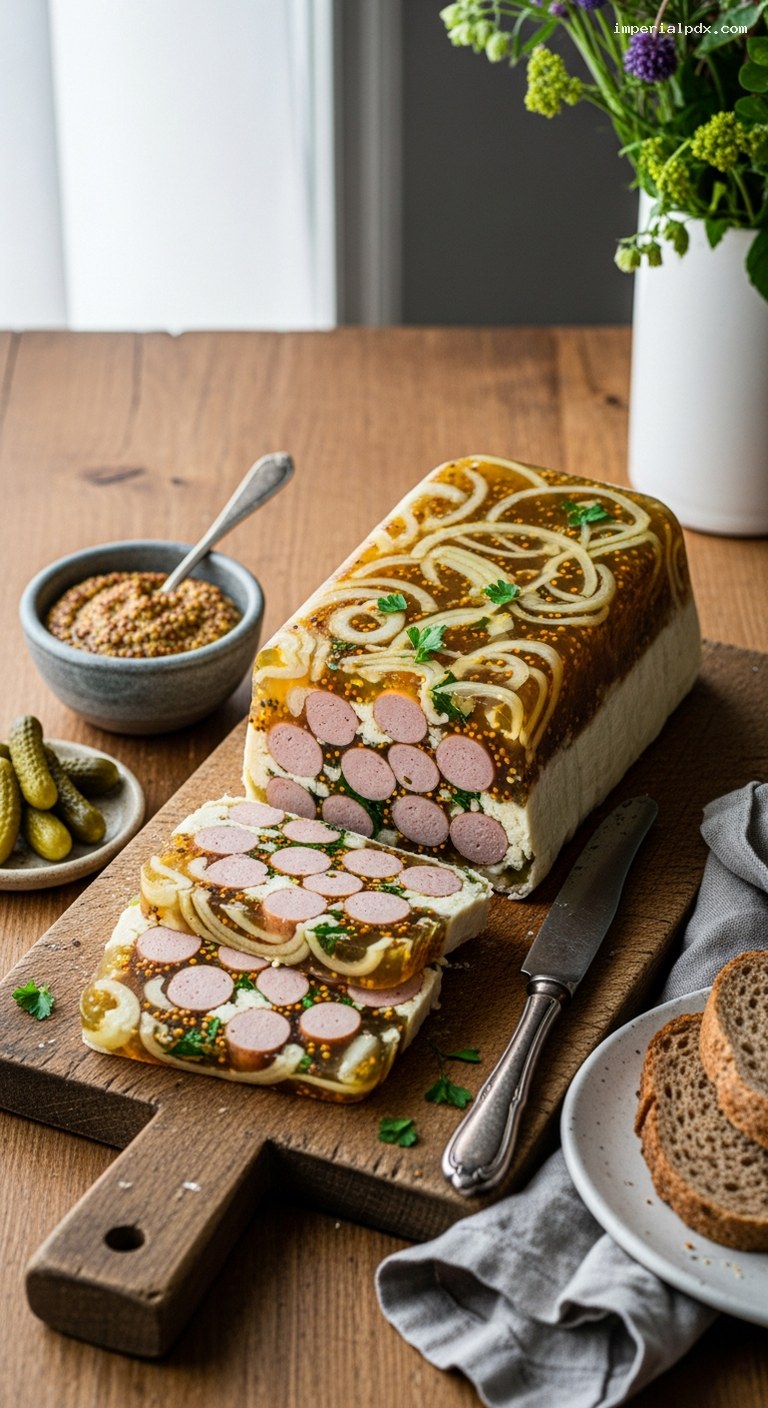
Quick Recipe Version (TL;DR)
Quick Ingredients
- 1 lb (450 g) fresh bratwurst sausages
- 1 ½ cups (360 ml) German-style lager or pilsner
- 2 cups (480 ml) unsalted chicken or pork stock
- 1 large yellow onion, thinly sliced
- 3 envelopes (21 g) unflavored powdered gelatin
- 2 tsp whole mustard seeds
- 1 bay leaf, 6–8 black peppercorns
- 1 Tbsp apple cider vinegar
- 2 tsp Dijon mustard
- 2 Tbsp chopped fresh parsley
- 1–1 ½ tsp kosher salt, freshly ground black pepper
- Butter or oil for browning, plastic wrap, 9×5 in (23×13 cm) loaf pan
Do This
- 1) Line a 9×5 in loaf pan with plastic wrap, leaving overhang.
- 2) Brown bratwursts in a little oil, then add onion, mustard seeds, bay, peppercorns, beer, and stock; simmer 20–25 minutes until sausages are cooked through.
- 3) Remove sausages to cool; strain and reduce braising liquid to about 3 cups; season with salt, pepper, vinegar, and Dijon.
- 4) Bloom gelatin in ½ cup cooled braising liquid, then whisk into remaining hot liquid until fully dissolved.
- 5) Chop bratwursts into bite-size pieces; toss with onions and parsley; arrange in lined loaf pan and pour warm gelatin-beer broth over the top.
- 6) Chill at least 8 hours until very firm, then unmold, slice, and serve cold or cool with mustard, pickles, and rustic bread.
Why You’ll Love This Recipe
- It transforms humble bratwurst and beer into an elegant, sliceable terrine that looks restaurant-worthy but is very doable at home.
- The beer-braised onions, mustard seeds, and rich stock set into a savory, clear jelly that is packed with flavor.
- Perfect for entertaining: make it entirely ahead, chill overnight, then simply unmold and slice before guests arrive.
- Delicious with rye bread, sharp mustard, and pickles for a very German-inspired charcuterie-style spread.
Grocery List
- Produce: 1 large yellow onion, fresh flat-leaf parsley, optional cornichons or pickles, lemon (optional for serving).
- Dairy: None required (a little butter for browning is optional).
- Pantry: Fresh bratwurst sausages, chicken or pork stock, German-style lager or pilsner, unflavored gelatin, whole mustard seeds, Dijon mustard, apple cider vinegar, bay leaf, black peppercorns, kosher salt, black pepper, neutral oil or butter, rustic bread or crackers for serving.
Full Ingredients
Beer-Braised Bratwurst Terrine
- 1 lb (450 g) fresh bratwurst sausages (about 4–5 links)
- 1 Tbsp neutral oil or unsalted butter (for browning)
- 1 large yellow onion (about 8 oz / 225 g), halved and thinly sliced
- 2 tsp whole mustard seeds (yellow or brown)
- 1 bay leaf
- 6–8 whole black peppercorns
- 1 ½ cups (360 ml) German-style lager or pilsner beer
- 2 cups (480 ml) unsalted chicken or pork stock (rich, preferably homemade or good-quality store-bought)
- 3 envelopes (21 g total) unflavored powdered gelatin
- 1 Tbsp apple cider vinegar
- 2 tsp Dijon mustard
- 2 Tbsp finely chopped fresh flat-leaf parsley
- 1–1 ½ tsp kosher salt, to taste (start with 1 tsp; adjust as needed)
- Freshly ground black pepper, to taste
For the Pan and Serving (Optional but Recommended)
- Extra plastic wrap, for lining the loaf pan
- Soft or spicy German mustard, for serving
- Cornichons or small dill pickles
- Rustic bread, rye bread, or crispbread
- Extra chopped parsley or thinly sliced chives, for garnish
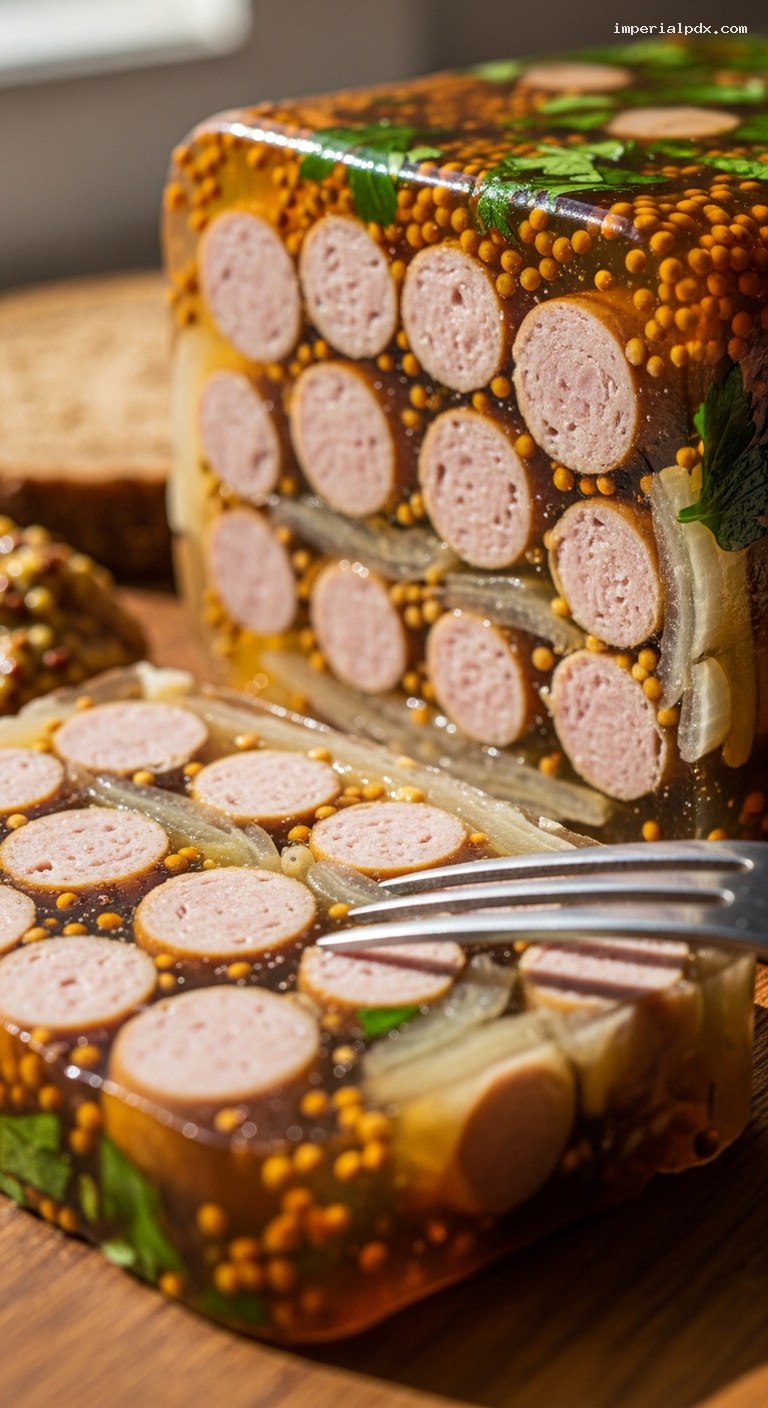
Step-by-Step Instructions
Step 1: Prepare the pan and ingredients
Line a 9×5 in (23×13 cm) loaf pan with plastic wrap, allowing plenty of overhang on all sides. This overhang will help you lift the terrine out later, so do not skip it. Smooth the plastic into the corners as neatly as you can.
Pat the bratwursts dry with paper towels so they brown nicely. Slice the onion in half from root to tip, then cut into thin half-moons. Finely chop the parsley and set it aside in the refrigerator to keep it fresh.
Step 2: Brown the bratwurst
In a wide, heavy-bottomed skillet or saucepan, heat the oil or butter over medium heat. When hot, add the bratwursts in a single layer. Brown them gently on all sides, turning every few minutes, for about 6–8 minutes total. They do not need to be cooked through yet; you just want a nice golden color for deeper flavor.
Once browned, transfer the sausages to a plate. Do not wipe out the pan; the browned bits on the bottom will flavor the broth.
Step 3: Beer-braise with onions, mustard seeds, and aromatics
In the same pan over medium heat, add the sliced onion and a pinch of salt. Cook, stirring often, until the onion softens and becomes translucent, about 5–7 minutes. It is fine if it picks up some browned bits from the pan.
Add the whole mustard seeds, bay leaf, and black peppercorns. Stir for 30 seconds to lightly toast the seeds and release their aroma.
Pour in the beer, scraping the bottom of the pan with a wooden spoon to dissolve any browned bits. Add the stock and stir to combine. Return the browned bratwursts (and any accumulated juices) to the pan.
Bring the mixture just up to a gentle simmer over medium heat, then reduce the heat to low. Simmer uncovered for 20–25 minutes, turning the sausages once or twice, until they are cooked through (internal temperature about 160°F / 71°C) and the onions are very soft.
Step 4: Strain, reduce, and season the braising liquid
Use tongs to remove the bratwursts to a cutting board. Let them cool until comfortable to handle.
Set a fine-mesh sieve over a large heatproof bowl or measuring jug and pour the contents of the pan through it. Press gently on the onions with the back of a spoon to extract as much flavorful liquid as possible. Reserve the onions separately; discard the bay leaf and peppercorns.
Measure the strained liquid. You want about 3 cups (720 ml) total. If you have more than 3 cups, return it to the pan and simmer over medium heat to reduce until you reach about 3 cups. If you have slightly less, you can top up with a little extra stock or water.
Season the hot liquid with 1 Tbsp apple cider vinegar, 2 tsp Dijon mustard, 1 tsp kosher salt, and a few grinds of black pepper. Whisk well to dissolve the mustard. Taste carefully: the liquid should be well seasoned and slightly tangy, because the flavor will mute a bit when chilled. Add more salt or vinegar to taste if needed. Set aside about ½ cup (120 ml) of this liquid in a separate small bowl to cool slightly; you will use it to bloom the gelatin.
Step 5: Bloom and dissolve the gelatin
Sprinkle the powdered gelatin evenly over the surface of the reserved ½ cup (120 ml) of warm-but-not-hot braising liquid. Let it stand undisturbed for 5–10 minutes. The gelatin will absorb the liquid and swell; this is called blooming.
Meanwhile, keep the remaining 2 ½ cups (600 ml) of seasoned braising liquid hot but not boiling; if it has cooled, warm it gently over low heat until steaming.
Once the gelatin has bloomed and looks thick and spongy, scrape it into the pot with the hot braising liquid. Whisk continuously over low heat until all the gelatin has dissolved completely, 1–2 minutes. Do not let the mixture come to a boil, which can weaken the gelatin.
When the liquid is clear and smooth with no visible granules, remove it from the heat. Let it cool until it is warm to the touch but not hot, about 10–15 minutes; this helps keep the sausage pieces from floating too much when you assemble the terrine.
Step 6: Chop the bratwurst and assemble the terrine
While the gelatin mixture is cooling, cut the cooled bratwursts into bite-size pieces, about ½ in (1.25 cm) thick. Aim for relatively even pieces so the slices look neat.
In a bowl, gently toss the chopped bratwurst with the reserved braised onions and the chopped parsley. Taste a piece and add a tiny pinch of salt or pepper if you think the filling itself needs it, keeping in mind the gelatin-rich broth is already seasoned.
Spread about one-third of the sausage-onion mixture in an even layer over the bottom of the lined loaf pan. Give the warm gelatin-beer broth a stir, then ladle in enough to just cover the layer. Tap the pan firmly but gently on the counter to release any air bubbles.
Repeat with another third of the sausage mixture and more liquid, then the final third and the remaining liquid, ensuring everything is fully submerged. Again, tap the pan on the counter several times to help the liquid settle and air escape. Fold the plastic wrap over the top to cover.
Step 7: Chill until firm, unmold, and serve
Transfer the assembled terrine to the refrigerator and chill undisturbed for at least 8 hours, preferably overnight, until completely set and very firm to the touch.
To unmold, peel back the top plastic wrap. Place a serving platter or cutting board over the loaf pan, then flip the whole thing over. Lift off the pan and carefully peel away the plastic wrap from the terrine. If it resists, you can briefly dip the outside of the pan in warm water before flipping to loosen it (do not let water touch the terrine itself).
Use a sharp knife warmed in hot water and wiped dry to slice the terrine into ½–¾ in (1.25–2 cm) thick slices. Wipe and re-warm the knife between slices for clean cuts.
Serve the terrine cold or just slightly cool, with mustard, cornichons, rustic or rye bread, and a sprinkle of fresh parsley or chives on top for color.
Pro Tips
- Choose the right beer: A clean, malty lager or pilsner works best. Avoid very bitter IPAs or heavily smoked beers, which can dominate the flavor and make the jelly taste harsh.
- Do not skimp on gelatin: For a firm, sliceable terrine that holds its shape, the ratio here (3 envelopes to about 3 cups liquid) is intentional. Using less may result in a wobbly terrine that falls apart when sliced.
- Keep the gelatin from boiling: Heat it just enough to dissolve. Boiling can break down the setting power and lead to a weak set.
- Neat slices need a sharp knife: A thin, sharp slicing knife or chef’s knife, warmed in hot water and dried before each cut, gives the cleanest, most attractive slices.
- Make it ahead for deeper flavor: The terrine actually tastes better on day two as the flavors meld, so it is ideal to make it a full day before you plan to serve it.
Variations
- Smoky bacon and brat terrine: Add 3–4 oz (85–115 g) finely diced smoked bacon or speck when you brown the bratwursts. Render until lightly crisp, then continue with the recipe. The smokiness adds a speck-like note to the jelly.
- Herb and garlic version: Add 1 lightly crushed garlic clove and a few sprigs of thyme to the braise (remove them before straining). Stir an extra tablespoon of mixed chopped herbs (parsley, chives, tarragon) into the sausage mixture before assembling.
- Oktoberfest platter: Set a thin layer of well-drained sauerkraut (squeezed dry) under the first layer of sausage in the mold, and use a darker Märzen-style beer in the braise. Serve slices with soft pretzels.
Storage & Make-Ahead
Once fully set, the bratwurst terrine can be stored tightly wrapped in plastic wrap or in an airtight container in the refrigerator for up to 4 days. Keep it cold at all times and slice only what you plan to serve; return the rest to the fridge promptly.
This recipe is perfect for making ahead: plan to prepare it at least 1 day before serving so it has plenty of time to firm up and the flavors can meld. Freezing is not recommended, as freezing and thawing will damage the delicate jelly texture and may cause it to weep or become grainy.
Nutrition (per serving)
Approximate values for 1 of 8 servings (without bread or condiments): about 260 calories; 17 g protein; 19 g fat; 5 g carbohydrates; 1 g fiber; 2 g sugar; 780 mg sodium. Actual values will vary based on the specific sausages, stock, and beer you use.