Quick Recipe Version (TL;DR)
Quick Ingredients
- 2 large duck breasts (10–12 oz / 280–340 g each), skin-on, boneless
- 3/4 cup (110 g) pitted cherries, chopped (fresh or thawed frozen)
- 1 small shallot + 1 small garlic clove, finely minced
- 3 tbsp unsalted butter, divided
- 2 tsp olive oil, divided
- 2 tsp chopped fresh thyme, 1 tsp chopped rosemary, 2 tbsp chopped parsley
- 1 tsp finely grated orange zest
- 2 tbsp (30 ml) dry red wine or ruby port + 1 tbsp (15 ml) brandy (optional)
- 1 tsp red wine or sherry vinegar
- 1/4 cup (15 g) fresh breadcrumbs
- 1 1/4 tsp kosher salt + 1/2 tsp black pepper, divided
- 1 tsp honey + 1 tsp Dijon mustard (for glaze)
- 1/3 cup (80 ml) red wine, 1/4 cup (60 ml) stock, 2 tbsp cherry jam (for sauce, optional)
Do This
- 1. Sauté shallot and garlic in 1 tbsp butter and 1 tsp oil; add cherries, herbs, wine, brandy, zest, vinegar, and breadcrumbs. Cook until thick and jammy; cool.
- 2. Trim and score duck skin. Butterfly breasts, open flat, and gently pound to an even thickness. Season with salt and pepper.
- 3. Spread cooled cherry stuffing over meat side, leaving a border. Roll tightly into a log, skin outside, and tie with kitchen twine. Chill 20–30 minutes.
- 4. Sear roulade in an oven-safe skillet, skin side down first, until golden and much of the fat is rendered. Brush with honey–Dijon.
- 5. Roast at 275°F (135°C) for 20–25 minutes, until internal temperature is 145–150°F (63–66°C). Cool to room temperature.
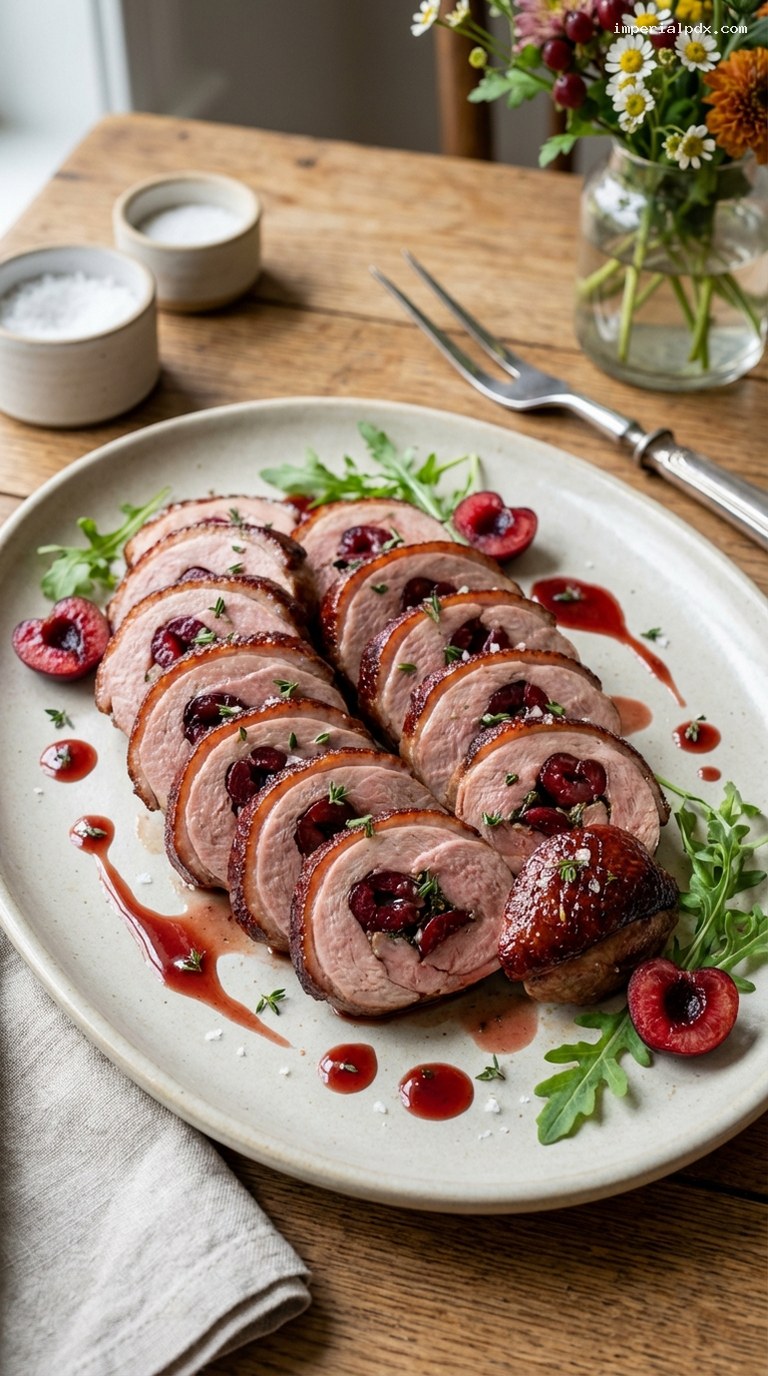
- 6. Wrap and chill at least 4 hours until firm. Slice into 1/4-inch (6 mm) rounds. Optional: make quick cherry pan sauce in the same skillet and serve alongside.
Why You’ll Love This Recipe
- Elegant but approachable: impressive charcuterie-style duck that a patient home cook can absolutely pull off.
- Beautiful contrast of flavors: rich duck, bright cherries, fresh herbs, and a gentle hint of orange and wine.
- Perfect make-ahead centerpiece: it is meant to be served cold, so you can prepare it the day before.
- Thin slices go a long way: a small amount of duck serves many guests as part of a grazing board.
Grocery List
- Produce: Cherries, shallot, garlic, fresh thyme, fresh rosemary, flat-leaf parsley, orange, optional arugula or salad greens.
- Dairy: Unsalted butter.
- Pantry: Duck breasts (skin-on, boneless), olive oil, fresh breadcrumbs, kosher salt, black pepper, honey, Dijon mustard, dry red wine or port, brandy (optional), red wine or sherry vinegar, cherry jam or preserves, chicken or duck stock, flaky sea salt.
Full Ingredients
For the Duck Roulade
- 2 large duck breasts (10–12 oz / 280–340 g each), skin-on, boneless
- 3/4 tsp kosher salt, divided
- 1/2 tsp freshly ground black pepper, divided
- 1 tsp honey
- 1 tsp Dijon mustard
- 1 tsp olive oil (for searing)
For the Cherry-Herb Stuffing
- 1 tbsp (14 g) unsalted butter
- 1 tsp olive oil
- 1 small shallot, finely minced (about 2 tbsp / 15 g)
- 1 small garlic clove, minced
- 3/4 cup (110 g) pitted sweet cherries, roughly chopped (fresh, or frozen and thawed, well drained)
- 2 tsp fresh thyme leaves, finely chopped
- 1 tsp fresh rosemary leaves, finely chopped
- 2 tbsp fresh flat-leaf parsley, finely chopped
- 1 tsp finely grated orange zest
- 2 tbsp (30 ml) dry red wine or ruby port
- 1 tbsp (15 ml) brandy (optional but lovely)
- 1 tsp red wine vinegar or sherry vinegar
- 1/4 cup (15 g) fresh breadcrumbs (from a firm white or country bread)
- 1/2 tsp kosher salt
- 1/4 tsp freshly ground black pepper
For the Cherry Pan Sauce (Optional but Recommended)
- 2 tbsp (28 g) duck fat from the pan (or 1 tbsp if that is all you have)
- 1/3 cup (80 ml) dry red wine
- 1/4 cup (60 ml) low-sodium chicken or duck stock
- 2 tbsp cherry jam or preserves
- 1 tsp red wine vinegar or sherry vinegar
- 2 tbsp (28 g) cold unsalted butter
- Pinch kosher salt and freshly ground black pepper, to taste
To Serve
- Small handful of baby arugula or mixed salad greens (optional, for plating)
- A few extra cherries, halved or quartered, for garnish (optional)
- Fresh thyme or parsley leaves, for sprinkling
- Flaky sea salt, for finishing
- Crusty bread, crackers, and other charcuterie board items, as desired
Step-by-Step Instructions
Step 1: Make the cherry-herb stuffing
In a medium skillet, heat 1 tbsp butter and 1 tsp olive oil over medium heat until the butter is melted and just starting to foam. Add the minced shallot and cook, stirring often, for 2–3 minutes until softened and translucent. Add the minced garlic and cook for 30 seconds more, just until fragrant.
Stir in the chopped cherries, thyme, and rosemary, plus a small pinch of salt. Cook for 3–4 minutes, stirring occasionally, until the cherries soften and release their juices and the pan looks a little jammy.
Pour in the red wine or port and brandy (if using). Let it bubble gently for 2–3 minutes, stirring, until most of the liquid has evaporated and the mixture is thick and glossy. Take the pan off the heat and stir in the orange zest, vinegar, fresh parsley, breadcrumbs, 1/2 tsp salt, and 1/4 tsp pepper.
The stuffing should be moist and hold together if you press it with a spoon, but not wet or runny. If it seems too loose, add a few more breadcrumbs; if it seems dry, sprinkle in a teaspoon or two of water or wine. Scrape the stuffing into a shallow bowl or plate and let it cool completely while you prepare the duck (about 10 minutes). Cool stuffing is important so it does not overcook the duck from the inside.
Step 2: Prep and butterfly the duck breasts
Pat the duck breasts very dry with paper towels. Trim any dangling flaps of fat or skin so you have neat, roughly rectangular pieces. Using a sharp knife, lightly score the skin in a diagonal crosshatch pattern about 1/2 inch (1 cm) apart, cutting through the skin and most of the fat but not into the meat. This helps render fat and gives a beautiful pattern later.
Place a duck breast on a cutting board, skin side down. With your knife parallel to the board, carefully slice into the thickest side of the meat, creating a “book” that opens out. Do not cut all the way through; leave about 1/2 inch (1 cm) uncut so it can open like a butterfly. Repeat with the second breast.
Open each breast out flat. Cover with a sheet of plastic wrap and gently pound the thickest parts with a meat mallet or the bottom of a small pan until you have an even thickness of about 1/2 inch (1.3 cm). This does not need to be perfect; you just want a fairly even rectangle so it rolls nicely.
Season the meat side of each breast with 1/4 tsp kosher salt and a light sprinkle of black pepper (save the rest for later). Flip so the skin side is down, ready to fill.
Step 3: Fill and roll the duck into a tight roulade
Divide the cooled cherry-herb stuffing between the two prepared duck breasts. Spread it evenly over the meat side, leaving a clean border of about 1/2 inch (1 cm) all the way around so the filling has room when you roll.
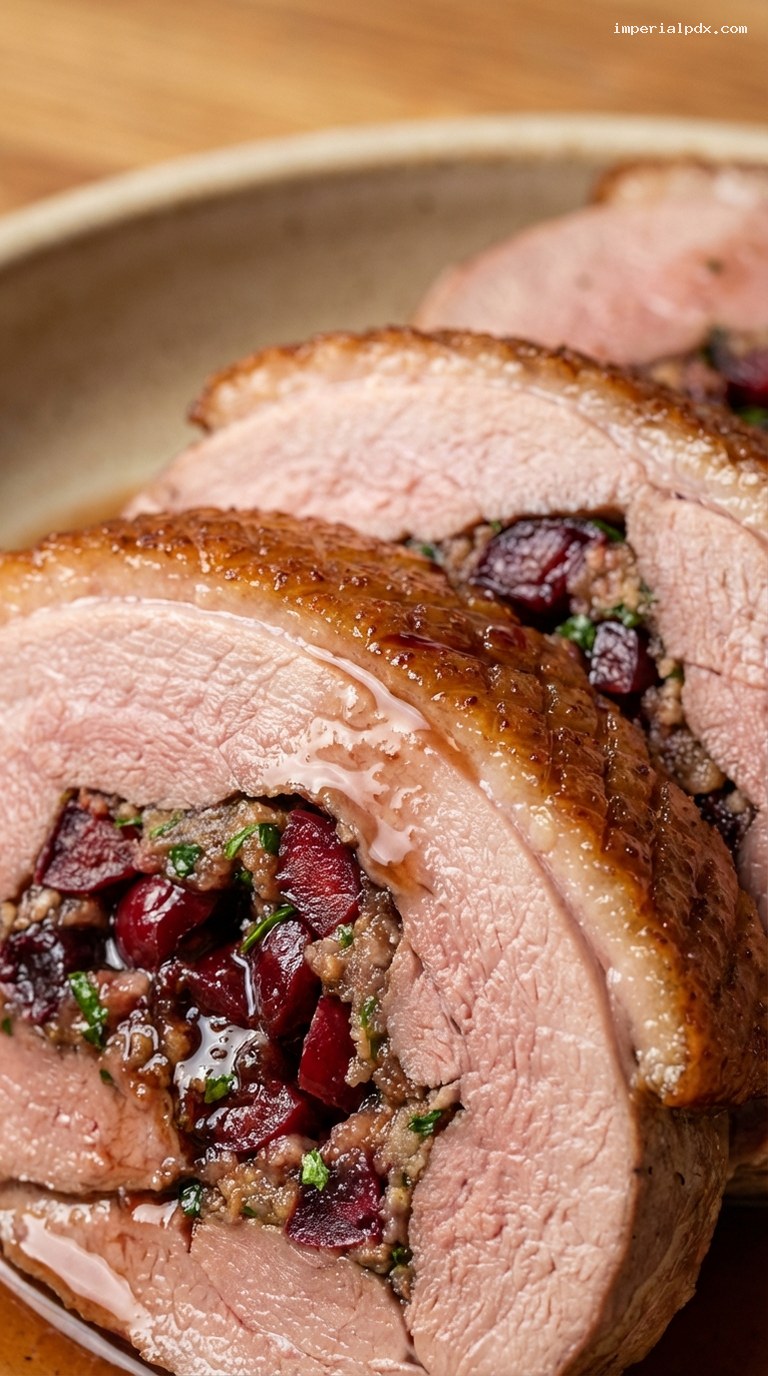
Starting from a long side of each breast, roll the meat up snugly over the stuffing, keeping the roll as tight and even as possible. You want the skin on the outside of the finished log. If any stuffing tries to escape, nudge it back in with your fingers and keep rolling.
Once rolled, position each roulade seam-side down. Cut lengths of kitchen twine and tie the roulade at 1–1 1/2 inch (2.5–4 cm) intervals, just tight enough to hold the shape without squeezing the filling out. Tuck in the end flaps of skin and secure with extra twine if needed.
Mix together the honey and Dijon mustard in a small bowl (you will brush this on later). Place the tied roulades on a plate, cover lightly, and refrigerate for 20–30 minutes to help them firm up. Meanwhile, preheat your oven to 275°F (135°C).
Step 4: Sear the roulade to render and brown the skin
When you are ready to cook, heat a heavy, oven-safe skillet (cast iron or stainless steel) over medium heat. Add 1 tsp olive oil. Place the duck roulades in the pan, seam-side up at first so you can quickly adjust any loose twine, then roll them so they are skin side down.
Cook over medium heat for 6–8 minutes, letting the fat slowly render and the skin turn deep golden brown. Regulate the heat so the fat bubbles moderately but does not smoke or burn. Spoon off excess fat into a heatproof bowl as it accumulates, leaving just a thin film in the pan (save that fat for roasting potatoes or making the sauce).
Once the skin side is nicely browned and much of the fat has rendered, carefully roll the roulades to brown the remaining sides for 2–3 minutes total, just to add some color. Turn the roulades skin side up. Brush them lightly and evenly with the prepared honey–Dijon mixture for a gentle glaze.
Step 5: Gently roast until just cooked through
Transfer the skillet with the seared roulades to the preheated 275°F (135°C) oven. Roast for 20–25 minutes, turning the pan halfway through, until an instant-read thermometer inserted into the center of the thickest part registers 145–150°F (63–66°C) for medium doneness. For fully cooked (but less pink) duck, aim for 160°F (71°C).
Remove the skillet from the oven and transfer the roulades to a clean cutting board. Sprinkle lightly with the remaining kosher salt and black pepper. Let them rest uncovered at room temperature for 10–15 minutes, until they are warm but no longer hot. This relaxes the meat and makes chilling more even later.
Pour most of the fat from the skillet into a container, leaving about 2 tbsp in the pan if you plan to make the optional sauce. Set the skillet aside; do not wash it yet.
Step 6: Chill thoroughly, then slice into elegant coins
Once the roulades have cooled to just slightly warm, wrap each one tightly in plastic wrap or foil, shaping them into neat cylinders as you wrap. This helps them hold a perfect round shape. Place the wrapped roulades on a plate or small tray and refrigerate for at least 4 hours, or preferably overnight, until completely cold and firm.
When ready to serve, unwrap the duck. Using a very sharp, thin-bladed knife, trim off a thin slice from each end to reveal a clean cross-section. Then slice into 1/4-inch (6 mm) rounds. For especially clean slices, wipe the blade with a warm, damp cloth or rinse and dry between cuts.
Arrange the slices slightly overlapping on a platter or wooden board. If using, scatter a few baby greens, fresh cherry halves, and herb leaves around and over the slices. Finish with a light sprinkle of flaky sea salt just before serving.
Step 7: Make the cherry pan sauce (optional) and serve
To make a simple sauce, place the reserved skillet with about 2 tbsp duck fat over medium heat. Add the 1/3 cup red wine and bring to a simmer, scraping up all the browned bits from the bottom with a wooden spoon. Reduce the wine by about half, 3–4 minutes.
Add the 1/4 cup stock and 2 tbsp cherry jam. Simmer gently for another 4–5 minutes, stirring occasionally, until the sauce is slightly thickened and glossy. Stir in the 1 tsp vinegar. Turn off the heat and whisk in the 2 tbsp cold butter, one cube at a time, until the sauce is silky. Season with a pinch of salt and pepper to taste.
For a refined presentation, spoon small puddles or drizzles of the warm sauce on the platter and nestle slices of cold duck roulade on top, or serve the sauce in a small ramekin alongside your charcuterie board so guests can add a dab to individual slices.
Pro Tips
- Cool stuffing, not hot: Filling the duck with hot stuffing can overcook the meat from the inside and make rolling messy. Give it time to cool to room temperature.
- Roll tightly but gently: A snug roll makes beautiful, tidy slices. If you see gaps, unwrap and re-roll before tying; it is easier to fix at the beginning.
- Do not rush the chill: The roulade must be thoroughly cold and firm to slice cleanly. Overnight chilling gives the best texture and presentation.
- Use your sharpest knife: A long, thin carving or chef’s knife works best. Gentle sawing motions help protect the stuffing layers.
- Save the duck fat: Any extra rendered fat is liquid gold for roasting potatoes, sautéing greens, or enriching the sauce.
Variations
- Dried cherry and pistachio: Replace half the fresh cherries with dried tart cherries, chopped, and add 2–3 tbsp chopped pistachios to the stuffing for a more nutty, chewy texture.
- Orange-fig and sage: Swap the cherries for chopped dried figs, double the orange zest, and replace rosemary with finely chopped fresh sage for a slightly sweeter, more aromatic roulade.
- Chicken roulade version: Use 2 large boneless, skin-on chicken breasts instead of duck. Butterfly and pound as directed, then follow the same stuffing, rolling, and roasting steps, cooking to an internal temperature of 165°F (74°C).
Storage & Make-Ahead
This recipe is ideal for making ahead. Once the roulades are cooked, wrapped, and chilled, they will keep in the refrigerator for up to 3 days. Slice just before serving for the cleanest look. The optional cherry pan sauce can be refrigerated in an airtight container for 3 days; rewarm gently over low heat, whisking in a teaspoon of water if needed to loosen.
For longer storage, you can freeze the whole chilled roulade tightly wrapped in plastic and then foil for up to 2 months. Thaw overnight in the refrigerator before slicing. If you plan to freeze, skip the sauce until serving day and make it fresh from the reserved duck fat and pan drippings.
Nutrition (per serving)
Approximate values for 1 of 6 appetizer servings (about 4–5 slices, without bread or extras): around 410 calories, 25 g fat, 11 g carbohydrates, 34 g protein, 2 g fiber, and 7 g sugar. Actual numbers will vary with the size of the duck breasts, how much fat is trimmed or rendered, and how much sauce is used.