
Quick Recipe Version (TL;DR)
Quick Ingredients
- 6 large eggs
- 3/4 cup liquid from 1 can sliced beets, plus 1/2 cup beet slices
- 3/4 cup distilled white vinegar
- 1/2 cup water
- 1/4 cup granulated sugar
- 1 1/2 teaspoons kosher salt for the brine
- 1/2 teaspoon whole black peppercorns
- 3 tablespoons mayonnaise
- 1 teaspoon Dijon mustard
- 1 teaspoon prepared horseradish, drained
- 1 teaspoon reserved beet brine
- 1 tablespoon chopped fresh dill, plus 2 teaspoons for garnish
- 1/8 teaspoon kosher salt for the filling
- 1/4 teaspoon cracked black pepper, divided
Do This
- 1. Boil the eggs for 11 minutes, then chill them in ice water for 10 minutes.
- 2. Simmer the beet liquid, vinegar, water, sugar, salt, and peppercorns for 2 minutes; cool for 15 minutes.
- 3. Peel the eggs, cover them with the brine and beet slices, and refrigerate at 40°F or colder for 8 hours.
- 4. Drain, dry, and halve the pickled eggs; transfer the yolks to a bowl.
- 5. Mash the yolks with mayonnaise, Dijon, horseradish, beet brine, dill, salt, and black pepper.
- 6. Fill the egg-white halves, garnish with dill and cracked pepper, and serve chilled.
Why You’ll Love This Recipe
- The beet brine turns ordinary eggs a striking natural pink.
- Dijon mustard and horseradish give the creamy filling a lively, savory bite.
- Fresh dill and cracked black pepper add freshness without overpowering the eggs.
- Most of the work can be completed in advance, making this an easy party appetizer.
Grocery List
- Produce: Fresh dill
- Dairy: 6 large eggs, mayonnaise
- Pantry: 1 can sliced beets, distilled white vinegar, granulated sugar, kosher salt, whole black peppercorns, Dijon mustard, prepared horseradish, cracked black pepper
Full Ingredients
For the Pickled Eggs
- 6 large eggs
- 3/4 cup beet liquid drained from one 15-ounce can sliced beets
- 1/2 cup canned sliced beets
- 3/4 cup distilled white vinegar
- 1/2 cup water
- 1/4 cup granulated sugar
- 1 1/2 teaspoons kosher salt
- 1/2 teaspoon whole black peppercorns
For the Deviled Egg Filling
- 6 cooked egg yolks from the pickled eggs
- 3 tablespoons mayonnaise
- 1 teaspoon Dijon mustard
- 1 teaspoon prepared horseradish, drained of excess liquid
- 1 teaspoon reserved beet brine
- 1 tablespoon finely chopped fresh dill
- 1/8 teaspoon kosher salt
- 1/8 teaspoon cracked black pepper
For Garnishing
- 2 teaspoons finely chopped fresh dill or 12 small dill sprigs
- 1/8 teaspoon cracked black pepper
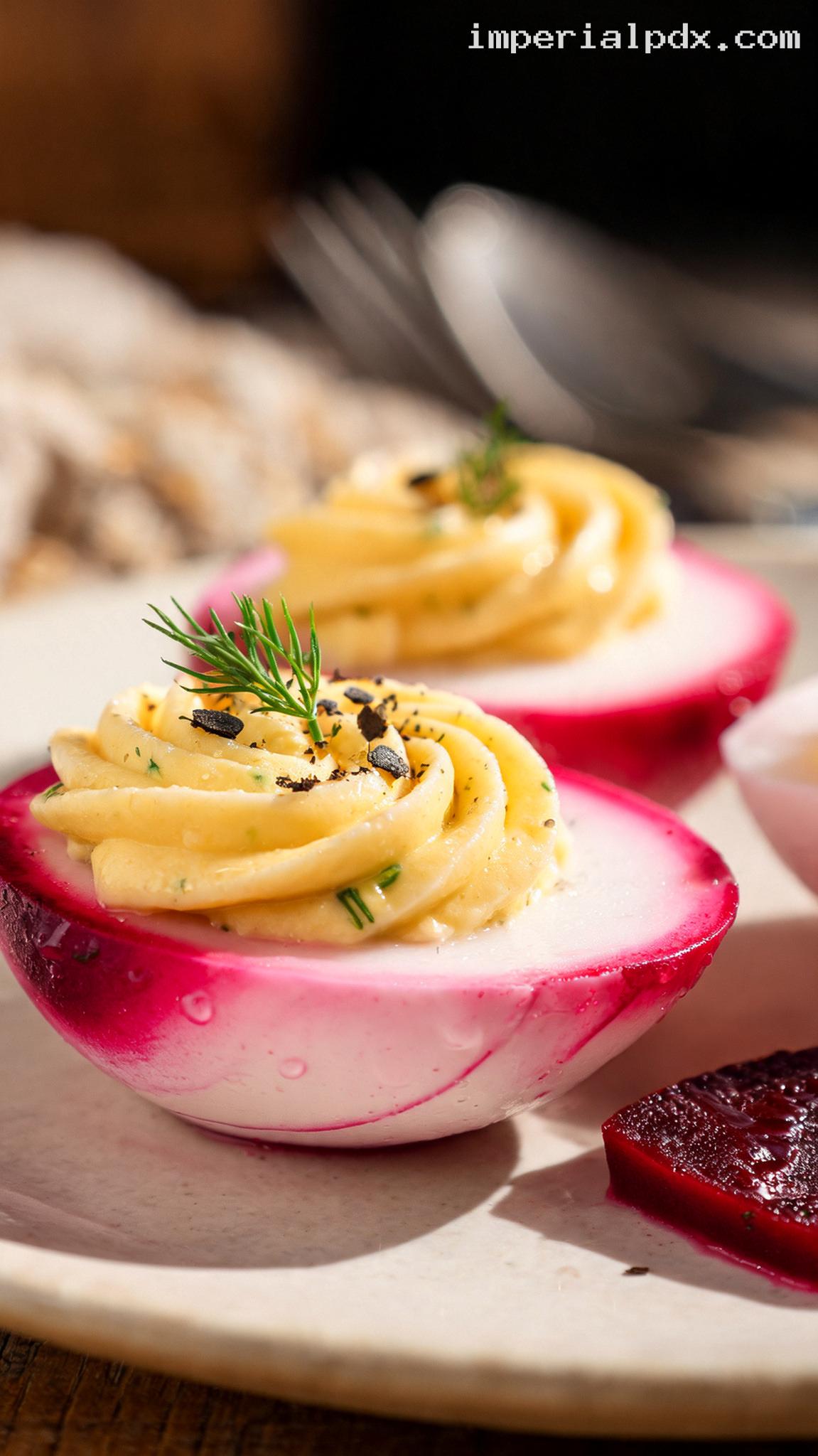
Step-by-Step Instructions
Step 1: Cook and chill the eggs
Fill a medium saucepan with enough water to cover the eggs by 1 inch and bring it to a full boil over high heat, approximately 212°F at sea level. Carefully lower the 6 eggs into the boiling water with a slotted spoon. Adjust the heat to maintain a gentle boil and cook for exactly 11 minutes.
While the eggs cook, fill a medium bowl with equal amounts of ice and cold water. Transfer the cooked eggs directly to the ice bath and leave them there for 10 minutes. This stops the cooking process and helps prevent a gray-green ring around the yolks.
Step 2: Make the beet pickling brine
While the eggs cool, combine 3/4 cup beet liquid, 3/4 cup distilled white vinegar, 1/2 cup water, 1/4 cup sugar, 1 1/2 teaspoons kosher salt, and 1/2 teaspoon whole peppercorns in a small saucepan. Bring the mixture to a gentle simmer over medium heat, approximately 200°F to 205°F. Stir and simmer for 2 minutes, until the sugar and salt are completely dissolved.
Remove the brine from the heat and let it cool for 15 minutes, or until it is no warmer than 100°F. Cooling the brine before adding the eggs helps keep the egg whites tender.
Step 3: Peel and pickle the eggs
Gently tap each chilled egg on the counter, roll it to loosen the shell, and peel it under a thin stream of cool water. Place the peeled eggs and 1/2 cup sliced beets in a clean 1-quart glass jar or a nonreactive container with a tight-fitting lid.
Pour the cooled brine and peppercorns over the eggs, making sure the eggs are completely submerged. Cover and refrigerate at 40°F or colder for exactly 8 hours for a vivid pink exterior and a delicate pink ring inside. Turn the eggs once after 4 hours if they are packed tightly. For deeper color, they may remain in the brine for up to 12 hours, but avoid pickling them longer than 24 hours because the whites can become firm and rubbery.
Step 4: Halve the pickled eggs
Remove the eggs from the brine, reserving 1 teaspoon of the brine for the filling. Pat the eggs thoroughly dry with paper towels so they do not slide while being cut. Slice each egg in half lengthwise with a thin, sharp knife, wiping the blade between cuts for clean edges. Gently lift out the yolks and place them in a medium bowl. Arrange the 12 pink egg-white halves on a serving platter.
Step 5: Prepare the creamy yolk filling
Mash the yolks thoroughly with a fork until no large lumps remain. Add 3 tablespoons mayonnaise, 1 teaspoon Dijon mustard, 1 teaspoon drained prepared horseradish, 1 teaspoon reserved beet brine, 1 tablespoon chopped dill, 1/8 teaspoon kosher salt, and 1/8 teaspoon cracked black pepper. Stir and press the mixture against the side of the bowl until smooth, creamy, and evenly combined.
For an especially silky filling, press the cooked yolks through a fine-mesh sieve before mixing in the remaining ingredients. The finished filling should be soft enough to pipe while still holding its shape.
Step 6: Fill the eggs
Transfer the yolk mixture to a piping bag fitted with a large open-star or round tip. Alternatively, spoon it into a zip-top bag and cut a 1/2-inch opening from one corner. Divide the filling evenly among the 12 egg-white halves, using approximately 1 tablespoon per half. You may also use two small spoons for a relaxed, rustic presentation.
Step 7: Garnish and serve
Top the eggs with 2 teaspoons chopped fresh dill or one small dill sprig per half. Finish with the remaining 1/8 teaspoon cracked black pepper. Refrigerate the assembled eggs for 15 minutes before serving so the filling is nicely chilled. Serve at 40°F or slightly above refrigerator temperature for the best flavor and texture.
Pro Tips
- Use a glass or nonreactive container: Vinegar can react with aluminum, copper, and cast iron, which may affect the flavor and color of the brine.
- Keep the eggs submerged: If an egg floats above the brine, place a small piece of parchment paper directly on the surface or turn the eggs every 2 hours for even coloring.
- Drain the horseradish: Press out excess liquid before measuring so the filling stays thick enough to pipe.
- Wipe the knife between cuts: A clean, slightly damp blade produces neat pink-and-yellow layers without smearing the yolks.
- Pipe just before serving when possible: The eggs will look freshest and the piped filling will keep its shape particularly well.
Variations
- Spicy beet deviled eggs: Add 1/4 teaspoon cayenne pepper and 1 teaspoon hot sauce to the yolk filling.
- Extra-herby filling: Replace 1 teaspoon of the dill with 1 teaspoon finely chopped chives or fresh tarragon.
- Smoky version: Add 1/4 teaspoon smoked paprika to the filling and garnish each egg with an additional light dusting.
Storage & Make-Ahead
The whole peeled eggs may be pickled up to 24 hours in advance and kept covered in the refrigerator at 40°F or colder. For easier party preparation, make the filling up to 1 day ahead and refrigerate it in an airtight container or sealed piping bag; store the drained egg-white halves separately, then fill them shortly before serving. Assembled deviled eggs can be refrigerated in a covered container for up to 2 days. Do not leave them at room temperature for more than 2 hours, or more than 1 hour when the temperature is above 90°F. Do not freeze the eggs, and discard the used pickling brine rather than reusing it.
Nutrition (per serving)
Calories: 125 kcal | Carbs: 2g | Protein: 6g | Fat: 10g | Saturated Fat: 2g | Fiber: 0g | Sugar: 2g | Sodium: 300mg | Cholesterol: 188mg