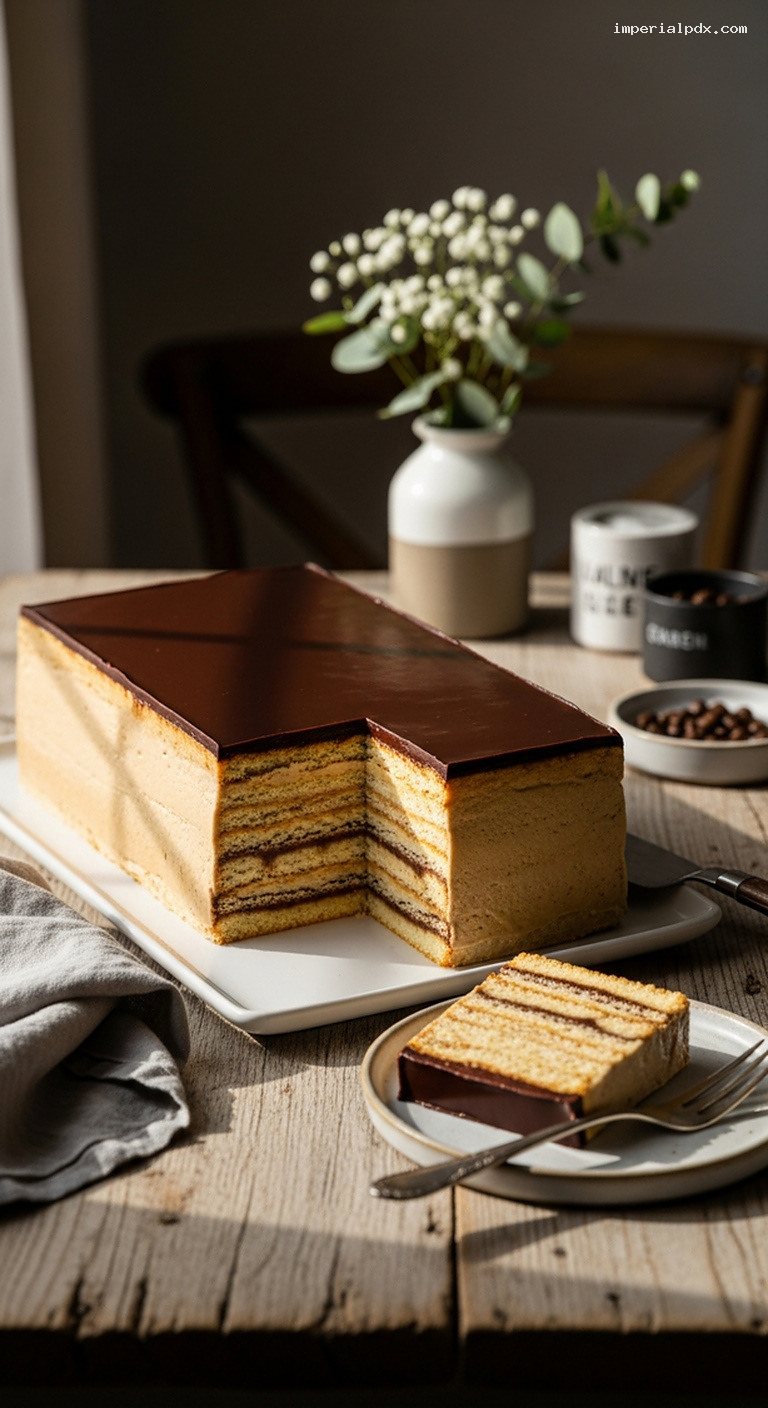
Quick Recipe Version (TL;DR)
Quick Ingredients
- Almond joconde sponge: 1 1/2 cups (150 g) almond flour; 1 1/2 cups (180 g) powdered sugar; 1/2 cup (60 g) all-purpose flour; 6 large eggs; 6 large egg whites; 1/4 cup (50 g) granulated sugar; 3 tbsp (45 g) unsalted butter, melted; 1/4 tsp fine salt.
- Coffee syrup: 1/2 cup (120 ml) water; 1/2 cup (100 g) granulated sugar; 2 tbsp instant espresso powder; 1–2 tbsp coffee liqueur (optional).
- Coffee buttercream: 5 large egg yolks; 3/4 cup (150 g) granulated sugar; 1/4 cup (60 ml) water; 1 1/2 cups (340 g) unsalted butter, very soft; 2 tbsp instant espresso powder + 2 tbsp hot water; 1 tsp vanilla extract; pinch fine salt.
- Dark chocolate ganache: 8 oz (225 g) dark chocolate 60–70%, finely chopped; 3/4 cup (180 ml) heavy cream; 2 tbsp (28 g) unsalted butter; 1 tbsp light corn syrup (optional).
- Chocolate glaze: 7 oz (200 g) dark chocolate 60–70%, finely chopped; 1/2 cup (120 ml) heavy cream; 2 tbsp (28 g) unsalted butter; 1 tbsp light corn syrup or neutral oil.
- Finishing: Cocoa powder or chopped chocolate for dusting edges (optional); edible gold leaf, chocolate curls, or coffee beans for garnish (optional).
Do This
- 1. Preheat oven to 400°F (200°C). Line a 12×17-inch (30×43 cm) rimmed baking sheet with parchment and lightly grease.
- 2. Make joconde: Whip whole eggs with almond flour, powdered sugar, and flour. Separately whip egg whites with sugar to medium peaks; fold into egg mixture with melted butter. Spread thinly in pan and bake 8–10 minutes until lightly golden. Cool and cut into 3 equal rectangles.
- 3. Simmer water and sugar for the coffee syrup, stir in espresso (and liqueur if using), and cool completely.
- 4. Make coffee buttercream: Beat yolks; cook sugar and water to 240°F (116°C) and stream into yolks. Beat until cool, then beat in soft butter, espresso concentrate, vanilla, and salt.
- 5. Make ganache: Pour hot cream over chopped chocolate, butter, and corn syrup; rest 2 minutes, then whisk smooth. Cool until thick but spreadable.
- 6. Assemble: Place first sponge on board, brush with syrup, spread half the buttercream. Top with second sponge, syrup, and all the ganache. Chill, then add third sponge, remaining syrup, and remaining buttercream. Chill until firm.
- 7. Make glaze: Pour warm glaze over chilled cake, smooth once, and chill until set. Trim edges and slice into neat rectangles to serve.
Why You’ll Love This Recipe
- Classic French patisserie at home: delicate almond sponge, intense coffee, and dark chocolate in every bite.
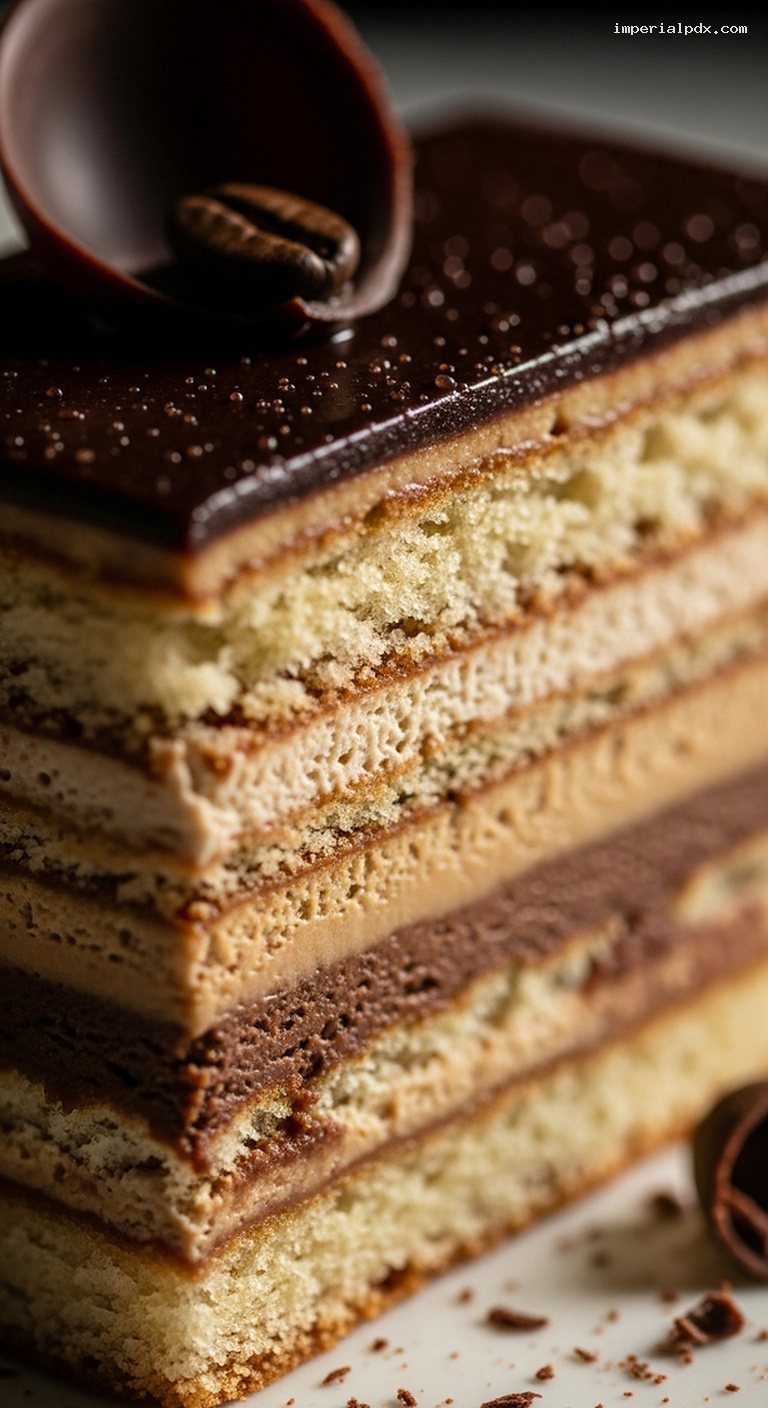
- Refined presentation: razor-sharp layers and a glossy chocolate top that looks straight out of a bakery window.
- Surprisingly make-ahead friendly: each component can be prepared in advance for a stress-free dessert.
- Deep, grown-up flavors: perfect for coffee lovers and chocolate fans who enjoy not-too-sweet desserts.
Grocery List
- Produce: None required (fresh berries or edible flowers optional for serving).
- Dairy: Unsalted butter; heavy cream.
- Pantry: Almond flour; powdered (confectioners’) sugar; granulated sugar; all-purpose flour; fine salt; instant espresso powder; dark chocolate (60–70% cocoa); light corn syrup or neutral oil; vanilla extract; coffee liqueur (optional).
Full Ingredients
For the Almond Joconde Sponge
- 1 1/2 cups (150 g) almond flour (finely ground, blanched almonds)
- 1 1/2 cups (180 g) powdered sugar
- 1/2 cup (60 g) all-purpose flour
- 6 large eggs, at room temperature
- 6 large egg whites, at room temperature
- 1/4 cup (50 g) granulated sugar
- 3 tbsp (45 g) unsalted butter, melted and cooled slightly
- 1/4 tsp fine salt
For the Coffee Syrup
- 1/2 cup (120 ml) water
- 1/2 cup (100 g) granulated sugar
- 2 tbsp instant espresso powder (or very finely ground instant coffee)
- 1–2 tbsp coffee liqueur such as Kahlúa (optional, for depth)
For the Coffee Buttercream
- 5 large egg yolks, at room temperature
- 3/4 cup (150 g) granulated sugar
- 1/4 cup (60 ml) water
- 1 1/2 cups (340 g) unsalted butter, very soft but not melted, cut into cubes
- 2 tbsp instant espresso powder
- 2 tbsp (30 ml) very hot water (to dissolve the espresso)
- 1 tsp vanilla extract
- Pinch of fine salt
For the Dark Chocolate Ganache
- 8 oz (225 g) dark chocolate 60–70% cocoa, finely chopped
- 3/4 cup (180 ml) heavy cream
- 2 tbsp (28 g) unsalted butter, cut into small pieces
- 1 tbsp light corn syrup (optional, for extra shine and softness)
For the Chocolate Glaze
- 7 oz (200 g) dark chocolate 60–70% cocoa, finely chopped
- 1/2 cup (120 ml) heavy cream
- 2 tbsp (28 g) unsalted butter, cut into small pieces
- 1 tbsp light corn syrup or neutral oil (such as grapeseed or canola)
For Finishing
- Edible gold leaf, chocolate curls, or whole coffee beans (optional)
- Cocoa powder or finely chopped dark chocolate for lightly coating the cut edges (optional)
Step-by-Step Instructions
Step 1: Prepare the pan and preheat the oven
Preheat your oven to 400°F (200°C), with a rack in the middle. Lightly grease a 12×17-inch (30×43 cm) rimmed baking sheet (a standard half-sheet pan). Line the bottom with parchment paper, making sure it lies flat with no wrinkles, then lightly grease the parchment as well. This thin, delicate sponge needs the parchment to release cleanly.
Gather and measure all your ingredients for the sponge, syrup, buttercream, ganache, and glaze. For a cake with multiple components like this one, having everything weighed out before you start (mise en place) makes the process much smoother. If your eggs and butter are cold, bring them to room temperature now: set eggs in a bowl of lukewarm water for 5–10 minutes, and cut butter into small cubes to soften.
Step 2: Make the almond joconde sponge
In a medium bowl, whisk together the almond flour, powdered sugar, and all-purpose flour until no lumps remain. In the bowl of a stand mixer fitted with the whisk attachment (or using a hand mixer), add the 6 whole eggs and beat on medium-high speed for about 5 minutes, until thick, pale, and increased in volume. With the mixer on low, gradually add the dry mixture, then increase speed to medium and beat just until smooth and airy, 1–2 minutes.
In a separate clean bowl, add the 6 egg whites and salt. Whip on medium speed until foamy, then slowly rain in the 1/4 cup (50 g) granulated sugar. Increase speed to medium-high and beat until glossy medium peaks form (the peaks hold their shape but gently curl at the tip), about 3–4 minutes. Do not overbeat to stiff, dry peaks.
Using a large spatula, fold about one-third of the whipped whites into the almond batter to lighten it. Gently fold in the remaining whites in two additions, keeping as much air in the batter as possible. Finally, drizzle the melted butter around the edges of the bowl and fold it in just until no streaks remain.
Immediately pour the batter into the prepared pan. Use an offset spatula to spread it into an even, thin layer right to the corners. Bake for 8–10 minutes, rotating the pan halfway through, until the top is lightly golden and springs back when gently pressed. Do not overbake; the cake should remain flexible.
Let the sponge cool in the pan for 5 minutes. Run a thin knife around the edges. Dust a clean sheet of parchment lightly with powdered sugar, then invert the warm cake onto it. Carefully peel off the baking parchment. Allow the cake to cool completely at room temperature.
Once cool, trim just the very browned edges, then measure and cut the sponge into 3 equal rectangles (each approximately 5 1/2 × 11–12 inches, depending on your pan). Set the layers aside, stacked between pieces of parchment to prevent sticking.
Step 3: Make the coffee syrup
In a small saucepan, combine the 1/2 cup (120 ml) water and 1/2 cup (100 g) granulated sugar. Bring to a gentle boil over medium heat, stirring until the sugar is completely dissolved. Once it reaches a simmer, cook for 1 minute, then remove from the heat.
Whisk in the 2 tbsp instant espresso powder until fully dissolved. If using, stir in 1–2 tbsp coffee liqueur for a more complex flavor. Transfer the syrup to a heatproof bowl or cup and let it cool to room temperature. A cool syrup will soak into the sponge more evenly without making it soggy.
Step 4: Make the coffee buttercream
In a small cup, dissolve the 2 tbsp instant espresso powder in 2 tbsp very hot water. Stir until smooth, then let this coffee concentrate cool to room temperature.
Place the 5 egg yolks in the bowl of a stand mixer fitted with the whisk attachment. Beat on medium speed for 2–3 minutes, until slightly thickened and pale.
Meanwhile, in a small saucepan, combine the 3/4 cup (150 g) sugar and 1/4 cup (60 ml) water. Stir just to moisten the sugar. Bring to a boil over medium heat without stirring further. Cook until the syrup reaches 240°F (116°C) on a candy or instant-read thermometer (soft-ball stage). This usually takes about 5–7 minutes from the boil.
With the mixer running on medium speed, carefully and slowly pour the hot sugar syrup in a thin stream down the side of the bowl into the whipping yolks (avoid hitting the whisk directly to minimize splatter). Once all the syrup is added, increase the speed to medium-high and beat until the mixture is very thick, pale, and cooled to room temperature, about 7–10 minutes. The outside of the bowl should feel just slightly warm or completely cool.
With the mixer on medium speed, begin adding the very soft butter, a few pieces at a time. Let each addition incorporate fully before adding more. The mixture may look curdled at some stages; keep beating and it will smooth out as long as everything is at room temperature. When all the butter is in, beat in the coffee concentrate, vanilla, and a small pinch of salt. Beat for 1–2 more minutes until silky and smooth.
If the buttercream seems too soft to spread, refrigerate it for 10–15 minutes, then re-whip briefly. If it seems too cool and stiff, warm the outside of the bowl briefly with your hands or over a pan of warm water and whip again.
Step 5: Make the dark chocolate ganache
Place the 8 oz (225 g) chopped dark chocolate in a heatproof bowl along with the 2 tbsp (28 g) butter and 1 tbsp light corn syrup (if using). In a small saucepan, heat the 3/4 cup (180 ml) heavy cream over medium heat just until it starts to gently simmer around the edges and small bubbles appear. Do not let it boil vigorously.
Pour the hot cream over the chocolate mixture. Let it sit undisturbed for 2–3 minutes to soften the chocolate, then whisk gently from the center outward until smooth, thick, and glossy.
Let the ganache cool at room temperature, stirring occasionally, until it reaches a spreadable consistency similar to soft peanut butter. This usually takes 20–30 minutes. If it thickens too much, you can briefly warm the bowl over a pan of hot water, stirring constantly, until loosened slightly.
Step 6: Assemble the opera cake layers
Choose a flat serving board or tray that will fit in your refrigerator. Place a sheet of parchment on it. Lay the first rectangle of sponge (smoothest side down) on the parchment. Using a pastry brush or spoon, generously soak the surface of the sponge with about one-third of the cooled coffee syrup. You want the sponge to be moist but not collapsing; it should still hold its shape.
Stir the coffee buttercream to loosen. Scoop about half of it onto the first sponge layer and spread it evenly with an offset spatula into a thin, smooth layer (roughly 1/4 inch / 6 mm thick). Make sure to go right to the edges. Place the cake in the refrigerator for about 10–15 minutes to firm the buttercream slightly.
Place the second sponge rectangle on top of the buttercream, lining up the edges neatly. Brush the second sponge with another third of the coffee syrup. Spread all of the cooled, spreadable ganache evenly over this layer, again going right to the edges. Chill for another 20–30 minutes, until the ganache is set but not rock hard.
Place the third sponge rectangle on top of the ganache. Brush with the remaining coffee syrup. Spread the remaining half of the coffee buttercream evenly over the top, aiming for a perfectly smooth, level surface. This top buttercream layer is the base for your glaze, so take your time to get it as flat and even as possible. Chill the assembled cake for at least 45–60 minutes, or until the buttercream is quite firm to the touch.
Step 7: Glaze, chill, and finish the cake
Once the cake is thoroughly chilled and firm, make the glaze. Place the 7 oz (200 g) chopped dark chocolate in a heatproof bowl with the 2 tbsp (28 g) butter and 1 tbsp light corn syrup or neutral oil. Heat the 1/2 cup (120 ml) heavy cream in a small saucepan over medium heat until just beginning to simmer. Pour the hot cream over the chocolate, let stand for 2 minutes, then whisk gently until smooth and shiny.
Let the glaze cool for about 5–10 minutes, stirring occasionally, until it thickens slightly but is still pourable. You want it to flow in a smooth sheet, not run like water.
Remove the cake from the refrigerator. If desired, place the cake on a wire rack set over a baking sheet to catch drips, or leave it on the parchment-lined board if your board has a lip. Pour the glaze in one confident motion along the center of the cake, allowing it to flow out toward the edges. Use an offset spatula to very gently nudge the glaze to cover the entire surface with as few strokes as possible to maintain a mirror-like finish.
Refrigerate the glazed cake for at least 1–2 hours, or until the glaze is fully set and firm to the touch. Once chilled, use a very sharp knife dipped in hot water and wiped dry to trim a thin slice from all four sides of the cake. This reveals perfectly clean layers. Wipe the knife between each cut.
Cut the cake into 12 neat rectangles or small squares. If you like, garnish each piece with a tiny piece of gold leaf, a chocolate curl, or a single coffee bean. Serve slightly chilled or at cool room temperature so the buttercream is silky but the layers still hold their shape.
Pro Tips
- Use a scale if possible. Opera cake is all about balance and precision; weighing ingredients (especially for the sponge and chocolate components) gives the most reliable results.
- Do not overbake the joconde. The sponge should be just set and lightly golden. Overbaking makes it dry and hard to roll or soak with syrup.
- Temperature is everything for buttercream. If the buttercream looks curdled, it is usually too cool; keep whipping or warm the bowl slightly. If it is soupy, it is too warm; chill briefly, then whip again.
- Chill between layers. Allow each layer (especially the buttercream and ganache) to firm up before adding the next. This keeps the layers straight and prevents them from sliding.
- Clean cuts for a professional look. Use a long, sharp knife dipped in hot water and wiped dry between each cut. This gives sharp, bakery-style slices that show off the layers.
Variations
- Hazelnut Opera Cake: Replace the almond flour with finely ground hazelnut flour, and add 1–2 tbsp hazelnut liqueur (such as Frangelico) to the coffee syrup. Garnish with toasted chopped hazelnuts.
- Vanilla–Chocolate Opera (no coffee): Omit the espresso powder. Replace the coffee syrup with a simple vanilla syrup (same water and sugar, plus 2 tsp vanilla). Flavor the buttercream with vanilla bean paste instead of coffee.
- Orange Mocha Opera: Add the finely grated zest of 1 orange to the sponge batter and 1–2 tbsp orange liqueur (such as Grand Marnier) to the coffee syrup for a subtle citrus twist.
Storage & Make-Ahead
Opera cake is an excellent make-ahead dessert. Once assembled and glazed, cover the cake loosely (a cake box or an inverted pan works well) and refrigerate for up to 3 days. For the cleanest slices, cut the cake while well chilled, then let portions sit at room temperature for about 15–20 minutes before serving.
You can also freeze the whole cake (before trimming the edges) or individual slices. Wrap tightly in plastic wrap, then in foil, and freeze for up to 2 months. Thaw overnight in the refrigerator, then bring to cool room temperature before serving.
Components can be prepared separately: the sponge can be baked a day in advance (wrap well), the coffee syrup keeps in the fridge for a week, and the buttercream and ganache can be made a day ahead and re-whipped or gently warmed to a spreadable consistency before assembly.
Nutrition (per serving)
Approximate values per serving (1 of 12): about 620 calories, 8 g protein, 43 g fat (26 g saturated), 51 g carbohydrates, 40 g sugars, and 2 g fiber. These numbers are estimates and will vary with exact ingredients and portion sizes.