Quick Recipe Version (TL;DR)
Quick Ingredients
- Poolish: 200 g bread flour (1 2/3 cups), 200 g water (3/4 cup + 2 tbsp), 1/8 tsp instant yeast
- Roasted garlic: 1 head garlic, 1 tsp olive oil, pinch salt
- Final dough: 300 g bread flour (2 1/2 cups), 190 g warm water (3/4 cup + 1 tbsp), 40 g tomato paste (2 tbsp + 2 tsp), 30 g roasted garlic puree (about 2 tbsp), 20 g olive oil (1 tbsp + 1 tsp), 2 tsp fine sea salt (11 g), 1/2 tsp instant yeast (1.5 g), 2 tsp dried oregano
- For shaping/baking: Semolina or flour for dusting; coarse salt (optional)
Do This
- 1. Stir poolish ingredients; cover and ferment 14 hours at room temp.
- 2. Roast 1 head garlic at 400°F/205°C for 45 minutes; squeeze out and mash 30 g.
- 3. Autolyse: mix poolish, 300 g flour, and 190 g water; rest 20 minutes.
- 4. Mix in tomato paste, roasted garlic, oil, salt, oregano, and 1/2 tsp yeast until smooth and elastic.
- 5. Bulk ferment 2 hours 15 minutes at 75–78°F/24–26°C with 3 stretch-and-folds every 30 minutes in the first 90 minutes.
- 6. Gently shape into a ciabatta; proof 45 minutes on a well-floured couche or parchment.
- 7. Bake on a stone/steel at 475°F/246°C with steam 12 minutes; then 450°F/232°C without steam 16–18 minutes. Cool 1 hour before slicing.
Why You’ll Love This Recipe
- Classic ciabatta airy crumb with a savory Italian twist of tomato, roasted garlic, and oregano.
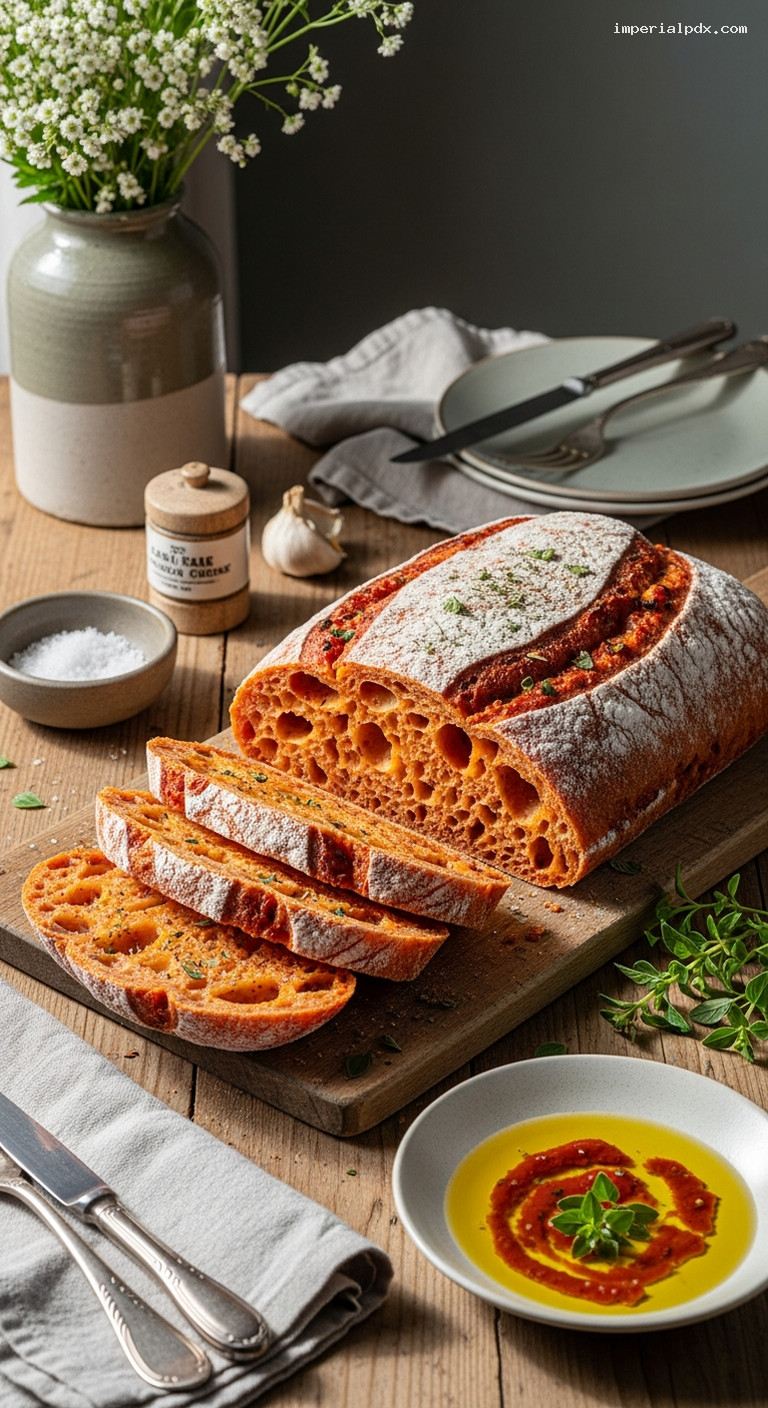
- Beautiful brick-red crust and herb-speckled interior that smells like an old-world bakery.
- High-hydration method with simple stretches—no stand mixer required.
- Perfect for dipping in olive oil, building panini, or serving alongside pasta and salads.
Grocery List
- Produce: 1 head garlic; fresh oregano (optional, for garnish)
- Dairy: None
- Pantry: Bread flour, instant yeast, tomato paste, olive oil, fine sea salt, dried oregano, sugar (optional), semolina or cornmeal (for dusting)
Full Ingredients
Poolish (Overnight Preferment)
- Bread flour: 200 g (1 2/3 cups)
- Water, room temperature: 200 g (3/4 cup + 2 tbsp)
- Instant yeast: 1/8 tsp
Roasted Garlic
- Garlic: 1 whole head
- Olive oil: 1 tsp
- Pinch of salt
Final Dough
- Bread flour: 300 g (2 1/2 cups)
- Warm water (85–90°F / 29–32°C): 190 g (3/4 cup + 1 tbsp)
- Tomato paste: 40 g (2 tbsp + 2 tsp)
- Roasted garlic puree: 30 g (about 2 tbsp)
- Olive oil: 20 g (1 tbsp + 1 tsp)
- Fine sea salt: 11 g (2 tsp)
- Instant yeast: 1/2 tsp (about 1.5 g)
- Dried oregano: 2 tsp
- Optional: 1 tsp sugar (to balance acidity and nudge fermentation)
For Shaping & Baking
- Semolina or flour, for dusting
- Coarse sea salt, a pinch for the top (optional)
- Hot water for oven steam (about 1 cup)
Step-by-Step Instructions
Step 1: Build the poolish (overnight)
In a medium bowl, whisk 200 g water and 1/8 tsp instant yeast, then stir in 200 g bread flour until no dry bits remain. Scrape down the sides, cover, and ferment at room temperature for 14 hours. It should be bubbly, doubled, and just beginning to recede in the center.
Step 2: Roast the garlic
Heat oven to 400°F (205°C). Slice the top off a head of garlic to expose cloves, drizzle with 1 tsp olive oil, sprinkle a pinch of salt, wrap in foil, and roast 45 minutes until soft and caramelized. Cool until handleable, then squeeze out and mash 30 g (about 2 tbsp) of roasted garlic puree. Reserve.
Step 3: Autolyse the dough
In a large bowl, combine the entire poolish, 300 g bread flour, and 190 g warm water. Mix until shaggy. Cover and rest 20 minutes. This hydrates the flour and jump-starts gluten development, making a high-hydration dough easier to handle.
Step 4: Mix in flavor and seasonings
Add 40 g tomato paste, 30 g roasted garlic, 20 g olive oil, 11 g salt, 2 tsp dried oregano, the optional 1 tsp sugar, and 1/2 tsp instant yeast. Using a dough whisk or your hand, mix vigorously for 3–4 minutes until the dough is cohesive and elastic. If using a stand mixer, mix on low for 2 minutes, then medium-low for 3 minutes; the dough will be sticky and supple. Target dough temperature: 75–78°F (24–26°C).
Step 5: Bulk ferment with stretch-and-folds
Cover and ferment at warm room temp (75–78°F / 24–26°C) for 2 hours 15 minutes. During the first 90 minutes, perform 3 sets of stretch-and-folds every 30 minutes: with wet hands, lift one side of dough up and over, rotate the bowl, and repeat 4 times per set. After the third set, let the dough rest undisturbed until the end of bulk. It should be aerated, jiggly, and about 60–70% expanded.
Step 6: Pre-shape, rest, and form the ciabatta
Generously dust a work surface with flour or semolina. Gently turn out the dough, trying not to deflate the gas. Lightly flour the top. With a bench knife, coax it into a rectangle about 9 × 6 inches, then let it rest 15 minutes. Using the bench knife, elongate into a 12–14 inch oblong. Fold the long edges slightly toward the center to build a little height, then flip seam-side down onto a well-floured couche or parchment-lined sheet. Dust the sides with flour to prevent sticking. Proof 45 minutes, loosely covered.
Step 7: Bake hot with steam
Place a baking stone or steel on the middle rack and a sturdy empty pan on the lower rack. Preheat to 500°F (260°C) for at least 45 minutes. When ready to bake, gently dimple the surface of the loaf with floured fingertips to pop any giant bubbles and even out the shape; sprinkle a pinch of coarse salt if using.
Slide the loaf onto the stone. Carefully pour about 1 cup hot water into the lower pan and close the door. Immediately reduce the oven to 475°F (246°C) and bake 12 minutes with steam. Vent steam by removing the pan, rotate the loaf, reduce to 450°F (232°C), and bake 16–18 minutes more, until deep mahogany with tomato-tinged edges and an internal temperature of 208–210°F (98–99°C).
Step 8: Cool and slice
Transfer to a rack and cool at least 1 hour before slicing. The crust will be crisp, and the crumb should be open, glossy, and tinted a warm tomato hue with flecks of roasted garlic and oregano.
Pro Tips
- Tomato paste adds acidity; the optional teaspoon of sugar helps balance flavor and supports fermentation.
- Keep hands wet or lightly oiled when handling this high-hydration dough; it should feel sticky but elastic.
- A hot stone or steel is key for a springy, holey crumb and a crisp crust—preheat thoroughly.
- For stronger herb aroma, rub dried oregano between your fingers before adding to release oils.
- If your kitchen is cool, extend bulk fermentation slightly; judge by the dough’s rise and jiggle, not just the clock.
Variations
- Olive and chili: Fold in 60 g chopped oil-cured black olives and 1–2 tsp chopped Calabrian chili during the last set of folds.
- Parmesan finish: Brush the shaped loaf lightly with olive oil and sprinkle 30 g finely grated Parmigiano-Reggiano before baking.
- Whole-wheat boost: Swap 50 g of the final-dough bread flour for whole-wheat flour and add 10–15 g extra water.
Storage & Make-Ahead
Best the day it is baked. Store at room temperature, cut-side down on a board for 12 hours, then in a paper bag inside a loose plastic bag up to 2 days. Refresh by baking at 350°F (175°C) for 8–10 minutes. Freeze sliced loaf in a zip-top bag up to 2 months; toast straight from frozen. Make-ahead: roast garlic up to 3 days in advance (refrigerate), and mix the poolish the night before baking.
Nutrition (per serving)
Approximate for 1/12 loaf: 175 calories; 6 g protein; 35 g carbohydrates; 2.5 g fat; 1 g fiber; 370 mg sodium.