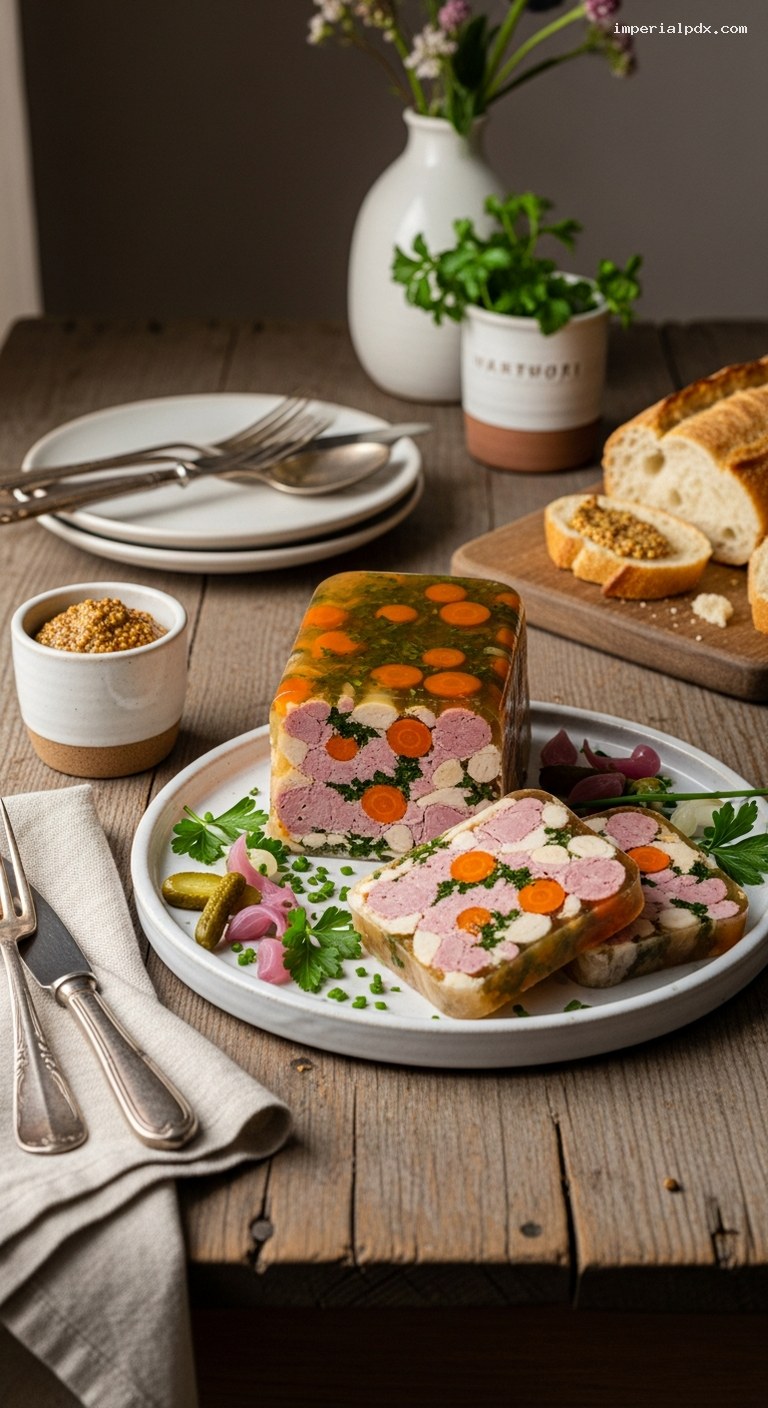
Quick Recipe Version (TL;DR)
Quick Ingredients
- 4 lb (1.8 kg) mixed pork head, hocks, trotters, or skin-on shoulder
- 1 large onion, 2 carrots, 2 celery stalks
- 6 garlic cloves, 2 bay leaves, 10 peppercorns
- 1 tsp whole allspice or 4–5 cloves (optional)
- 1 Tbsp kosher salt (for stock) + 1–1½ tsp more to finish
- 1/3 cup (80 ml) white wine or apple cider vinegar
- 1/2 cup (15 g) chopped fresh herbs (parsley, chives, thyme)
- 2–3 envelopes (2–3 Tbsp / 18–27 g) unflavored gelatin (optional but reliable)
- Water to cover (about 4–5 qt / 4–5 L)
Do This
- 1. Rinse pork well. Cover with cold water, bring to a boil 5 minutes, then drain and rinse to remove impurities.
- 2. Return pork to pot with vegetables, aromatics, salt, and fresh water. Simmer gently 3–3½ hours, skimming, until meat is very tender and falling from the bone.
- 3. Remove meat and skin; cool enough to handle. Strain broth and boil rapidly to reduce to about 4 cups (1 L). Skim fat.
- 4. Chop meat, skin, and any rich fat into small bite-size pieces. Toss with chopped herbs, vinegar, extra salt, and pepper to taste.
- 5. If using gelatin, bloom it in 1/2 cup (120 ml) cold water, then whisk into hot reduced broth until dissolved.
- 6. Pack meat mixture into 1–2 loaf pans. Pour hot seasoned broth over to just cover. Tap pans to release air pockets.
- 7. Cool to room temperature, then chill at least 8 hours or overnight until firmly set. Unmold, slice cold, and serve with bread, mustard, and pickles.
Why You’ll Love This Recipe
- Classic French-country charcuterie made approachable for a home kitchen.
- Uses humble, economical pork cuts and transforms them into something elegant.
- Loaded with savory flavor, natural collagen, and fresh herbs for a bright finish.
- Perfect for making ahead: slice straight from the fridge for guests or everyday snacking.
Grocery List
- Produce: Onion, carrots, celery, garlic, fresh flat-leaf parsley, fresh chives, fresh thyme or tarragon, lemons (optional for serving).
- Dairy: None required (serve with butter on bread if you like).
- Pantry: Pork head and/or pork hocks/trotters/skin-on shoulder, kosher or sea salt, black pepper, whole peppercorns, bay leaves, whole allspice berries or cloves, white wine or apple cider vinegar, unflavored powdered gelatin (optional but recommended), Dijon or whole-grain mustard, pickles or cornichons (for serving).
Full Ingredients
For the Pork and Stock
- 2–3 lb (900 g–1.4 kg) pork head pieces, split and cleaned (ask your butcher to cut; include ears and skin if possible)
- 1–2 lb (450–900 g) additional collagen-rich cuts, such as:
- Fresh pork hocks, trotters, or skin-on pork shoulder or picnic roast
- 1 large yellow onion (about 8 oz / 225 g), peeled and quartered
- 2 medium carrots (about 6 oz / 170 g), peeled and cut into large chunks
- 2 celery stalks, cut into large chunks
- 6 garlic cloves, lightly crushed
- 2 bay leaves
- 10 whole black peppercorns
- 1 tsp whole allspice berries or 4–5 whole cloves (optional, for warm spice notes)
- 1 Tbsp kosher salt (for the stock; you will add more to taste later)
- Cold water to cover (about 4–5 qt / 4–5 L, depending on your pot)
For Seasoning and Assembly
- 1/3 cup (80 ml) white wine vinegar or apple cider vinegar
- 1/2 cup (loosely packed, about 15 g) finely chopped fresh herbs:
- 1/3 cup (10 g) flat-leaf parsley
- 2 Tbsp (4 g) fresh chives
- 2 Tbsp (4 g) fresh thyme or tarragon leaves
- 1–1½ tsp kosher salt, or to taste (for seasoning the meat and broth)
- 1/2 tsp freshly ground black pepper, or to taste
Optional: For Extra-Firm Set
- 2–3 envelopes unflavored powdered gelatin (each envelope 1 Tbsp / 9 g; total 2–3 Tbsp / 18–27 g)
- 1/2 cup (120 ml) cold water (for blooming the gelatin)
To Finish and Serve
- Cornichons or small pickles
- Whole-grain or Dijon mustard
- Crusty bread or toasted baguette slices
- Lemon wedges (optional, for a bright squeeze at the table)
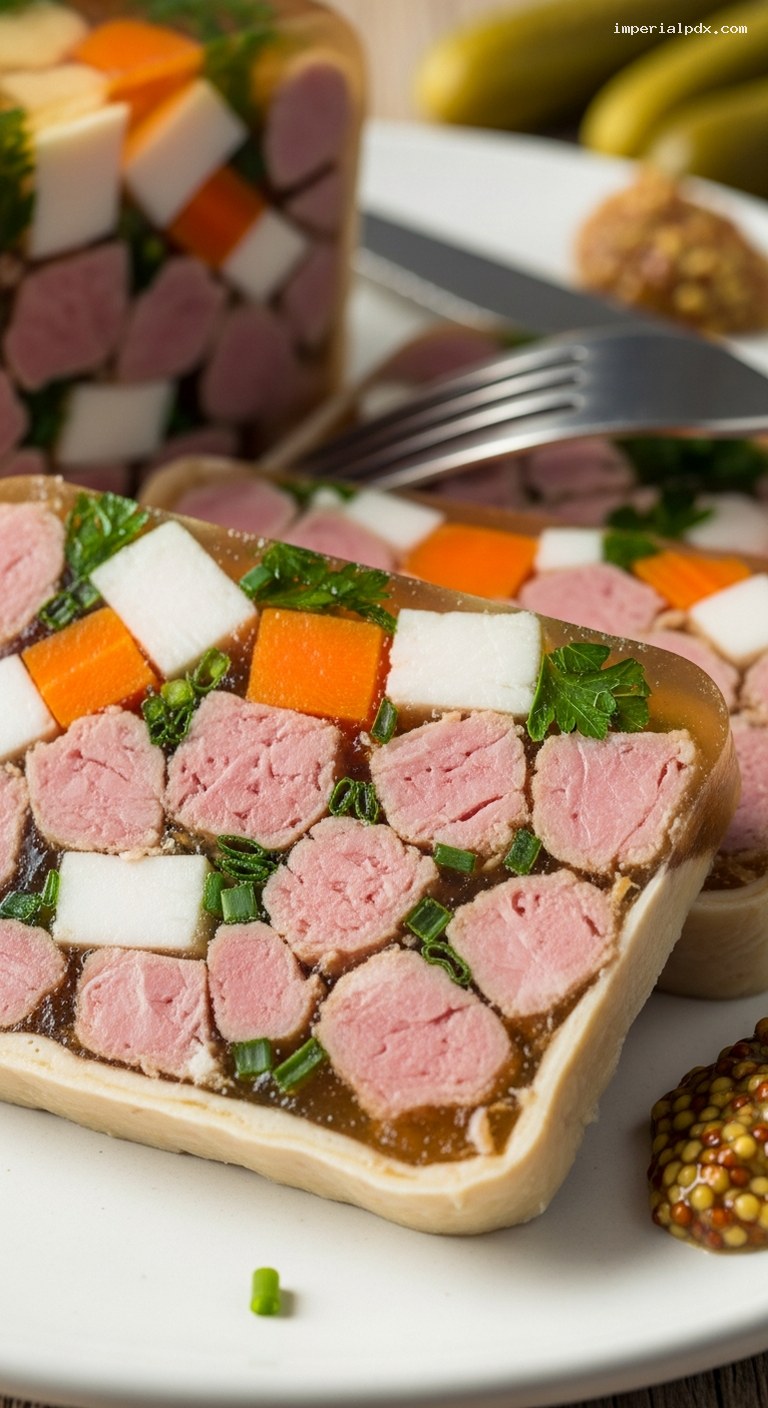
Step-by-Step Instructions
Step 1: Clean, Blanch, and Prepare the Pork
Rinse all pork pieces thoroughly under cold running water, scrubbing away any visible bone dust or blood. If there are any stray hairs on the skin, singe them carefully with a kitchen torch or over a gas flame, then scrape with a knife. Place all pork into a large, heavy stockpot (at least 8 qt / 7.5 L).
Cover the pork with cold water by about 2 in (5 cm). Bring to a full boil over medium-high heat and let it boil for 5 minutes. A gray foam and impurities will rise to the surface. Turn off the heat, carefully drain the pot, and rinse the pork and pot under cold water. This blanching step produces a much clearer, cleaner-tasting jelly.
Step 2: Build the Aromatic Stock and Simmer Gently
Return the blanched pork to the cleaned pot. Add the onion, carrots, celery, garlic, bay leaves, peppercorns, optional allspice or cloves, and 1 Tbsp kosher salt. Pour in enough cold water to cover everything by about 1–2 in (2.5–5 cm).
Bring the pot just to a simmer over medium heat. Once small bubbles break at the edges, reduce the heat to low so the liquid barely simmers (about 185–195°F / 85–90°C). Avoid a rolling boil, which makes the broth cloudy and the meat stringy. Partially cover the pot and cook for 3–3½ hours, skimming off foam or excess fat occasionally, until the meat, skin, and connective tissue are very tender and practically falling from the bones.
Step 3: Strain, Reduce, and Clarify the Broth
When the meat is fully tender, use tongs or a slotted spoon to lift all pork pieces into a large bowl or tray to cool slightly. Strain the broth through a fine-mesh sieve into another large pot or heatproof bowl, discarding the spent vegetables and aromatics.
Measure the strained broth. You want to end up with about 4 cups (1 L) of very flavorful liquid to set the terrine. If you have more, pour the broth into a clean pot and boil briskly over medium-high heat to reduce to about 4 cups, 15–25 minutes depending on the starting volume. Skim off any foam and excess fat as it reduces. Taste the hot broth: it should be well-seasoned and slightly salty, because the flavor will soften once it is chilled and mixed with the meat. Adjust with a little more salt if needed.
Step 4: Chop the Meat and Season with Herbs and Vinegar
While the broth reduces, and when the pork is cool enough to handle but still warm, pick all the meat, skin, and soft connective tissue from the bones. Discard any large pieces of gristle or cartilage that feel unpleasantly hard, but keep the tender skin and gelatinous bits—these are what help the terrine set and give it luxurious texture.
Chop the meat, skin, and any soft fat into small bite-sized pieces, about 1/4–1/2 in (0.5–1 cm). You want a rustic mosaic rather than a fine mince. Place everything in a large mixing bowl. Add the chopped parsley, chives, and thyme (or tarragon). Sprinkle over 1/3 cup (80 ml) vinegar, 1 tsp kosher salt, and 1/2 tsp freshly ground black pepper to start. Toss well, then taste a small piece of meat. Adjust with more salt, pepper, or vinegar until it tastes bright and well seasoned. Remember the chilled terrine will taste slightly less intense than the warm mixture.
Step 5: Incorporate Gelatin (If Using) and Finish the Broth
If you are using powdered gelatin for an extra-reliable set, pour 1/2 cup (120 ml) cold water into a small bowl. Sprinkle the gelatin evenly over the surface and let it stand for 5–10 minutes to bloom and fully hydrate.
When the broth has reduced to about 4 cups (1 L) and is very hot but not furiously boiling, whisk the bloomed gelatin into the broth until completely dissolved. If you are not using gelatin, simply make sure the reduced broth is hot and well-seasoned. At this stage, you can add a small extra splash of vinegar (1–2 Tbsp) if the broth tastes flat; it should be pleasantly savory with a gentle tang.
Step 6: Pack the Terrine and Pour the Broth
Lightly oil or line 1–2 loaf pans (9 x 5 in / 23 x 13 cm) or terrine molds with plastic wrap, leaving enough overhang to help unmold later. For a tall terrine, pack into one mold; for thinner loaves, divide between two.
Spread the chopped, seasoned meat mixture evenly in the prepared mold(s), pressing lightly with a spoon to eliminate large air pockets. The meat should come almost to the top, leaving a little space for broth. Slowly ladle the hot broth over the meat, letting it seep down into the gaps. Gently tap the molds on the counter to release trapped air and top up with more broth until the liquid just covers the meat.
Let the terrine cool on the counter until no longer steaming, about 45–60 minutes. Cover tightly with plastic wrap or lids.
Step 7: Chill Firmly, Slice, and Serve
Transfer the covered terrine to the refrigerator and chill until completely set and very firm, at least 8 hours or overnight. The jelly should be fully solid, and the loaf should feel dense when pressed.
To unmold, run a thin knife around the edges. If lined with plastic, simply lift it out. Otherwise, briefly dip the bottom of the pan into warm water for 10–15 seconds, then invert onto a cutting board and gently shake. Slice with a very sharp knife into 1/4–1/2 in (0.5–1 cm) thick slices, wiping the blade between cuts for clean edges.
Serve the head cheese well-chilled, with crusty bread or toast, cornichons or pickles, and a spoonful of whole-grain mustard. A few extra chopped herbs or a squeeze of lemon brighten the plate beautifully. Enjoy as part of a rustic charcuterie board, as an appetizer, or in a hearty sandwich.
Pro Tips
- Gentle simmer is key: Keep the stock at a lazy simmer, never a rolling boil, for the clearest broth and most tender meat.
- Taste and adjust while warm: Season both the meat mixture and the broth before assembling. The finished terrine should have enough salt and a gentle but clear hit of vinegar.
- Do not skimp on skin: The skin, ears, and trotters are what give natural gelatin. If you are light on skin, definitely add the powdered gelatin.
- Fine but rustic chop: Aim for small, even pieces so the slices hold together neatly, but not so small that it turns into a paste.
- Chill completely before slicing: For the cleanest slices, chill overnight and use a very sharp chef’s knife, wiping the blade between cuts.
Variations
- Mixed pork and veal: Replace up to 1 lb (450 g) of the pork with veal breast or shank for a lighter color and slightly more delicate flavor.
- Herb and lemon twist: Add the finely grated zest of 1 lemon to the meat mixture along with extra parsley and chives for a brighter, fresher profile.
- Spiced country style: Add 1 tsp smoked paprika and 1/2 tsp ground coriander to the meat mixture, and tuck a few extra garlic cloves into the simmering stock for bolder, more rustic flavors.
Storage & Make-Ahead
Head cheese is ideal for making ahead. Once fully chilled and set, keep it tightly wrapped in the refrigerator for up to 5 days. For best quality, slice only what you need and keep the remainder covered as a whole loaf, which helps prevent drying.
To store slices, layer them between pieces of parchment in an airtight container. The natural gelatin keeps the meat moist, but if the edges begin to dry, you can brush them lightly with a little reserved broth or neutral oil before serving.
For longer storage, you can freeze tightly wrapped whole portions for up to 2 months, though the texture of the jelly may become slightly more crumbly after thawing. Thaw overnight in the refrigerator and serve well-chilled.
Nutrition (per serving)
Approximate values for 1 of 12 servings (about 3–4 oz / 85–115 g): 260 calories; 18 g protein; 20 g fat; 4 g saturated fat; 1–2 g carbohydrates; 0 g fiber; 1 g sugar; 520 mg sodium. Actual values will vary based on the exact cuts of pork used and how much fat is trimmed.