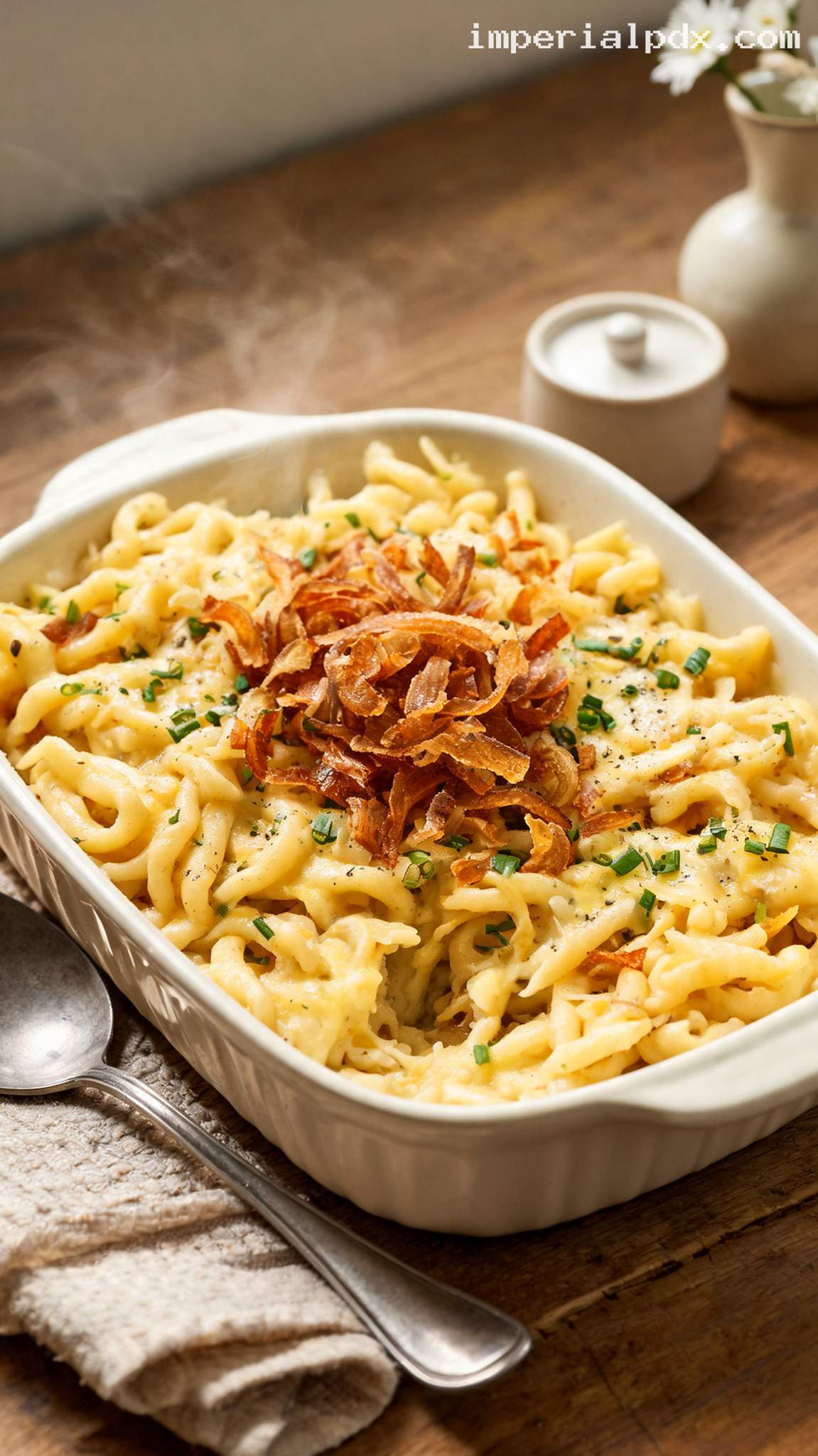
Quick Recipe Version (TL;DR)
Quick Ingredients
- Noodles: 400 g all-purpose flour, 4 large eggs, 200 ml water, 1 teaspoon fine sea salt, and 1/8 teaspoon ground nutmeg.
- Cooking water: 4 liters water and 1 tablespoon fine sea salt.
- Cheese: 150 g Emmental and 150 g Gruyère, freshly grated; choose cheeses made with vegetarian rennet.
- Onions: 450 g yellow onions, thinly sliced; 60 ml neutral oil; and 1/4 teaspoon fine sea salt.
- Finishing: 14 g unsalted butter, 120 ml reserved noodle cooking water, 2 tablespoons chopped chives, and 1/4 teaspoon freshly ground black pepper.
Do This
- 1. Beat the flour, eggs, 200 ml water, salt, and nutmeg into a thick, elastic batter. Rest for 10 minutes.
- 2. Heat the oven to 180°C / 350°F. Butter a 2-liter baking dish and mix the grated cheeses.
- 3. Fry the onions in the oil over medium heat for 20 minutes, then medium-high heat for 3–5 minutes, until deep golden with crisp edges. Drain and salt.
- 4. Meanwhile, bring the salted cooking water to a gentle boil. Press the batter through a spätzle maker in four batches; cook each batch for 1 minute after the noodles float.
- 5. Layer each hot batch in the baking dish with 75 g cheese and 30 ml reserved cooking water.
- 6. Bake uncovered for 12 minutes. Rest for 3 minutes, then top with the fried onions, chives, and black pepper.
Why You’ll Love This Recipe
- Cozy Alpine comfort: Tender egg noodles, nutty melted cheese, and sweet golden onions make a wonderfully satisfying meat-free main.
- No pasta rolling required: The simple batter goes straight through a spätzle maker into simmering water.
- Lovely contrasting textures: Soft, springy noodles meet stretchy cheese and crisp-edged onions.
- Simple ingredients, generous results: A few everyday staples become a hearty dinner for four.
Grocery List
- Produce: 450 g yellow onions, approximately 2 large; 1 small bunch fresh chives.
- Dairy: 150 g Emmental, 150 g Gruyère, and 14 g unsalted butter. Look for vegetarian-rennet cheeses.
- Eggs: 4 large eggs.
- Pantry: 400 g all-purpose flour, 60 ml neutral oil, fine sea salt, ground nutmeg, and black pepper.
Full Ingredients
For the Spätzle
- 400 g all-purpose flour, approximately 3 1/3 cups, spooned and leveled
- 4 large eggs
- 200 ml room-temperature water
- 1 teaspoon fine sea salt, approximately 6 g
- 1/8 teaspoon ground nutmeg
For the Cooking Pot
- 4 liters water
- 1 tablespoon fine sea salt, approximately 18 g
For the Cheese Layers
- 150 g Emmental, freshly grated
- 150 g Gruyère, freshly grated
- 14 g unsalted butter, softened, for greasing the dish
- 120 ml reserved noodle cooking water, divided into four 30 ml portions
Vegetarian note: Some traditional Alpine cheeses contain animal rennet. Choose Emmental and Gruyère labeled vegetarian or made with microbial rennet to keep this dish meat-free.
For the Fried Onions and Finishing
- 450 g peeled yellow onions, approximately 2 large, sliced into 2 mm half-moons
- 60 ml neutral oil, such as sunflower or canola oil, approximately 1/4 cup
- 1/4 teaspoon fine sea salt, approximately 1.5 g
- 2 tablespoons finely chopped fresh chives, approximately 6 g
- 1/4 teaspoon freshly ground black pepper
Equipment
- A spätzle maker, spätzle press, or sturdy large-hole colander
- A large mixing bowl and sturdy wooden spoon
- A 28–30 cm / 11–12 inch frying pan
- A large pot and slotted spoon or spider strainer
- A 2-liter ovenproof baking dish
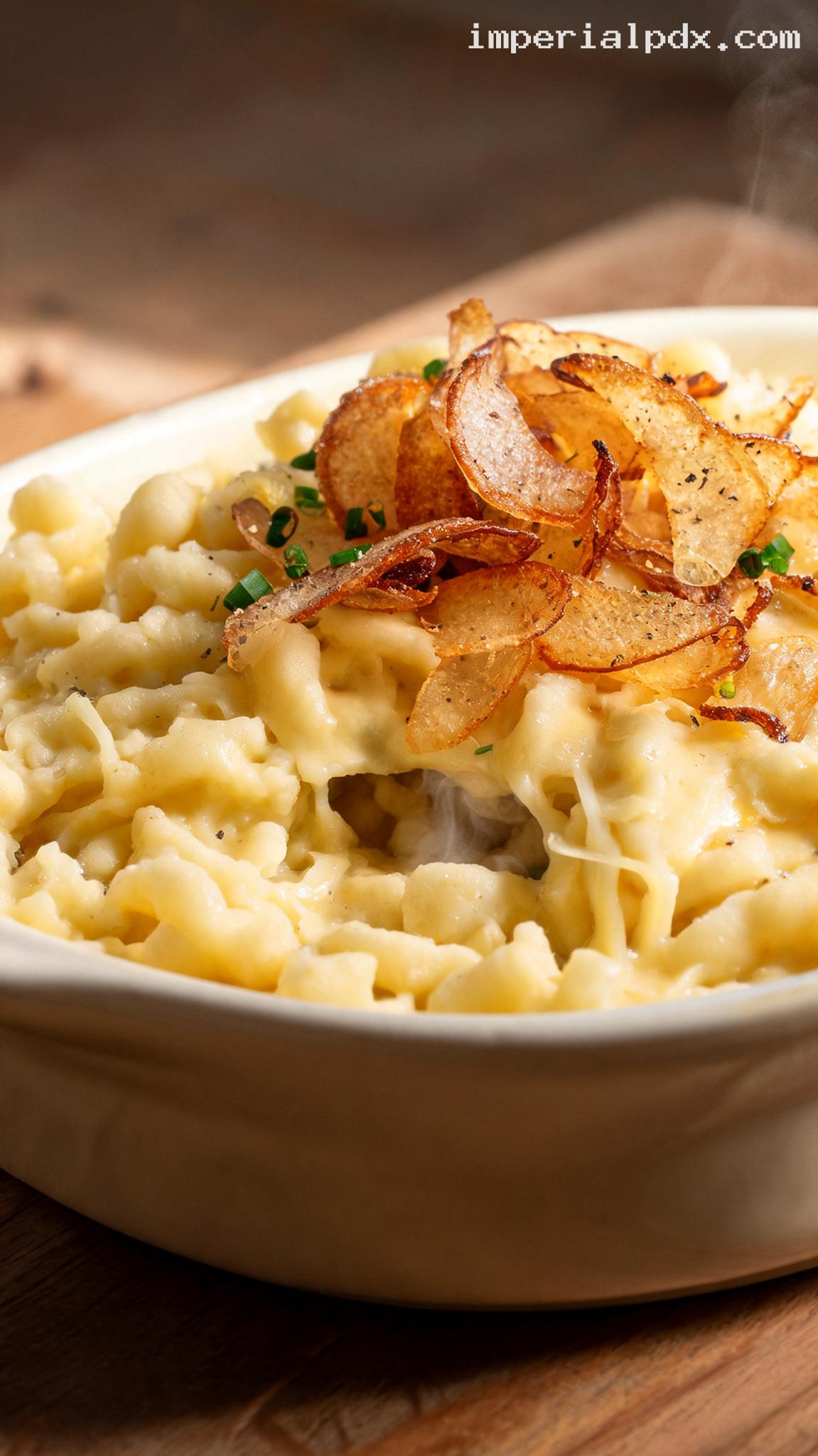
Step-by-Step Instructions
Step 1: Beat the spätzle batter
Place the flour, 1 teaspoon salt, and nutmeg in a large bowl. Make a well in the center and add the eggs and 200 ml water. Stir until no dry flour remains, then beat vigorously with a wooden spoon for 3–4 minutes, until the batter looks glossy and elastic and begins to form small bubbles.
The batter should be much thicker than pancake batter: it should stretch from the spoon in heavy ribbons rather than pour freely. Cover and rest for 10 minutes while you prepare the remaining ingredients.
Step 2: Prepare the cheese and baking dish
Heat the oven to 180°C / 350°F conventional, or 160°C fan, with a rack in the middle. Grease the baking dish with all 14 g butter. Mix the grated Emmental and Gruyère, then divide into four 75 g portions.
Slice the onions evenly so they cook at the same rate. Line a large plate or tray with paper towels for draining them later.
Step 3: Fry the onions until deeply golden
Heat the oil in the frying pan over medium heat for 1 minute. Add the onions, separate the slices, and spread them across the pan. Cook for 20 minutes, stirring every 2–3 minutes, until softened and golden. While they cook, start heating the noodle water as described in the next step.
Increase the heat to medium-high and fry for another 3–5 minutes, stirring frequently, until the onions are deep golden with crisp, browned edges. Lower the heat if any thin pieces begin to darken too quickly. Lift the onions out with a slotted spoon, spread them on the lined plate, and sprinkle with 1/4 teaspoon salt. Keep them uncovered so their edges stay crisp.
Step 4: Bring the cooking water to a gentle boil
While the onions are frying, bring 4 liters water and 1 tablespoon salt to a boil in a large pot. Reduce the heat slightly so the water bubbles steadily without boiling violently. Set the buttered baking dish beside the stove on a heatproof surface.
Position your spätzle maker over the pot according to its instructions. If using a large-hole colander, work carefully over the steam and press the batter through with a sturdy spatula without allowing the colander to touch the water.
Step 5: Cook and layer the spätzle
Work in four batches, using one-quarter of the batter each time. Press or scrape the batter into the gently boiling water to form short, irregular noodles. Stir gently once to prevent sticking. Once the noodles float, cook for 1 additional minute; each batch usually takes 2–3 minutes in the water.
Before removing the first batch, scoop out 120 ml cooking water into a measuring jug. Lift out the noodles with a slotted spoon, let them drain over the pot for about 5 seconds, and transfer them directly to the buttered dish. Do not rinse them or let them dry out.
Spread the noodles into an even layer, sprinkle with 75 g cheese, and drizzle over 30 ml reserved cooking water. Repeat with the remaining three batches, ending with cheese. The hot noodles begin melting the cheese immediately, while the small additions of starchy water keep the layers moist and glossy.
Step 6: Melt the cheese in the oven
Bake uncovered for 12 minutes, until the cheese is fully melted and the edges are gently bubbling. You are looking for soft, cheesy layers rather than a browned casserole crust, so skip the broiler.
If the onions are ready before the baking dish, leave them spread out and uncovered. Adding them only at the end keeps them from softening in the steam.
Step 7: Add the onions and serve
Let the Käsespätzle stand for 3 minutes. Scatter the fried onions generously over the top, followed by the chopped chives and black pepper. Serve immediately, scooping down through all the cheese-and-noodle layers.
A sharply dressed green salad or a simple cucumber salad makes a refreshing partner to the rich cheese.
Pro Tips
- Grate your own cheese: Freshly grated cheese melts more smoothly than pre-shredded cheese coated with anti-caking ingredients.
- Keep the batter thick: A thin batter can produce fragile noodles. Beat it well, then allow the full 10-minute rest before cooking.
- Use gentle bubbles: A rolling boil can break up freshly formed spätzle. Steady, gentle boiling gives them time to set.
- Watch the onion color: Deep golden onions taste sweet and savory; very dark brown onions can turn bitter. Remove them promptly once their edges are crisp.
- Keep the layers moist: Measure the reserved cooking water rather than guessing. A little helps the cheese coat the noodles; too much leaves liquid in the bottom of the dish.
Variations
- Bolder Alpine flavor: Replace the 150 g Gruyère with 150 g vegetarian-rennet Bergkäse or Appenzeller for a more pronounced, savory cheese flavor.
- Mushroom Käsespätzle: Sauté 250 g sliced cremini mushrooms in an additional 1 tablespoon oil over medium-high heat for 8–10 minutes, until their moisture evaporates. Divide them between the noodle layers.
- Store-bought shortcut: Replace the homemade batter with 800 g refrigerated fresh spätzle. Cook according to the package directions, reserve 120 ml cooking water, and assemble in four layers as directed.
Storage & Make-Ahead
Refrigerate: Cool leftovers promptly and refrigerate in a covered container within 2 hours. Store for up to 3 days. Keep any extra fried onions in a separate container so they do not absorb moisture from the noodles.
Reheat: For each serving, add 1 tablespoon water, cover, and warm in a 180°C / 350°F oven for 20–25 minutes, until the center reaches 74°C / 165°F. Re-crisp reserved onions separately in a dry frying pan over medium heat for 2–3 minutes, then add them after reheating.
Make ahead: Grate the cheese and slice the onions up to 1 day ahead; refrigerate separately. You can also cook the spätzle 1 day ahead: briefly rinse with cold water, drain thoroughly, toss with 1 teaspoon additional neutral oil, and refrigerate. To assemble, dip the noodles in gently boiling water for 30–60 seconds to heat through, then drain and layer with the cheese and measured cooking water.
Freeze: Freeze the cooked, unlayered noodles for up to 2 months. Thaw overnight in the refrigerator before reheating and assembling. For the best texture, prepare the cheese layers and fried onions fresh.
Nutrition (per serving)
Calories: 930 kcal | Carbs: 88g | Protein: 40g | Fat: 46g | Saturated Fat: 19g | Fiber: 5g | Sugar: 6g | Sodium: 1280mg | Cholesterol: 280mg
Estimated values for one-quarter of the recipe. Actual nutrition varies with the cheese brands, oil left in the frying pan, and salt absorbed during cooking.