Quick Recipe Version (TL;DR)
Quick Ingredients
- 1 whole beef tongue (1.5–2 kg / 3–4.5 lb)
- 3 L (about 3.2 qt) cold water
- 150 g kosher salt
- 75 g sugar
- 1 tsp (5 g) pink curing salt #1 (optional but recommended)
- 1 onion, 6 cloves garlic, 3 bay leaves
- 2 tbsp whole spices (peppercorns, coriander, mustard seeds)
- 1 carrot, 1 celery stalk (for simmering)
- Olive oil, fresh herbs, mustard, pickles for serving (optional)
Do This
- 1. Rinse and trim tongue. Make brine by dissolving salts and sugar in part of the water with spices, then add remaining cold water and chill completely.
- 2. Submerge tongue in cold brine in a non-reactive container. Refrigerate 5–7 days, turning once daily so it cures evenly.
- 3. Rinse tongue under cold water; discard brine. Place in a large pot with onion, carrot, celery, bay leaves, and enough water to cover.
- 4. Bring just to a simmer, skim foam, then cook gently (185–203°F / 85–95°C) for 2.5–3.5 hours until very tender.
- 5. Remove tongue (reserve some cooking liquid). While still warm but handleable, peel off the thick outer skin and trim any tough bits.
- 6. Place peeled tongue in a snug container, cover halfway with reserved liquid, weight lightly, and chill 4 hours or overnight until very cold and firm.
- 7. Slice very thinly across the grain. Serve chilled as deli-style cold cuts with olive oil, herbs, mustard, and pickles.
Why You’ll Love This Recipe
- Produces incredibly tender, melt-in-your-mouth slices with a beautiful rosy cured color.
- Hands-off friendly: most of the time is passive curing, simmering, and chilling.
- Makes a generous batch of deli-style cold cuts that keep well for days.
- Versatile: perfect for sandwiches, charcuterie boards, or thinly sliced in tacos and salads.
Grocery List
- Produce: 1 whole beef tongue (from the butcher), 2 onions, 1 carrot, 1 celery stalk, 1 head of garlic, fresh parsley or cilantro (for garnish), lemons or limes (optional for serving).
- Dairy: None required.
- Pantry: Kosher salt, pink curing salt #1 (Prague Powder #1, optional but recommended), granulated sugar, black peppercorns, coriander seeds, mustard seeds, bay leaves, dried thyme or oregano, whole cloves (optional), olive oil, whole-grain or Dijon mustard, pickles or cornichons.
Full Ingredients
Main Ingredient
- 1 whole beef tongue, 1.5–2 kg (3–4.5 lb), fresh or thawed if previously frozen
For the Curing Brine (Lengua Curada)
- 3 L cold water (about 3.2 qt), divided
- 150 g kosher salt (about 3/4 cup Diamond Crystal or 1/2 cup + 2 tbsp Morton’s)
- 75 g granulated sugar (about 6 tbsp or a heaping 1/3 cup)
- 1 tsp (5 g) pink curing salt #1 (Prague Powder #1, 6.25% sodium nitrite) optional but recommended for color and flavor; do not increase this amount
- 1 medium onion, sliced
- 6 cloves garlic, smashed
- 3 bay leaves
- 1 tbsp whole black peppercorns
- 1 tbsp whole coriander seeds
- 1 tsp mustard seeds (yellow or brown)
- 1 tsp dried thyme or oregano (or 2–3 fresh sprigs)
- 4 whole cloves (optional, for a subtle warm spice note)
For Simmering the Tongue
- 1 onion, halved (no need to peel)
- 1 carrot, cut into chunks
- 1 celery stalk, cut into chunks (optional but nice)
- 2 bay leaves
- 1 tsp whole black peppercorns
- Cold water to cover the tongue by about 5 cm (2 in), roughly 3–4 L depending on your pot
To Finish and Serve (Optional but Recommended)
- 2–3 tbsp extra-virgin olive oil
- Flaky sea salt or fine salt, to taste
- Freshly ground black pepper
- 2–3 tbsp chopped fresh parsley, cilantro, or chives
- Whole-grain or Dijon mustard
- Pickled onions, cornichons, or other pickles
- Crusty bread, rye bread, or crackers
- Lemon or lime wedges (optional, especially nice if serving in a more Latin-style spread)
Step-by-Step Instructions
Step 1: Rinse and Trim the Beef Tongue
Unwrap the beef tongue and rinse it thoroughly under cold running water, rubbing the surface with your hands to remove any clinging blood or bits of membrane. Pat very dry with paper towels.
If there are any large hanging flaps of fat or ragged edges, trim them off with a sharp knife, but keep the tongue in one solid piece so it cures and slices nicely later. Do not worry about the thick outer skin yet; that will come off easily after cooking.
Step 2: Make and Chill the Curing Brine
In a large pot, combine 1 L (about 1 qt) of the water with the kosher salt, sugar, and pink curing salt #1 (if using). Add the sliced onion, smashed garlic, bay leaves, peppercorns, coriander seeds, mustard seeds, thyme or oregano, and cloves if using.
Place the pot over medium heat and stir until the salt and sugar are completely dissolved and the mixture just comes to a bare simmer. You are not trying to cook the aromatics heavily, only to dissolve the seasonings and wake up the spices. Turn off the heat.
Add the remaining 2 L (about 2.1 qt) of cold water to the pot to cool the brine down quickly. Stir well, then let the brine sit until it reaches room temperature. For food safety, then refrigerate the brine until it is completely cold before adding the tongue (you can speed this up by setting the pot in an ice bath).
Step 3: Cure the Tongue in the Brine (5–7 Days)
Place the cleaned tongue into a non-reactive container that will hold it snugly, such as a glass or ceramic baking dish, a food-grade plastic tub, or a large zip-top brining bag set in a bowl. Pour the fully chilled brine over the tongue, making sure it is completely submerged.
If needed, place a small plate or clean weight on top to keep the tongue underwater. Cover the container and refrigerate for 5–7 days. Once a day, turn the tongue over in the brine so it cures evenly on all sides. For a 1.5–2 kg tongue, 6 days is a good target; go toward 5 days for a smaller tongue and 7 days for a very large one.
During this time, the salt, sugar, spices, and curing salt (if used) will penetrate the meat, giving it a gentle cured flavor, a rosy color, and a tender, silky texture.
Step 4: Rinse and Set Up the Simmering Pot
After curing, remove the tongue from the brine and discard the brine (do not reuse it). Rinse the tongue thoroughly under cold running water, scrubbing off any clinging spices or aromatics. Pat dry with paper towels.
Place the tongue into a large, heavy pot or Dutch oven. Add the halved onion, carrot pieces, celery, bay leaves, and peppercorns. Pour in enough cold water to cover the tongue by about 5 cm (2 in); this will usually be around 3–4 L of water, depending on the size of your pot.
Set the pot over medium-high heat and slowly bring the water up toward a simmer. As it heats, skim off any foam that rises to the surface with a spoon or small ladle; this will help keep the cooking liquid clearer and the final tongue cleaner-tasting.
Step 5: Gently Simmer Until Very Tender
Once the pot is near a simmer, reduce the heat to low or medium-low so the liquid bubbles very gently. Aim for a temperature in the range of 85–95°C (185–203°F): small, lazy bubbles rather than a vigorous boil. Cover the pot with the lid slightly ajar to reduce evaporation while allowing some steam to escape.
Simmer the tongue for 2.5–3.5 hours, depending on its size and thickness. Begin checking for doneness around the 2.5-hour mark. To test, insert a thin skewer, cake tester, or sharp knife into the thickest part of the tongue; it should slide in and out with almost no resistance, like softened butter or a cooked potato.
If it still feels firm, continue simmering, checking every 20–30 minutes. Add a bit more hot water if needed to keep the tongue submerged. Low, gentle heat is key here; boiling too hard can toughen the exterior.
Step 6: Peel, Trim, and Chill Under Gentle Pressure
When the tongue is very tender, carefully lift it out of the cooking liquid and place it on a cutting board to cool slightly. Reserve 1–2 cups of the cooking liquid and strain it through a fine sieve; discard the remaining liquid or save it separately as a flavorful broth for soups or beans.
While the tongue is still warm but cool enough to handle (after about 5–10 minutes), peel off the thick outer skin. Start at the tip and pull it back; it should come away in large pieces. Trim off any small patches of rough skin or tough gristly bits from the underside, as well as any hard cartilage you may find near the base. Try to keep the overall shape even for nice slices later.
To get beautifully compact, deli-style slices, place the peeled tongue in a snug loaf pan or small container just big enough to hold it. Pour in enough reserved cooking liquid to come about halfway up the sides. Lay a piece of parchment or plastic wrap on the surface, then cover with foil and place a light weight on top (a clean food can or small jar works well). Refrigerate until completely cold and firm, at least 4 hours or ideally overnight.
Step 7: Slice Thinly and Serve Chilled
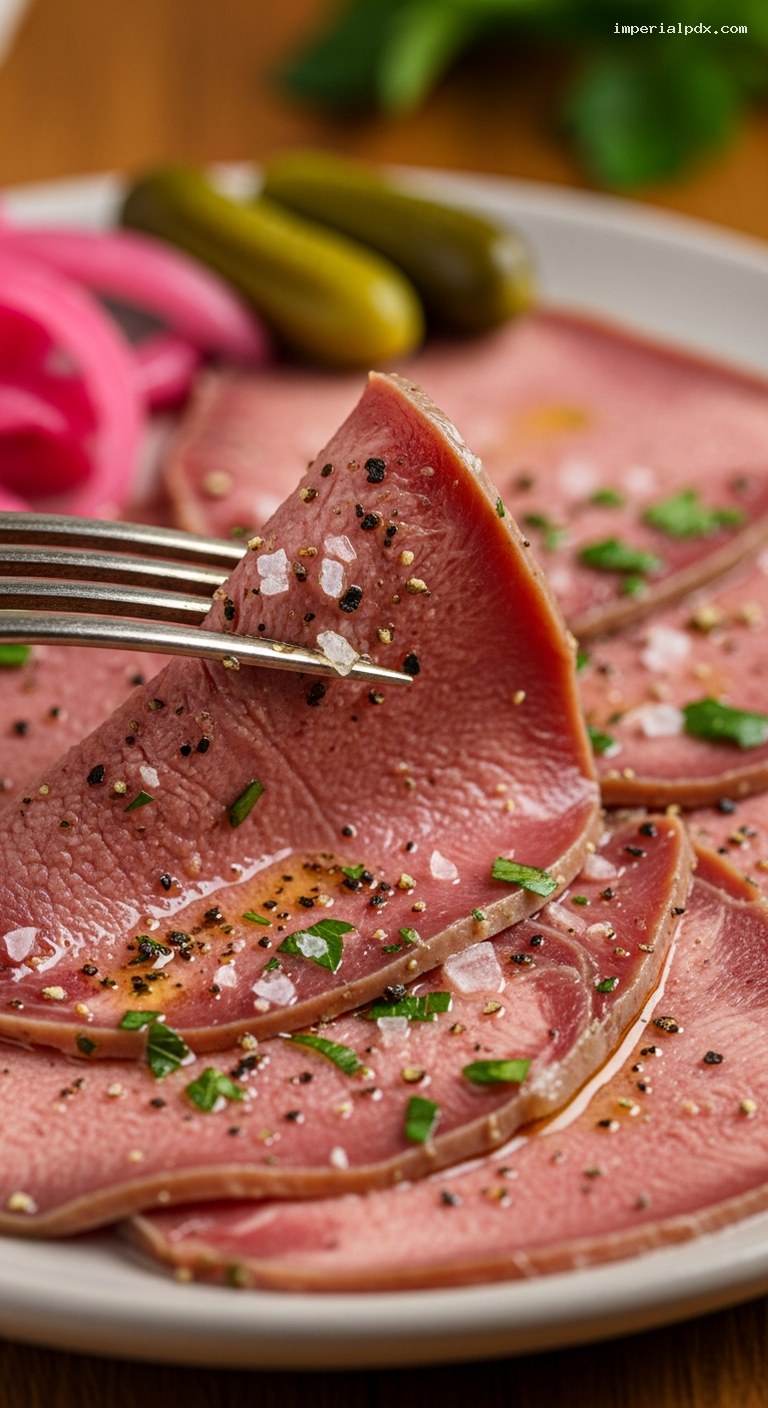
Once fully chilled, remove the tongue from its container and pat it dry. Using a very sharp slicing knife (or a meat slicer, if you have one), cut the tongue crosswise against the grain into very thin slices, about 2–3 mm thick. Cutting against the grain is what gives you that delicate, melt-in-the-mouth texture.
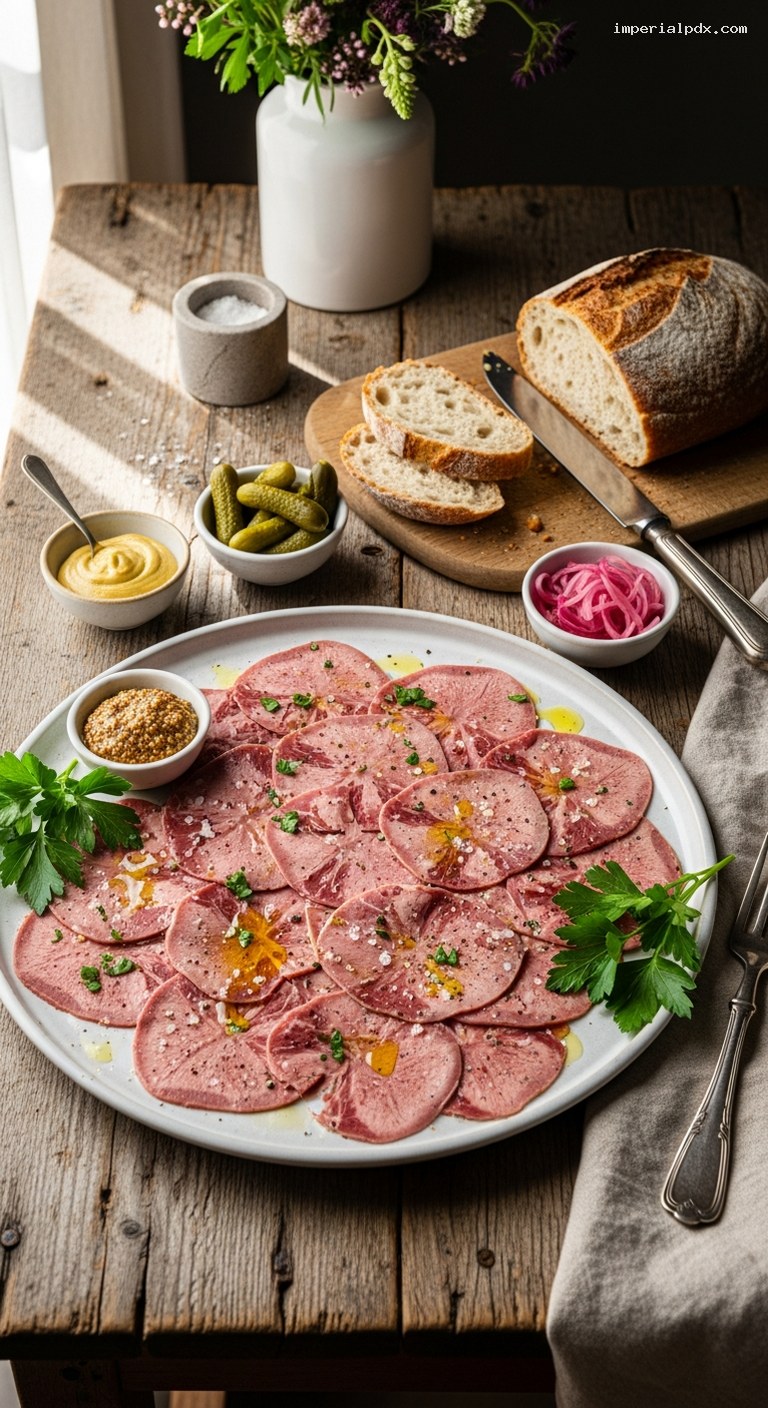
Arrange the slices in overlapping rows or fanned-out circles on a platter. Drizzle lightly with extra-virgin olive oil, then sprinkle with flaky salt (if needed; taste a slice first), freshly ground black pepper, and a shower of chopped fresh herbs.
Serve the cured beef tongue cold, deli-style, with mustard, pickles or cornichons, and crusty or rye bread. It also makes an excellent filling for sandwiches, or you can briefly sear thicker slices in a hot pan and serve them warm in tacos or on top of salads.
Pro Tips
- Do not rush the cure: The 5–7 day brining time is what gives the tongue its seasoned, cured flavor and tender texture. Less time will taste more like plain boiled tongue rather than lengua curada.
- Keep everything cold: Always chill the brine completely before adding the tongue, and keep the curing container in the coldest part of your fridge (below 4°C / 40°F).
- Simmer, do not boil: A gentle simmer keeps the muscle fibers from tightening. If the surface is bouncing vigorously, lower the heat.
- Pressing improves slicing: Chilling the tongue under a light weight in a snug container helps it set into an even shape, so you will get pretty, uniform slices.
- Taste before salting: Because the tongue is cured, it may need little or no additional salt when serving. Always taste a slice first, then adjust.
Variations
- Smoked Lengua Curada: After simmering, peeling, and trimming, smoke the tongue at 107–120°C (225–250°F) for 1–2 hours over mild wood (apple, cherry, or oak). Then chill and slice as directed. You will get beautiful smoke-kissed edges and a deeper flavor.
- Garlic & Herb Mediterranean Style: Increase the garlic in the brine to 10 cloves and add a sprig of rosemary and a strip of lemon peel. Serve thin slices with extra-virgin olive oil, capers, chopped parsley, and lemon wedges.
- Taco-Ready Lengua: Add a dried chile (guajillo or ancho) and a teaspoon of ground cumin to the brine. After chilling, slice the tongue a bit thicker, quickly sear the slices in a hot pan, and serve in warm tortillas with onion, cilantro, lime, and salsa.
Storage & Make-Ahead
This recipe is ideal for making ahead. Once cooked, peeled, and chilled, the whole tongue can be wrapped tightly in plastic wrap or parchment and then in foil, and stored in the refrigerator for up to 5 days. For deli-style convenience, you can slice the tongue and layer the slices in a shallow container, separating layers with parchment or wax paper to prevent sticking, then cover tightly and refrigerate.
For longer storage, freeze whole or sliced tongue. Wrap it very well (plastic wrap plus a freezer bag or airtight container) and freeze for up to 2 months. Thaw overnight in the refrigerator and serve chilled or gently re-warmed in a covered pan with a splash of broth. Do not refreeze once thawed. Always keep the meat refrigerated when not actively slicing or serving.
Nutrition (per serving)
Approximate values per serving (about 85 g / 3 oz cooked tongue, without olive oil or accompaniments): 220 calories; 17 g protein; 16 g fat; 6 g saturated fat; 75 mg cholesterol; 0 g carbohydrates; 0 g fiber; 0 g sugars; approximately 800 mg sodium (this will vary with curing time and exact salt used). Adding olive oil, bread, or condiments will increase calories and fat accordingly.