Quick Recipe Version (TL;DR)
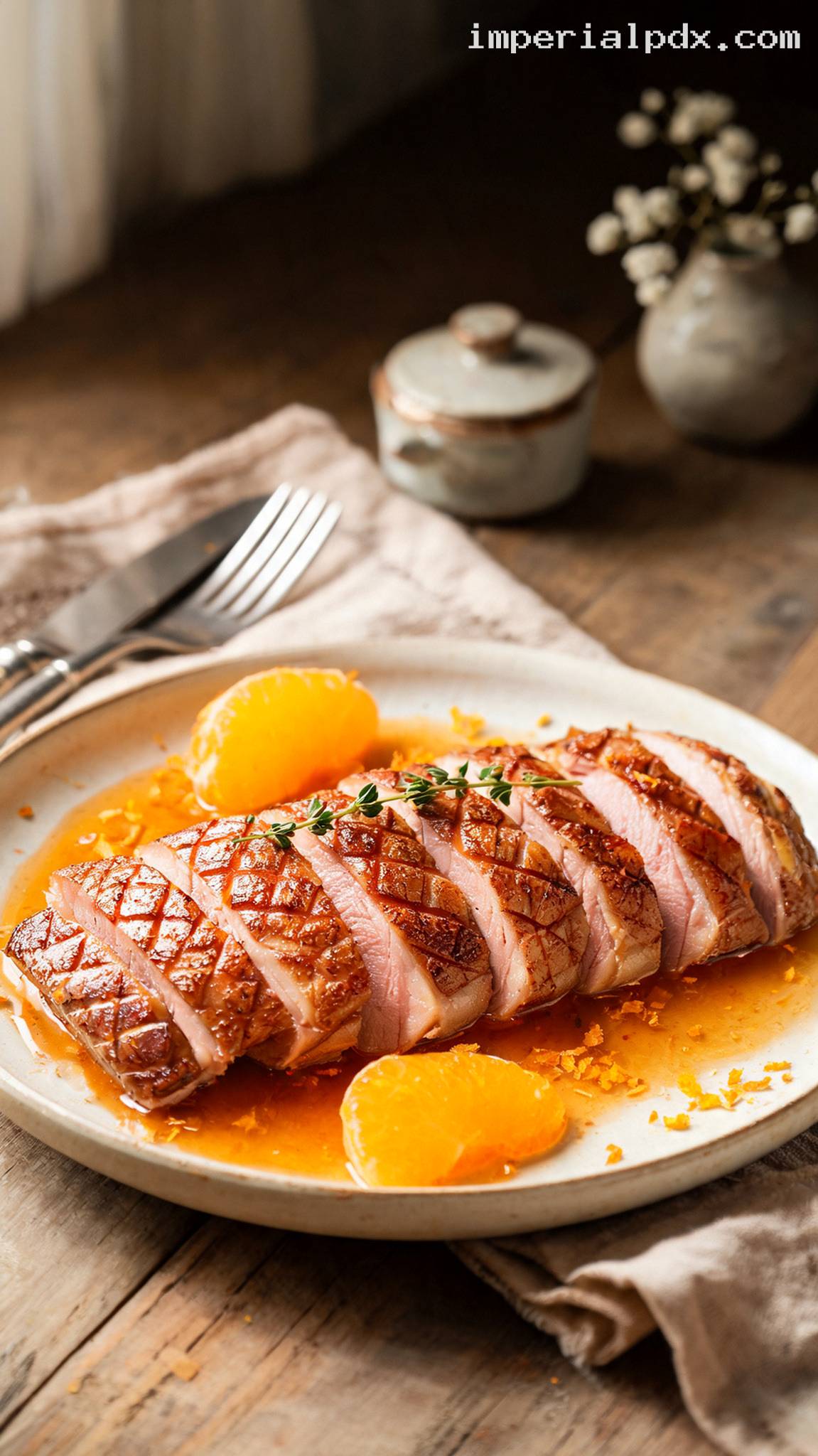
Duck à l’Orange with Crispy Skin pairs golden, crackly duck breasts with a glossy orange sauce that is sweet, buttery, and pleasantly tangy. This approachable version uses duck breasts rather than a whole bird for an elegant holiday dinner without hours of roasting.
Quick Ingredients
- 4 boneless, skin-on duck breasts, 8 ounces (225 g) each
- 1 teaspoon fine sea salt and 1/2 teaspoon freshly ground black pepper, for the duck
- 1 cup (240 ml) freshly squeezed orange juice
- 2 teaspoons finely grated orange zest, divided
- 1/2 cup (120 ml) low-sodium chicken stock
- 2 tablespoons (42 g) honey
- 2 tablespoons (30 ml) white wine vinegar
- 1/4 teaspoon fine sea salt, for the sauce
- 1 teaspoon cornstarch mixed with 1 tablespoon cold water
- 2 tablespoons (28 g) cold unsalted butter, cubed
- 8 orange segments and 4 small thyme sprigs, for optional garnish
Do This
- 1. Heat the oven to 400°F (200°C). Pat the duck dry, score the skin in a shallow diamond pattern, and season with salt and pepper.
- 2. Place the breasts skin-side down in two cold, dry, oven-safe skillets. Cook over medium-low heat for 14–18 minutes, pouring off excess fat as it collects.
- 3. Meanwhile, simmer the orange juice, 1 teaspoon zest, stock, honey, vinegar, and sauce salt for 12–15 minutes, until reduced to about 3/4 cup (180 ml). Whisk in the cornstarch slurry and simmer for 1 minute.
- 4. Turn the duck and cook for 2 minutes. Transfer the skillets to the oven for approximately 6–12 minutes, until the thickest part of each breast reaches 165°F (74°C).
- 5. Rest the duck skin-side up, uncovered, for 10 minutes. Gently rewarm the sauce, remove it from the heat, and whisk in the cold butter.
- 6. Slice the duck, spoon sauce beneath or beside it, and finish with the remaining zest, optional orange segments, and thyme. Keep most of the sauce off the skin so it stays crisp.
Why You’ll Love This Recipe
- Beautifully crisp skin: Starting in a cold skillet slowly renders the fat, giving the skin time to turn deeply golden.
- A balanced orange sauce: Fresh juice, fragrant zest, honey, and vinegar create brightness without an overly sugary finish.
- Special enough for a celebration: Sliced duck and glossy sauce look restaurant-worthy with surprisingly simple plating.
- A practical cooking rhythm: The sauce simmers while the duck cooks, and several elements can be prepared ahead.
Grocery List
- Meat: 4 boneless, skin-on duck breasts, about 2 pounds (900 g) total.
- Produce: 4 medium oranges, enough for 1 cup juice, 2 teaspoons zest, and optional garnish; fresh thyme, optional.
- Dairy: Unsalted butter.
- Pantry: Low-sodium chicken stock, honey, white wine vinegar, cornstarch, fine sea salt, and black pepper.
Full Ingredients
For the Crispy Duck
- 4 boneless, skin-on duck breasts, 8 ounces (225 g) each, thawed completely if previously frozen
- 1 teaspoon fine sea salt
- 1/2 teaspoon freshly ground black pepper
For the Orange Sauce
- 1 cup (240 ml) freshly squeezed orange juice, strained to remove seeds and excess pulp
- 1 teaspoon finely grated orange zest, with no white pith
- 1/2 cup (120 ml) low-sodium chicken stock
- 2 tablespoons (42 g) honey
- 2 tablespoons (30 ml) white wine vinegar
- 1/4 teaspoon fine sea salt
- 1 teaspoon cornstarch
- 1 tablespoon (15 ml) cold water
- 2 tablespoons (28 g) cold unsalted butter, cut into small cubes
For Finishing
- 1 teaspoon finely grated orange zest
- 8 membrane-free orange segments, optional
- 4 small fresh thyme sprigs, optional
Equipment: Two 12-inch oven-safe skillets, a small saucepan, a fine grater, a sharp knife, an instant-read thermometer, and a heatproof container for the rendered duck fat. Using two skillets gives the breasts enough space to render rather than steam.
Step-by-Step Instructions
Step 1: Prepare and dry the duck
Heat the oven to 400°F (200°C), with a rack in the middle. Pat the duck breasts thoroughly dry with paper towels. Trim away any loose, overhanging flaps of skin, leaving the main skin layer intact.
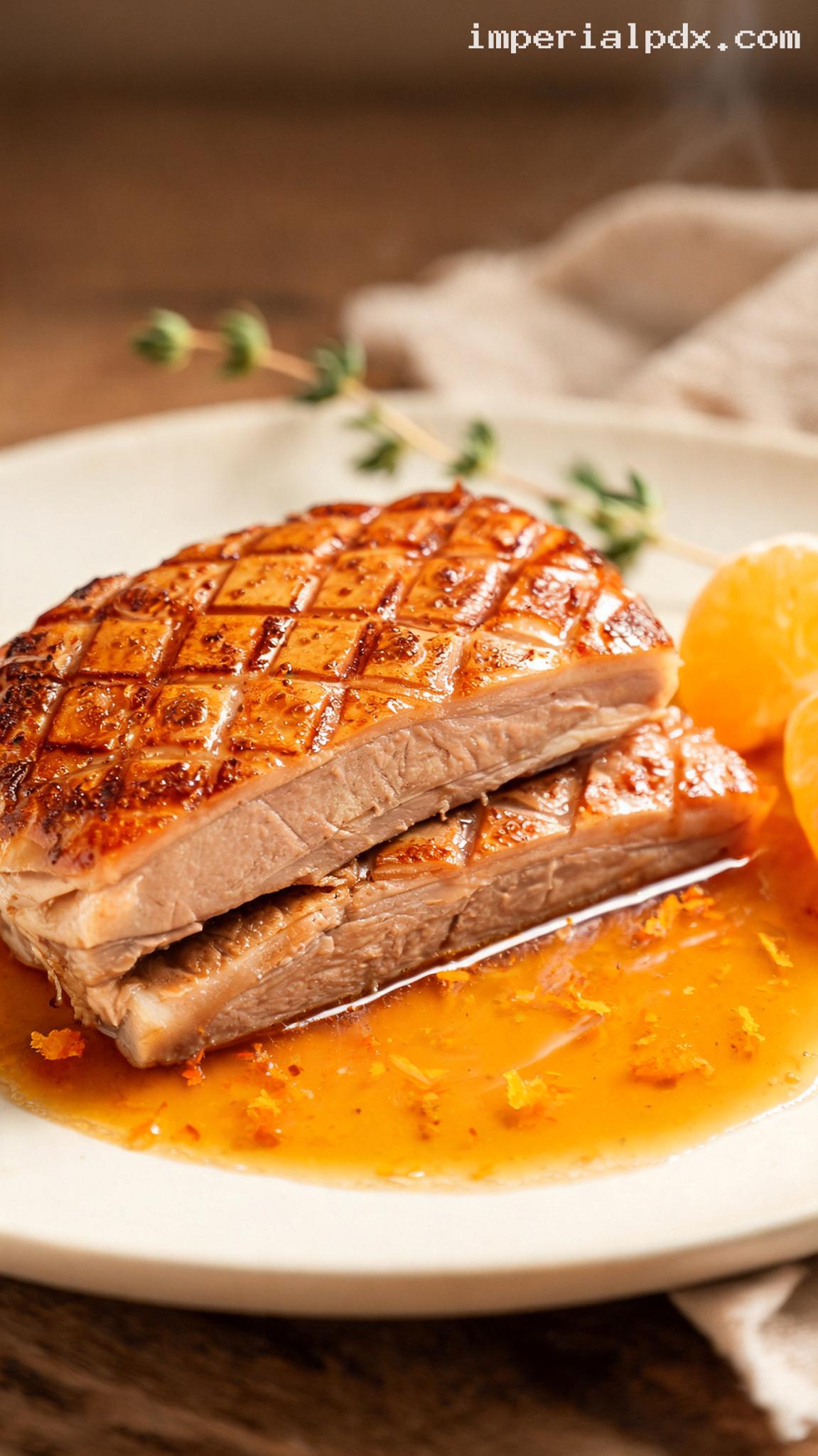
Using a sharp knife, score the skin in diagonal lines about 1/4 inch (6 mm) apart, then score in the opposite direction to create diamonds. Cut through the skin and into the fat without cutting into the meat. Season all sides with 1 teaspoon fine sea salt and 1/2 teaspoon black pepper.
Optional for even crisper skin: Place the scored, salted breasts skin-side up on a rack over a tray and refrigerate uncovered for 8–24 hours. Keep the tray on a low refrigerator shelf, away from ready-to-eat foods. Pat away any surface moisture before cooking.
Step 2: Slowly render the skin
Place two duck breasts in each of two cold, dry, oven-safe skillets, skin-side down. Do not add oil. Set the skillets over medium-low heat and cook for 14–18 minutes, until the skin is deeply golden and much of the fat beneath it has rendered.
For the first minute, gently press each breast with a spatula so the skin makes even contact with the pan. Every few minutes, carefully spoon or pour the excess fat into a heatproof container, leaving only a thin film in each skillet. If the skin darkens quickly before the fat renders, lower the heat. The goal is a steady, gentle sizzle, not aggressive frying.
Step 3: Simmer the orange sauce
While the duck renders, combine the orange juice, 1 teaspoon orange zest, chicken stock, honey, white wine vinegar, and 1/4 teaspoon salt in a small saucepan. Bring to a gentle boil over medium heat, then reduce to a steady simmer.
Simmer uncovered for 12–15 minutes, stirring occasionally, until reduced to approximately 3/4 cup (180 ml). The sauce should smell fragrant and taste distinctly orange, with both sweetness and tang.
Mix the cornstarch and cold water until smooth. Whisk the slurry into the simmering sauce and cook for 1 minute, stirring, until lightly thickened. Remove from the heat and set aside. The butter will go in just before serving.
Step 4: Finish cooking the duck
Once the skin is crisp and golden, turn the breasts meat-side down and cook for 2 minutes. Carefully transfer both skillets to the oven, leaving the breasts skin-side up.
Roast for approximately 6–12 minutes, checking early with an instant-read thermometer inserted horizontally into the thickest part of each breast. For food safety, cook duck to 165°F (74°C). Thickness and starting temperature affect the cooking time, so use the thermometer rather than the clock as your final guide; continue cooking if necessary.
Remember that skillet handles will be extremely hot after they leave the oven. Keep an oven mitt draped over each handle as a reminder.
Step 5: Rest the duck and finish the sauce
Transfer the duck to a clean cutting board, skin-side up, and rest for 10 minutes. Leave it uncovered so steam does not soften the skin.
Near the end of the resting time, gently rewarm the sauce over low heat. Remove the saucepan from the heat and whisk in the cold butter, a few cubes at a time, until the sauce is smooth and glossy. Do not boil after adding the butter, which can make the sauce separate.
Step 6: Slice and serve beautifully
Using a sharp knife, slice each breast across the grain into pieces about 1/2 inch (1.3 cm) thick. Keep the skin attached to each slice.
Spoon one-quarter of the orange sauce onto each warmed plate, then arrange the sliced duck partly over the sauce with the crisp skin facing upward. Alternatively, serve the sauce alongside. Finish with the remaining 1 teaspoon orange zest and, if using, 2 orange segments and 1 small thyme sprig per plate.
Serve immediately with potato purée, roasted potatoes, or green beans. Keeping the sauce underneath or beside the duck preserves that lovely crackly skin.
Pro Tips
- Dry skin is essential: Pat the breasts especially well around the scored lines. Surface moisture delays browning.
- Render patiently: Raising the heat too quickly can brown the surface while leaving a thick, chewy layer of fat underneath.
- Zest before juicing: Grate only the colored outer peel. The white pith can make the sauce bitter.
- Keep the sauce pourable: It should lightly coat a spoon, not resemble jam. If it becomes too thick, whisk in hot water, 1 tablespoon at a time.
- Save the rendered fat: Cool it slightly, strain into a clean container, and refrigerate. It is excellent for roasting potatoes. Never pour it down the drain.
Variations
- Blood orange: Replace the orange juice with the same amount of blood orange juice and use blood orange zest and segments. The sauce will have a deeper reddish-orange color.
- Orange liqueur: After reducing the sauce, add 1 tablespoon (15 ml) Grand Marnier or Cointreau. Simmer for 2 minutes before adding the cornstarch slurry. No flambéing is needed.
- Gently spiced: Add 1 whole star anise while the sauce reduces, then remove it before adding the slurry. Its subtle warmth is especially lovely for a holiday meal.
Storage & Make-Ahead
Make ahead: Score and salt the duck up to 24 hours ahead and refrigerate uncovered as directed above. Prepare the sauce through the cornstarch step up to 2 days ahead; cool promptly and refrigerate in a covered container. Reheat gently, then whisk in the butter just before serving.
Refrigerate leftovers: Store the duck and sauce separately in airtight containers within 2 hours of cooking. Refrigerate at 40°F (4°C) or below and use within 3 days.
Reheat: Place the duck skin-side up on a rack over a baking tray in a 350°F (175°C) oven. Begin checking after 12 minutes and continue until the center reaches 165°F (74°C). If needed, briefly broil the skin for 1–2 minutes, watching constantly. Rewarm the sauce separately over low heat, whisking in a little water if it has thickened. Reheated duck will be firmer and less crisp than freshly cooked duck.
Nutrition (per serving)
Estimated for one duck breast with one-quarter of the sauce, excluding optional garnishes and side dishes. Values vary with the size of the breasts and the amount of fat rendered and discarded.
Calories: 540 kcal | Carbs: 19g | Protein: 39g | Fat: 34g | Saturated Fat: 12g | Fiber: 0g | Sugar: 17g | Sodium: 870mg | Cholesterol: 175mg


