Quick Recipe Version (TL;DR)
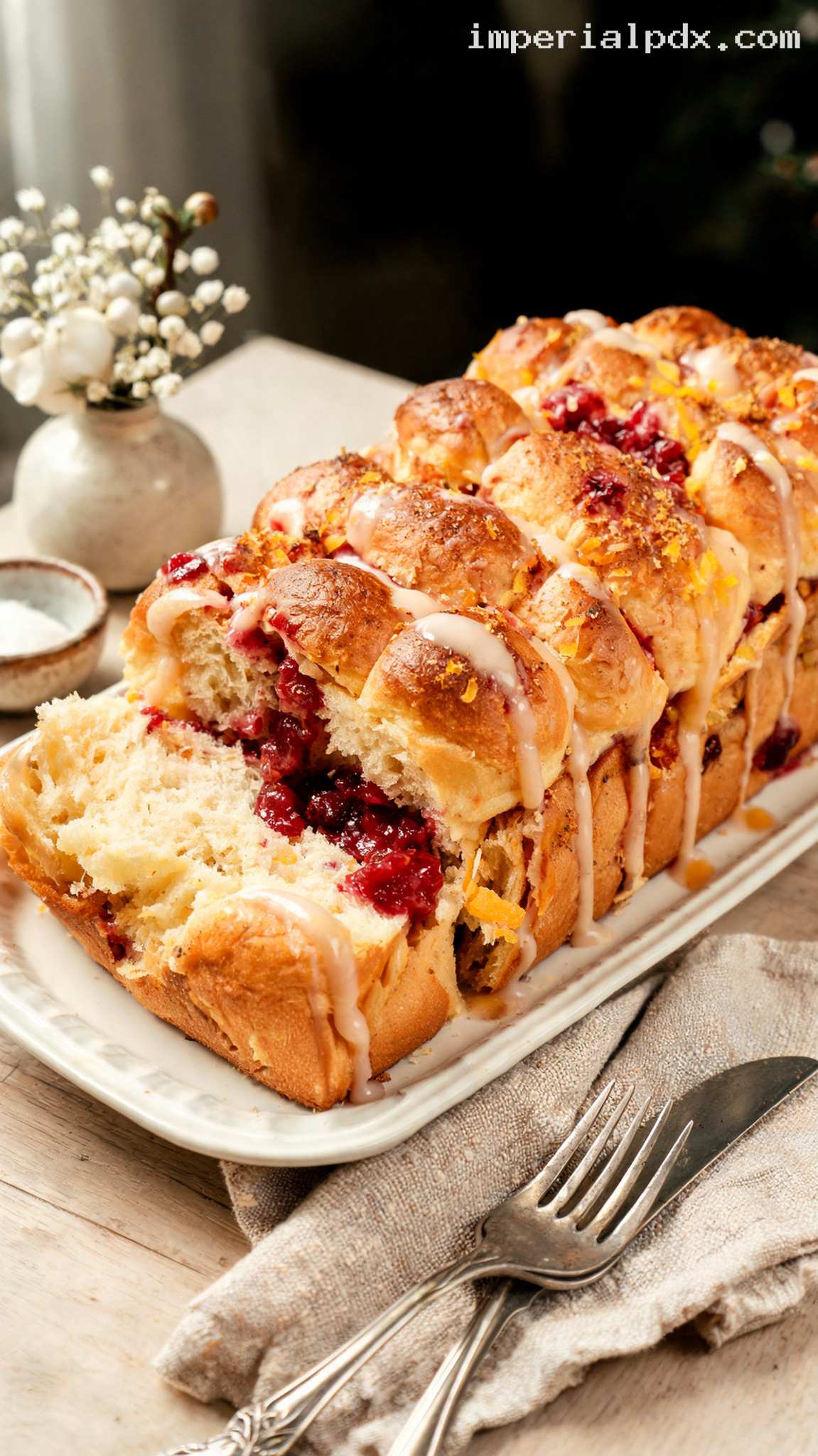
Cranberry Orange Pull-Apart Christmas Bread is a soft, buttery yeast loaf layered with tart cranberry compote, fresh orange zest, brown sugar, and cinnamon, then finished with a delicate orange-vanilla glaze.
Quick Ingredients
- Dough: 3 1/4 cups (390 g) all-purpose flour, plus 1 tablespoon (8 g) for dusting; 1/4 cup (50 g) granulated sugar; 2 1/4 teaspoons (7 g) instant yeast; 1 teaspoon (6 g) fine table salt.
- Dough liquids: 3/4 cup (180 ml) whole milk, warmed to 105–110°F (40–43°C); 2 large eggs; 4 tablespoons (56 g) unsalted butter, melted and cooled until warm.
- Compote: 1 1/2 cups (150 g) fresh or frozen cranberries, 1/4 cup (50 g) granulated sugar, and 1/4 cup (60 ml) fresh orange juice.
- Layer filling: 2 tablespoons (28 g) softened unsalted butter, 1/4 cup (50 g) packed light brown sugar, 1 tablespoon (6 g) finely grated orange zest, and 1 teaspoon ground cinnamon.
- Glaze: 1 cup (120 g) powdered sugar, 2 tablespoons (30 ml) fresh orange juice, and 1/2 teaspoon vanilla extract.
Do This
- 1. Simmer the cranberries, granulated sugar, and orange juice for 10 minutes, stirring and crushing the berries, until thick and spreadable. Cool completely.
- 2. Mix the dough ingredients and knead until smooth and slightly tacky, about 10 minutes by hand. Cover and let rise for 60 minutes, or until doubled.
- 3. Roll the dough into a 12-by-18-inch rectangle. Spread with softened butter and cooled compote, then sprinkle with the brown sugar, orange zest, and cinnamon.
- 4. Cut into twenty-four 3-inch squares. Stack in groups of four and stand the stacks on edge in a parchment-lined 9-by-5-inch metal loaf pan.
- 5. Cover loosely and let rise for 45 minutes, until puffy. Preheat the oven to 350°F (175°C).
- 6. Bake for approximately 50 minutes, tenting with foil after 25 minutes. The bread should be golden and register 195–200°F (90–93°C) in a doughy section near the center.
- 7. Cool in the pan for 15 minutes, then on a rack for 30 minutes. Whisk the glaze ingredients together and drizzle over the warm, not hot, loaf.
Why You’ll Love This Recipe
- Festive flavor in every layer: Tart cranberries and bright orange balance the buttery bread and sweet glaze.
- No perfect shaping required: The slightly uneven layers bake into a beautiful, ruffled loaf.
- Soft and shareable: Pull off a tender section for Christmas breakfast, brunch, or an afternoon treat.
- Easy to plan ahead: Make the compote in advance or refrigerate the shaped loaf overnight.
Grocery List
- Produce: 1 1/2 cups fresh cranberries, or buy frozen; 2 medium oranges to provide 1 tablespoon zest and 6 tablespoons juice.
- Dairy: Whole milk, 6 tablespoons unsalted butter, and 2 large eggs.
- Pantry: All-purpose flour, instant yeast, granulated sugar, light brown sugar, powdered sugar, fine table salt, ground cinnamon, and vanilla extract.
- Baking supplies: Parchment paper and aluminum foil.
Full Ingredients
For the Sweet Yeast Dough
- 3 1/4 cups (390 g) all-purpose flour, spooned into the measuring cup and leveled
- 1/4 cup (50 g) granulated sugar
- 2 1/4 teaspoons (7 g) instant yeast, equivalent to one standard packet
- 1 teaspoon (6 g) fine table salt
- 3/4 cup (180 ml) whole milk, warmed to 105–110°F (40–43°C)
- 2 large eggs, at room temperature
- 4 tablespoons (56 g) unsalted butter, melted and cooled to below 110°F (43°C)
- 1 tablespoon (8 g) all-purpose flour, for lightly dusting the work surface
For the Cranberry Compote
- 1 1/2 cups (150 g) fresh or frozen cranberries; do not thaw frozen berries
- 1/4 cup (50 g) granulated sugar
- 1/4 cup (60 ml) fresh orange juice
For the Orange-Cinnamon Layers
- 2 tablespoons (28 g) unsalted butter, softened
- 1/4 cup (50 g) packed light brown sugar
- 1 tablespoon (6 g) finely grated orange zest, using only the colored peel
- 1 teaspoon ground cinnamon
For the Orange-Vanilla Glaze
- 1 cup (120 g) powdered sugar, sifted if lumpy
- 2 tablespoons (30 ml) fresh orange juice
- 1/2 teaspoon vanilla extract
Step-by-Step Instructions
Step 1: Cook and cool the cranberry compote
Combine the cranberries, 1/4 cup granulated sugar, and 1/4 cup orange juice in a small saucepan. Bring to a simmer over medium heat, then reduce the heat to medium-low. Cook for 10 minutes, stirring frequently and pressing the berries with a spoon as they burst.
The finished compote should be thick and jammy, with no puddle of loose juice. A spoon dragged across the bottom of the pan should leave a trail that stays visible briefly. If necessary, cook for another 1–3 minutes to reach that consistency. You should have approximately 3/4 cup of compote.
Transfer to a shallow bowl and refrigerate for about 20 minutes, stirring once, until completely cool. You can mix and knead the dough while it cools.
Step 2: Mix and knead the buttery dough
In a large mixing bowl or the bowl of a stand mixer, whisk together the flour, 1/4 cup granulated sugar, instant yeast, and salt. Add the warm milk, eggs, and melted butter. Mix with a sturdy spoon or dough hook until no dry patches remain.
Knead with the dough hook on medium-low speed for 6–8 minutes, or by hand on a lightly floured surface for 10–12 minutes. The dough should become smooth, elastic, and slightly tacky rather than wet or paste-like. Use the measured dusting flour sparingly; adding too much flour makes the finished bread less tender.
Step 3: Let the dough rise until doubled
Shape the dough into a ball and return it to the mixing bowl. Cover with a lid or a clean, slightly damp kitchen towel. Let rise in a warm, draft-free spot, ideally 75–80°F (24–27°C), for approximately 60 minutes, until doubled in volume.
A cooler kitchen may require another 15–30 minutes. Judge the dough by its size rather than the clock: it should look noticeably inflated, and a gently pressed fingertip should leave an indentation that slowly begins to fill back in.
Step 4: Roll and fill the dough
Line a 9-by-5-by-3-inch metal loaf pan with parchment paper, leaving an overhang along the long sides to help lift out the finished bread. In a small bowl, mix the brown sugar, orange zest, and cinnamon, rubbing the zest into the sugar with your fingertips to release its fragrance.
Gently press the air out of the risen dough. On the lightly floured work surface, roll it into a 12-by-18-inch rectangle. If the dough keeps springing back, cover it and let it rest for 5 minutes before continuing.
Spread the softened butter evenly over the dough, followed by a thin, even layer of all the cooled compote. Sprinkle the orange-cinnamon sugar evenly over the top. Spread the filling nearly to the edges without leaving thick patches.
Step 5: Stack the layers and let them rise
Using a sharp knife or pizza cutter, cut the rectangle into twenty-four 3-inch squares: four rows along the 12-inch side and six columns along the 18-inch side. Loosely stack the squares in six groups of four, keeping the filling between the layers.
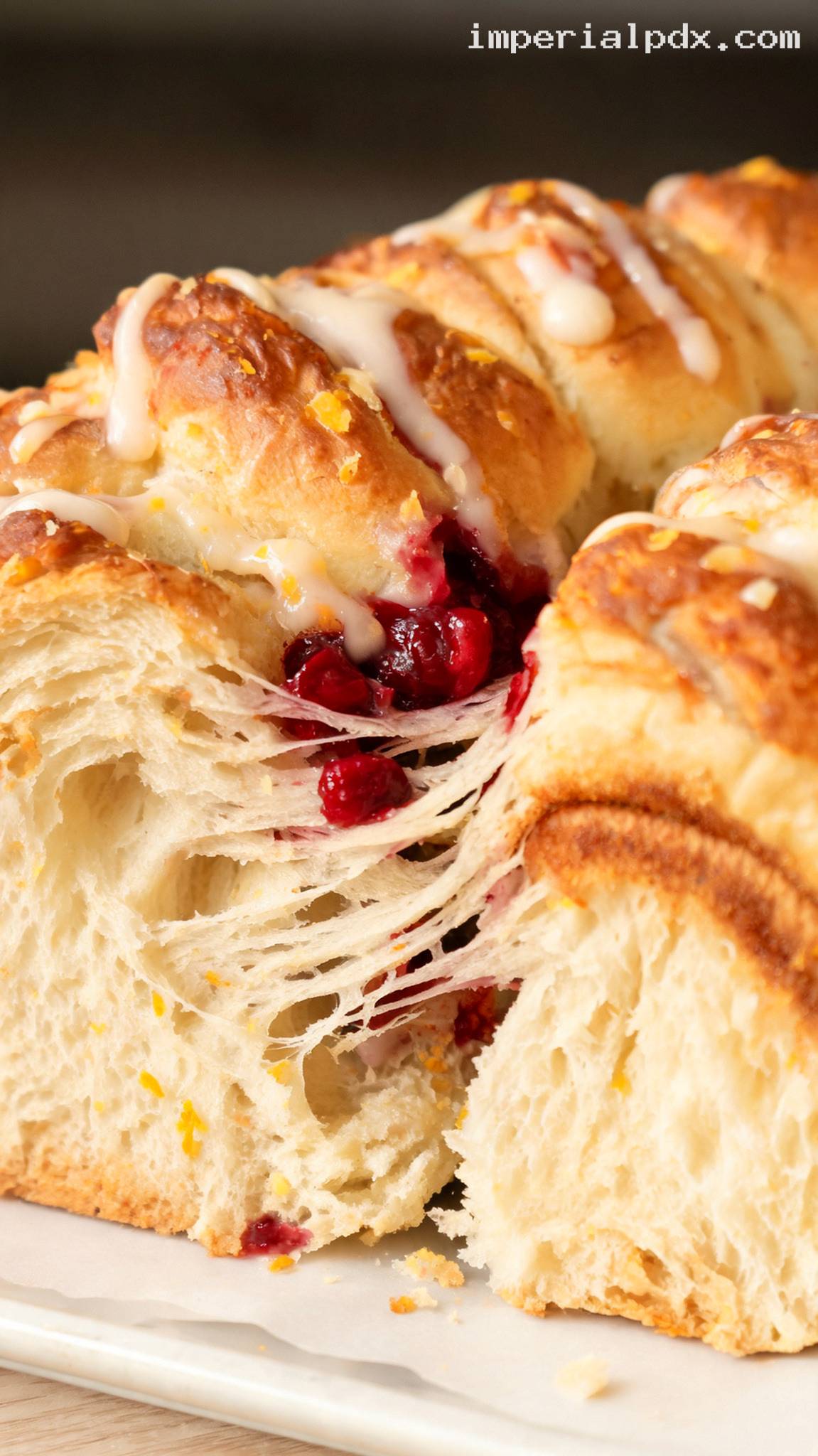
Stand each stack on edge in the prepared pan, arranging the layers along the length of the pan like cards in a file. The broad faces of the squares should face the short ends of the pan, with their cut edges pointing upward. Tilting the pan onto one short end while adding the stacks can make this easier. Return it to its normal position afterward, and do not compress the layers tightly.
Cover loosely and let rise for approximately 45 minutes, until the layers look puffy and the upper edges approach the rim of the pan. During the final 20 minutes of rising, preheat the oven to 350°F (175°C), with a rack in the lower-middle position.
Step 6: Bake until golden and cooked through
Bake for approximately 50 minutes. After 25 minutes, loosely tent the top with aluminum foil to protect the exposed edges from getting too dark. Begin checking for doneness at 45 minutes; the loaf may need up to 55 minutes, depending on your oven and pan.
The bread is ready when the top is deep golden and an instant-read thermometer inserted into a doughy section near the center registers 195–200°F (90–93°C). Avoid measuring only the cranberry filling, which can give a misleading reading. If the center is not ready, continue baking under the foil in 5-minute increments.
Step 7: Cool the loaf without trapping steam
Set the pan on a wire rack and let the bread cool for 15 minutes. Use the parchment overhang to carefully lift the loaf out, supporting it underneath with a wide spatula if needed. Remove the parchment from the sides and let the bread cool on the rack for another 30 minutes.
The loaf should be warm rather than hot before glazing. This short wait also helps the soft layers set so they pull apart neatly instead of tearing into a sticky center.
Step 8: Glaze and serve
Whisk the powdered sugar, 2 tablespoons orange juice, and vanilla extract until smooth. The glaze should fall from the whisk in a thin ribbon. Drizzle it across the ridged top, allowing a little to run into the cranberry-filled folds and down the sides.
Let the glaze settle for 10 minutes if you prefer a slightly set finish, or serve right away for a softer glaze. Transfer to a serving platter and invite everyone to pull away a warm layer. For tidier portions, use a serrated knife to cut the loaf into 12 servings.
Pro Tips
- Cool the filling completely: Warm compote softens the butter and makes the dough slippery and difficult to stack.
- Keep the compote thick: Watery filling can create gummy pockets between the layers. Cook off excess liquid before assembling.
- Use the correct pan: A 9-by-5-by-3-inch metal loaf pan gives this generously filled loaf room to rise. A smaller 8 1/2-by-4 1/2-inch pan may overflow.
- Let the dough stay slightly tacky: Soft dough makes soft bread. Lightly flour your hands rather than repeatedly adding flour to the dough.
- Check the center, not just the crust: The sugary top browns before the interior finishes baking, so use foil and a thermometer for the best result.
Variations
- Cranberry-orange pecan: Sprinkle 1/3 cup (40 g) finely chopped toasted pecans over the cinnamon-sugar layer before cutting and stacking.
- Orange-cardamom: Replace the 1 teaspoon cinnamon with 1/2 teaspoon cinnamon and 1/2 teaspoon ground cardamom for a fragrant holiday variation.
- Less-sweet finish: Make half the glaze using 1/2 cup (60 g) powdered sugar, 1 tablespoon (15 ml) orange juice, and 1/4 teaspoon vanilla extract, then drizzle lightly.
Storage & Make-Ahead
Room temperature: Once completely cool, store the bread in an airtight container for up to 2 days. For longer storage, refrigerate for up to 5 days total, although refrigeration will firm the crumb.
Freezing: Wrap the cooled loaf or individual portions tightly, then place in a freezer-safe bag and freeze for up to 2 months. Freezing before glazing gives the neatest results. Thaw overnight in the refrigerator, then warm and glaze before serving.
Reheating: Warm an individual portion in the microwave for 10–15 seconds. To refresh an unglazed loaf, wrap loosely in foil and warm at 300°F (150°C) for 10–15 minutes. Add the glaze afterward.
Compote ahead: Prepare the compote up to 4 days in advance and refrigerate in a covered container. Use it cold or cool, never hot.
Overnight option: Assemble the loaf through stacking, then cover and refrigerate immediately for 8–12 hours instead of completing the second rise. The next day, uncover, cover loosely again, and let stand at room temperature for 60–90 minutes, or until puffy and approaching the pan rim. Bake as directed. This replaces the standard second rise and extends the total recipe time.
Nutrition (per serving)
Calories: 290 kcal | Carbs: 59g | Protein: 5g | Fat: 7g | Saturated Fat: 4g | Fiber: 2g | Sugar: 33g | Sodium: 220mg | Cholesterol: 48mg
Nutrition is an estimate for one-twelfth of the loaf, including the full glaze and excluding optional variations.


