Quick Recipe Version (TL;DR)
Quick Ingredients
- 480 ml (2 cups) whole milk, for crème anglaise
- 240 ml (1 cup) heavy cream
- 1 vanilla bean or 2 tsp vanilla bean paste
- 6 large egg yolks + 6 large egg whites
- 420 g (about 2 cups + 2 tbsp) granulated or caster sugar, divided
- 720 ml (3 cups) whole milk + 240 ml (1 cup) water, for poaching
- 1/2 tsp cream of tartar or 1 tsp lemon juice; pinch of salt
- 150 g (3/4 cup) sugar + 60 ml (1/4 cup) water + 1 tsp lemon juice for caramel
- 30 g (1/4 cup) flaked almonds, toasted
- 15 g (1 tbsp) unsalted butter (optional, for softer caramel)
Do This
- 1) Make crème anglaise: scald milk, cream, and vanilla; whisk yolks with sugar and salt; temper with hot dairy, cook gently until it coats the back of a spoon, strain, chill completely.
- 2) Prepare poaching liquid: gently heat 720 ml milk, 240 ml water, and 1 tbsp sugar in a wide saucepan until barely simmering, then keep warm.
- 3) Beat meringue: whip egg whites with salt and cream of tartar to soft peaks, gradually add sugar, whip to glossy stiff peaks.
- 4) Poach “islands”: scoop large quenelles of meringue and poach 1–2 minutes per side until puffed and just set; drain on a lined tray and chill.
- 5) Toast almonds in a dry pan over medium heat until golden; cool.
- 6) Make caramel: cook sugar, water, and lemon juice to a deep amber; off heat, whisk in butter if using; cool slightly until syrupy.
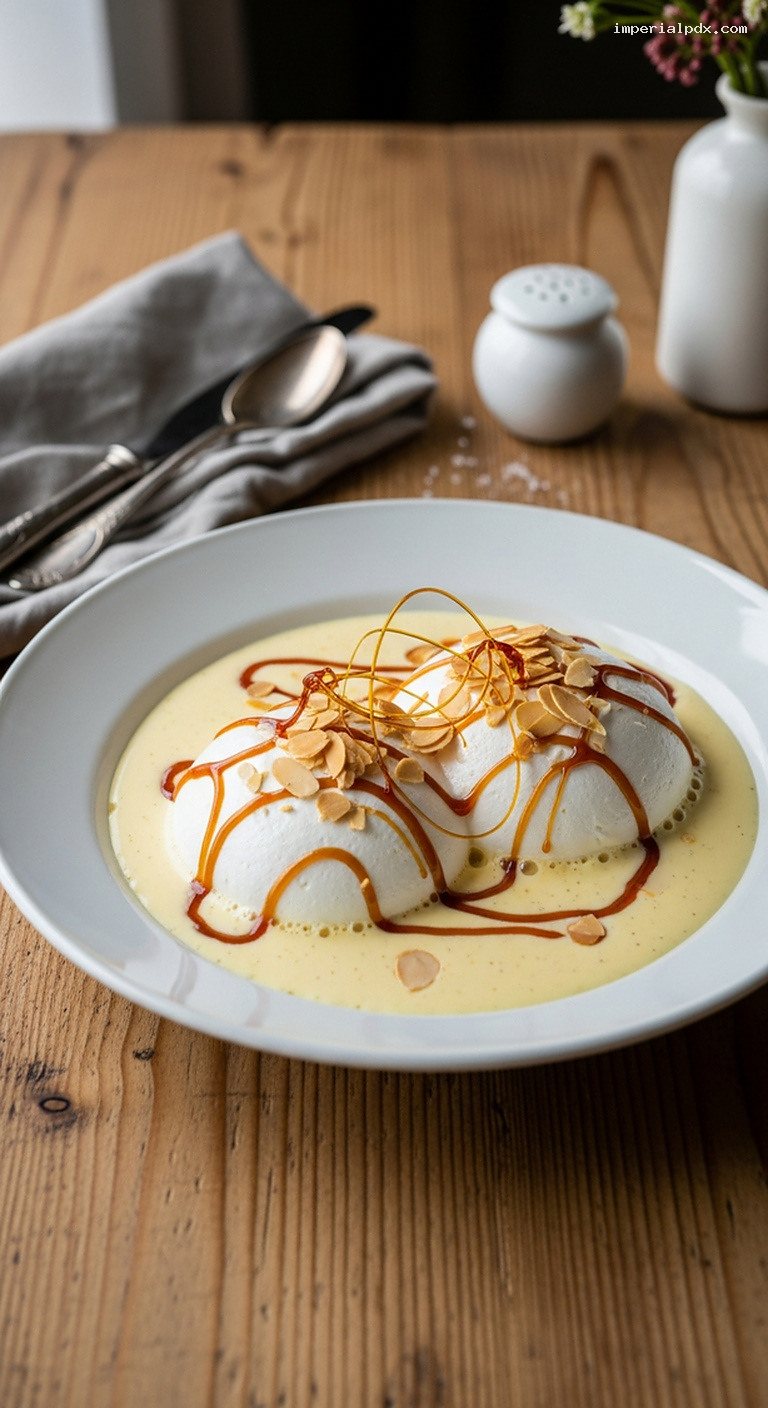
- 7) Serve: pour chilled crème anglaise into shallow bowls, float meringue islands on top, drizzle with warm caramel, and scatter toasted almonds.
Why You’ll Love This Recipe
- Light-as-air meringue “clouds” contrast beautifully with the silky, rich vanilla crème anglaise.
- Looks restaurant-fancy but uses simple, inexpensive pantry ingredients.
- Perfect make-ahead dessert: the custard and poached meringues can be prepared in advance.
- The bittersweet caramel and toasted almonds add crunch and depth, so every spoonful is layered and interesting.
Grocery List
- Produce: 6 large eggs, 1 vanilla bean (or jar of vanilla bean paste or extract), 1 lemon (optional, for caramel)
- Dairy: Whole milk (about 1.2 litres / 5 cups), heavy cream (240 ml / 1 cup), unsalted butter (small piece for caramel, optional)
- Pantry: Granulated or caster sugar, fine sea salt, cream of tartar (or extra lemon juice), flaked (sliced) almonds, water
Full Ingredients
For the Vanilla Crème Anglaise
- 480 ml (2 cups) whole milk
- 240 ml (1 cup) heavy cream
- 1 vanilla bean, split and seeds scraped (or 2 tsp vanilla bean paste or pure vanilla extract)
- 6 large egg yolks (about 110 g), at room temperature
- 120 g (1/2 cup + 1 tbsp) granulated or caster sugar
- 1 small pinch fine sea salt
For the Poached Meringue “Islands”
- 6 large egg whites (about 180 g), at room temperature
- 1/4 tsp fine sea salt
- 1/2 tsp cream of tartar or 1 tsp fresh lemon juice
- 150 g (3/4 cup) caster or superfine sugar
- 1 tsp pure vanilla extract (optional, for lightly scented meringue)
For the Poaching Liquid
- 720 ml (3 cups) whole milk
- 240 ml (1 cup) water
- 1 tbsp granulated sugar (optional, helps gently set the meringues)
For the Caramel Drizzle
- 150 g (3/4 cup) granulated sugar
- 60 ml (1/4 cup) water
- 1 tsp lemon juice (helps prevent crystallization)
- 15 g (1 tbsp) unsalted butter, at room temperature (optional, for a slightly softer caramel)
For Topping and Serving
- 30 g (1/4 cup) flaked (sliced) almonds
- Extra vanilla bean seeds or a tiny pinch of flaky sea salt, for finishing (optional)
Step-by-Step Instructions
Step 1: Get Organized and Separate the Eggs
Line a baking sheet or large plate with parchment paper for the poached meringues later. Set out two medium mixing bowls (one for yolks, one for whites), plus a large heatproof bowl for whisking the custard.
Carefully separate the 6 eggs, placing the yolks in one bowl and the whites in another. Make sure there is absolutely no yolk or grease in the egg whites; even a small amount will prevent them from whipping properly. Let the egg whites come to room temperature (about 20–30 minutes) while you start the crème anglaise, as they whip more easily when not cold.
Step 2: Make the Vanilla Crème Anglaise
In a medium saucepan, combine 480 ml (2 cups) whole milk and 240 ml (1 cup) heavy cream. If using a vanilla bean, split it lengthwise, scrape out the seeds, and add both seeds and pod to the pan. If using vanilla bean paste, add it now. Place over medium heat and warm until the mixture is steaming and small bubbles appear around the edges, just below a simmer. Do not let it boil.
While the dairy heats, whisk the egg yolks, 120 g sugar, and a pinch of salt in the large heatproof bowl until slightly thickened and paler, 1–2 minutes. Slowly pour the hot milk-and-cream mixture into the yolks in a thin stream, whisking constantly to temper the eggs without scrambling them. Discard the vanilla bean pod if used, then pour the mixture back into the saucepan.
Cook over low to medium-low heat, stirring constantly with a wooden spoon or heatproof spatula, scraping the bottom and sides. The custard is ready when it thickens enough to coat the back of the spoon and a finger drawn through it leaves a clear line, about 5–8 minutes. It should never boil. If you have a thermometer, aim for 78–82°C (172–180°F).
Immediately strain the custard through a fine-mesh sieve into a clean bowl to catch any tiny cooked egg bits. If using vanilla extract (instead of bean or paste), stir it in now off the heat. Press plastic wrap directly on the surface to prevent a skin from forming, cool to room temperature, then refrigerate until thoroughly chilled, at least 2 hours.
Step 3: Prepare the Poaching Liquid for the Meringues
In a wide, deep sauté pan or large shallow saucepan, combine 720 ml (3 cups) whole milk, 240 ml (1 cup) water, and 1 tbsp sugar (if using). Place over low heat and warm gently until just below a simmer. You want the surface to be still with only the occasional small bubble around the edges; a rolling boil will shred the meringues.
Once the liquid is hot, maintain it at this very gentle heat. If it starts to simmer too vigorously, reduce the heat or briefly move the pan off the burner. Keeping this poaching liquid at the right temperature is key for smooth, tender “islands.”
Step 4: Whip the Meringue to Glossy Stiff Peaks
Make sure your mixing bowl and beaters are completely clean and dry. Add the room-temperature egg whites to the bowl along with 1/4 tsp fine salt and 1/2 tsp cream of tartar (or 1 tsp lemon juice). Using an electric mixer on medium speed, beat until soft peaks form (the whites look foamy and hold a very soft shape), about 2–3 minutes.
Increase the speed to medium-high and begin adding 150 g (3/4 cup) caster sugar, 1 tablespoon at a time, beating well after each addition. This gradual addition helps dissolve the sugar and gives a smoother texture. Continue to whip until the meringue is thick, very glossy, and holds stiff peaks that stand upright when you lift the beaters, about 3–5 more minutes. If using vanilla extract in the meringue, beat it in briefly at the end.
The meringue should feel smooth when rubbed between your fingers (no grittiness). If it feels sandy, whip for another minute or two to help dissolve more of the sugar.
Step 5: Poach the Meringue “Islands”
Using two large spoons, scoop generous oval-shaped quenelles or clouds of meringue (about 2–3 tablespoons each). Gently lay each one onto the surface of the hot but not boiling milk mixture, leaving a little space between them as they will puff up. Work in batches so you do not crowd the pan.
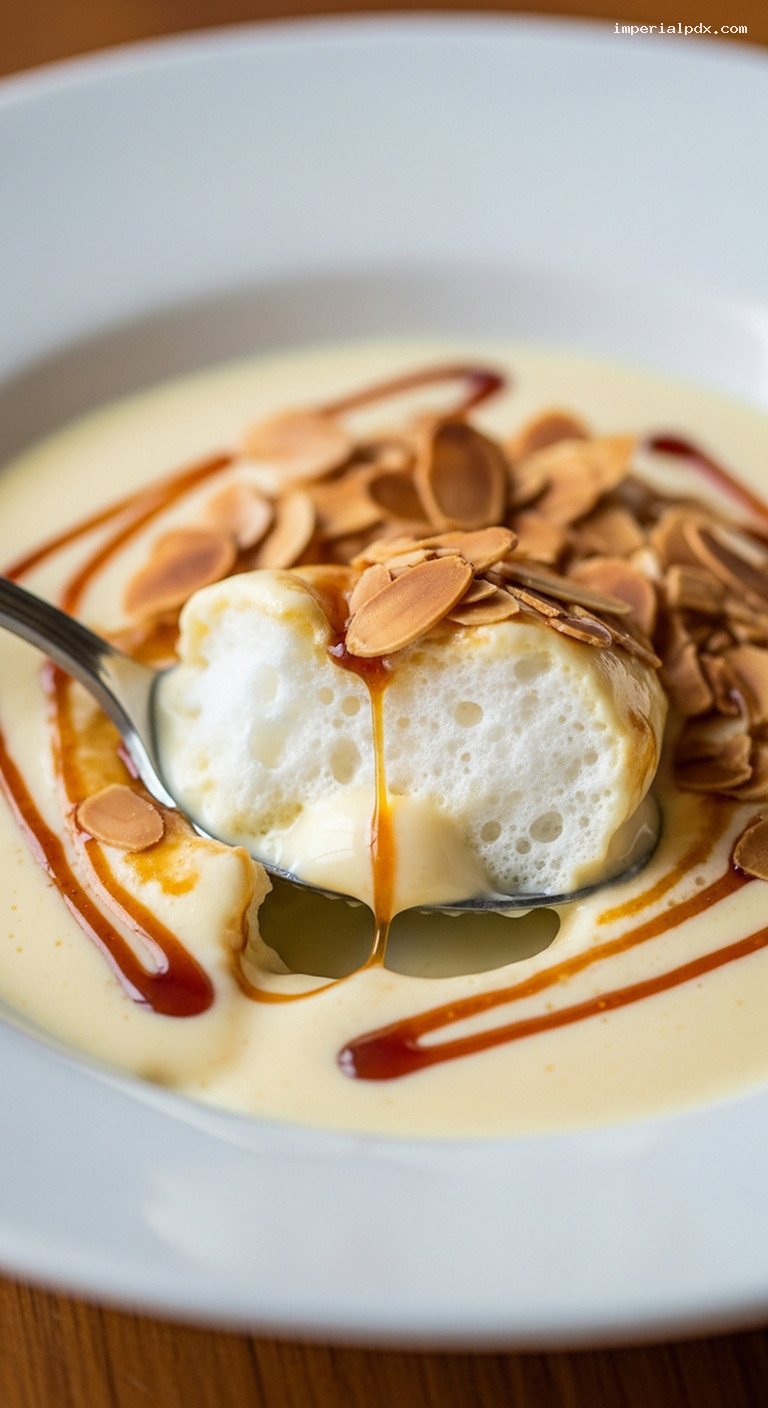
Poach each meringue for about 1–2 minutes on the first side, until it has puffed slightly and the underside looks set. Carefully turn each piece using a slotted spoon and poach for another 1–2 minutes. The meringues should feel light and just set but still soft in the center; they will continue to firm up slightly as they cool.
Lift the cooked “islands” out with a slotted spoon, let excess liquid drip off, and place them onto the prepared parchment-lined tray. Repeat with the remaining meringue. Once all the islands are poached, cover the tray lightly and refrigerate until cold, at least 1 hour. They can be kept refrigerated for up to 24 hours.
Step 6: Toast the Almonds and Make the Caramel
To toast the flaked almonds, place them in a dry skillet over medium heat. Cook, stirring frequently, until lightly golden and fragrant, 3–5 minutes. Watch them closely as they can burn quickly. Transfer immediately to a plate to cool.
For the caramel, in a small, clean saucepan, combine 150 g sugar, 60 ml water, and 1 tsp lemon juice. Stir gently just to moisten the sugar, then bring to a boil over medium heat without stirring. Cook, swirling the pan occasionally, until the syrup turns a deep amber color, 8–12 minutes depending on your stove. Watch very carefully as it can go from perfect to burnt quickly.
Once it reaches a rich amber, remove from the heat. If using, carefully whisk in the 15 g butter (it will bubble up). Let the caramel cool for a few minutes until it thickens slightly to a good drizzling consistency. If it becomes too thick, you can rewarm it gently over low heat or whisk in a teaspoon or two of hot water to loosen.
Step 7: Assemble and Serve Your Île Flottante
When ready to serve, give the chilled crème anglaise a good stir. If it has thickened too much, you can loosen it with a tablespoon or two of cold milk. Pour a generous pool of custard into each shallow dessert bowl or plate.
Place one or two poached meringue “islands” gently on top of the custard in each bowl so they appear to float. Drizzle warm (not boiling hot) caramel over the top in thin streams. Let some caramel drip onto the custard for a beautiful contrast of pale cream and amber.
Finish by scattering toasted flaked almonds over each island. If you like, add a tiny pinch of flaky sea salt or a few extra vanilla seeds for a final touch. Serve immediately so the meringue stays airy and the caramel retains its shine, while the custard is cool and silky underneath.
Pro Tips
- Keep the custard low and slow. Crème anglaise should never boil. Use medium-low heat and stir constantly. If it starts to steam aggressively, remove the pan from the heat and keep stirring.
- Use very gentle heat for poaching. If the milk is simmering or boiling, the meringues will break apart and become ragged. Aim for just below a simmer with only the occasional small bubble.
- Whip the meringue properly. Add sugar gradually and whip until the mixture is very glossy and holds stiff peaks. Underwhipped meringue will deflate; overwhipped can become grainy.
- Prepare elements ahead. Make the crème anglaise and poach the meringues a day ahead, then simply rewarm the caramel and assemble just before serving.
- Use a light hand with the caramel. The bitterness of a deep amber caramel is a lovely contrast, but if you go too dark it will taste burnt. Pull it from the heat as soon as it turns a rich golden-amber.
Variations
- Orange blossom or citrus twist: Add 1–2 tsp orange blossom water or finely grated zest of 1 orange or lemon to the custard at the end of cooking for a subtle floral or citrus note.
- Praline crunch: Stir a handful of finely chopped caramelized nuts (hazelnut or almond praline) into the toasted almonds for extra crunch and flavor.
- Chocolate-swirled custard: Whisk 60 g (about 1/3 cup) finely chopped dark chocolate into half of the hot crème anglaise, then marble the plain and chocolate custards together in the serving bowls for a dramatic look.
Storage & Make-Ahead
Crème anglaise: Store in an airtight container in the refrigerator for up to 3 days. Press plastic wrap directly onto the surface to prevent a skin from forming. Stir well before serving; thin with a splash of cold milk if needed.
Meringue “islands”: Poached meringues keep well, covered, in the refrigerator for up to 24 hours. They may release a little liquid; simply lift them gently with a slotted spoon when plating.
Caramel: Caramel firms as it cools. You can make it a day ahead and store at room temperature in a heatproof jar. Before serving, warm it gently in a hot water bath or for a few seconds in the microwave until pourable again, adding a teaspoon or two of hot water if necessary.
Fully assembled dessert: For best texture, assemble just before serving. If needed, you can plate up to 30 minutes ahead and refrigerate; add the caramel drizzle at the last moment so it stays glossy.
Nutrition (per serving)
Approximate values per serving (1/6 of recipe): about 580 calories; 26 g fat; 78 g carbohydrates; 10 g protein; 57 g sugars; 0.4 g fiber; 230 mg sodium. Actual values will vary depending on exact ingredients and portion sizes.