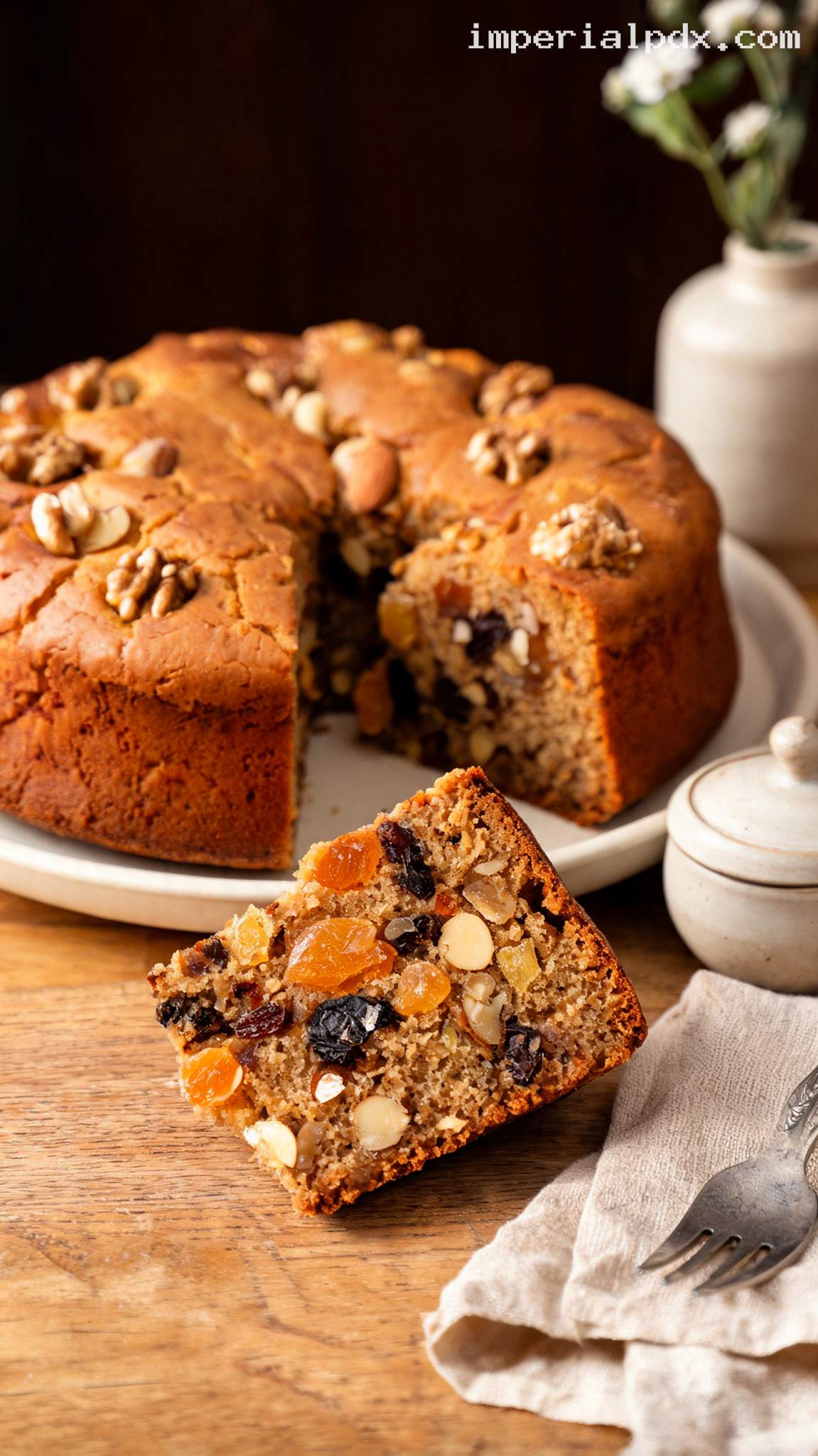
Chilean Pan de Pascua Christmas Fruit Cake
Rich with dried fruit, crunchy nuts, warm spices, and fragrant orange zest, Pan de Pascua is a much-loved Chilean Christmas tradition. Despite its name, this holiday favorite is a cake rather than a bread: dense but tender, wonderfully aromatic, and even better the day after baking.
Quick Recipe Version (TL;DR)
Quick Ingredients
- Fruit: 150 g raisins, 100 g chopped dried apricots, and 100 g chopped candied orange and lemon peel
- Soaking liquid: 60 ml strong brewed coffee, cooled, and 60 ml dark rum
- Nuts: 100 g walnut halves and 75 g whole almonds, both coarsely chopped
- Dry ingredients: 300 g all-purpose flour, 2 teaspoons baking powder, and 1/2 teaspoon fine salt
- Spices: 2 teaspoons ground cinnamon, 1/2 teaspoon ground cloves, and 1/2 teaspoon ground nutmeg
- Batter: 170 g softened unsalted butter, 165 g packed dark brown sugar, 4 large eggs, 2 tablespoons molasses, 2 teaspoons vanilla extract, and 1 tablespoon finely grated orange zest
Do This
- 1. Combine the raisins, apricots, candied peel, coffee, and rum. Cover and soak for 30 minutes; keep all the liquid.
- 2. Heat the oven to 160°C / 320°F. Grease and line a 9-inch round, 3-inch-deep cake pan.
- 3. Reserve 2 tablespoons of the measured flour. Whisk the remaining flour with the baking powder, salt, cinnamon, cloves, and nutmeg.
- 4. Beat the butter and sugar for 4 minutes. Beat in the eggs individually, then add the molasses, vanilla, and orange zest.
- 5. Fold in the dry ingredients in two additions, alternating with the liquid drained from the fruit. Toss the fruit and nuts with the reserved flour, then fold them into the batter.
- 6. Transfer to the pan and bake for approximately 90 minutes, until a skewer inserted into the center comes out without wet batter. Tent loosely with foil after 60 minutes if needed.
- 7. Cool in the pan for 20 minutes, then on a rack for at least 2 hours 40 minutes before slicing. For the fullest flavor, wrap the cooled cake and serve the next day.
Why You’ll Love This Recipe
- Deep holiday flavor: Cinnamon, cloves, nutmeg, coffee, rum, and orange zest make every slice wonderfully fragrant.
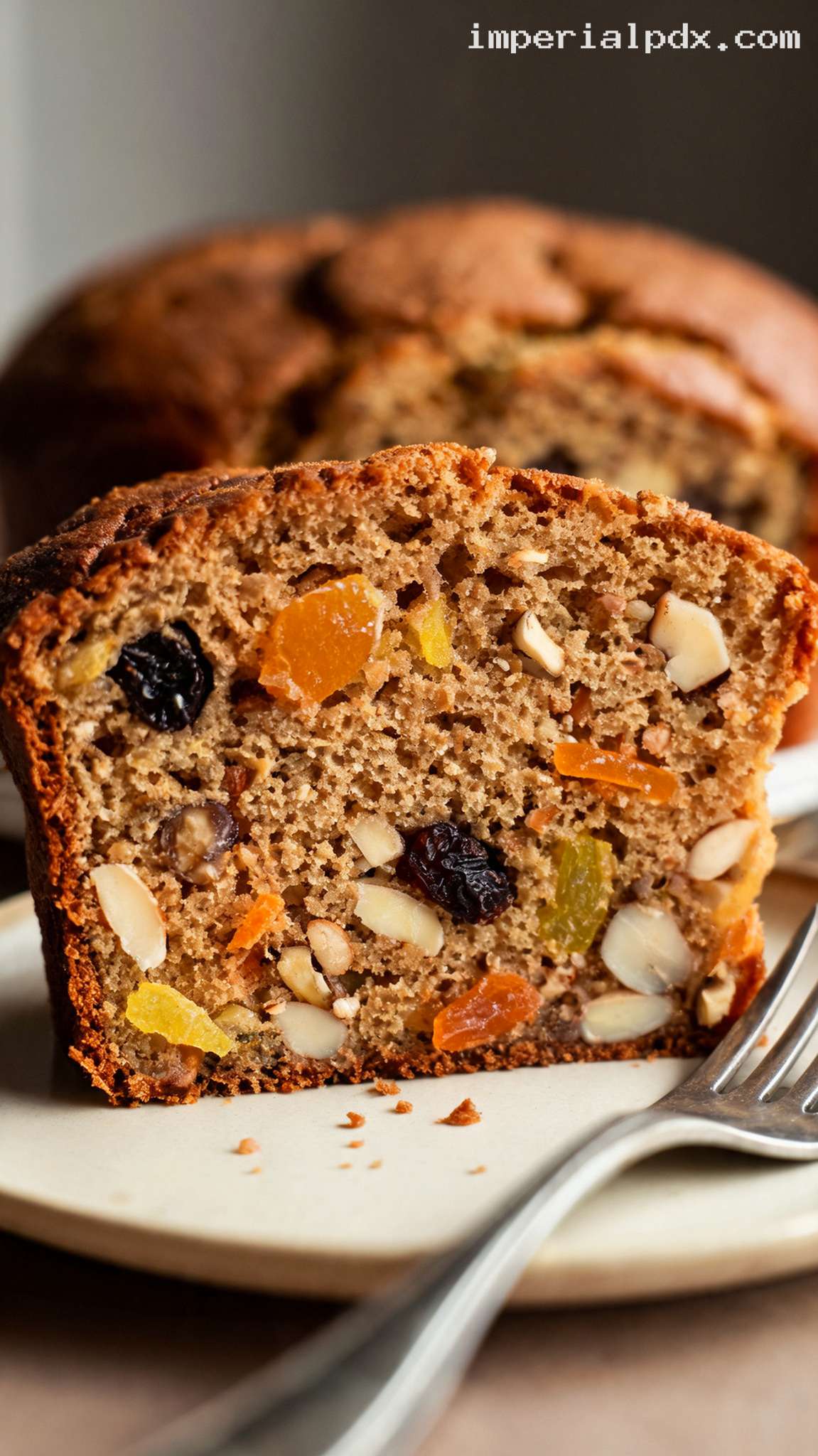
- Plenty of texture: Juicy raisins, chewy apricots, candied citrus, walnuts, and almonds fill the tender crumb.
- A practical make-ahead dessert: The flavor becomes rounder and the cake slices more neatly after an overnight rest.
- No elaborate decorating: Its golden-brown crust and fruit-studded slices are beautiful just as they are.
Grocery List
- Produce: 1 large orange for the zest
- Dairy: Unsalted butter
- Eggs: 4 large eggs
- Pantry: All-purpose flour, dark brown sugar, baking powder, fine salt, molasses, vanilla extract, raisins, dried apricots, candied orange and lemon peel, walnuts, almonds, coffee, and dark rum
- Spices: Ground cinnamon, ground cloves, and ground nutmeg
Full Ingredients
For the Soaked Fruit
- 150 g raisins, about 1 cup
- 100 g dried apricots, cut into 1/4-inch pieces, about 2/3 cup chopped
- 100 g mixed candied orange and lemon peel, finely chopped, about 1/2 cup
- 60 ml strong brewed coffee, cooled, 1/4 cup
- 60 ml dark rum, 1/4 cup
For the Nuts and Dry Ingredients
- 100 g walnut halves, about 1 cup before chopping, coarsely chopped
- 75 g whole almonds, about 1/2 cup before chopping, coarsely chopped
- 300 g all-purpose flour, 2 1/2 cups spooned and leveled, divided
- 2 teaspoons baking powder
- 1/2 teaspoon fine salt
- 2 teaspoons ground cinnamon
- 1/2 teaspoon ground cloves
- 1/2 teaspoon ground nutmeg
For the Batter
- 170 g unsalted butter, 3/4 cup, softened to room temperature, plus 1 teaspoon for greasing the pan
- 165 g dark brown sugar, 3/4 cup packed
- 4 large eggs, at room temperature
- 2 tablespoons molasses, 40 g
- 2 teaspoons vanilla extract
- 1 tablespoon finely grated orange zest, from approximately 1 large orange
Step-by-Step Instructions
Step 1: Soak the dried fruit
Place the raisins, chopped apricots, and candied citrus peel in a medium bowl. Pour over the cooled coffee and dark rum, then stir well. Cover and let stand for 30 minutes, stirring once after 15 minutes. The fruit will soften and absorb some of the flavorful liquid.
After soaking, set a sieve over a bowl and drain the fruit for 2 minutes. Save the drained liquid: it goes into the batter, so nothing is discarded.
Step 2: Prepare the oven and pan
Heat the oven to 160°C / 320°F, conventional setting, with a rack in the middle. Grease a 9-inch round cake pan that is at least 3 inches deep with 1 teaspoon butter. Line the bottom and sides with baking parchment, allowing the side paper to extend about 1 inch above the rim. A deep springform pan also works well.
Coarsely chop the walnuts and almonds into roughly 1/4-inch pieces. Keep the pieces small enough to distribute easily through the batter, but not so fine that they lose their crunch.
Step 3: Mix the flour and spices
Measure out 2 tablespoons from the 300 g flour and set that portion aside for the fruit and nuts. In a large bowl, whisk the remaining flour with the baking powder, salt, cinnamon, cloves, and nutmeg until evenly combined.
Step 4: Cream the butter and sugar
Using a hand mixer or a stand mixer fitted with the paddle attachment, beat the softened butter and dark brown sugar on medium speed for 4 minutes, scraping down the bowl halfway through. The mixture should look lighter and feel fluffy rather than compact.
Add the eggs one at a time, beating for approximately 30 seconds after each addition and scraping the bowl as needed. Beat in the molasses, vanilla, and orange zest for 30 seconds. A slightly curdled appearance at this stage is fine; the flour will bring the batter together.
Step 5: Fold in the fruit and nuts
With a sturdy spatula, fold half the dry mixture into the butter mixture. Fold in the reserved soaking liquid, followed by the remaining dry mixture. Stop as soon as the flour is mostly incorporated.
Toss the drained fruit and chopped nuts with the reserved 2 tablespoons flour, breaking up any sticky clumps. Fold them into the batter until evenly distributed and no dry pockets remain. The finished batter will be thick, scoopable, and generously packed with fruit and nuts.
Step 6: Bake gently until cooked through
Spoon the batter into the prepared pan and smooth the top, making a shallow depression in the center to encourage even rising. Bake for approximately 90 minutes. At 60 minutes, check the surface; if it is already deeply browned, cover it loosely with foil without pressing on the cake.
Begin testing the center at 80 minutes. The cake is ready when a long skewer inserted into the middle comes out with a few moist crumbs but no wet batter. Test a second spot if the skewer passes through a piece of fruit. If needed, continue baking in 5-minute increments. An instant-read thermometer inserted into the center should register approximately 96–98°C / 205–208°F.
Step 7: Cool completely and slice
Set the pan on a wire rack and let the cake cool for 20 minutes. Carefully release the springform ring or turn the cake out, remove the parchment, and return it upright to the rack. Let it cool for at least 2 hours 40 minutes more, until completely cool.
For the best texture and flavor, wrap the cooled cake tightly and let it rest overnight before serving. Cut into 16 wedges with a sharp serrated knife, wiping the blade between cuts. Serve plain with coffee or tea; this richly flavored cake does not need frosting.
Pro Tips
- Weigh the flour if possible. Too much flour can turn a pleasantly dense fruit cake into a dry one.
- Start with room-temperature ingredients. Butter should yield to gentle pressure without looking oily, and eggs should not feel refrigerator-cold.
- Do not increase the oven temperature to hurry it along. A moderate oven gives the center time to bake before the fruit and crust become too dark.
- Judge the center, not just the top. A browned surface can hide an underbaked middle, so always use a long skewer.
- Wait before cutting. Warm fruit cake is fragile; cooling and resting help the crumb hold its generous filling.
Variations
- No-rum version: Replace the 60 ml rum with 60 ml orange juice or an additional 60 ml cooled coffee. Baking does not reliably remove all alcohol, so use this substitution when avoiding alcohol.
- Different dried fruit: Replace the 100 g apricots with 100 g chopped dried figs or pitted prunes. Keep the raisins and candied peel unchanged.
- All-walnut version: Replace the 75 g almonds with 75 g additional walnuts, for 175 g walnuts total.
Storage & Make-Ahead
Make ahead: Bake the cake 1–2 days before serving for a more developed flavor. You can also soak the fruit, covered, in the refrigerator for up to 24 hours; let it stand at room temperature for 30 minutes before draining and mixing.
Room temperature: Once completely cool, wrap tightly and keep in an airtight container in a cool, dry place for up to 3 days. In a warm or humid kitchen, refrigerate instead. Refrigerator: Store tightly wrapped for up to 7 days and bring individual slices to room temperature before serving.
Freezer: Wrap the whole cake or individual slices in plastic wrap, then place in a freezer bag or airtight container. Freeze for up to 3 months. Thaw overnight in the refrigerator while still wrapped, then let stand at room temperature for approximately 1 hour before serving.
Nutrition (per serving)
Estimated values for 1 of 16 slices, using the rum version. Actual values vary with ingredient brands and substitutions.
Calories: 360 kcal | Carbs: 45g | Protein: 6g | Fat: 17g | Saturated Fat: 6g | Fiber: 3g | Sugar: 26g | Sodium: 155mg | Cholesterol: 69mg


