Quick Recipe Version (TL;DR)
Quick Ingredients
- Bread flour 500 g (about 4 cups)
- Whole milk 220 g (1 cup minus 2 tbsp) + water 60 g (1/4 cup)
- Granulated sugar 70 g (1/3 cup) + honey 20 g (1 tbsp)
- Instant yeast 8 g (2 1/4 tsp) or active dry 10 g (3 tsp, bloomed)
- Fine salt 10 g (1 3/4 tsp)
- Large eggs 2 (1 for dough, 1 for wash)
- Unsalted butter 280 g total (60 g in dough + 220 g for lamination)
- Vanilla extract 1 tsp; lemon zest (optional)
- Almíbar: sugar 120 g (1/2 cup) + water 120 g (1/2 cup) + lemon peel + 1/2 tsp vanilla
Do This
- 1) Mix dough: combine milk, water, sugar, honey, egg, yeast, vanilla; add flour and salt; knead in 60 g soft butter until smooth. Chill overnight (8–12 h).
- 2) Make butter block: shape 220 g butter into a 15 cm square; chill.
- 3) Enclose butter; roll to 20×60 cm; do a 3-fold. Chill 30 minutes.
- 4) Do two more 3-fold turns, chilling 30 minutes between.
- 5) Roll to 35×50 cm, 4 mm thick; cut 16 triangles (base 9 cm). Notch and roll into crescents.
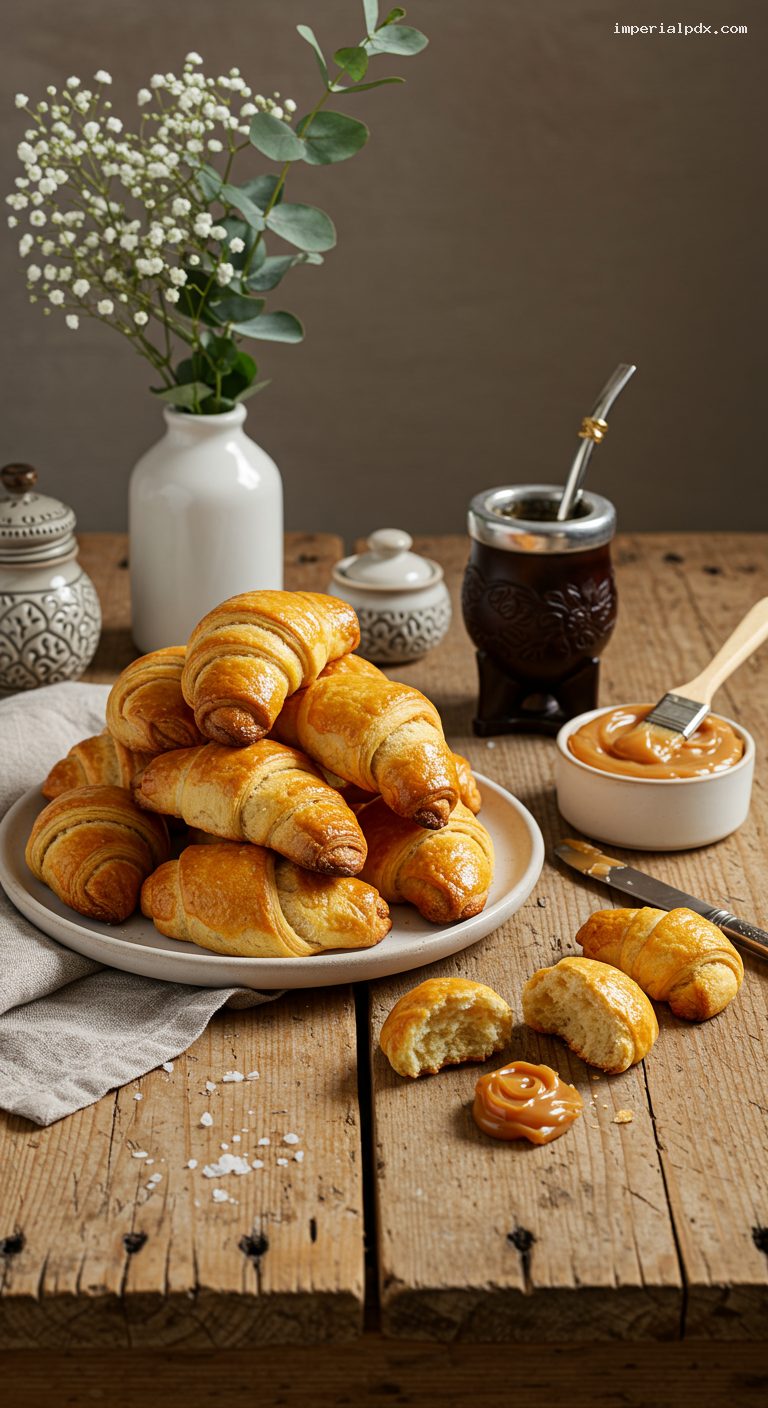
- 6) Proof 1.5–2.5 h at 26–28°C (79–82°F). Egg wash, bake at 190°C/375°F for 16–20 min. Brush hot almíbar twice, cool 10 min.
Why You’ll Love This Recipe
- Pillowy, buttery layers with that classic glossy almíbar finish.
- Clear, home-cook friendly lamination steps with precise sizes and times.
- Overnight rest for better flavor and an easier rollout.
- Freezer-friendly for fresh-baked medialunas anytime.
Grocery List
- Produce: 1 lemon (zest and peel for syrup)
- Dairy: Unsalted butter, whole milk, eggs
- Pantry: Bread flour, granulated sugar, honey, vanilla extract, instant or active dry yeast, fine salt
Full Ingredients
Sweet Yeasted Dough
- Bread flour: 500 g (about 4 cups)
- Whole milk: 220 g (1 cup minus 2 tbsp), lukewarm 24–27°C/75–80°F
- Water: 60 g (1/4 cup), lukewarm
- Granulated sugar: 70 g (1/3 cup)
- Honey: 20 g (1 tbsp)
- Instant yeast: 8 g (2 1/4 tsp)
or active dry yeast: 10 g (3 tsp), bloomed 5 minutes in the warm milk - Fine sea salt: 10 g (1 3/4 tsp)
- Large egg: 1 (about 50 g)
- Unsalted butter, softened: 60 g (4 tbsp)
- Vanilla extract: 1 tsp
- Optional: finely grated lemon zest from 1/2 lemon
Butter Block (Beurrage)
- Unsalted butter, cold: 220 g (about 1 cup minus 2 tbsp)
Egg Wash
- Large egg: 1
- Whole milk: 1 tbsp
- Pinch of salt
Almíbar (Light Syrup Glaze)
- Granulated sugar: 120 g (1/2 cup)
- Water: 120 g (1/2 cup)
- Lemon peel (1 wide strip) and 1/2 tsp vanilla extract
Step-by-Step Instructions
Step 1: Mix the enriched dough
In a large bowl or stand mixer, whisk milk, water, sugar, honey, egg, vanilla, and yeast (bloom active dry yeast in the milk first if using). Add flour and salt and mix until shaggy. Knead on low–medium until smooth and elastic, 6–8 minutes by mixer or 10 minutes by hand. Add the softened 60 g butter and continue kneading until fully incorporated and the dough is supple and slightly tacky, 2–3 minutes more. Target dough temperature: 24–26°C (75–79°F). Work in the optional lemon zest.
Step 2: First chill for easy lamination
Shape dough into a square about 20×20 cm (8×8 inches). Wrap and refrigerate at least 4 hours, preferably overnight (8–12 hours). This relaxes gluten, develops flavor, and keeps the dough cold for clean layers.
Step 3: Make the butter block
Place 220 g cold butter on parchment. Cover with another sheet and tap/roll into a 15×15 cm (6×6 inch) square, about 1 cm thick. Chill until firm but pliable—think cool modeling clay. When ready to laminate, the butter and dough should be a similar firmness; if butter is too hard, give it a minute at room temp; if too soft, refrigerate briefly.
Step 4: Enclose the butter and make the first turn
On a lightly floured surface, roll the dough to a 30×30 cm (12×12 inch) square. Place the butter block centered on the dough at a diamond angle. Fold the dough corners over the butter to fully encase it, pinching seams closed. Roll gently into a 20×60 cm (8×24 inch) rectangle. Brush off excess flour and make a letter fold (fold top third down, bottom third up). Wrap and refrigerate 30 minutes.
Step 5: Second and third turns
Rotate the dough 90 degrees (folds facing you like a book). Roll again to 20×60 cm and do another letter fold. Chill 30 minutes. Repeat once more for a total of 3 turns. After the third turn, chill 30 minutes; if the dough feels warm, add 10 minutes in the freezer before the final roll.
Step 6: Final sheet and cut the triangles
Roll the laminated dough to a 35×50 cm (14×20 inch) rectangle, about 4 mm (3/16 inch) thick. Trim the edges to reveal clean layers. Measure along the long side and mark 9 cm (3 1/2 inch) intervals along the bottom; offset marks along the top to create triangle guides. Cut into 16 long isosceles triangles (base ~9 cm; height ~18–20 cm). Cut a 1 cm notch at each base—this helps with the crescent shape.
Step 7: Shape and proof until pillowy
Gently elongate each triangle to 22–24 cm by tugging the tip. Roll from base to tip with light tension. Curve the ends inward to form crescents and place seam-side down on two parchment-lined baking sheets, spacing 5 cm apart. Cover loosely with plastic or place trays inside large bags. Proof at 26–28°C (79–82°F) with moderate humidity for 1.5–2.5 hours, until puffy, jiggly, and slightly larger; they should not feel greasy. Preheat the oven to 190°C/375°F (conventional) or 180°C/355°F (fan).
Step 8: Bake glossy and finish with almíbar
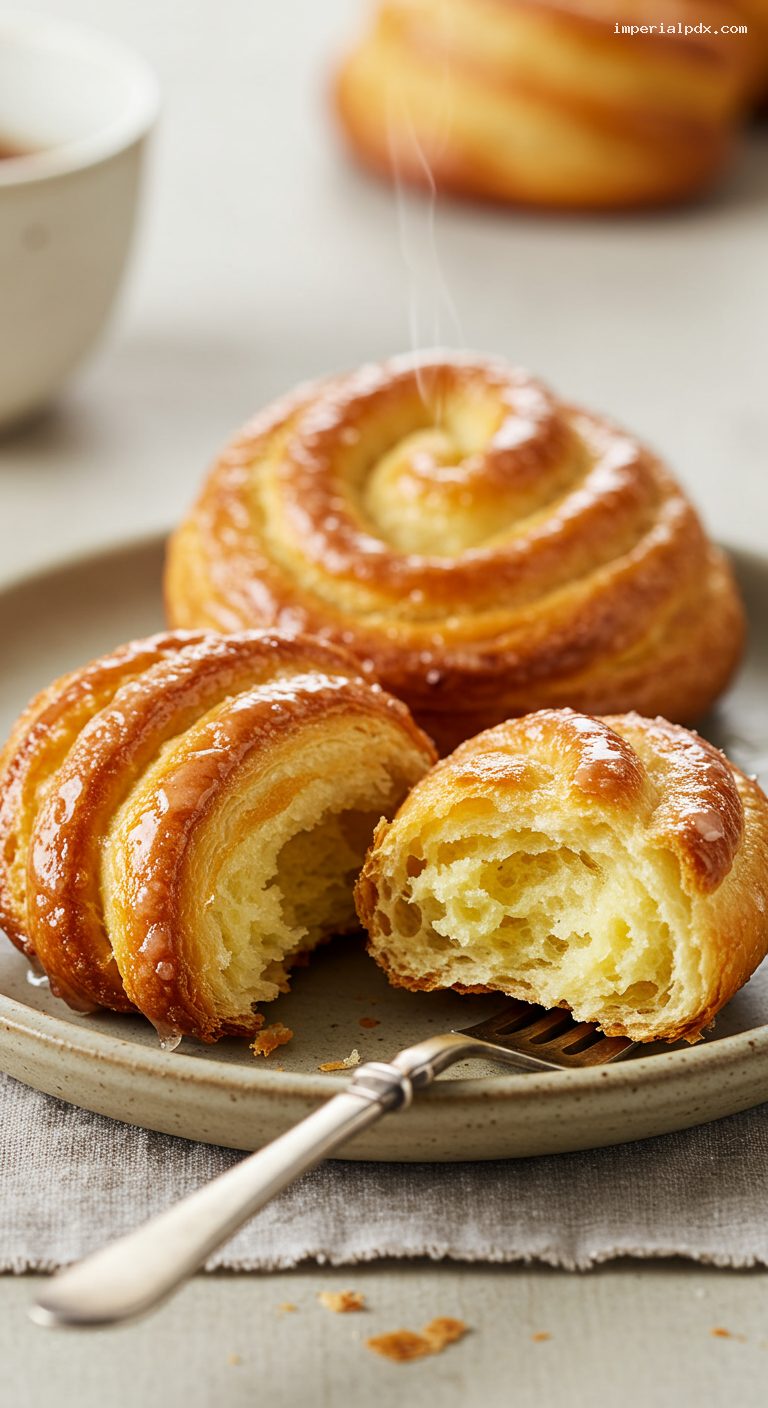
Whisk egg wash (1 egg, 1 tbsp milk, pinch of salt). Gently brush the tops, avoiding cut edges. Bake 16–20 minutes until deep golden, rotating trays halfway. While they bake, make the almíbar: combine sugar, water, and lemon peel in a small pot; simmer 2 minutes, remove peel, stir in vanilla, and keep hot. Immediately upon removing medialunas from the oven, brush generously with hot almíbar. Wait 2 minutes, brush a second coat for a delicate sheen. Cool 10–15 minutes and enjoy warm.
Pro Tips
- Match butter and dough firmness for clean layers; too cold butter will shatter, too soft will smear.
- Use a ruler for consistent triangles; uniform size equals even baking.
- Proof warm but not hot; aim for 26–28°C. A turned-off oven with a mug of hot water makes a quick proof box.
- Brush egg wash lightly and avoid the cut edges so layers can rise without sticking.
- Apply almíbar while pastries are sizzling hot so the glaze sets thin and shiny.
Variations
- Mini medialunas: Cut 24 smaller triangles; bake 12–14 minutes.
- Orange and vanilla: Swap lemon zest for orange zest and add 1/4 tsp orange extract to the almíbar.
- Chocolate-dipped ends: Once cool, dip tips in melted dark chocolate; let set on parchment.
Storage & Make-Ahead
Best the day they are baked. Store at room temperature in an airtight container up to 24 hours. Re-crisp at 170°C/340°F for 5–7 minutes; brush a touch more warm almíbar if you like. Freeze baked, cooled medialunas (un-glazed) up to 1 month; thaw and reheat as above, then glaze. For make-ahead shaping, freeze after shaping but before proofing on a tray; once solid, bag up to 1 month. Thaw overnight in the fridge, then proof 2–3 hours at 26–28°C and bake.
Nutrition (per serving)
Approximate per medialuna: 280 kcal; 15 g fat (9 g saturated); 33 g carbohydrates; 12 g sugars; 4 g protein; 1 g fiber; 175 mg sodium.