Quick Recipe Version (TL;DR)
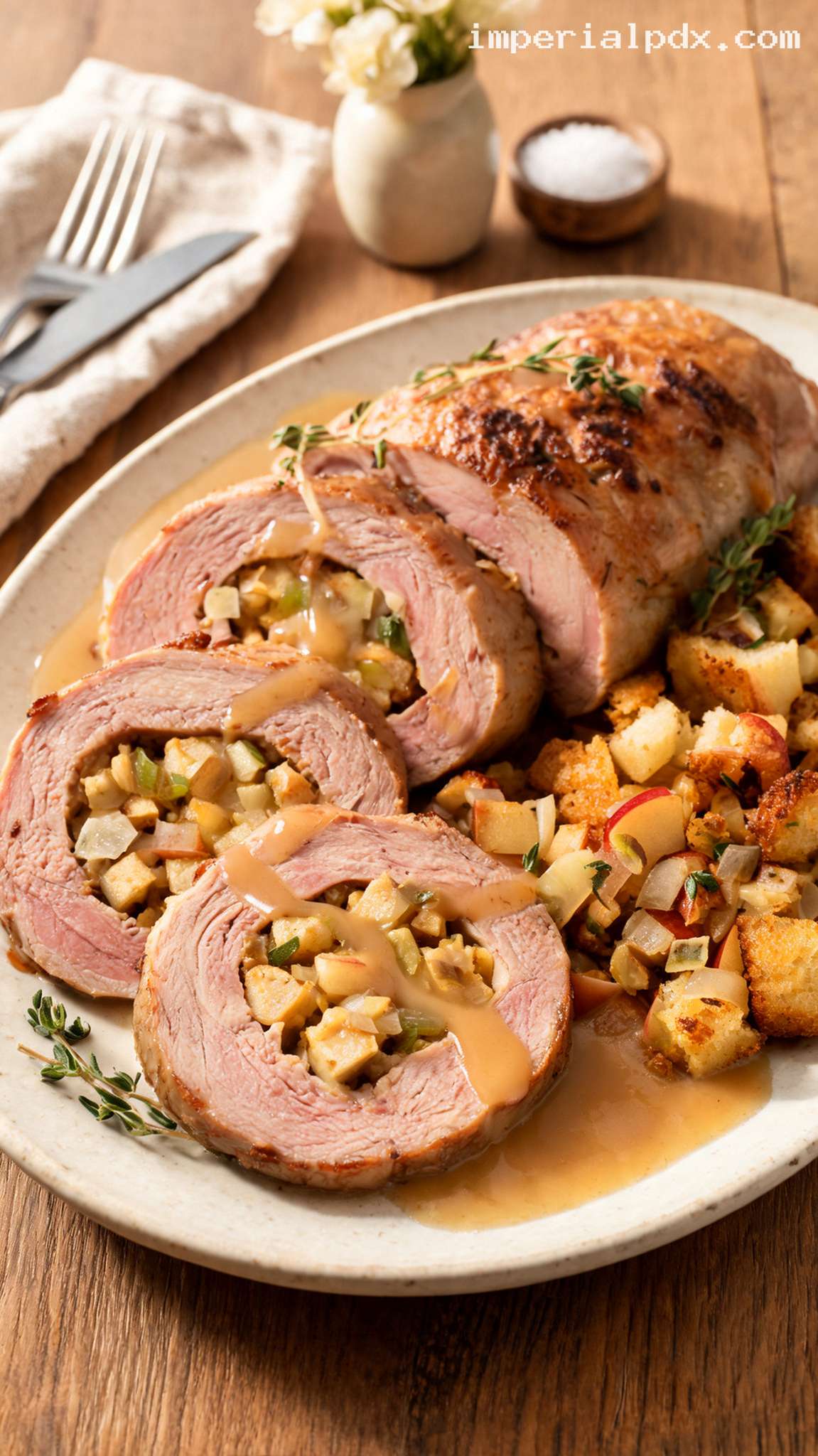
Amish-Style Pork Tenderloin with Apple and Herb Stuffing pairs juicy roasted pork with buttery bread stuffing, tender apples, and fragrant herbs. A light apple cider gravy brings everything together for a comforting, farmhouse-inspired main course.
Quick Ingredients
- 2 pork tenderloins, 1 pound each, trimmed
- 3 cups firm white bread cut into 1/2-inch cubes, about 4 ounces
- 1 medium firm apple, cored and cut into 1/4-inch dice, about 1 1/4 cups
- 1 small yellow onion, finely diced, about 3/4 cup
- 2 celery stalks, finely diced, about 3/4 cup
- 4 tablespoons unsalted butter, divided
- 1 tablespoon chopped fresh sage and 2 teaspoons fresh thyme leaves
- 1 1/2 cups low-sodium chicken broth, divided
- 1 1/4 teaspoons fine salt and 3/4 teaspoon black pepper, divided
- 1 tablespoon olive oil
- For the gravy: 1 tablespoon all-purpose flour, 1/2 cup nonalcoholic apple cider, and 1 teaspoon apple cider vinegar, plus the reserved butter and broth
Do This
- 1. Heat the oven to 400°F. Toast the bread cubes on a baking sheet for 8 minutes.
- 2. Butterfly and gently pound each tenderloin to an even 1/2-inch thickness. Season with 3/4 teaspoon salt and 1/2 teaspoon pepper.
- 3. Cook the onion and celery in 3 tablespoons butter for 6 minutes. Add the apple for 3 minutes, then the herbs for 30 seconds. Stir in the bread, 1/2 cup broth, and remaining salt and pepper; cover and heat until the stuffing reaches 165°F.
- 4. Immediately spread 1 cup hot stuffing over each tenderloin, roll, and tie with kitchen twine. Brush with olive oil. Put the remaining stuffing in a small parchment-lined baking dish.
- 5. Roast for 30–35 minutes, checking at 25 minutes. The pork must reach at least 145°F and the stuffing inside must reach 165°F. Bake the extra stuffing alongside, covered for 20 minutes, then uncovered until golden and 165°F.
- 6. Rest the pork for 10 minutes. Meanwhile, make gravy in the roasting skillet with the remaining 1 tablespoon butter, flour, cider, remaining 1 cup broth, and vinegar.
- 7. Remove the twine, cut into 1-inch slices, and serve with the extra stuffing and pan juices or cider gravy.
Why You’ll Love This Recipe
- Comforting without being heavy: Sweet-tart apple and a splash of cider brighten the rich pork and buttery stuffing.
- Simple, familiar ingredients: Bread, onions, celery, sage, and thyme deliver classic farmhouse flavor.
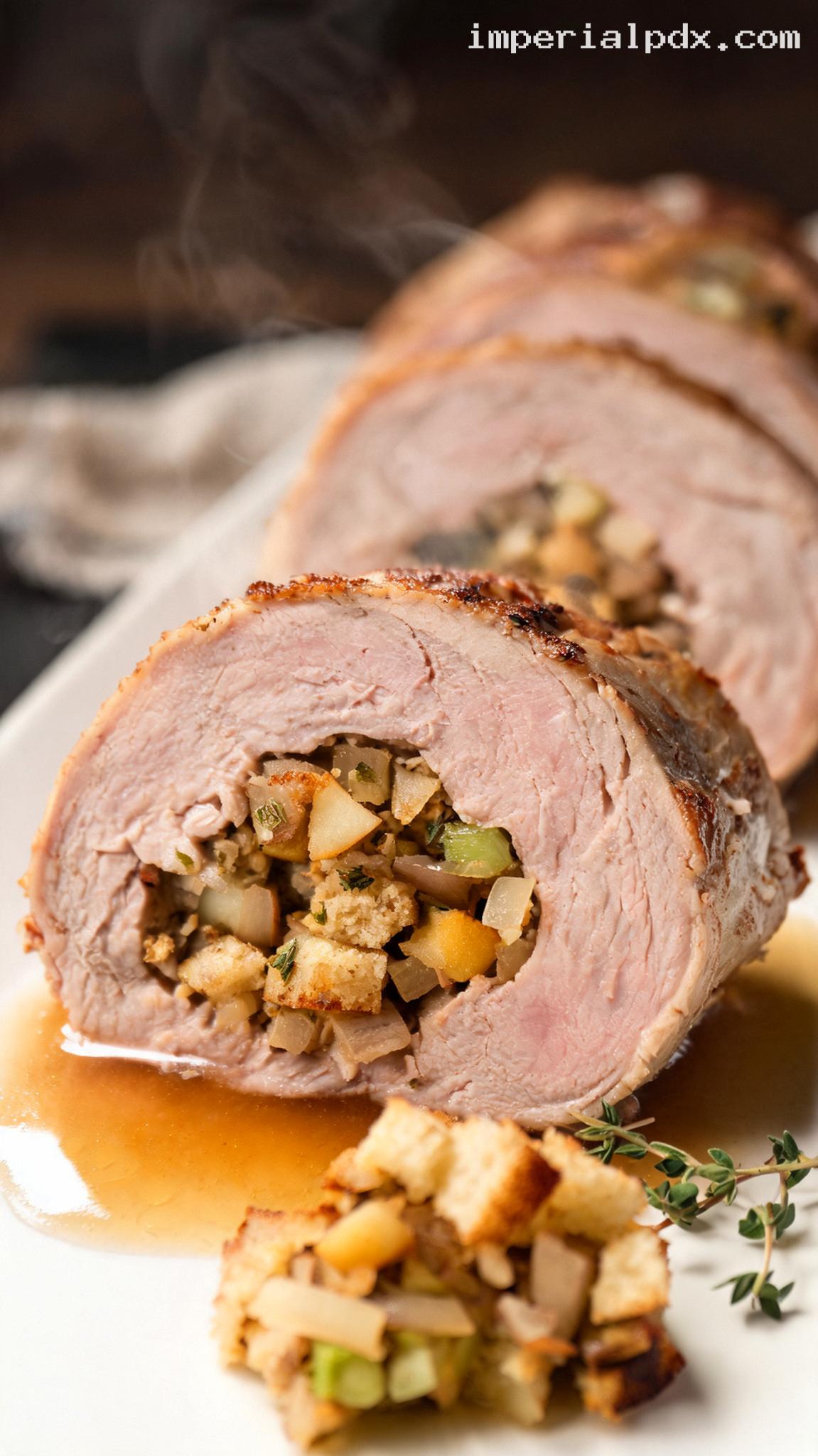
- A beautiful presentation: Thick slices reveal a generous spiral of apple-and-herb stuffing.
- Nothing goes to waste: Extra stuffing bakes beside the pork, and the roasting juices become an easy gravy.
Grocery List
- Produce: 1 medium firm apple, 1 small yellow onion, 2 celery stalks, fresh sage, fresh thyme.
- Meat: 2 pork tenderloins, approximately 1 pound each.
- Dairy: Unsalted butter.
- Bakery: Firm white sandwich bread or a simple country loaf.
- Pantry: Low-sodium chicken broth, olive oil, all-purpose flour, nonalcoholic apple cider, apple cider vinegar, fine salt, black pepper.
- Kitchen supplies: Kitchen twine, parchment paper, aluminum foil, and an instant-read thermometer.
Full Ingredients
For the Pork
- 2 pork tenderloins, 1 pound each, silver skin removed
- 3/4 teaspoon fine salt
- 1/2 teaspoon freshly ground black pepper
- 1 tablespoon olive oil
For the Apple and Herb Stuffing
- 3 cups firm white bread cut into 1/2-inch cubes, about 4 ounces or 115 grams
- 3 tablespoons unsalted butter
- 1 small yellow onion, finely diced, about 3/4 cup
- 2 celery stalks, finely diced, about 3/4 cup
- 1 medium firm apple, such as Honeycrisp, Braeburn, or Granny Smith, cored and cut into 1/4-inch dice, about 1 1/4 cups; peel if preferred
- 1 tablespoon finely chopped fresh sage
- 2 teaspoons fresh thyme leaves
- 1/2 teaspoon fine salt
- 1/4 teaspoon freshly ground black pepper
- 1/2 cup low-sodium chicken broth
For the Light Apple Cider Gravy
- Pan drippings from the roasted pork, with excess fat spooned off
- 1 tablespoon unsalted butter
- 1 tablespoon all-purpose flour
- 1/2 cup nonalcoholic apple cider, not apple cider vinegar
- 1 cup low-sodium chicken broth
- 1 teaspoon apple cider vinegar
Prefer a simpler finish? Skip the gravy ingredients and serve the pork with its warm pan juices.
Step-by-Step Instructions
Step 1: Heat the oven and dry the bread
Heat the oven to 400°F (204°C) with a rack in the middle position. Spread the bread cubes on a rimmed baking sheet and bake for 8 minutes, stirring after 4 minutes. The cubes should feel dry on the outside but need not be deeply browned. Set aside.
Line a small, approximately 1-quart baking dish with parchment paper for the extra stuffing. Have a 12-inch ovenproof skillet and kitchen twine ready.
Step 2: Butterfly and season the pork
Pat the tenderloins dry. To remove any silver skin, slide a small sharp knife beneath the shiny membrane and cut it away, angling the blade slightly upward to avoid removing too much meat.
Working with one tenderloin at a time, make a lengthwise cut down its center, stopping about 1/2 inch before cutting through the bottom. Open the meat like a book. If necessary, make shallow cuts into the thicker sides so it opens more evenly.
Place the meat between sheets of plastic wrap and gently pound it to an even 1/2-inch thickness, approximately 10 inches long and 6 inches wide. Season both tenderloins evenly with the 3/4 teaspoon salt and 1/2 teaspoon pepper. Refrigerate while you prepare the stuffing. Wash your hands and clean any surfaces that touched raw pork.
Step 3: Make the warm apple and herb stuffing
Melt 3 tablespoons butter in a large skillet over medium heat. Add the onion and celery and cook for 6 minutes, stirring frequently, until softened. Add the diced apple and cook for 3 minutes; it should soften slightly while keeping its shape.
Stir in the sage and thyme and cook for 30 seconds. Add the toasted bread, 1/2 teaspoon salt, 1/4 teaspoon pepper, and 1/2 cup broth. Fold gently until the bread is evenly moistened.
Cover, reduce the heat to low, and heat for approximately 4 minutes, stirring once, until the stuffing reaches 165°F (74°C). It should be moist enough to hold together loosely, not wet or mashed. Keep it covered and hot while you begin filling the pork.
Step 4: Fill, roll, and tie the tenderloins
Lay the tenderloins open on a clean work surface. Spread 1 cup of hot stuffing over each, leaving a 1-inch border around the edges. Do not pack the stuffing tightly.
Starting at a long edge, roll each tenderloin into a compact log so it retains its original long shape. Tie with kitchen twine at 1 1/2-inch intervals, securing the ends as needed. A little filling showing at the ends is fine.
Place the rolls seam-side down in the ovenproof skillet, leaving space between them, and brush with the 1 tablespoon olive oil. Transfer the remaining stuffing, approximately 2 cups, to the prepared baking dish and cover with foil. Roast immediately after filling; do not refrigerate assembled, raw stuffed pork for later cooking.
Step 5: Roast the pork and extra stuffing
Place the skillet and covered stuffing dish in the oven. Roast the pork for approximately 30–35 minutes, beginning temperature checks at 25 minutes. Insert an instant-read thermometer from the side into the thickest part of the meat, then check the center of the stuffing separately.
The pork must reach at least 145°F (63°C), and the stuffing inside each tenderloin must reach 165°F (74°C). Check both rolls, and do not rely on color alone. Starting with hot stuffing helps the filling reach its safe temperature without unnecessarily extending the pork’s cooking time.
Bake the extra stuffing covered for 20 minutes, then uncover and bake for another 10–15 minutes, until the center reaches 165°F and the exposed bread edges are golden.
If the pork reaches 145°F before its filling reaches 165°F, carefully remove the twine, open the roll, and transfer the filling to the extra-stuffing dish to finish heating to 165°F. Rest the cooked pork separately rather than continuing to roast it until dry.
Step 6: Rest the pork and save the juices
Transfer the finished tenderloins to a cutting board and tent loosely with foil. Rest for 10 minutes before slicing. This exceeds the minimum 3-minute rest required for pork cooked to 145°F and helps the juices settle.
Keep the extra stuffing covered and warm. Leave the browned bits in the roasting skillet, spooning off excess fat so that approximately 1 tablespoon of drippings remains. If serving without gravy, reserve the pan juices for spooning over the sliced pork.
Step 7: Make the light apple cider gravy
Place the roasting skillet over medium heat, remembering that its handle will be hot. Add the remaining 1 tablespoon butter. Once melted, whisk in the 1 tablespoon flour and cook for 1 minute, stirring constantly.
Gradually whisk in the 1/2 cup apple cider, scraping up the browned bits, followed by the remaining 1 cup broth. Bring to a gentle simmer and cook for 4–5 minutes, whisking occasionally, until lightly thickened and smooth.
Stir in the 1 teaspoon apple cider vinegar and any juices collected on the cutting board. The finished gravy should lightly coat a spoon rather than feel thick or heavy.
Step 8: Slice and serve
Snip off and discard all kitchen twine. Using a sharp knife, cut the tenderloins crosswise into 1-inch-thick slices, supporting each slice gently so the stuffing stays in place.
Arrange on a warm platter with the extra golden-edged stuffing alongside. Spoon a little gravy or pan juice over the pork, leaving the apple-and-herb centers visible. Serve the remaining gravy at the table. Buttered green beans, roasted carrots, or a crisp cabbage slaw make lovely accompaniments.
Pro Tips
- Choose tenderloin, not pork loin: Tenderloins are small, narrow cuts that cook quickly. A larger pork loin needs a different preparation and roasting schedule.
- Keep the apple pieces small: A 1/4-inch dice helps the fruit soften evenly and makes the stuffed pork easier to roll and slice.
- Dry the bread first: Lightly toasted cubes absorb the butter and broth without turning the filling into a paste.
- Avoid overfilling: One cup of stuffing per tenderloin is enough. Baking the rest separately gives you extra crisp edges without straining the rolls.
- Check two temperatures: Measuring the meat and the stuffing separately is essential. The filling’s 165°F target is higher than the pork’s 145°F minimum.
Variations
- Pear and herb: Replace the apple with 1 1/4 cups finely diced firm Bosc pear. Keep the cider gravy for a gentle fruit contrast.
- Whole-wheat farmhouse stuffing: Replace the white bread with 3 cups, about 4 ounces, of firm whole-wheat bread cubes. Add 1 tablespoon extra broth if the stuffing seems dry.
- Dried-herb option: Replace the fresh sage with 1 teaspoon rubbed dried sage and the fresh thyme with 3/4 teaspoon dried thyme.
Storage & Make-Ahead
Refrigerate: Remove any remaining twine, divide the pork and stuffing into shallow containers, and refrigerate within 2 hours of cooking. Store the pork, stuffing, and gravy in covered containers for 3–4 days.
Freeze: Freeze portions with a little gravy in airtight containers for up to 2 months for best quality. Thaw overnight in the refrigerator.
Reheat: Arrange pork slices and stuffing in a baking dish with 1–2 tablespoons broth per serving. Cover tightly and warm at 325°F (163°C) for approximately 20–25 minutes, until both the pork and stuffing reach 165°F. Reheat gravy separately over medium-low heat, stirring until it reaches 165°F.
Prepare ahead: Toast the bread and butterfly the pork up to 1 day ahead; keep the bread airtight at room temperature and the pork covered in the refrigerator. You may also cook the apple, onion, celery, and herb mixture 1 day ahead and refrigerate it promptly. Reheat that mixture, add the bread and broth, and bring the completed stuffing to 165°F before filling. Assemble and roast the stuffed pork immediately.
Nutrition (per serving)
Calories: 385 kcal | Carbs: 22g | Protein: 35g | Fat: 17g | Saturated Fat: 7g | Fiber: 2g | Sugar: 8g | Sodium: 800mg | Cholesterol: 120mg
Estimated for one-sixth of the recipe, including the extra stuffing and apple cider gravy. Actual values depend on the bread, broth, and pork used.