
Quick Recipe Version (TL;DR)
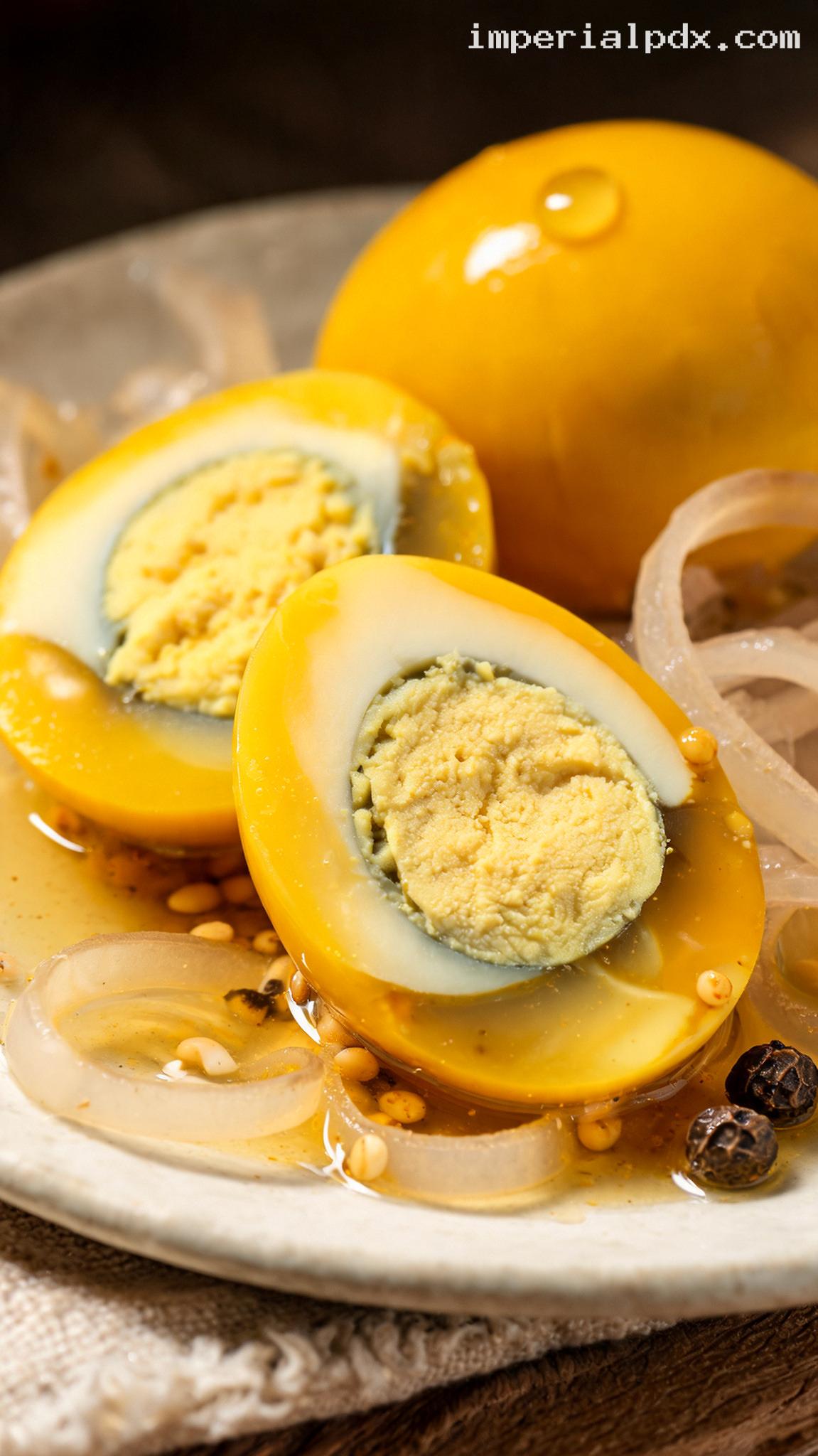
Amish-Style Pickled Mustard Eggs with Turmeric are refrigerator-pickled eggs with a sunny golden color and a tangy, gently sweet mustard brine. Serve them cold with pickled onion slices, fresh bread, potato salad, or a hearty sandwich.
Quick Ingredients
- 12 large eggs
- 1 medium yellow onion, about 5 ounces (150 g), thinly sliced
- 2 cups (480 ml) distilled white vinegar, labeled 5% acidity
- 1 cup (240 ml) water
- 1/2 cup (100 g) granulated sugar
- 2 teaspoons (12 g) pickling salt
- 1 tablespoon (9 g) yellow mustard seeds
- 1 teaspoon (3 g) ground turmeric
- 1/2 teaspoon (1 g) whole black peppercorns
Do This
- 1. Wash a 2-quart glass jar and its lid thoroughly. Thinly slice the onion.
- 2. Cover the eggs with cold water by 1 inch. Bring to a rolling boil, cover, remove from the heat, and let stand for 12 minutes.
- 3. Meanwhile, combine the vinegar, measured water, sugar, salt, mustard seeds, turmeric, peppercorns, and onion. Bring to a boil, then simmer for 5 minutes.
- 4. Chill the eggs in an ice-water bath for 10 minutes. Cool the brine in a separate ice-water bath for about 30 minutes, until it reaches 40°F (4°C) or colder.
- 5. Peel the eggs without piercing them, then layer them in the jar with the cooled onions. Pour in the chilled brine to cover completely.
- 6. Cover and refrigerate at 40°F (4°C) or below for at least 72 hours; the flavor is fuller after 7 days.
- 7. Serve chilled, whole or halved, with a few onion slices and mustard seeds. Keep refrigerated and use within 4 weeks.
Important: These are refrigerator pickles, not shelf-stable canned eggs. Keep them refrigerated throughout pickling and storage.
Why You’ll Love This Recipe
- Bright, balanced flavor: Vinegar brings the tang, sugar softens the sharp edges, and mustard seeds add a warm, savory bite.
- A beautiful golden finish: Turmeric colors the egg whites and onions without overpowering the brine.
- Simple farmhouse ingredients: A handful of pantry staples turns ordinary hard-boiled eggs into something special.
- Made for preparing ahead: Once the jar is in the refrigerator, time does the flavor-building work.
Grocery List
- Produce: 1 medium yellow onion, approximately 5 ounces (150 g).
- Dairy: No dairy products needed; pick up 12 large eggs from the refrigerated egg section.
- Pantry: Distilled white vinegar labeled 5% acidity, granulated sugar, pickling salt, yellow mustard seeds, ground turmeric, and whole black peppercorns.
Full Ingredients
For the Eggs
- 12 large eggs, refrigerated until cooking
- Cold water for boiling, enough to cover the eggs by 1 inch (2.5 cm)
- Ice and cold water for cooling the cooked eggs
For the Golden Mustard Brine
- 2 cups (480 ml) distilled white vinegar, labeled 5% acidity
- 1 cup (240 ml) water
- 1/2 cup (100 g) granulated sugar
- 2 teaspoons (12 g) pickling salt
- 1 tablespoon (9 g) yellow mustard seeds
- 1 teaspoon (3 g) ground turmeric
- 1/2 teaspoon (1 g) whole black peppercorns
- 1 medium yellow onion, peeled and sliced into 1/8-inch (3 mm) half-moons, approximately 5 ounces (150 g)
Equipment
- 1 clean 2-quart (1.9-liter) glass jar with a tight-fitting lid, or two 1-quart jars
- A large saucepan for the eggs
- A nonreactive saucepan, such as stainless steel or enamel, for the brine
- A large bowl for the egg ice bath and a second bowl for cooling the brine
- A food thermometer and clean utensils
Step-by-Step Instructions
Step 1: Prepare the Jar and Onion
Wash the jar and lid thoroughly with hot, soapy water, rinse well, and let them drain on a clean towel. Check that the glass is free of chips or cracks. This recipe does not involve canning or creating a shelf-stable seal.
Peel the onion and slice it into 1/8-inch (3 mm) half-moons. Measure the remaining brine ingredients before you begin cooking. Turmeric stains easily, so use a stain-resistant work surface and wipe up spills promptly.
Step 2: Hard-Boil the Eggs
Arrange the 12 eggs in a single layer in a large saucepan. Add enough cold water to cover them by 1 inch (2.5 cm). Bring to a full rolling boil over high heat, then immediately cover the pan and remove it from the heat.
Let the eggs stand in the covered pan for 12 minutes. Transfer them to a large bowl of ice water and chill for 10 minutes. This produces firm, fully cooked yolks and stops the cooking before the eggs become rubbery.
Step 3: Make the Mustard-Turmeric Brine
While the eggs cook, combine the 2 cups vinegar, 1 cup water, sugar, pickling salt, mustard seeds, turmeric, peppercorns, and sliced onion in a nonreactive saucepan.
Bring to a boil over medium-high heat, stirring until the sugar and salt dissolve. Reduce the heat to maintain a gentle simmer and cook for 5 minutes, uncovered. The onions should soften slightly while retaining some texture.
Step 4: Cool the Brine and Peel the Eggs
Remove the brine from the heat. Set the saucepan in a larger bowl of ice water, keeping the ice water out of the saucepan. Stir the brine occasionally with a clean spoon and replenish the ice as needed. Allow about 30 minutes for cooling, and check that the brine reaches 40°F (4°C) or colder before using it.
Meanwhile, gently crack and peel the chilled eggs. If needed, rinse them briefly under cold running water to remove shell fragments. Keep the peeled eggs refrigerated while the brine finishes cooling. Do not prick, score, or pierce the eggs to speed up pickling.
Step 5: Pack the Jar
Using clean utensils, layer the peeled eggs and cooled onion slices in the jar. Pour in the chilled brine, including the mustard seeds and peppercorns. Stir the brine just before pouring because turmeric tends to settle.
The eggs must be completely submerged. Use a clean, food-safe pickle weight if needed to keep the top egg beneath the liquid. If the jar shape leaves an egg exposed, transfer everything to a better-fitting container rather than diluting the brine with plain water.
If additional brine is necessary, make a small batch with 1/2 cup (120 ml) vinegar labeled 5% acidity, 1/4 cup (60 ml) water, 2 tablespoons (25 g) sugar, and 1/2 teaspoon (3 g) pickling salt. Simmer for 5 minutes, cool to 40°F (4°C) or colder, then add only enough to cover the eggs.
Step 6: Refrigerate and Let the Flavor Develop
Close the lid, label the jar with the preparation date, and refrigerate immediately at 40°F (4°C) or below. Keep the jar on an interior refrigerator shelf rather than in the door, where temperatures fluctuate more.
Wait at least 72 hours before serving. The eggs will have a light pickled flavor at that point; after 7 days, the mustard, onion, and vinegar flavors are more rounded and pronounced. Large eggs can take 1 to 2 weeks to develop a deeper pickled flavor. Never leave the jar at room temperature to speed up the process.
Step 7: Serve Chilled
Remove the eggs with a clean utensil and let excess brine drain off. Serve whole or slice lengthwise with a sharp knife. Add a few pickled onion ribbons and mustard seeds from the jar, plus a very small spoonful of brine if you like a glossier presentation.
These eggs are especially good alongside potato salad, thick slices of fresh bread, ham sandwiches, or a simple farmhouse lunch. Their tangy flavor is a welcome contrast to creamy salads and rich sandwich fillings.
Pro Tips
- Choose slightly older eggs: Eggs purchased about a week before cooking often peel more easily than very fresh eggs. Keep them refrigerated until needed.
- Use the specified vinegar: Choose commercially bottled vinegar labeled 5% acidity. Do not substitute vinegar of unknown acidity or add extra water to soften the flavor.
- Expect turmeric to settle: A little yellow sediment is normal. Gently swirl the closed jar while keeping the eggs submerged; vigorous shaking is unnecessary.
- Keep the egg whites intact: Peel carefully for a prettier result, and never puncture the eggs to encourage brine penetration.
- Let the calendar do the work: Start the jar 7 days before a gathering for a well-developed flavor without last-minute preparation.
Variations
- A little heat: Add 1/4 teaspoon crushed red pepper flakes to the brine before simmering.
- Garlic-mustard eggs: Add 2 peeled garlic cloves, lightly crushed, to the brine before simmering. Keep the same refrigeration and storage instructions.
- Apple cider vinegar version: Replace the 2 cups distilled white vinegar with 2 cups commercially bottled apple cider vinegar labeled 5% acidity for a slightly fruitier flavor and a deeper golden color.
Storage & Make-Ahead
Keep the eggs fully submerged in their original brine and refrigerated at 40°F (4°C) or below. For this home recipe, use them within 4 weeks of preparation. Always remove eggs with a clean utensil, and do not return served eggs or used brine to the jar.
This is a refrigerator-only recipe: do not water-bath can it, store it in the pantry, or treat a tightly closed lid as proof of preservation. Pickled eggs are not suitable for home canning. Do not reuse the brine for a second batch.
For make-ahead convenience, cook and peel the eggs up to 24 hours before assembling the jar, then refrigerate them promptly in a clean, covered container. Serve only the portion you plan to eat. Discard eggs left unrefrigerated for more than 2 hours, or more than 1 hour when the surrounding temperature exceeds 90°F (32°C).
Discard the entire batch if you notice mold, unexpected bubbling, a swollen lid, sliminess, or an off odor. Do not taste questionable eggs to check them, and remember that the absence of visible spoilage does not make improperly stored eggs safe.
Nutrition (per serving)
Estimated for 1 drained egg with a few onion slices. The brine is not intended to be consumed in full; sugar and sodium values vary with brine absorption and how thoroughly the eggs are drained.
Calories: 90 kcal | Carbs: 4g | Protein: 6g | Fat: 5g | Saturated Fat: 1.6g | Fiber: 0g | Sugar: 3g | Sodium: 250mg | Cholesterol: 186mg