Quick Recipe Version (TL;DR)
Quick Ingredients
- 4 small boneless, skinless chicken breasts (about 700 g total)
- 250 g boneless, skinless chicken thighs (or breast trimmings), diced and well chilled
- 120 ml cold heavy cream
- 1 large egg white
- 30 g mixed soft herbs (parsley, chives, tarragon, chervil), finely chopped
- 1 small garlic clove, minced
- 1 small shallot, finely minced
- 1 l low-sodium chicken stock + 500 ml water
- 1 carrot, 1 celery stalk, 1 small onion, 2 bay leaves, 8 black peppercorns
- 2 tbsp olive oil
- 1 tbsp fresh lemon juice
- Fine salt and white pepper
- Soft salad leaves and extra fresh herbs for serving
Do This
- 1. Chill diced chicken, cream, and food processor bowl/blade for 10–15 minutes to keep the forcemeat cold.
- 2. Blend chilled diced chicken with garlic, shallot, salt, and white pepper; pulse in egg white, then cream until smooth. Fold in chopped herbs; keep refrigerated.
- 3. Butterfly and gently pound chicken breasts to 0.6–0.8 cm thickness. Season lightly with salt and white pepper.
- 4. Spread a thin, even layer of herb forcemeat on each breast, leaving a 1.5 cm border. Roll up tightly from the short end, then wrap each roll firmly in plastic wrap and then foil, twisting ends to form neat logs.
- 5. Simmer stock, water, carrot, celery, onion, bay leaves, and peppercorns; reduce to a bare simmer (80–85°C / 175–185°F). Add roulades and poach 20–25 minutes, until internal temperature reaches 74°C / 165°F.
- 6. Transfer roulades to an ice bath until cool, then refrigerate at least 4 hours or overnight, still wrapped.
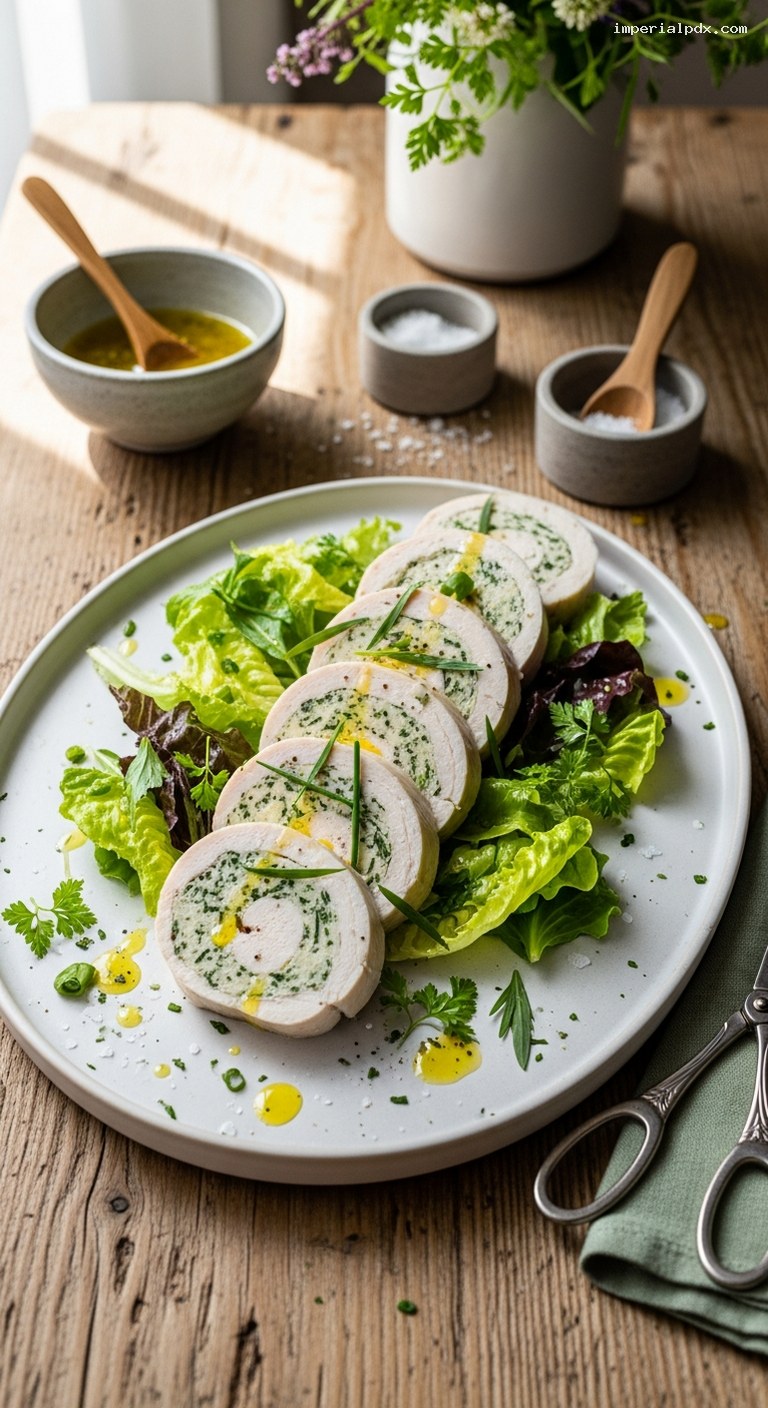
- 7. Unwrap, trim ends, and slice into 1.5 cm medallions. Arrange on salad leaves, whisk olive oil with lemon juice and a spoonful of poaching liquid, season, and drizzle lightly over the chilled chicken. Serve cold.
Why You’ll Love This Recipe
- Elegant enough for entertaining, but completely achievable in a home kitchen.
- Served chilled, so it is perfect for make-ahead dinners, picnics, and warm-weather gatherings.
- Light, tender chicken wrapped around a fragrant herb filling for big flavor without heaviness.
- Beautiful medallions slice cleanly and plate like something from a restaurant.
Grocery List
- Produce: 1 carrot, 1 celery stalk, 2 small onions or 1 onion + 1 shallot, 1 garlic bulb, fresh parsley, chives, tarragon, chervil (if available), salad greens, 1 lemon
- Dairy: Heavy cream (at least 120 ml)
- Pantry: Boneless, skinless chicken breasts, boneless skinless chicken thighs (or extra breasts), low-sodium chicken stock, olive oil, bay leaves, whole black peppercorns, Dijon mustard (optional), fine salt, white pepper, flaky sea salt (optional)
Full Ingredients
For the Herb Chicken Roulade
- 4 small boneless, skinless chicken breasts (about 170 g each; total about 700 g)
- 250 g boneless, skinless chicken thighs or breast trimmings, diced and very cold
- 120 ml cold heavy cream
- 1 large egg white
- 30 g mixed soft herbs, finely chopped (about 3 packed tbsp), for example:
- 2 tbsp flat-leaf parsley
- 2 tsp chives
- 2 tsp tarragon
- 2 tsp chervil (or extra parsley if unavailable)
- 1 small shallot, very finely minced (about 2 tbsp)
- 1 small garlic clove, minced
- 1 tsp fine sea salt (for the forcemeat), plus more to season the breasts
- 1/2 tsp ground white pepper (or finely ground black pepper)
For the Poaching Broth (Court Bouillon)
- 1 l low-sodium chicken stock
- 500 ml water
- 1 medium carrot, cut into chunks
- 1 celery stalk, cut into chunks
- 1 small onion, quartered (no need to peel)
- 2 garlic cloves, lightly crushed
- 2 bay leaves
- 8 whole black peppercorns
- 2 sprigs fresh thyme (optional)
- A few parsley stems (optional, if you have them leftover from the herbs)
- 1 tsp fine sea salt, or to taste
For Serving
- 80–100 g soft salad leaves (butter lettuce, baby spinach, or mixed greens)
- 2 tbsp olive oil
- 1 tbsp fresh lemon juice
- 1 tbsp strained poaching broth (optional but lovely)
- 1/2 tsp Dijon mustard (optional, for a slightly creamier dressing)
- Pinch of sugar or honey (optional, to round out the acidity)
- Fine sea salt and freshly ground white or black pepper, to taste
- Extra chopped herbs (parsley, chives, tarragon) for garnish
- Flaky sea salt, for finishing (optional)
Step-by-Step Instructions
Step 1: Chill everything for a silky forcemeat
For the herb forcemeat (the smooth, flavorful filling), it is important to keep everything cold so the mixture stays smooth and emulsified. Place the diced chicken thighs, the heavy cream, and the bowl and blade of your food processor into the refrigerator (or freezer) for 10–15 minutes before you begin. Cold ingredients make the texture tender and prevent the fat from separating.
While those chill, finely chop your herbs, mince the shallot and garlic, and set them aside. Butterfly the chicken breasts if you like (see Step 3 for details) or leave them whole for now; we will be pounding them later.
Step 2: Make the fine herb forcemeat
Place the chilled diced chicken thighs into the chilled food processor bowl. Add the minced shallot, minced garlic, 1 tsp fine sea salt, and 1/2 tsp white pepper. Pulse several times until the chicken is finely chopped and starting to clump together.
Add the egg white and process briefly to mix. With the machine running, slowly pour in the cold heavy cream through the feed tube. Stop and scrape down the sides as needed, processing just until you have a smooth, thick paste. The bowl should still feel cold; if it starts to feel warm, chill the mixture for 10–15 minutes and resume.
Scrape the forcemeat into a bowl and gently fold in the chopped herbs. To check seasoning, cook a teaspoon of the mixture in a small skillet or microwave it on a plate until fully cooked, then taste. Add a pinch more salt or pepper to the raw mixture if needed. Cover and refrigerate while you prepare the chicken breasts.
Step 3: Butterfly and flatten the chicken breasts
Place one chicken breast on a cutting board. With a sharp knife, slice horizontally through the thickest side, stopping about 1 cm before you cut all the way through, so you can open it like a book. Repeat with the remaining breasts. If your breasts are already fairly small and even, you may skip the butterflying and just pound them.
Place each breast between two sheets of plastic wrap or baking parchment. Using a meat mallet or the flat side of a rolling pin, gently pound until the chicken is an even 0.6–0.8 cm thick. Work from the center outwards and avoid tearing the meat. Remove the top layer of plastic, lightly season both sides of each breast with fine salt and a pinch of white pepper, and set aside on a tray.
Step 4: Fill, roll, and wrap the roulades
Lay a large sheet of plastic wrap (about 30–35 cm long) on your work surface. Place one flattened chicken breast on top, smooth side down, with the short end closest to you.
Spread about one quarter of the herb forcemeat in a thin, even layer over the chicken, leaving a 1.5 cm border all around so the filling does not squeeze out when rolling. Starting from the short end nearest you, roll the chicken up firmly but gently into a tight log, keeping the filling inside.
Use the plastic wrap to help you roll and tighten: wrap the plastic around the log, then grab the two ends of the plastic and twist in opposite directions until the roulade becomes taut and cylindrical, like a thick sausage. Tie the ends in knots or secure with kitchen string. For extra security and to help hold the shape, wrap each plastic-wrapped log in a layer of aluminum foil and twist the ends again. Repeat with the remaining chicken breasts and filling to make 4 roulades.
Step 5: Prepare the aromatic poaching broth
In a wide, deep pot or Dutch oven, combine the chicken stock, water, carrot, celery, onion, garlic cloves, bay leaves, peppercorns, thyme, parsley stems (if using), and 1 tsp fine sea salt. Bring to a gentle boil over medium-high heat, then reduce the heat to low.
Let the broth simmer very gently for 10 minutes to extract flavor from the vegetables and aromatics. Skim off any foam that rises to the top. After 10 minutes, adjust the heat so the liquid is at a bare simmer, around 80–85°C (175–185°F) if you have a thermometer. You want small lazy bubbles and gentle movement, not a rolling boil, so the roulades cook delicately and stay tender.
Step 6: Poach the roulades gently until just cooked
Carefully lower the wrapped chicken roulades into the simmering broth. They should be fully submerged; if needed, add a little extra hot water to cover. Place a small heatproof plate on top as a weight if they float excessively.
Maintain the broth at 80–85°C (175–185°F) and poach for 20–25 minutes. Try not to let the liquid boil; adjust the heat as needed. After 20 minutes, remove one roulade and quickly check the internal temperature by inserting an instant-read thermometer into the center from one end (you can pierce through the foil and plastic). It should read at least 74°C (165°F). If it is lower, return it to the pot and continue poaching for another 5 minutes before checking again.
Once all roulades reach 74°C (165°F), remove them from the broth and set them on a plate to rest for 5 minutes while you prepare an ice bath.
Step 7: Rapidly chill, then refrigerate until very cold
Fill a large bowl or sink with cold water and plenty of ice. Place the still-wrapped roulades into the ice bath, weighting gently if needed to keep them submerged. Chill for about 20 minutes, or until they feel completely cool all the way through.
Once cooled, transfer the roulades (still wrapped) to a plate or shallow dish, cover, and refrigerate for at least 4 hours or, ideally, overnight. This resting time allows the juices to set, the filling to firm up, and the flavors to develop, so you get clean slices and a pleasant, sliceable texture.
Step 8: Slice, dress, and serve chilled
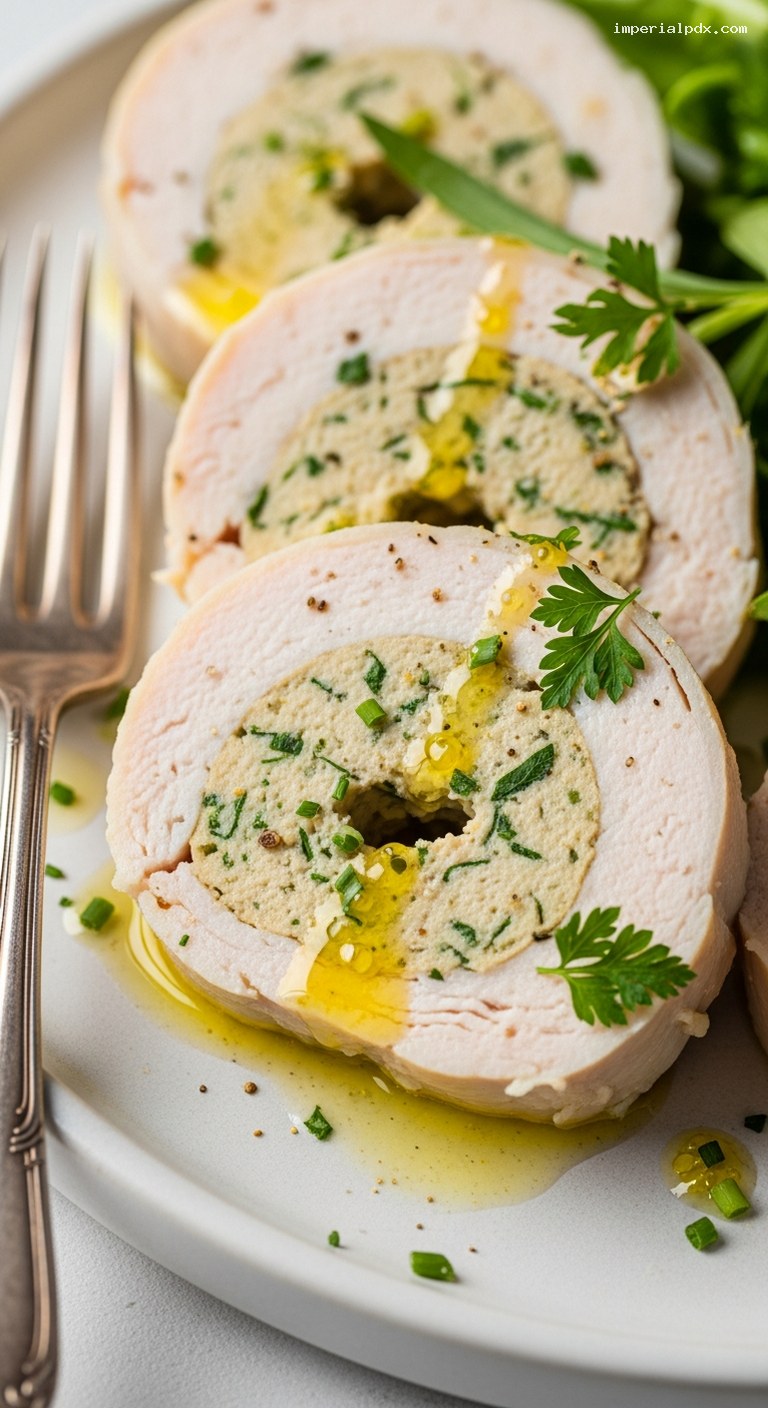
When ready to serve, line a platter with salad leaves. Remove the roulades from the refrigerator, unwrap them carefully, and trim off the untidy ends with a sharp knife. Slice into neat medallions about 1.5 cm thick, wiping the knife with a damp cloth between cuts for the cleanest edges.
To make a simple dressing, whisk together 2 tbsp olive oil, 1 tbsp lemon juice, 1 tbsp strained poaching broth (optional), 1/2 tsp Dijon mustard (if using), a pinch of sugar or honey, and a good pinch of salt and pepper. Taste and adjust acidity or seasoning.
Arrange the medallions slightly overlapping on the bed of salad leaves. Spoon or drizzle the dressing lightly over the chicken and greens. Scatter extra chopped herbs and a pinch of flaky sea salt over the top. Serve well chilled or cool, not straight from the fridge coldest setting, so the flavors can shine.
Pro Tips
- Keep it cold: For the smoothest forcemeat, keep the chicken, cream, and equipment well chilled. If the mixture ever looks greasy or loose, pop it into the fridge for 15 minutes and then continue.
- Season boldly: Cold food always tastes a bit more muted, so season the forcemeat slightly more than you think you need (but still taste a cooked sample to be sure).
- Gentle heat is key: A bare simmer keeps the roulades tender. If the broth is bubbling hard, the meat can toughen and the filling can become spongy.
- Slice with confidence: Chill thoroughly and use a long, sharp, thin-bladed knife. A gentle sawing motion gives clean medallions without squashing the filling.
- Concerned about plastic wrap? Use high-quality, heat-safe wrap, or roll first in baking parchment, then in foil, or use a vacuum-sealed bag designed for sous-vide cooking.
Variations
- Dijon–Tarragon Roulade: Add 1–2 tsp Dijon mustard to the forcemeat and increase the tarragon slightly. Serve with a mustardy vinaigrette (extra Dijon and a little honey) for a bistro-style twist.
- Mediterranean Herb & Olive: Swap half the parsley for basil, and fold in 2 tbsp very finely chopped pitted black olives and a few sun-dried tomatoes into the forcemeat. Dress with lemon, olive oil, and a hint of garlic.
- Asparagus Center: Blanch thin asparagus spears for 1–2 minutes, cool in ice water, and pat dry. Lay a few spears along the center of each pounded breast before spreading a slightly thinner layer of forcemeat, then roll as usual. When sliced, each medallion has a pretty green stripe.
Storage & Make-Ahead
Once poached, chilled, and still wrapped, the roulades will keep in the refrigerator for up to 3 days. For best texture and food safety, do not leave them at room temperature for more than 1 hour. This recipe is ideal for making a day in advance: prepare and poach the roulades, chill overnight, and slice just before serving.
Leftover slices are delicious layered into sandwiches, served over grain salads, or tucked into lunch boxes. Freezing is not recommended, as it can affect the delicate, smooth texture of the filling.
Nutrition (per serving)
Approximate values per serving (one quarter of the recipe, including a light drizzle of dressing): about 380–420 calories; 48–52 g protein; 18–22 g fat; 2–4 g carbohydrates; <1 g fiber; 1–2 g sugars; 450–600 mg sodium. These numbers will vary based on exact ingredients and how much dressing you use.