Quick Recipe Version (TL;DR)
Quick Ingredients
- 700 g pork shoulder, well chilled, in 2–3 cm cubes
- 300 g firm pork back fat, well chilled, in 1–2 cm cubes
- 25 g kosher salt (2.5% of meat and fat weight)
- 2.5 g Prague Powder #2 (curing salt #2, 0.25% of meat and fat weight)
- 30 g Spanish smoked paprika (pimentón de la Vera, sweet or bittersweet)
- 12 g fresh garlic, finely minced (about 4 cloves)
- 6 g sugar or dextrose (about 1 tsp)
- 3 g freshly ground black pepper (about 1 tsp)
- 2 g dried oregano (about 1 tsp, optional)
- 60 ml dry white wine, well chilled
- Natural hog casings, 32–36 mm, rinsed and soaked
Do This
- 1. Chill grinder parts, mixing bowl, and meat until almost firm but not frozen.
- 2. Toss meat and fat with salt, Prague Powder #2, paprika, garlic, sugar, pepper, and oregano; chill 30 minutes.
- 3. Grind once on a medium plate (4.5–6 mm), then mix in chilled white wine until the mixture is sticky and well bound.
- 4. Stuff into soaked hog casings, forming 25–30 cm links, and tie off tightly.
- 5. Prick air pockets, then hang at 20–22°C (68–72°F) for 24–48 hours to ferment slightly.
- 6. Move to a curing chamber at 12–15°C (54–59°F) and 75–80% humidity; dry 2–4 weeks until the sausages lose 30–35% of their weight.
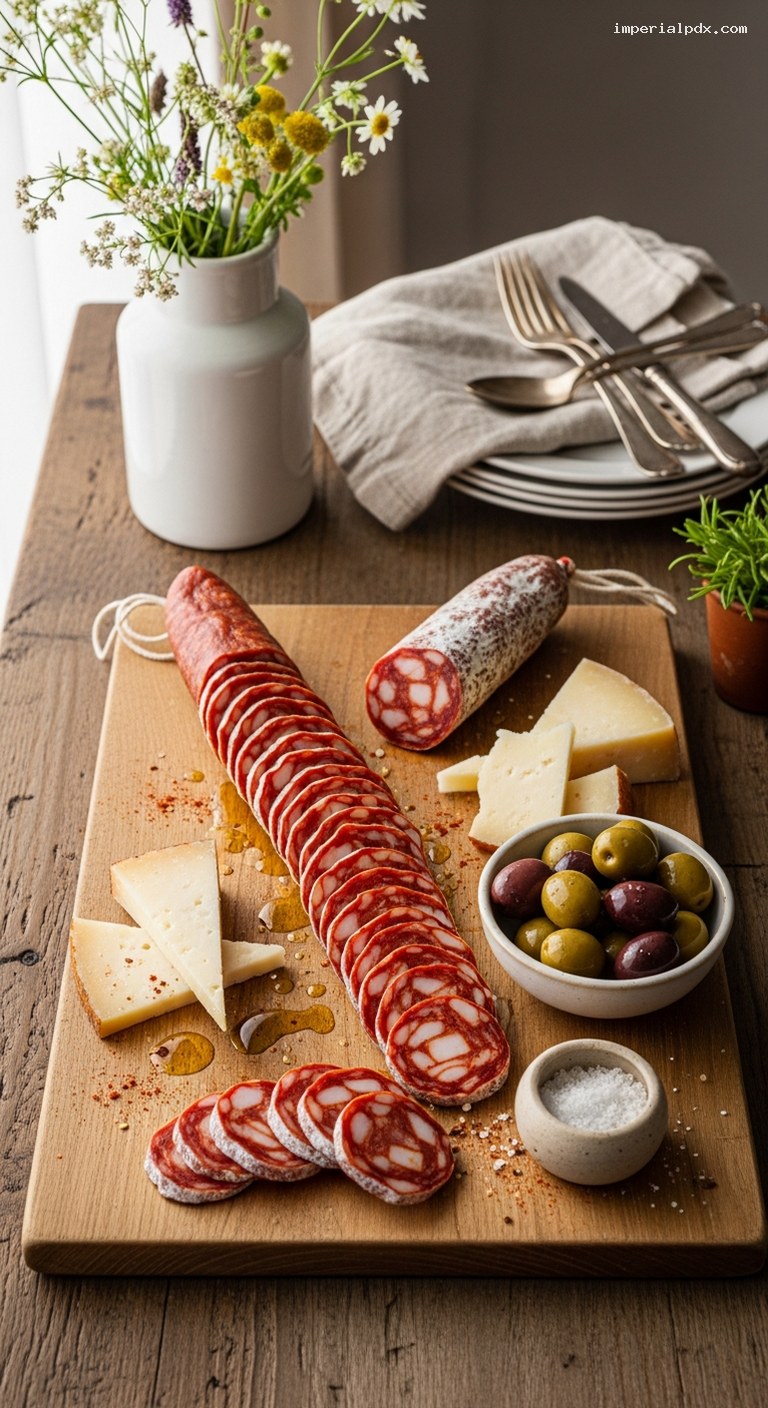
- 7. Slice thinly and serve at room temperature with manchego cheese and olives; refrigerate leftovers well wrapped.
Why You’ll Love This Recipe
- Classic Spanish flavor: bold smoked paprika, garlic, and pork in beautiful deep red slices.
- Designed for home kitchens, with clear, exact measurements and step-by-step curing guidance.
- Perfect for tapas boards with manchego, olives, and crusty bread, or for adding depth to stews, beans, and paella.
- Makes a generous batch that keeps for weeks, so you can enjoy it slowly or share with friends.
Grocery List
- Produce: Fresh garlic, optional fresh herbs for serving (parsley, thyme), lemon (for serving, optional)
- Dairy: Manchego cheese (for serving, optional but highly recommended)
- Pantry: Pork shoulder, pork back fat, kosher salt, Prague Powder #2 (curing salt #2), Spanish smoked paprika (pimentón), sugar or dextrose, black pepper, dried oregano, dry white wine, natural hog casings, olives and crusty bread (for serving, optional)
Full Ingredients
For the Spanish Chorizo
- 700 g pork shoulder, well chilled, cut into 2–3 cm cubes (about 1 lb 8 oz)
- 300 g firm pork back fat, well chilled, cut into 1–2 cm cubes (about 10.5 oz)
- 25 g kosher salt (2.5% of total meat and fat weight; about 4 tsp Diamond Crystal)
- 2.5 g Prague Powder #2 (curing salt #2) (0.25% of meat and fat weight; about 1/2 tsp, but always weigh if possible)
- 30 g Spanish smoked paprika (pimentón de la Vera), sweet or a mix of sweet and hot (about 4 Tbsp)
- 12 g fresh garlic, very finely minced (about 4 medium cloves)
- 6 g sugar or dextrose (about 1 level tsp) to gently feed fermentation
- 3 g freshly ground black pepper (about 1 tsp)
- 2 g dried oregano (about 1 tsp, optional but traditional in many regions)
- 1 g ground hot paprika or cayenne (about 1/2 tsp, optional for a picante version)
- 60 ml dry white wine, very cold (about 1/4 cup), such as dry fino sherry or a crisp white
Casings
- Natural hog casings, 32–36 mm diameter, enough for about 1 kg of sausage (usually 2–3 standard lengths)
Optional for Serving
- Manchego cheese, thinly sliced or in wedges
- Mixed Spanish olives (such as manzanilla, gordal, or arbequina)
- Crusty bread or toasted baguette slices
- Extra smoked paprika or olive oil for drizzling, optional
Equipment (Highly Recommended)
- Meat grinder with medium plate (4.5–6 mm)
- Sausage stuffer (or a stuffing attachment for your grinder)
- Accurate digital scale (for grams)
- Kitchen thermometer and, ideally, a small digital scale for Prague Powder #2
- Clean skewers or sausage pricker
- Hooks or rods for hanging sausages
- Curing chamber (or converted fridge with temperature and humidity control)
Step-by-Step Instructions
Step 1: Prepare and Chill Meat, Fat, and Equipment
Cut the pork shoulder into 2–3 cm cubes and the firm pork back fat into slightly smaller 1–2 cm cubes. Lay the pieces on a tray in a single layer and place them in the coldest part of your refrigerator or briefly in the freezer for 20–30 minutes, until they are very cold and starting to firm up but not frozen solid. Cold meat grinds more cleanly and reduces smearing of the fat, which is crucial for a good sausage texture.
Meanwhile, place your grinder parts (auger, plate, blade) and mixing bowl in the freezer to chill. Rinse the hog casings thoroughly under cool running water, then soak them in a bowl of fresh water for at least 30 minutes (or according to the package instructions). Run water through each casing to flush out excess salt and check for leaks. Keep the casings refrigerated in clean water until ready to stuff.
Step 2: Season the Meat with Salt, Cure, and Spices
Weigh your total meat and fat to confirm it is 1000 g; adjust salt and Prague Powder #2 if needed to maintain 2.5% salt and 0.25% curing salt. In a small bowl, combine the kosher salt, Prague Powder #2, smoked paprika, sugar or dextrose, black pepper, dried oregano, and optional hot paprika or cayenne. Mix until the spices are evenly distributed.
In a large chilled bowl or pan, toss the cold meat and fat cubes with the minced garlic, then sprinkle the spice mixture evenly over everything. Use clean hands or a spatula to mix thoroughly, ensuring every piece is coated. Cover and refrigerate for at least 30 minutes and up to 2 hours. This short rest allows the salt and cure to begin penetrating the meat and firms it further for grinding.
Step 3: Grind the Meat and Mix to a Sticky Bind
Set up your grinder with a medium plate (4.5–6 mm). Working in batches if needed, grind the chilled, seasoned meat and fat into a chilled bowl set over another bowl of ice, if possible, to keep everything cold. If at any point the meat starts to feel soft or warm, pause and chill it again briefly.
Once ground, pour the very cold white wine evenly over the meat. Using one clean hand (or a sturdy spatula), mix the sausage meat vigorously for 3–5 minutes. Scoop it up and slap it back into the bowl, turning and folding, until the mixture becomes sticky, cohesive, and starts to cling to your hand and the bowl. This develops the protein network that gives good sliceable texture in the finished chorizo. When ready, a small test ball pressed between your fingers should feel springy and hold together well. Cover and chill again while you prepare to stuff.
Step 4: Stuff and Link the Sausages
Fit your sausage stuffer (or grinder with stuffing horn) with a 32–36 mm tube. Slide a length of soaked hog casing onto the horn, leaving a 10–15 cm tail hanging off the end. Tie a tight knot in the tail. Gently pack the sausage mixture into the stuffer, removing any obvious air pockets.
Begin stuffing, guiding the casing as it fills so it is firmly packed but not overstretched. Aim for a smooth, slightly springy feel. When you reach the end of a casing, leave another 10–15 cm tail and twist or tie off. Once you have one long coil, lay it on a clean surface and gently twist into 25–30 cm links (about 10–12 inches), alternating directions with each twist so the previous one does not undo itself.
Use a sterile skewer or sausage pricker to carefully prick any visible air bubbles. This helps prevent spoilage spots and gives a more even cure. Weigh the entire batch (or individual links) now and write down the weight; you will use this later to calculate 30–35% weight loss during drying.
Step 5: Ferment the Links Briefly
Hang the sausages on clean hooks or rods in a draft-free place at 20–22°C (68–72°F) with moderate humidity for 24–48 hours. This can be a warm room, a curing chamber set slightly warmer, or an oven with the light on and door cracked open, provided you can keep the temperature in range and there is some air circulation.
This stage allows a mild fermentation to begin, helping to develop tangy, complex flavors and improving safety by lowering the pH. You should notice the sausages becoming slightly darker and firmer to the touch after this period. Avoid temperatures above 24°C (75°F), which can encourage unwanted bacteria. If your environment is very dry, hang a damp cloth or tray of water nearby to prevent the casings from hardening too quickly.
Step 6: Dry Cure (and Optional Light Smoke)
After fermentation, move the sausages to your curing chamber or a controlled environment set to 12–15°C (54–59°F) with 75–80% relative humidity and gentle air movement. Hang the links so they do not touch each other, allowing air to circulate around each sausage. Dry for 2–4 weeks, checking periodically. The goal is a 30–35% weight loss from the original weight you recorded. For example, a 1000 g batch is ready when it weighs about 650–700 g total.
If you want a lightly smoked chorizo, you can cold-smoke the links for 2–4 hours at 20–25°C (68–77°F) with gentle smoke (using hardwood like oak or beech) during the first few days of drying. Keep the temperature low enough that the fat does not melt and the sausages do not cook. After smoking, continue drying as above. When ready, the chorizo should feel firm but not rock-hard, with a deep red color and a pleasant, cured aroma.
Step 7: Slice, Serve, and Store
Once the sausages have lost 30–35% of their weight and feel firm throughout, they are ready to eat. Wipe the surface gently with a clean, dry cloth if needed. Some natural mold is normal in dry curing; if it is white and powdery, it is generally harmless. Any green, black, or fuzzy mold should be wiped off with a cloth lightly dampened in vinegar, then dried again.
Slice the chorizo thinly on a slight angle. For a classic Spanish tapas spread, serve at cool room temperature with wedges of manchego cheese, a bowl of mixed olives, and crusty bread. Store leftover chorizo wrapped in parchment and then loosely in plastic or a container in the refrigerator. Properly dried chorizo will keep for several weeks, and its flavor will continue to deepen over time.
Pro Tips
- Use a scale, not cups. Curing salt must be accurately measured by weight for safety. Aim for 0.25% Prague Powder #2 based on the total weight of meat and fat.
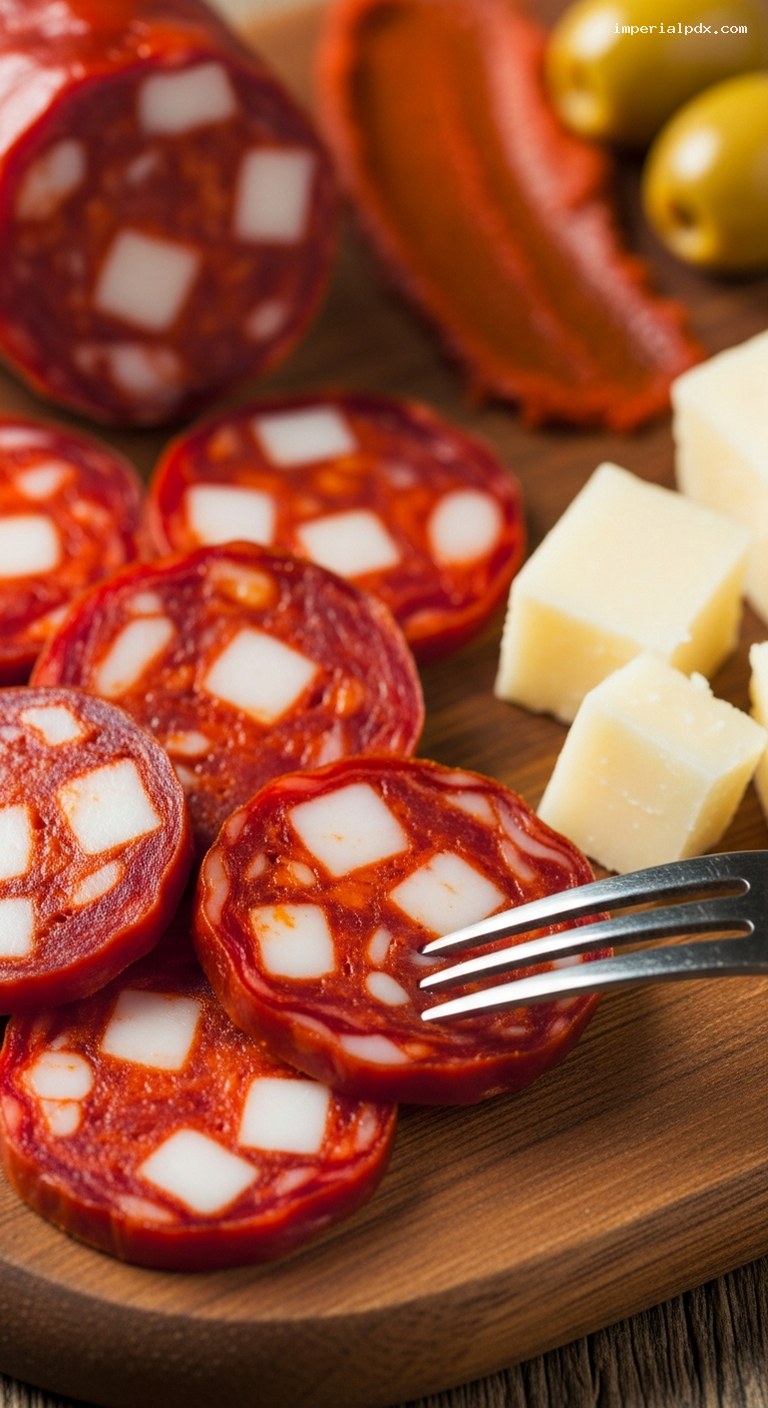
- Keep everything cold. Cold meat and equipment prevent fat smearing, giving you those beautiful, distinct white fat cubes in every slice.
- Do not rush the drying. Target 30–35% weight loss rather than only going by days; actual time depends on temperature, humidity, and sausage thickness.
- Control humidity. Too low and the outside dries hard (case hardening); too high and you risk spoilage. A curing chamber with a humidity controller is ideal.
- Flavor develops over time. The chorizo will taste good at 30% weight loss but can become even more complex if you let some links dry a bit longer.
Variations
- Extra Picante Chorizo: Increase hot smoked paprika or cayenne to 3–4 g total and use half sweet, half hot pimentón. Keep the total paprika around 30 g for balance.
- Smoked and Fully Cooked Chorizo: Instead of long drying, smoke the fresh stuffed sausages at 93°C (200°F) until the internal temperature reaches 65°C (150°F). Chill quickly and refrigerate. This gives great flavor and a shorter timeline, but it is not shelf-stable like a dry-cured sausage.
- Herb-Forward Chorizo: Add 3–4 g dried thyme or marjoram and reduce the smoked paprika slightly to let the herbs shine. This is lovely for stews and braises.
Storage & Make-Ahead
Dry-cured Spanish chorizo is essentially a make-ahead project. The entire recipe is built around curing time, so plan at least 2 weeks in advance, and up to a month, before you want to serve it. Once the chorizo has reached 30–35% weight loss and you like the texture, wrap it in parchment and store it in the refrigerator. It will keep for several weeks, often longer, with flavor slowly intensifying. For longer storage, you can vacuum seal individual links and refrigerate them for several months, or freeze for up to 6 months. Always let chilled or frozen chorizo come back to cool room temperature before serving so the fat softens and the flavors open up. Cooked, smoked chorizo (if you choose that variation) should be refrigerated and enjoyed within about 7–10 days or frozen for up to 3 months.
Nutrition (per serving)
Approximate values per 60 g (about 6–8 thin slices): 260 calories; 22 g fat; 8 g saturated fat; 14 g protein; 1 g carbohydrates; 0 g fiber; 1 g sugar; 800–900 mg sodium. Actual values will vary based on exact fat content, drying level, and any added cheeses or accompaniments.