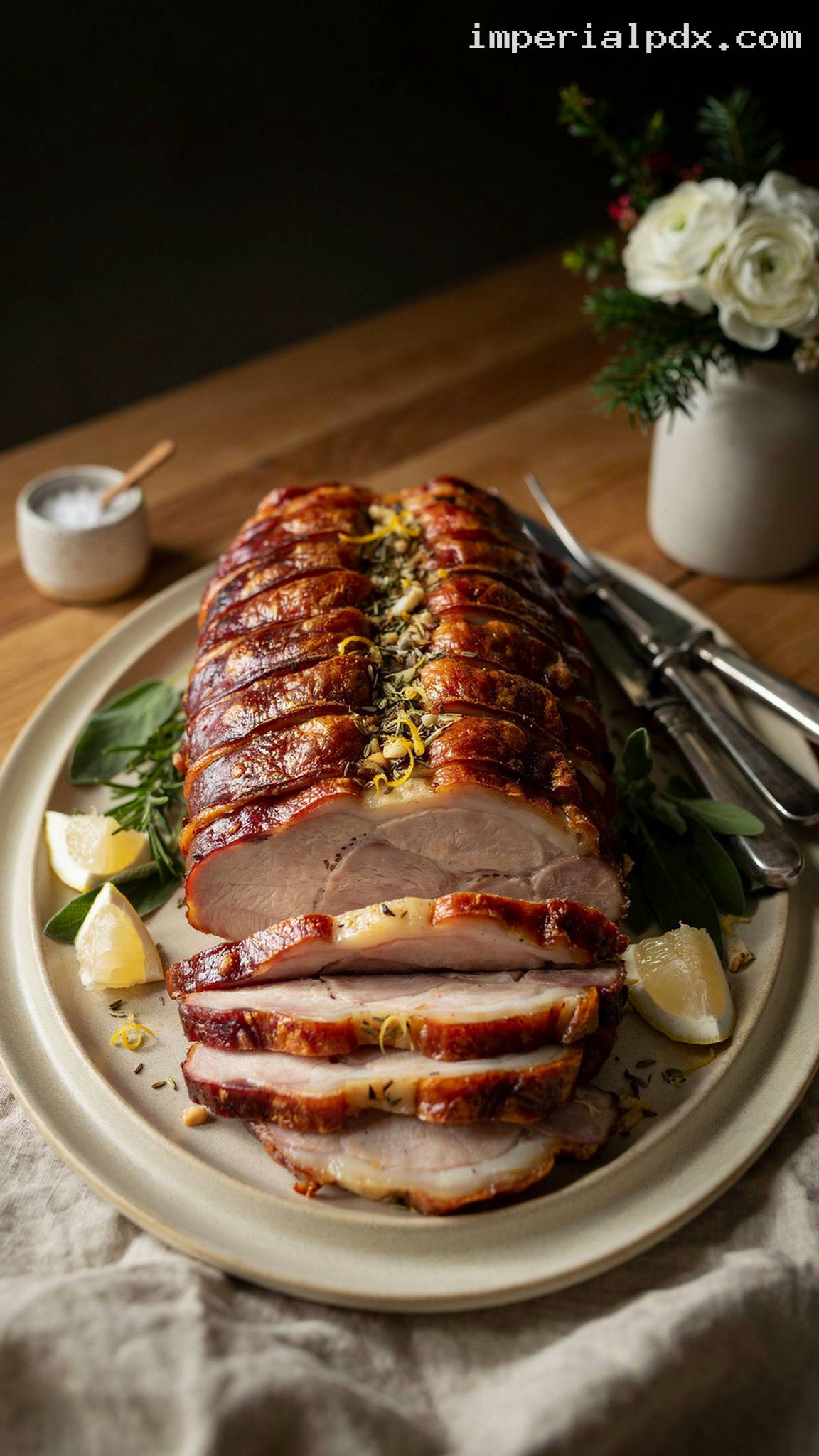
Christmas Porchetta with Fennel and Garlic
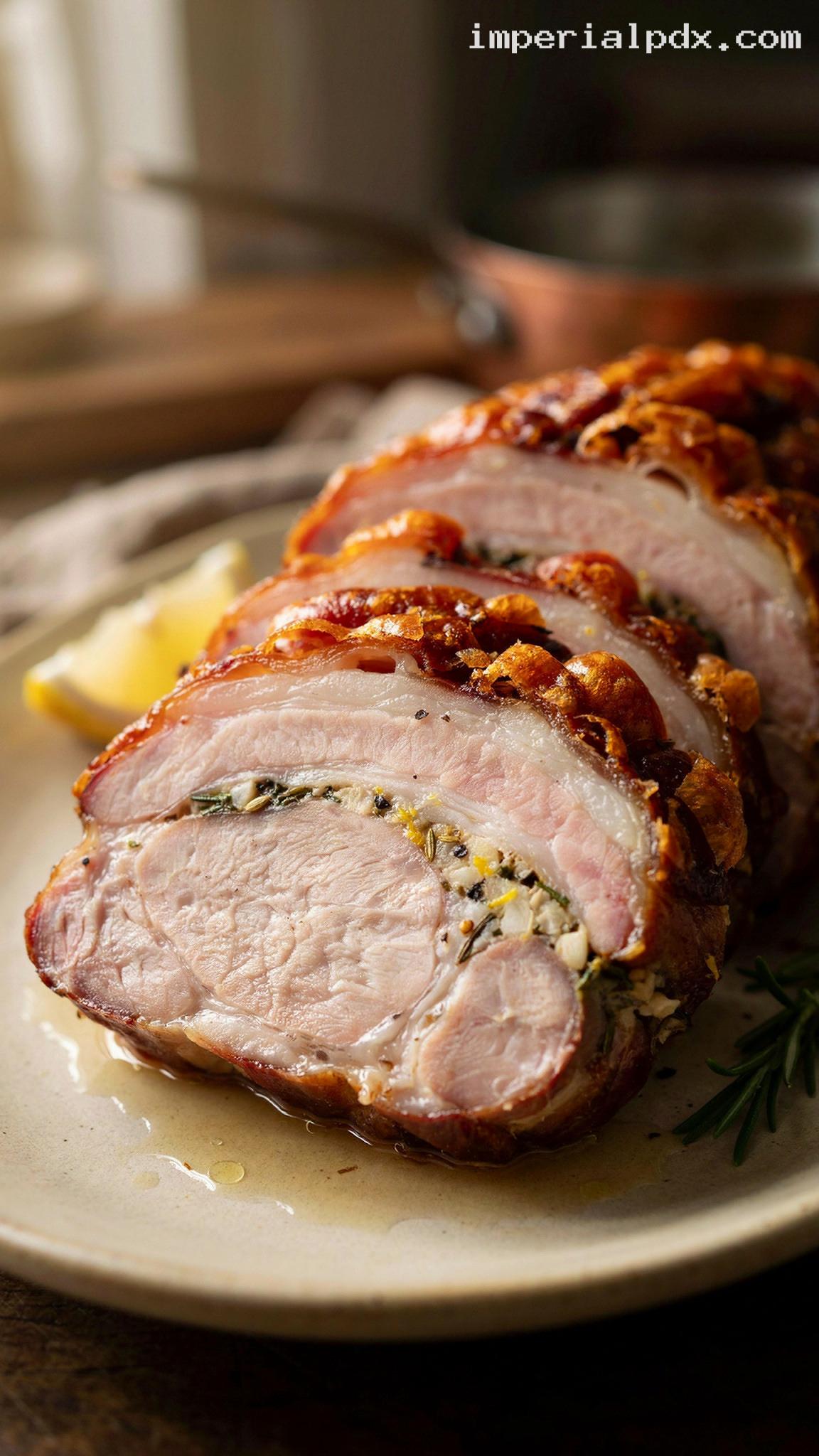
This spectacular Italian-style roast wraps tender pork loin in richly flavored pork belly, with a fragrant spiral of toasted fennel, rosemary, sage, garlic, and lemon. An overnight rest dries the skin, a gentle roast cooks the meat, and a final blast of heat creates the crisp, golden crackling that makes porchetta such a celebration-worthy centerpiece.
Quick Recipe Version (TL;DR)
Quick Ingredients
- 2.5 kg (5½ lb) boneless, skin-on pork belly, approximately 40 × 30 cm (16 × 12 inches)
- 1 kg (2¼ lb) boneless pork loin, approximately 28 cm (11 inches) long
- 42 g kosher salt, divided: 30 g for the meat and 12 g for the skin
- 2 tablespoons (12 g) fennel seeds
- 2 tablespoons finely chopped fresh rosemary
- 2 tablespoons finely chopped fresh sage
- 10 garlic cloves (approximately 40 g), finely minced
- 2 tablespoons finely grated lemon zest, from approximately 2 large lemons
- 2 teaspoons freshly ground black pepper
- 1 tablespoon (15 ml) olive oil
- Optional garnish: 2 small rosemary sprigs, 6 sage leaves, and wedges cut from the zested lemons
Do This
- 1. Pat the pork dry. Prick the belly skin shallowly, then turn it over and score the flesh without cutting through the skin.
- 2. Toast the fennel seeds for 2 minutes, crush, and mix with the rosemary, sage, garlic, lemon zest, pepper, and olive oil.
- 3. Season the belly flesh and loin with 30 g salt. Spread the herb mixture over the flesh, wrap the belly around the loin, and tie every 2.5 cm (1 inch).
- 4. Rub the skin with the remaining 12 g salt. Refrigerate uncovered on a rack for 24 hours.
- 5. Pat the skin dry and roast seam-side down at 300°F (150°C) for approximately 2 hours 30 minutes, until the center of the loin reaches 135°F (57°C).
- 6. Increase the oven to 475°F (245°C) and roast for approximately 30 minutes, until the skin is blistered and the center of the loin reaches at least 145°F (63°C).
- 7. Rest uncovered for 30 minutes, remove the string, and carve into thick slices with a piece of crackling on each portion.
Why You’ll Love This Recipe
- A true holiday centerpiece: Golden crackling and a fragrant herb spiral make every slice feel special.
- Two delicious textures: The pork belly becomes rich and tender while the loin provides substantial, succulent slices.
- Most preparation happens ahead: Roll and season the roast the day before, leaving Christmas Day mostly hands-off.
- Big flavor from simple ingredients: Toasted fennel, fresh herbs, garlic, and lemon balance the richness beautifully.
Grocery List
- Meat: One 2.5 kg boneless, skin-on pork belly and one 1 kg boneless pork loin. Ask the butcher for a rectangular belly suitable for wrapping around the loin.
- Produce: 1 large head of garlic, 2 large lemons, 1 bunch fresh rosemary, and 1 bunch fresh sage.
- Dairy: None needed.
- Pantry: Fennel seeds, kosher salt, black pepper, and olive oil.
- Kitchen supplies: Butcher’s twine, a roasting rack and deep roasting pan, a sharp knife, and a reliable meat thermometer.
Full Ingredients
For the Pork
- 2.5 kg (5½ lb) boneless, skin-on pork belly, approximately 40 × 30 cm (16 × 12 inches), with an even thickness of approximately 2 cm (¾ inch)
- 1 kg (2¼ lb) boneless pork loin, approximately 28 cm (11 inches) long and 7–8 cm (3 inches) across; use loin, not tenderloin
- 42 g kosher salt, divided into 30 g for the meat and 12 g for the skin; weigh the salt because crystal sizes vary by brand
For the Fennel and Garlic Filling
- 2 tablespoons (12 g) fennel seeds
- 2 tablespoons finely chopped fresh rosemary leaves
- 2 tablespoons finely chopped fresh sage leaves
- 10 garlic cloves (approximately 40 g), finely minced
- 2 tablespoons finely grated lemon zest, from approximately 2 large lemons; avoid the bitter white pith
- 2 teaspoons freshly ground black pepper
- 1 tablespoon (15 ml) olive oil
For Serving, Optional
- 2 small fresh rosemary sprigs
- 6 fresh sage leaves
- The 2 zested lemons, cut into wedges
Before you begin: Check that the belly can wrap around the loin with the skin facing outward and the edges meeting neatly. Pork belly dimensions vary, so ask your butcher to help match the cuts. All oven temperatures below are for a conventional oven.
Step-by-Step Instructions
Step 1: Prepare the belly and loin
Pat both cuts of pork thoroughly dry with paper towels; do not rinse them. Set the belly skin-side up on a clean board. Using a sharp skewer or the tip of a small knife, make shallow pinpricks across the skin, approximately 1 cm (½ inch) apart. Pierce only the skin, not deeply into the meat. These tiny openings help the fat render and the skin blister.
Turn the belly skin-side down. Score the flesh in a crosshatch pattern, making cuts approximately 6 mm (¼ inch) deep and 2.5 cm (1 inch) apart without cutting through the skin. Trim any tough silverskin from the loin, leaving its soft fat intact.
Step 2: Toast the fennel and make the filling
Place the fennel seeds in a small, dry skillet over medium heat. Toast for 2 minutes, shaking the pan frequently, until fragrant and slightly darker. Transfer immediately to a mortar or cutting board and let cool for 2 minutes.
Coarsely crush the fennel seeds with a pestle or the flat side of a heavy knife. Mix with the chopped rosemary, sage, garlic, lemon zest, black pepper, and olive oil to make a fragrant, coarse paste.
Step 3: Season, roll, and tie
Sprinkle 20 g of the salt evenly over the scored flesh of the belly, working it into the cuts. Season the loin all over with another 10 g salt. Spread the herb paste over the belly flesh, keeping it off the skin.
Place the loin along one 30 cm (12-inch) edge of the belly. Wrap the belly tightly around it so the skin forms the outside of the cylinder. The belly edges should meet or overlap by no more than 1 cm (½ inch); trim a narrow strip if necessary to avoid trapping a thick layer of skin inside the roast.
Tie securely with butcher’s twine at 2.5 cm (1-inch) intervals, starting in the middle and working toward the ends. The roll should feel firm and even, but the twine should not cut deeply into the skin.
Step 4: Dry the skin overnight
Rub the remaining 12 g salt evenly over the exposed skin. Set the porchetta seam-side down on a rack over a rimmed tray. Refrigerate uncovered for 24 hours at 40°F (4°C) or below, on a low shelf away from ready-to-eat foods.
This uncovered rest seasons the pork and dries the skin, which is essential for crisp crackling. Keep the skin exposed rather than covering it with plastic wrap or foil.
Step 5: Roast gently until nearly cooked
Preheat the oven to 300°F (150°C), with a rack in the lower-middle position. Transfer the porchetta to a roasting rack in a deep roasting pan, keeping the seam underneath. Blot away any moisture or visible wet salt patches from the skin with paper towels. Do not rinse or oil the skin.
Insert a leave-in thermometer from one end into the center of the loin, avoiding a pocket of fat. Roast for approximately 2 hours 30 minutes, beginning temperature checks after 2 hours. Move to the next step when the loin reaches 135°F (57°C). Depending on the roast’s diameter and starting temperature, this stage may take 2 hours 15 minutes to 3 hours.
The belly should be softening around the loin. Check its thickest meaty section with a thin skewer; it should meet much less resistance than it did when raw. If the pan collects a deep pool of fat, carefully spoon off most of it while the pan is resting securely on a heatproof surface.
Step 6: Turn up the heat for crackling
Increase the oven temperature to 475°F (245°C), leaving the roast inside as the oven heats. Continue roasting for approximately 30 minutes, checking after 15 minutes and then every 5 minutes. Rotate the pan once if one side colors faster.
The skin should become deeply golden, blistered, and hard enough to sound crisp when lightly tapped. Check the center of the loin in two places: it must reach at least 145°F (63°C). Temperature, rather than the clock, determines when the roast is ready.
If a small patch of skin becomes dark before the rest is crisp, shield only that patch with foil. Do not cover the whole roast, and keep the fresh herb garnishes off the porchetta until after cooking so they do not burn.
Step 7: Rest without softening the skin
Transfer the porchetta to a carving board and rest uncovered for 30 minutes. Do not tent it with foil, which traps steam and softens the crackling. The center must remain at or above 145°F (63°C) for at least 3 minutes; this resting period allows ample time for that safety hold.
Keep any collected meat juices separate from the crackling. If serving them alongside, skim away excess fat and offer the juices in a small jug rather than pouring them over the crisp skin.
Step 8: Carve and serve
Snip away all the twine. Use a sharp serrated knife to cut through the crackling, then a carving knife to slice through the meat. Cut slices approximately 1.5–2 cm (⅝–¾ inch) thick, dividing larger slices as needed to make 14 generous portions.
Arrange the slices beside the remaining roast on a warm platter. Garnish with the optional rosemary, sage, and lemon wedges. Roast potatoes and a sharply dressed green salad make lovely accompaniments, and a squeeze of lemon balances the rich pork beautifully.
Pro Tips
- Dry skin matters more than extra oil: The uncovered overnight rest and a final blot before roasting are your best tools for crisp crackling.
- Match the cuts before seasoning: A modest-diameter loin cooks more evenly inside the belly than a short, very thick piece.
- Start the hot finish before the loin is fully cooked: Raising the heat at 135°F (57°C) gives the skin time to blister while the center finishes cooking.
- Use a thermometer: Two roasts of the same weight can cook differently because their diameters differ. Begin checking early.
- Rescue stubborn crackling separately: If the meat is ready but one area of skin remains chewy, carefully remove that section after resting and crisp it on a tray at 475°F (245°C) for 5–10 minutes, watching closely.
Variations
- Gently spicy: Add 1 teaspoon crushed red pepper flakes to the herb filling.
- Orange and fennel: Replace the 2 tablespoons lemon zest with 2 tablespoons finely grated orange zest.
- Extra woodsy herbs: Replace 1 tablespoon of the chopped sage with 1 tablespoon fresh thyme leaves.
Storage & Make-Ahead
Make ahead: Assemble, tie, and salt the porchetta 24 hours before roasting. Keep it uncovered in the refrigerator throughout the drying period. For the best crackling and juiciest loin, roast it on the day you plan to serve it.
Refrigerate: Within 2 hours of cooking, divide leftovers into smaller portions and refrigerate in shallow containers at 40°F (4°C) or below. Store for 3–4 days. If practical, separate the crackling from the meat to make reheating easier.
Reheat: Place sliced meat in a covered ovenproof dish with 2 tablespoons water or reserved, defatted juices. Heat at 325°F (165°C) for approximately 20–30 minutes, until the center reaches 165°F (74°C). Crisp the separated crackling on a tray at 450°F (230°C) for 5–8 minutes, checking frequently.
Freeze: Freeze cooked meat in airtight portions for up to 2 months for best quality. Thaw overnight in the refrigerator before reheating. Crackling loses some crispness after freezing.
Nutrition (per serving)
Estimated for 1 of 14 servings, excluding optional accompaniments. Values vary substantially with the pork’s fat content and the amount of fat rendered during roasting.
Calories: 820 kcal | Carbs: 2g | Protein: 35g | Fat: 74g | Saturated Fat: 26g | Fiber: 1g | Sugar: 0g | Sodium: 1150mg | Cholesterol: 135mg


