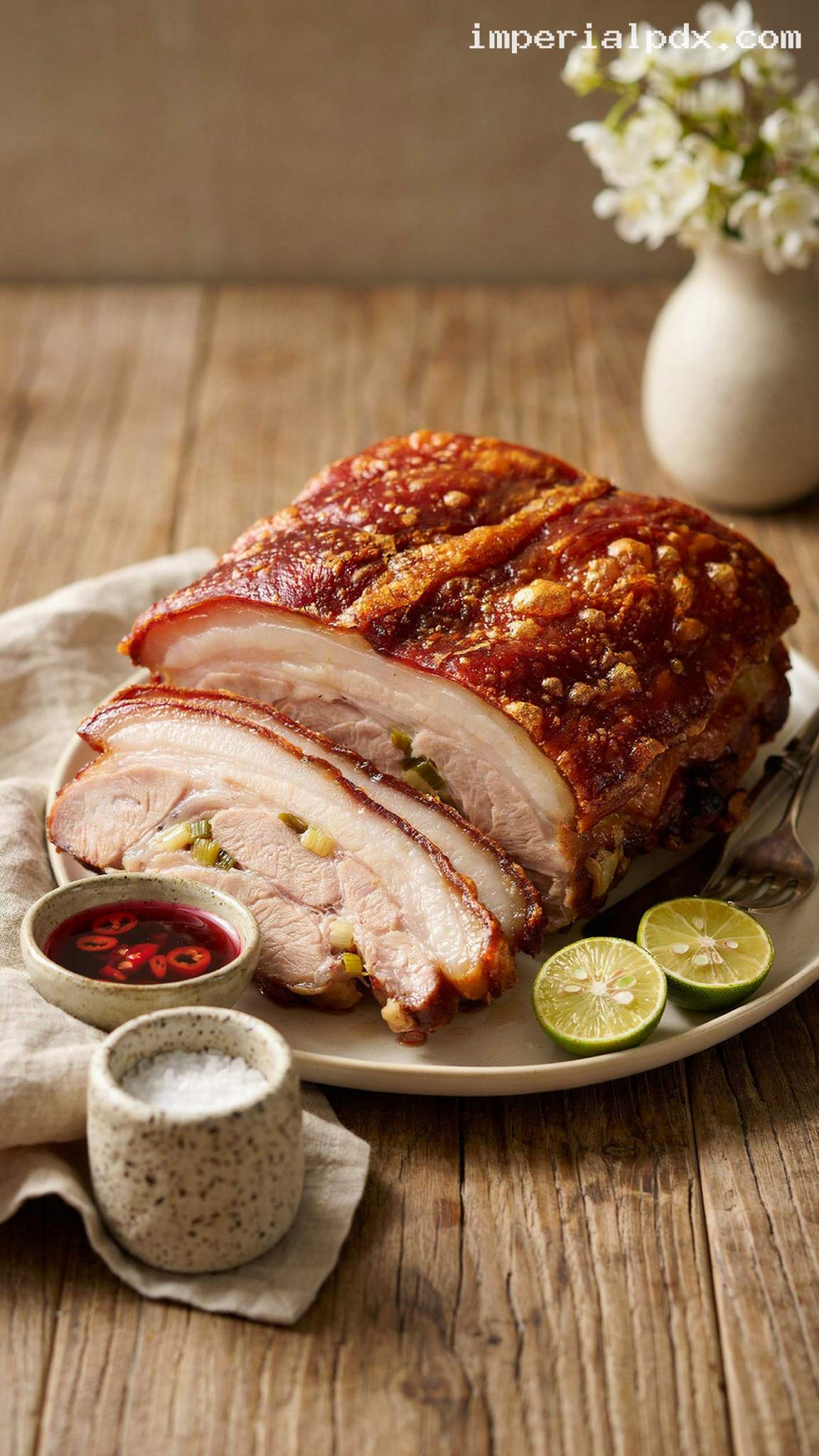
Quick Recipe Version (TL;DR)
Filipino Lechon Belly with Crispy Garlic Herb Skin is a celebration-worthy pork roast filled with lemongrass, garlic, spring onions, bay leaves, and black pepper. An overnight drying period and a hot finish create deeply golden, shatteringly crisp skin.
Quick Ingredients
- 1 boneless, skin-on pork belly, 6 pounds (2.7 kg), rectangular and evenly thick
- 24 g fine sea salt, divided into 20 g for the meat and 4 g for the skin
- 1 tablespoon (15 ml) white vinegar
- 16 large garlic cloves, approximately 64 g, divided
- 3 lemongrass stalks, tough layers removed, yielding approximately 60 g tender inner stalk
- 6 spring onions (90 g), trimmed
- 4 dried bay leaves, divided
- 2 teaspoons (5 g) coarsely ground black pepper
- 2 tablespoons (30 ml) neutral oil, such as canola or rice bran oil
- 1 cup (240 ml) water, for the roasting pan
- Optional for serving: steamed rice, spiced vinegar, and halved calamansi
Do This
- 1. Pat the pork dry. Prick the skin shallowly, wipe it with the vinegar, and season the meat with 20 g salt and the black pepper.
- 2. Fill with 12 minced garlic cloves, finely chopped lemongrass, spring onions, and 3 bay leaves. Roll tightly, tie with kitchen twine, and rub the skin with the remaining 4 g salt.
- 3. Refrigerate uncovered on a rack for 12 hours, with the seam underneath.
- 4. Roast on a rack at 300°F (150°C), conventional oven, for approximately 3 hours 45 minutes, with 1 cup water in the pan below. Begin checking the center after 3 hours.
- 5. During roasting, gently heat the oil with the remaining 4 crushed garlic cloves and 1 bay leaf for 6 minutes. Strain, then brush 2 teaspoons of the aromatic oil thinly over the dry skin before the final roast.
- 6. Transfer the pork and rack to a clean roasting pan. Increase the oven to 450°F (230°C) and roast for approximately 30 minutes, until the skin crackles and the center reaches 190–200°F (88–93°C).
- 7. Rest uncovered for 25 minutes. Remove the twine, slice into thick rounds, remove the whole bay leaves, and serve.
Why You’ll Love This Recipe
- Properly crisp crackling: Overnight drying, shallow skin pricking, and a hot final roast work together to create a beautifully blistered crust.
- Fragrant, flavorful meat: Lemongrass, garlic, spring onions, bay, and pepper season the pork from the inside.
- Garlic-herb flavor without burnt bits: Strained garlic-and-bay oil adds aroma without leaving garlic pieces on the skin to scorch.
- A manageable celebration roast: A rolled pork belly gives you the festive spirit of Filipino lechon without roasting a whole pig.
Grocery List
- Meat: One 6-pound (2.7 kg) boneless, skin-on pork belly.
- Produce: 16 large garlic cloves, 3 lemongrass stalks, 6 spring onions, and optional calamansi and fresh red chilies for serving.
- Dairy: None needed.
- Pantry: Fine sea salt, white vinegar, dried bay leaves, black pepper, neutral oil, and optional rice and Filipino spiced vinegar.
- Kitchen supplies: Food-safe cotton kitchen twine, paper towels, a sturdy roasting rack, and a roasting pan.
Full Ingredients
For the Pork and Skin
- 1 boneless, skin-on pork belly, 6 pounds (2.7 kg), approximately 12 × 14 inches (30 × 35 cm), with the skin intact
- 24 g fine sea salt, divided: 20 g for the meat and 4 g for the skin; weigh it because salt volume varies by brand
- 1 tablespoon (15 ml) white vinegar, for wiping the skin
- 1 cup (240 ml) water, for the bottom of the roasting pan
For the Aromatic Filling
- 12 large garlic cloves (approximately 48 g), finely minced
- 3 lemongrass stalks, tough outer layers and woody tops removed, yielding approximately 60 g tender inner stalk, very finely chopped
- 6 spring onions (90 g), white and green parts, cut into 2-inch (5 cm) lengths
- 3 dried bay leaves, left whole so they can be removed before eating
- 2 teaspoons (5 g) coarsely ground black pepper
For the Garlic-Bay Skin Oil
- 2 tablespoons (30 ml) neutral oil, such as canola or rice bran oil
- 4 large garlic cloves (approximately 16 g), lightly crushed
- 1 dried bay leaf
The infusion makes more oil than you need for brushing. Use only 2 teaspoons (10 ml) on the pork; a thin coating is enough.
For Serving, Optional
- 6 cups cooked jasmine rice, approximately 900 g
- ½ cup (120 ml) Filipino spiced vinegar, served separately
- 6 calamansi, halved, or 2 limes, cut into wedges
- 2 small fresh red chilies, thinly sliced, for the dipping vinegar
Helpful Equipment
- A rimmed tray and rack that fit in your refrigerator
- A roasting pan with a sturdy rack, plus a clean second pan for the high-heat finish
- Food-safe cotton kitchen twine
- A clean metal skewer or dedicated pork-skin pricking tool
- An instant-read thermometer or oven-safe probe thermometer
- A small saucepan, fine-mesh strainer, and pastry brush
- A sharp carving knife or serrated knife
Step-by-Step Instructions
Step 1: Prepare the pork and dry the skin
Start the day before serving. Check the belly for any remaining bones or cartilage, and remove them with a sharp knife. Do not rinse the raw pork; pat both sides thoroughly dry with paper towels.
Place the belly skin-side up. Using a clean metal skewer or pork-skin pricking tool, make shallow holes across the skin, approximately ¼ inch (6 mm) apart. Pierce only the skin, not deeply into the fat or meat. Deep punctures let juices rise to the surface and can interfere with crisping.
Moisten a paper towel with the 1 tablespoon white vinegar and wipe the skin evenly. Let it sit for 5 minutes, then blot away any visible moisture.
Step 2: Add the filling and roll tightly
Turn the belly skin-side down. Make shallow cuts approximately ¼ inch (6 mm) deep in the thickest areas of meat, without cutting through to the skin. Rub the meat with 20 g fine sea salt and the 2 teaspoons black pepper, working the seasoning into the cuts.
Spread the 12 minced garlic cloves and finely chopped lemongrass over the meat, leaving a 1-inch (2.5 cm) border around the edges. Arrange the spring onions and 3 whole bay leaves across the center.
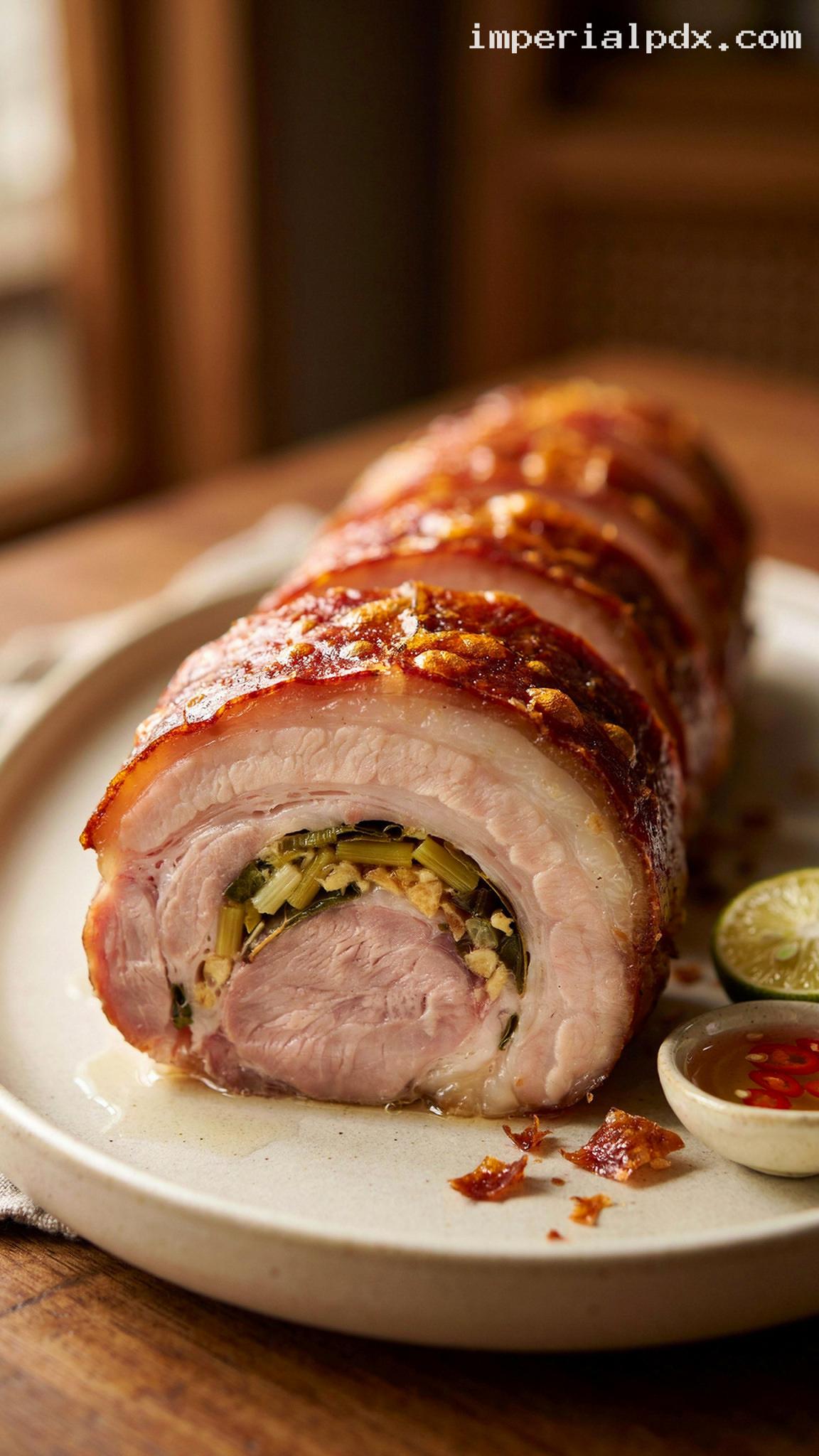
Roll from one long edge toward the other, enclosing the filling and keeping the skin on the outside. Aim for skin edges that meet rather than overlap; skin tucked inside the roll will not become crisp. Tie firmly with kitchen twine at approximately 1½-inch (4 cm) intervals. The finished roll should feel secure, not squeezed so tightly that filling spills out.
Step 3: Refrigerate uncovered overnight
Pat the outside dry again, then rub the remaining 4 g salt evenly over the skin. Place the pork seam-side down on a rack over a rimmed tray. Refrigerate uncovered for 12 hours at 40°F (4°C) or below, on a low shelf away from ready-to-eat food.
By the next day, the skin should feel dry and slightly firm. If you see any beads of moisture, blot them off before roasting. You can extend the uncovered drying time to 24 hours if that better suits your schedule.
Step 4: Slow-roast until the meat is nearly tender
Preheat a conventional oven to 300°F (150°C), with a rack in the lower-middle position. Set the pork seam-side down on a sturdy roasting rack inside a roasting pan. Pour 1 cup (240 ml) water into the pan, keeping the water below the pork.
Roast for approximately 3 hours 45 minutes. Begin checking the center after 3 hours, inserting the thermometer from one end into the thickest meat rather than the aromatic filling. Before the high-heat finish, aim for approximately 185–190°F (85–88°C), with a probe sliding into the meat with little resistance.
If the pan dries out early and the drippings begin to burn, add ½ cup (120 ml) hot water at a time to the pan only. Do not pour water over the pork, baste the skin, or cover the roast. The exact roasting time depends on the roll’s diameter and your oven.
Step 5: Make the garlic-bay oil
During the last 30 minutes of slow-roasting, combine the 2 tablespoons neutral oil, 4 crushed garlic cloves, and 1 bay leaf in a small saucepan. Heat over low heat for 6 minutes, until fragrant and the garlic is just beginning to turn pale gold. Keep the heat gentle; dark garlic will make the oil taste bitter.
Strain into a heatproof bowl and discard the garlic and bay leaf. Use the oil during this cooking session, and discard any unused portion rather than keeping it at room temperature.
Step 6: Finish with high heat for crackling skin
Remove the pork from the oven and increase the temperature to 450°F (230°C). Carefully transfer the pork and its rack to a clean roasting pan, leaving the collected water and fat behind. This reduces the chance of the old drippings smoking during the hot finish.
If the skin has any moisture on it, blot it carefully with paper towels held in tongs. Brush the skin with just 2 teaspoons (10 ml) of the strained garlic-bay oil, spreading it into a very thin film. Do not add the cooked garlic or herbs to the surface.
Return the pork to the oven and roast for approximately 30 minutes. Check after 15 minutes and rotate the pan halfway through if your oven browns unevenly. The skin should become deeply golden, blistered, and hard when gently tapped. Aim for a final center temperature of 190–200°F (88–93°C) for tender, sliceable belly.
If a small area darkens too quickly, shield only that spot with a little foil. Do not cover the whole roast. If the skin is crisp before the center reaches the tenderness target, lower the oven to 300°F (150°C) and continue cooking until tender.
Step 7: Rest, carve, and serve
Transfer the roast to a carving board and rest uncovered for 25 minutes. Avoid tenting it with foil: trapped steam softens the crackling.
Snip off every piece of twine. Using a sharp carving knife or serrated knife, cut through the crackling with a gentle sawing motion, then slice the meat into approximately 1-inch (2.5 cm) rounds. Remove the whole bay leaves as you carve, and discard any unexpectedly tough pieces of lemongrass.
Serve immediately with steamed rice, calamansi, and spiced vinegar on the side. Keep the dipping vinegar off the skin until each bite is ready to eat so the crackling stays crisp.
Pro Tips
- Buy the right belly: Ask for a boneless, skin-on slab that is evenly thick and suitable for rolling. Avoid pieces with large tears in the skin or very thin, floppy ends.
- Dryness matters more than extra oil: The uncovered refrigerator rest is one of the most important steps. A wet surface must lose its moisture before it can become crisp.
- Keep garlic beneath the skin or strain it out: Raw minced garlic on the outside will burn during the hot finish. The filling and strained finishing oil give you garlic flavor without scorched bits.
- Use temperature and tenderness together: The listed times are planning estimates. A tightly rolled belly may take longer than a thinner roll, even at the same weight.
- Expect the best crackling on top: The exposed upper skin crisps most dramatically; the underside and seam can be less crisp. Arrange slices with the best crackling facing upward.
Variations
- Chili-garlic filling: Add 2 finely chopped bird’s-eye chilies to the filling for a gentle but noticeable heat. Wear gloves when handling the chilies.
- Citrus-pepper version: Add 2 teaspoons finely grated lime zest to the filling. Keep citrus juice off the skin before roasting.
- Simple black-pepper crackling: Replace the infused oil with 2 teaspoons plain neutral oil. Keep all the garlic and aromatics inside the roast for a slightly simpler finish.
Storage & Make-Ahead
Make ahead: Fill, roll, tie, and salt the pork up to 24 hours before roasting. Refrigerate uncovered on a rack at 40°F (4°C) or below. For the crispiest result, roast it on the day you plan to serve it.
Refrigerate leftovers: Within 2 hours of cooking, divide leftover pork into smaller portions and refrigerate in shallow containers. Store for 3–4 days. Once chilled, cover securely. Keep the skin separate from the meat where practical so it is easier to re-crisp.
Reheat: Place pork slices in a baking dish with 2 tablespoons (30 ml) water or unsalted stock around the meat, not on the skin. Cover the meat portion loosely and heat at 325°F (165°C) for approximately 20–30 minutes, until the center reaches 165°F (74°C). Uncover and finish at 425°F (220°C) for 5–10 minutes to refresh the skin, watching carefully. Refrigerated crackling may not return to its original texture.
Freeze: Freeze cooled portions in airtight containers for up to 2 months. Thaw overnight in the refrigerator before reheating. The meat freezes better than the crackling.
Nutrition (per serving)
Calories: 910 kcal | Carbs: 2g | Protein: 22g | Fat: 90g | Saturated Fat: 33g | Fiber: 0g | Sugar: 0g | Sodium: 820mg | Cholesterol: 120mg
Estimated for one-twelfth of the roast, excluding rice, dipping vinegar, and optional garnishes. Pork belly varies considerably in fat content, and the amount of fat rendered and discarded will affect the final nutrition.


