Quick Recipe Version (TL;DR)
Quick Ingredients
- Puff base: 1 sheet (about 250 g) all-butter puff pastry, thawed but cold; 1 egg (for egg wash)
- Choux pastry: 1/2 cup (120 ml) water, 1/2 cup (120 ml) whole milk, 1/2 cup (115 g) unsalted butter, 2 tsp sugar, 1/2 tsp fine salt, 1 1/4 cups (150 g) all-purpose flour, 4 large eggs
- Vanilla pastry cream: 2 cups (500 ml) whole milk, 1 vanilla bean or 2 tsp vanilla extract, 5 large egg yolks, 1/2 cup + 2 tbsp (120 g) sugar, 1/3 cup (40 g) cornstarch, 2 tbsp (30 g) unsalted butter, 2 1/4 tsp (7 g) powdered gelatin + 2 tbsp cold water
- Whipped cream: 1 1/2 cups (360 ml) heavy cream, 2 tbsp (15 g) powdered sugar
- Caramel: 1 cup (200 g) sugar, 1/4 cup (60 ml) water, a few drops lemon juice
- Optional garnish: Fresh berries, mint leaves, confectioners’ sugar
Do This
- 1. Cook vanilla pastry cream: infuse milk with vanilla, whisk yolks, sugar, and cornstarch, temper with hot milk, cook until thick, add butter and bloomed gelatin, chill completely.
- 2. Roll puff pastry into a 10–11 in (25–28 cm) circle, dock the center, chill on a parchment-lined tray.
- 3. Make pâte à choux, pipe a thick ring on the puff base and 16–20 small puffs on a second tray; bake until deeply golden and dry.
- 4. Whip heavy cream with powdered sugar; loosen chilled pastry cream and fold in whipped cream to make diplomat cream. Pipe some into the cooled cream puffs.
- 5. Cook caramel to a deep amber; dip tops of filled puffs to glaze, then use caramel to stick them around the choux ring.
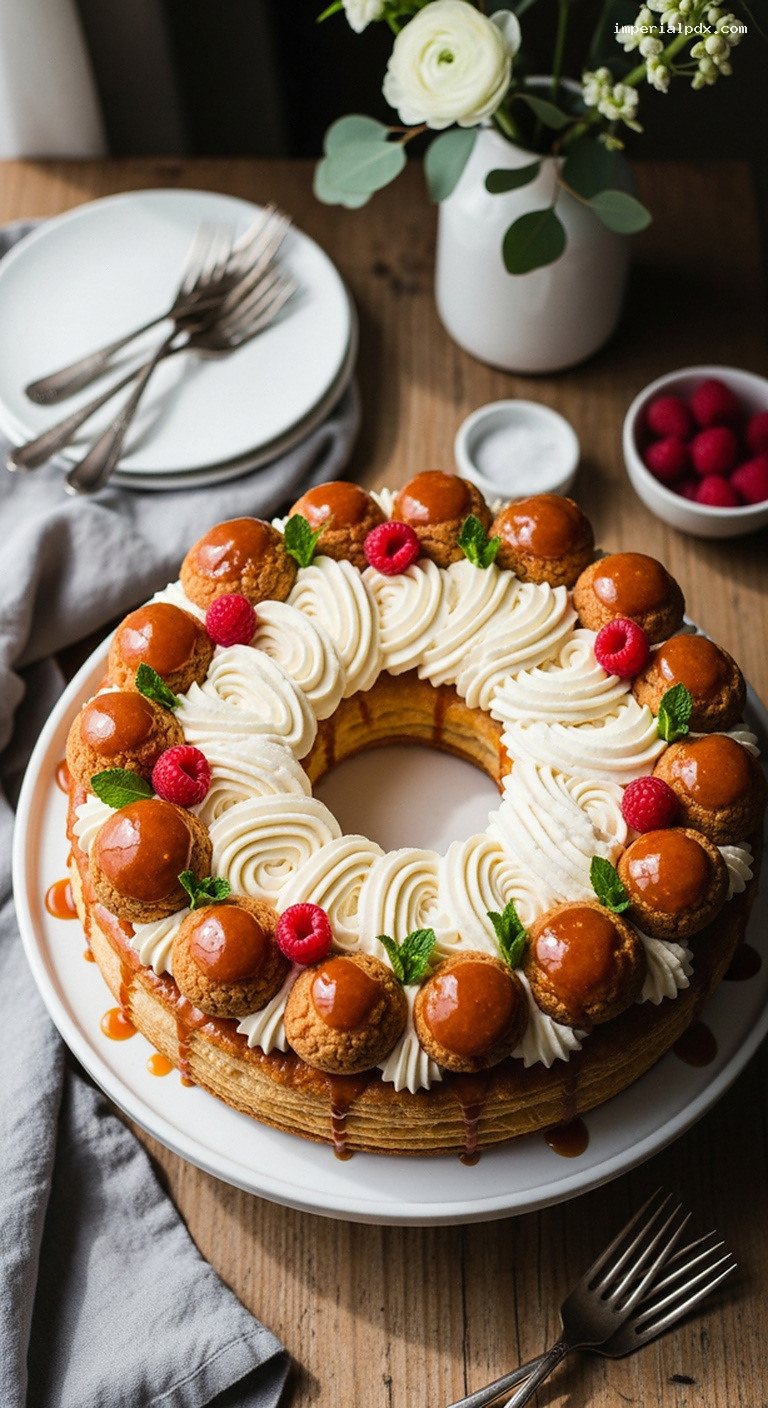
- 6. Pipe a generous layer of diplomat cream in the center and swirl more cream in tall waves. Chill 1 hour, garnish, and serve.
Why You’ll Love This Recipe
- A dramatic, show-stopping centerpiece with bakery-level looks but clear, step-by-step instructions for home cooks.
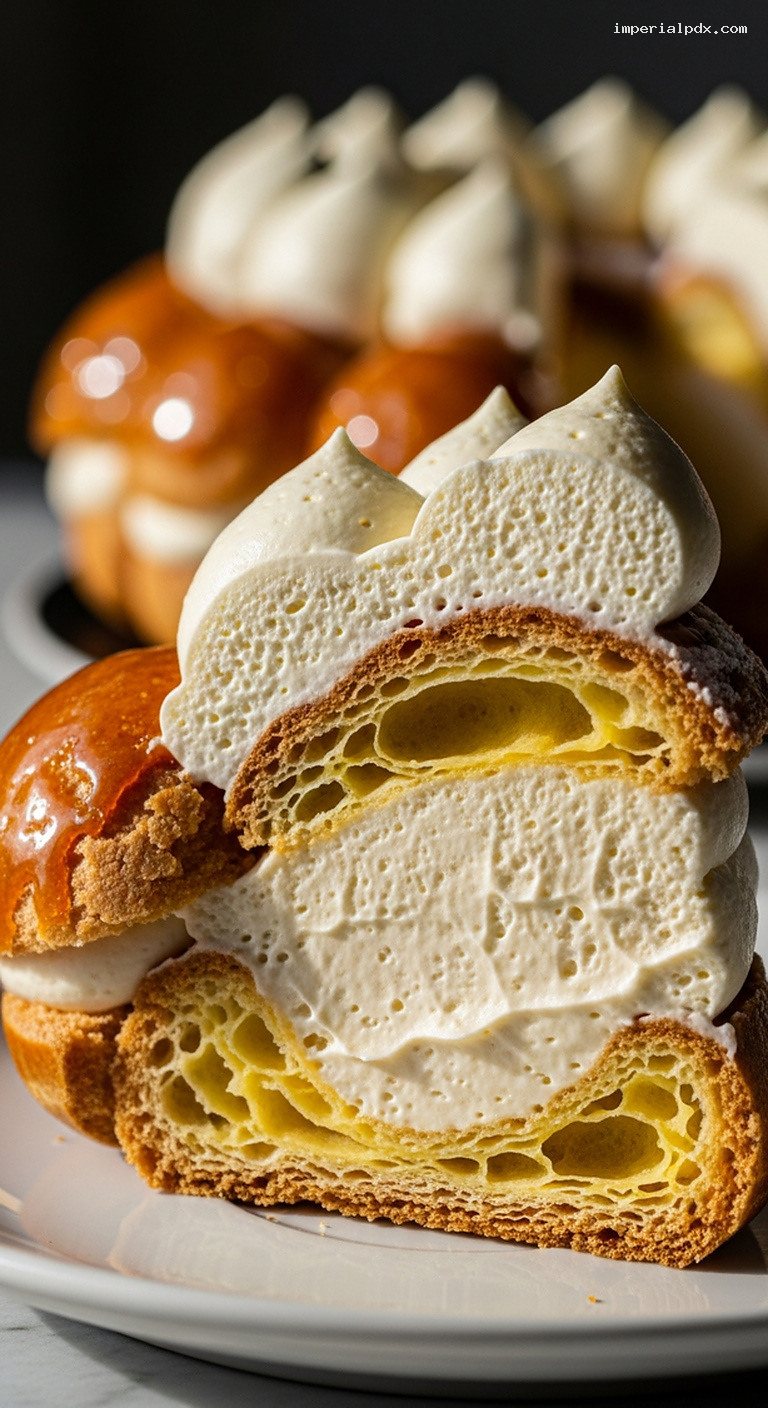
- Perfect texture contrast: crisp, flaky puff pastry, airy cream puffs, glassy caramel, and cloud-like vanilla cream.
- Make-ahead friendly: prepare the cream and shells in advance, then assemble the cake when you are ready to impress.
- Endlessly customizable with different flavors (chocolate, coffee, fruit) once you master the base recipe.
Grocery List
- Produce: Optional: fresh berries (raspberries, strawberries), fresh mint
- Dairy: Whole milk, heavy whipping cream, unsalted butter, large eggs
- Pantry: All-purpose flour, granulated sugar, powdered sugar, cornstarch, powdered gelatin, vanilla bean or vanilla extract, puff pastry (all-butter, frozen), fine salt, lemon juice (or bottled), confectioners’ sugar (for dusting, optional)
Full Ingredients
For the Vanilla Pastry Cream (for Diplomat Cream)
- 2 cups (500 ml) whole milk
- 1 vanilla bean, split and scraped or 2 tsp pure vanilla extract
- 5 large egg yolks
- 1/2 cup + 2 tbsp (120 g) granulated sugar, divided
- 1/3 cup (40 g) cornstarch
- Pinch of fine salt
- 2 tbsp (30 g) unsalted butter, cut into cubes
- 2 1/4 tsp (7 g) powdered gelatin
- 2 tbsp (30 ml) cold water (for blooming gelatin)
For the Puff Pastry Base
- 1 sheet all-butter puff pastry (about 250 g), thawed but still cold
- 1 large egg, beaten with 1 tsp water (egg wash)
- All-purpose flour, for dusting the surface
For the Pâte à Choux (Cream Puffs and Ring)
- 1/2 cup (120 ml) water
- 1/2 cup (120 ml) whole milk
- 1/2 cup (115 g) unsalted butter, cut into pieces
- 2 tsp (8 g) granulated sugar
- 1/2 tsp fine salt
- 1 1/4 cups (150 g) all-purpose flour
- 4 large eggs, at room temperature
- Extra beaten egg from the egg wash above, as needed, for brushing
For the Diplomat Cream
- All of the chilled vanilla pastry cream (from above)
- 1 1/2 cups (360 ml) cold heavy whipping cream
- 2 tbsp (15 g) powdered sugar
For the Caramel Glaze and Assembly
- 1 cup (200 g) granulated sugar
- 1/4 cup (60 ml) water
- A few drops fresh lemon juice (about 1/4 tsp; helps prevent crystallization)
- Optional: confectioners’ sugar for dusting, fresh berries, and small mint leaves for garnish
Step-by-Step Instructions
Step 1: Make and Chill the Vanilla Pastry Cream
Start with the pastry cream so it has plenty of time to chill. In a small bowl, sprinkle the powdered gelatin evenly over 2 tbsp (30 ml) cold water. Let it sit for at least 5–10 minutes to bloom.
In a medium saucepan, combine the milk and half of the sugar (1/4 cup + 1 tbsp / 60 g). If using a vanilla bean, scrape the seeds into the milk and add the pod as well. Heat over medium until steaming and just starting to bubble around the edges; do not let it fully boil.
Meanwhile, in a separate bowl, whisk together the egg yolks, remaining sugar, cornstarch, and a pinch of salt until thick and pale. Slowly pour in about 1/3 of the hot milk while whisking constantly to temper the eggs. Pour this mixture back into the saucepan with the remaining milk, whisking well.
Return the pan to medium heat and cook, whisking constantly, until the pastry cream thickens and large bubbles start to pop, 1–3 minutes. Once it boils, cook for 30–60 seconds more to fully cook the starch. Remove from heat. Take out the vanilla pod (if using).
Immediately whisk in the butter until smooth, then add the bloomed gelatin and stir until fully melted and incorporated. If using vanilla extract instead of a bean, stir it in now. Pour the hot pastry cream into a shallow dish or bowl, press plastic wrap directly onto the surface to prevent a skin, and chill in the refrigerator until completely cold and set, at least 2 hours (and up to 2 days).
Step 2: Prepare the Puff Pastry Base
While the pastry cream chills, prepare the base. Line a large baking sheet with parchment paper. Lightly flour your work surface and roll the puff pastry into a circle about 10–11 inches (25–28 cm) in diameter and about 1/8 inch (3 mm) thick. Use a plate or cake pan as a guide and trim the edges to get a neat circle if you like.
Transfer the pastry circle to the prepared baking sheet. Using a fork, prick (dock) the center area all over, leaving a 1-inch (2.5 cm) border around the edge un-pricked. This keeps the center flatter while allowing the edge to puff slightly.
Lightly mark (do not cut through) an inner circle about 8 inches (20 cm) across; this will guide where you pipe the choux ring later. Brush the outer 1-inch border very lightly with egg wash. Place the tray in the refrigerator to keep the pastry cold while you prepare the pâte à choux.
Step 3: Make the Pâte à Choux and Bake the Base and Cream Puffs
Preheat the oven to 400°F (200°C) with a rack in the middle. Line a second baking sheet with parchment paper for the individual cream puffs.
In a medium saucepan, combine the water, milk, butter, sugar, and salt. Heat over medium until the butter melts and the mixture just comes to a full boil. Remove from the heat, add the flour all at once, and stir vigorously with a wooden spoon or spatula until it forms a thick dough that pulls away from the sides of the pan.
Return the pan to medium heat and cook the dough, stirring constantly, for 1–2 minutes. It should look smooth and leave a thin film on the bottom of the pan. Transfer the dough to a mixing bowl and let cool for 5 minutes so it is warm but not hot.
Beat in the eggs one at a time, mixing well after each addition (you can use a wooden spoon, hand mixer, or stand mixer with paddle attachment). The finished dough should be smooth, glossy, and fall from the spoon in a thick V shape. If it is very stiff, you can beat in a small amount of extra beaten egg, a teaspoon at a time.
Transfer the choux dough to a piping bag fitted with a 1/2-inch (1.25 cm) plain round tip. Take the chilled puff pastry from the fridge. Pipe a thick ring of choux along the marked inner circle, about 3/4 inch (2 cm) wide and high. On the second parchment-lined tray, pipe 16–20 small mounds about 1 inch (2.5 cm) across and 3/4 inch (2 cm) high, spaced well apart.
Lightly brush the choux ring and the tops of the small mounds with remaining egg wash, avoiding drips down the sides. Bake both trays at 400°F (200°C) for 15–20 minutes, until the choux is well risen and starting to turn golden. Do not open the oven during this time.
Without removing the trays, reduce the oven temperature to 350°F (175°C). Bake for another 15–20 minutes, rotating the trays halfway, until everything is deeply golden brown and feels light and hollow when you tap the bottoms. Turn off the oven, crack the door open with a wooden spoon, and let the pastries dry inside for 10 minutes. Remove and cool completely on wire racks.
Step 4: Prepare the Diplomat Cream and Fill the Cream Puffs
Once the pastry cream is fully chilled and the shells are cool, make the diplomat cream. In a large bowl, whisk the cold pastry cream until smooth and creamy. If it is very stiff, you can briefly whisk it with a hand mixer to loosen.
In a separate chilled bowl, whip the heavy cream and powdered sugar to medium peaks: the cream should hold its shape but still look soft and slightly droopy at the tips. Do not overwhip.
Fold about one-third of the whipped cream into the pastry cream to lighten it, then gently fold in the rest in two additions, using a spatula and broad, sweeping motions. Stop as soon as the mixture is smooth and uniform; you want to keep as much air as possible.
Transfer about one-third of the diplomat cream to a piping bag fitted with a small plain tip (about 1/4 inch / 6 mm). Use a skewer or the tip of a knife to poke a small hole in the bottom of each cream puff. Insert the piping tip and gently fill each puff until it feels just heavy and full, but not bursting. Set the filled puffs aside on a tray.
Transfer the remaining diplomat cream to a clean piping bag fitted with a large star tip or Saint-Honoré tip for the decorative swirls later. Keep the bag in the refrigerator if your kitchen is warm.
Step 5: Make the Caramel and Glaze the Cream Puffs
Prepare everything before you start the caramel: have the baked puff pastry base with choux ring on a serving platter, the tray of filled cream puffs nearby, and a bowl of ice water ready in case of sugar splashes. Caramel hardens quickly, so you need to work efficiently.
In a small, heavy-bottomed saucepan, combine the sugar, water, and a few drops of lemon juice. Heat over medium-high heat without stirring. Let the sugar dissolve and come to a boil, occasionally swirling the pan gently to ensure even cooking. Continue boiling until the syrup turns a deep amber color, 8–10 minutes. Watch closely near the end; it can go from perfect to burnt quickly.
Once the caramel is a rich amber, reduce the heat to the lowest setting to keep it fluid without darkening too much. Working carefully (hot sugar is extremely hot), hold each filled cream puff with tongs or by pinching the sides with your fingers protected by a glove. Dip the top of the puff into the caramel so it gets a thin, glossy cap, then place it caramel-side up on a parchment-lined tray to set. Repeat with all the puffs.
To attach the cream puffs to the cake, re-dip the side or base of each glazed puff lightly in caramel and press it against the outer edge of the baked choux ring, spacing them evenly all the way around. You should have a beautiful crown of caramel-glazed puffs encircling the cake. If the caramel thickens, gently rewarm it over low heat.
Step 6: Fill the Center and Pipe Elegant Swirls
Once the caramel has set and the cream puffs are securely attached, turn to the center of the Saint-Honoré. Pipe a layer of diplomat cream in the middle of the base, inside the choux ring, to create a slightly domed filling. You can smooth it gently with an offset spatula.
Now, using the same bag fitted with a large star or Saint-Honoré tip, pipe generous swirls, waves, or zigzags of diplomat cream over the center, building height and volume. Classic Saint-Honoré often features elongated, slightly diagonal swipes of cream radiating from the center; you can also simply pipe rosettes or continuous ruffles. Aim for a billowy, cloud-like effect.
If desired, tuck a few small fresh berries or mint leaves between some of the cream puffs, and/or lightly dust the top of the cream with confectioners’ sugar just before serving for a soft, snowy look.
Step 7: Chill, Garnish, and Serve
Transfer the finished Saint-Honoré cake to the refrigerator and chill for at least 1 hour before serving. This allows the diplomat cream to firm up slightly, the flavors to meld, and the structure to stabilize so slices hold together.
Just before serving, you can add any final touches: a few more berries, an extra light dusting of confectioners’ sugar, or tiny mint leaves for color. Use a sharp, serrated knife to cut clean wedges, pressing straight down through the cream puffs and base rather than sawing back and forth.
Serve chilled but not icy-cold; taking the cake out of the fridge 10–15 minutes before serving lets the flavors and textures shine. Enjoy the contrast of crisp, flaky pastry, glassy caramel, airy choux, and silky vanilla cream in every bite.
Pro Tips
- Respect chilling times: A well-chilled pastry cream makes a stable diplomat cream that pipes beautifully and holds its shape.
- Dry out the choux: Letting the baked cream puffs sit in a cooling oven with the door cracked helps prevent soggy shells later.
- Work safely with caramel: Use a small pan, long-handled tools, and keep a bowl of ice water nearby. Never touch hot caramel directly with your fingers.
- Test choux dough texture: The dough should form a thick, continuous V when it falls from the spatula. If it breaks off in chunks, it is too stiff and needs a touch more egg.
- Plan your timing: Make the pastry cream and shells a day ahead if you like; save the caramel and final assembly for just before serving.
Variations
- Chocolate Saint-Honoré: Whisk 2–3 tbsp (10–15 g) cocoa powder into the cornstarch for the pastry cream and fold in 2 oz (55 g) melted dark chocolate (cooled slightly) before chilling.
- Coffee Saint-Honoré: Infuse the milk for the pastry cream with 2–3 tbsp finely ground coffee (then strain) or add 2–3 tsp instant espresso powder. Garnish with chocolate-covered coffee beans.
- Berry Saint-Honoré: Spread a thin layer of raspberry or strawberry jam over the baked puff base before adding the diplomat cream, and decorate the top generously with fresh berries.
Storage & Make-Ahead
This dessert is best enjoyed the day it is assembled, when the puff pastry and choux are still pleasantly crisp. Once assembled, store the Saint-Honoré cake in the refrigerator, loosely covered, for up to 24 hours. The caramel will soften slightly in the fridge but will still taste wonderful.
For easier entertaining, you can prepare components ahead:
- Pastry cream: Make up to 2 days in advance and keep refrigerated with plastic wrap pressed onto the surface.
- Baked choux and puff base: Bake up to 1 day ahead. Once completely cool, store in an airtight container at room temperature. If they soften, you can re-crisp them in a 300°F (150°C) oven for 5–8 minutes, then cool before filling.
- Diplomat cream: Best made the day of serving, within a few hours of assembly.
- Caramel: Must be made fresh right before glazing and assembling, as it hardens on standing.
Nutrition (per serving)
Approximate values for one of 12 servings (will vary with portion size and garnishes): about 600 calories; 9 g protein; 44 g carbohydrates; 40 g total fat (25 g saturated); 210 mg cholesterol; 220 mg sodium; 1 g fiber; 30 g sugars. This is a rich, celebratory dessert, so small slices go a long way.