Quick Recipe Version (TL;DR)
Quick Ingredients
- 1 lb (450 g) ground venison
- 12 oz (340 g) fatty ground pork or pork shoulder
- 4 oz (115 g) pork back fat or very fatty bacon, finely diced
- 1/2 cup (120 ml) dry red wine
- 2 tbsp brandy or cognac (optional)
- 2 cloves garlic, minced; 1 small shallot, minced
- 8 juniper berries, lightly crushed
- 2 tsp chopped fresh thyme (plus extra sprigs)
- 2 large eggs
- 1/3 cup (80 ml) heavy cream
- 1/2 cup (30 g) fresh breadcrumbs
- 2 1/2 tsp kosher salt (use 1 3/4 tsp if using table salt)
- 1 1/2 tsp freshly ground black pepper
- 1/4 tsp ground allspice (or nutmeg)
- 6–8 thin slices streaky bacon (for lining the terrine)
Do This
- 1. Marinate venison, pork, and pork fat with red wine, brandy, garlic, shallot, juniper, thyme, salt, and pepper 8–24 hours in the fridge.
- 2. Preheat oven to 325°F (160°C). Line a 1 1/2- to 2-quart terrine or loaf pan with bacon, letting it overhang the sides.
- 3. Mix marinated meats (discard bay leaf if used) with eggs, cream, breadcrumbs, extra thyme, and allspice until sticky and well combined.
- 4. Pack mixture firmly into the terrine, tap to remove air pockets, fold bacon over the top, and cover tightly with foil or a lid.
- 5. Place terrine in a roasting pan, add hot water halfway up the sides, and bake 1 1/4–1 1/2 hours, until internal temperature reaches 160°F (71°C).
- 6. Cool to room temperature, then weight the top of the pâté and chill at least 8 hours or overnight.
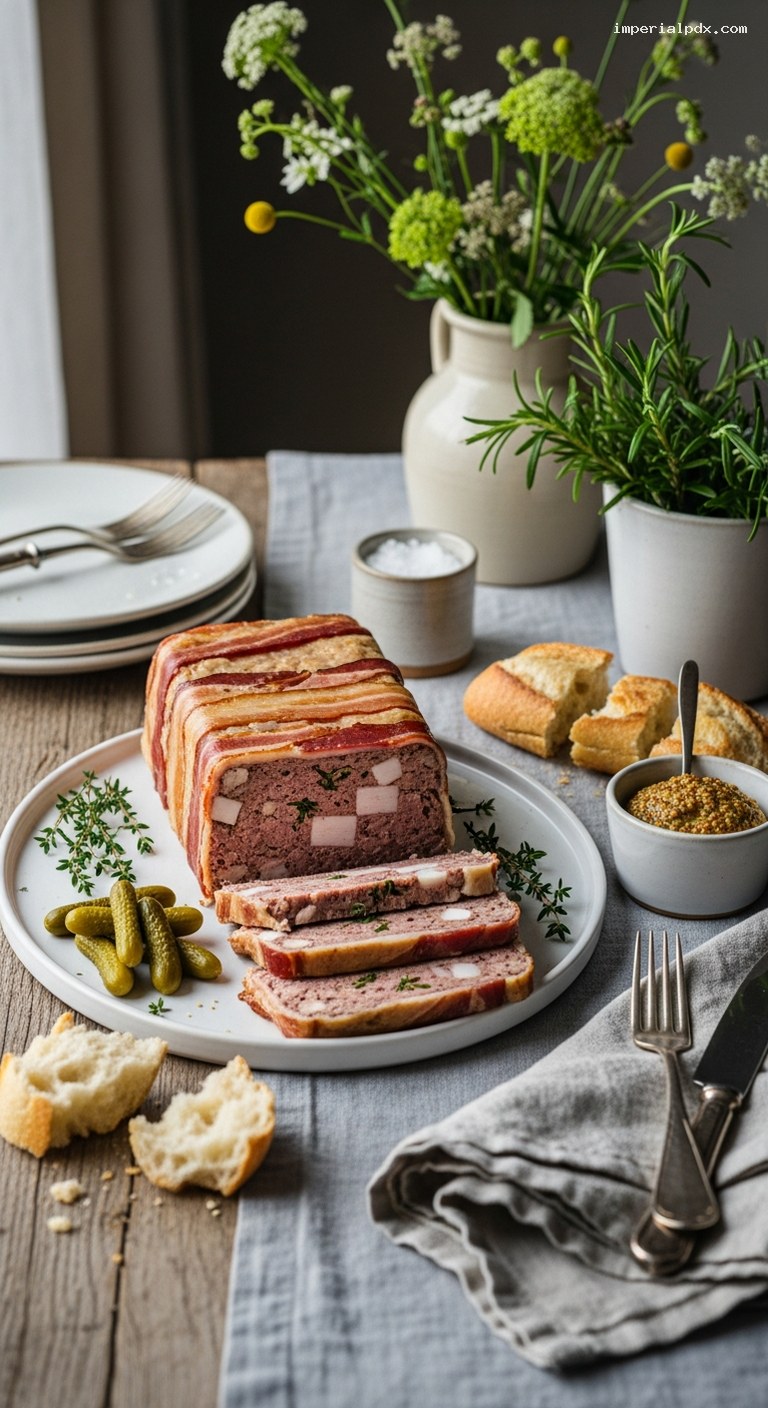
- 7. Unmold, slice with a sharp knife, and serve at cool room temperature with crusty bread, cornichons, and mustard.
Why You’ll Love This Recipe
- Deep, complex flavor from wild venison, red wine, juniper, and thyme that feels special but not fussy.
- Make-ahead friendly: perfect for holidays, dinner parties, and charcuterie boards.
- Country-style texture: rustic, sliceable, and studded with tender pieces of pork and fat for richness.
- Surprisingly achievable with basic kitchen tools and a standard loaf pan.
Grocery List
- Produce: Garlic, shallot, fresh thyme, optional parsley or chives (for garnish).
- Dairy: Heavy cream, eggs, butter (optional, for greasing and finishing).
- Pantry: Dry red wine, brandy or cognac (optional), juniper berries, bay leaf, black pepper, kosher salt, ground allspice or nutmeg, fresh breadcrumbs, Dijon or whole-grain mustard, cornichons, crusty bread or baguette.
Full Ingredients
For the Meat and Marinade
- 1 lb (450 g) ground venison (or venison cut into 1/2-inch cubes if you have a grinder)
- 12 oz (340 g) fatty ground pork or pork shoulder, coarsely ground
- 4 oz (115 g) pork back fat, salt pork, or very fatty bacon, finely diced
- 1/2 cup (120 ml) dry red wine (e.g., Côtes du Rhône, Merlot, or Cabernet)
- 2 tbsp brandy or cognac (optional but traditional and delicious)
- 2 cloves garlic, finely minced
- 1 small shallot, finely minced (or 1/4 small onion)
- 8 juniper berries, lightly crushed with the side of a knife
- 2 sprigs fresh thyme (or 1/2 tsp dried thyme)
- 1 bay leaf
- 1 1/2 tsp kosher salt (use about 1 tsp if using table salt)
- 1 tsp freshly ground black pepper
For the Pâté Base
- 2 large eggs
- 1/3 cup (80 ml) heavy cream
- 1/2 cup (30 g) fresh breadcrumbs (from a rustic or country-style bread)
- 1 tsp chopped fresh thyme leaves
- 1/2 tsp kosher salt (or 1/3 tsp table salt), plus more to taste if needed
- 1/2 tsp freshly ground black pepper
- 1/4 tsp ground allspice (or substitute 1/8 tsp ground nutmeg + 1/8 tsp ground clove)
For Lining and Baking the Terrine
- 6–8 thin slices streaky bacon, pancetta, or additional pork back fat (to line and cover the terrine)
- Soft butter, for greasing the terrine or loaf pan (if not fully lined with bacon)
- Hot water, for the baking water bath
For Serving
- Cornichons or small pickles
- Dijon or whole-grain mustard
- Crusty bread, baguette slices, or rustic crackers
- Extra thyme sprigs or chopped fresh parsley/chives for garnish
Step-by-Step Instructions
Step 1: Marinate the meats for deep flavor
In a large non-reactive bowl (glass or stainless steel), combine the ground venison, ground pork or pork shoulder, and diced pork fat. Pour in the red wine and brandy (if using). Add the minced garlic, minced shallot, crushed juniper berries, thyme sprigs, bay leaf, 1 1/2 teaspoons kosher salt, and 1 teaspoon black pepper. Use clean hands or a sturdy spoon to gently mix everything together until the seasonings and wine are evenly distributed.
Cover the bowl tightly with plastic wrap or a lid. Refrigerate for at least 8 hours and up to 24 hours. This rest allows the meat to absorb the wine and aromatics, giving the pâté its characteristic depth and subtle wild-game perfume. Stir the mixture once or twice during marinating if you think of it, to keep everything evenly soaked.
Step 2: Prepare the terrine or loaf pan
About 30 minutes before you are ready to bake, remove the marinated meats from the refrigerator to take the chill off slightly. Preheat your oven to 325°F (160°C). Place a folded kitchen towel in the bottom of a deep roasting pan; this will keep the terrine from sliding and encourage gentle cooking. Set a full kettle of water to boil for the water bath.
Use a 1 1/2- to 2-quart (about 1.5–2 L) ceramic terrine, enamelware mold, or standard 9 x 5-inch (23 x 13 cm) loaf pan. Lightly grease the inside with soft butter if not fully lining it. Lay the bacon slices along the bottom and sides of the pan, letting them overhang the edges; slightly overlap the slices so there are no gaps. This lining adds flavor and protects the pâté from drying out as it bakes.
Step 3: Mix the pâté base until sticky and cohesive
Remove and discard the bay leaf and woody thyme stems from the marinated meat. If you have a meat grinder, you can pass the mixture through the coarse plate once for a more uniform country texture, but this is optional. For a more rustic pâté, you can leave it as-is or pulse a third of it briefly in a food processor to help bind.
In a separate bowl, beat the eggs with the heavy cream. Stir in the fresh breadcrumbs, chopped thyme, remaining 1/2 teaspoon kosher salt, 1/2 teaspoon black pepper, and ground allspice. Let this sit for 5 minutes so the breadcrumbs soften.
Add the egg and breadcrumb mixture to the marinated meats. Using your hands, mix and knead the meats and seasonings together for 1–2 minutes, until the mixture becomes sticky and cohesive and starts to clump together. This slight “kneading” helps the proteins bind and gives the pâté a nice sliceable texture. Taste a small pinch by frying it in a skillet until cooked through; adjust salt and pepper if needed.
Step 4: Pack the terrine and set up the water bath
Spoon the meat mixture into the bacon-lined terrine or loaf pan in 2–3 additions, pressing firmly with the back of a spoon or your fingers to eliminate air pockets. Tap the pan gently on the counter a few times as you go. Mound the top slightly higher than the rim, as the pâté will shrink a little while baking.
Fold the overhanging bacon slices over the top to completely cover the surface; add an extra slice or two if there are any gaps. Cover the terrine tightly with its lid or with a double layer of aluminum foil crimped firmly around the edges.
Place the covered terrine in the prepared roasting pan. Carefully pour the just-boiled water into the roasting pan until it comes about halfway up the sides of the terrine. This gentle water bath (bain-marie) ensures even, moist cooking without curdling the eggs or toughening the venison.
Step 5: Bake until just cooked through
Transfer the roasting pan with the terrine and water bath to the preheated 325°F (160°C) oven. Bake for 1 hour 15 minutes to 1 hour 30 minutes, or until an instant-read thermometer inserted into the center of the pâté (through the foil) registers 160°F (71°C). Start checking at the 1 hour 10 minute mark to avoid overcooking.
If the top seems to be browning too much when you lift the foil to check, re-cover it well. The bacon might release some fat into the pan; that is normal. When the proper internal temperature is reached, remove the roasting pan from the oven but leave the terrine in the hot water for another 10 minutes to finish gently. Then carefully lift the terrine out of the water and place it on a cooling rack. Discard the water.
Step 6: Cool, weight, and chill for best texture
Allow the terrine to cool at room temperature, still covered, until just barely warm to the touch, about 1 hour. For a classic, compact pâte texture, weight it while it chills: Cut a piece of parchment to fit just inside the terrine, set it on the surface of the pâté, then place a small cutting board or piece of cardboard wrapped in foil on top. Add a couple of cans or a small weight on top. This gently presses out any air pockets and gives clean, tight slices.
Refrigerate the weighted terrine for at least 8 hours, preferably overnight and up to 3 days before serving. The flavor improves significantly after a day as the seasonings, wine, and game mellow and marry.
Step 7: Unmold, slice, and serve
When ready to serve, remove the weights and parchment. Run a thin knife or spatula around the inside edges of the terrine to loosen it. Invert onto a cutting board or serving platter; you may need to give it a gentle shake. If some jelly or fat has collected around the edges, you can trim it, reserve it for spreading on toast, or leave it for a more rustic presentation.
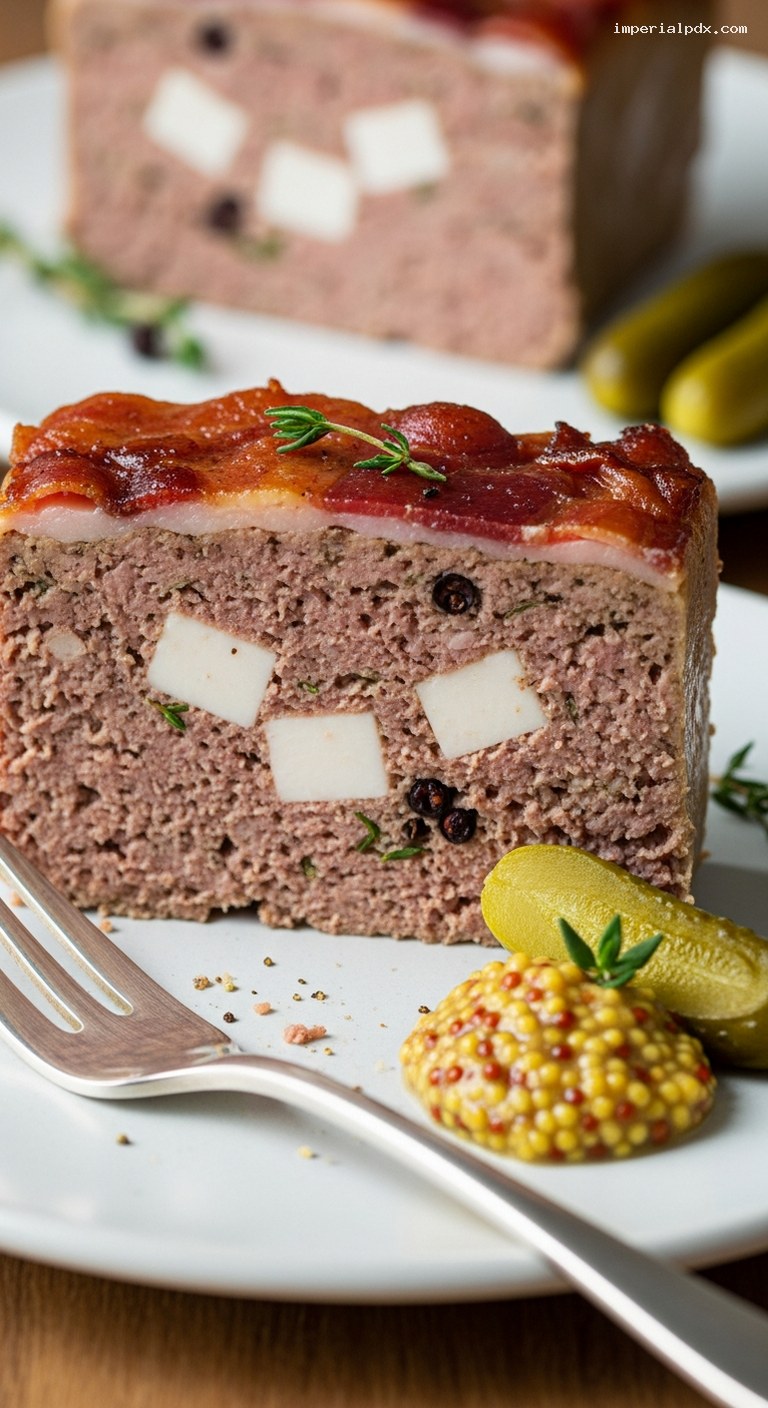
Slice the pâté with a very sharp knife into 1/2-inch (1.25 cm) slices, wiping the blade between cuts for neat edges. Serve slightly cool or at cool room temperature, arranged on a board or platter with cornichons, grainy or Dijon mustard, crusty bread, and a few sprigs of fresh thyme or chopped parsley for color. It pairs wonderfully with a simple green salad and the same red wine you used in the marinade.
Pro Tips
- Do not skip the chill time: The pâté will seem loose and underwhelming when first baked; overnight chilling firms the texture and dramatically improves the flavor.
- Check the temperature, not just the time: An instant-read thermometer is the best way to avoid a dry pâté. Pull it promptly at 160°F (71°C) in the center.
- Adjust salt carefully: Different salts vary in strength. If using table salt instead of kosher, use about 25–30% less and always taste a small cooked sample of the mixture before baking.
- Grind or pulse for your preferred texture: For a chunkier, “country” feel, leave some larger bits of meat and fat. For a smoother slice, grind everything or pulse more of the mixture in a food processor.
- Use a drinkable wine: The red wine flavor is noticeable, so choose something you enjoy drinking, dry and not too oaky.
Variations
- Wild mushroom venison pâté: Sauté 1 cup (70 g) finely chopped mushrooms in butter until well browned and nearly dry. Cool and fold into the meat mixture before packing the terrine.
- Peppercorn-crusted pâté: After unmolding, press coarsely crushed black and pink peppercorns onto the top and sides for a pretty and spicy crust.
- Dried fruit and herb version: Add 1/4 cup (35 g) chopped dried cherries, prunes, or figs and 2 tbsp chopped fresh parsley for a slightly sweeter, more aromatic pâté that pairs beautifully with cheese boards.
Storage & Make-Ahead
This venison pâté is ideal for making in advance. Once baked, pressed, and fully chilled, keep it tightly wrapped in the refrigerator for up to 5 days. For serving, slice only what you need and keep the rest wrapped to prevent drying out. To freeze, wrap the unmolded pâté (or individual slices) tightly in plastic wrap and then in foil, or place in an airtight container. Freeze for up to 2 months. Thaw overnight in the refrigerator, then bring slices to cool room temperature before serving. Leftover slices make excellent sandwiches and are great pan-seared briefly in a little butter and served with a green salad.
Nutrition (per serving)
Approximate values per serving (1 of 12): about 320 calories; 24 g fat; 20 g protein; 4 g carbohydrate; 0.5 g fiber; 2 g sugars; 650 mg sodium. Actual values will vary based on specific ingredients, portion sizes, and accompaniments.