Quick Recipe Version (TL;DR)
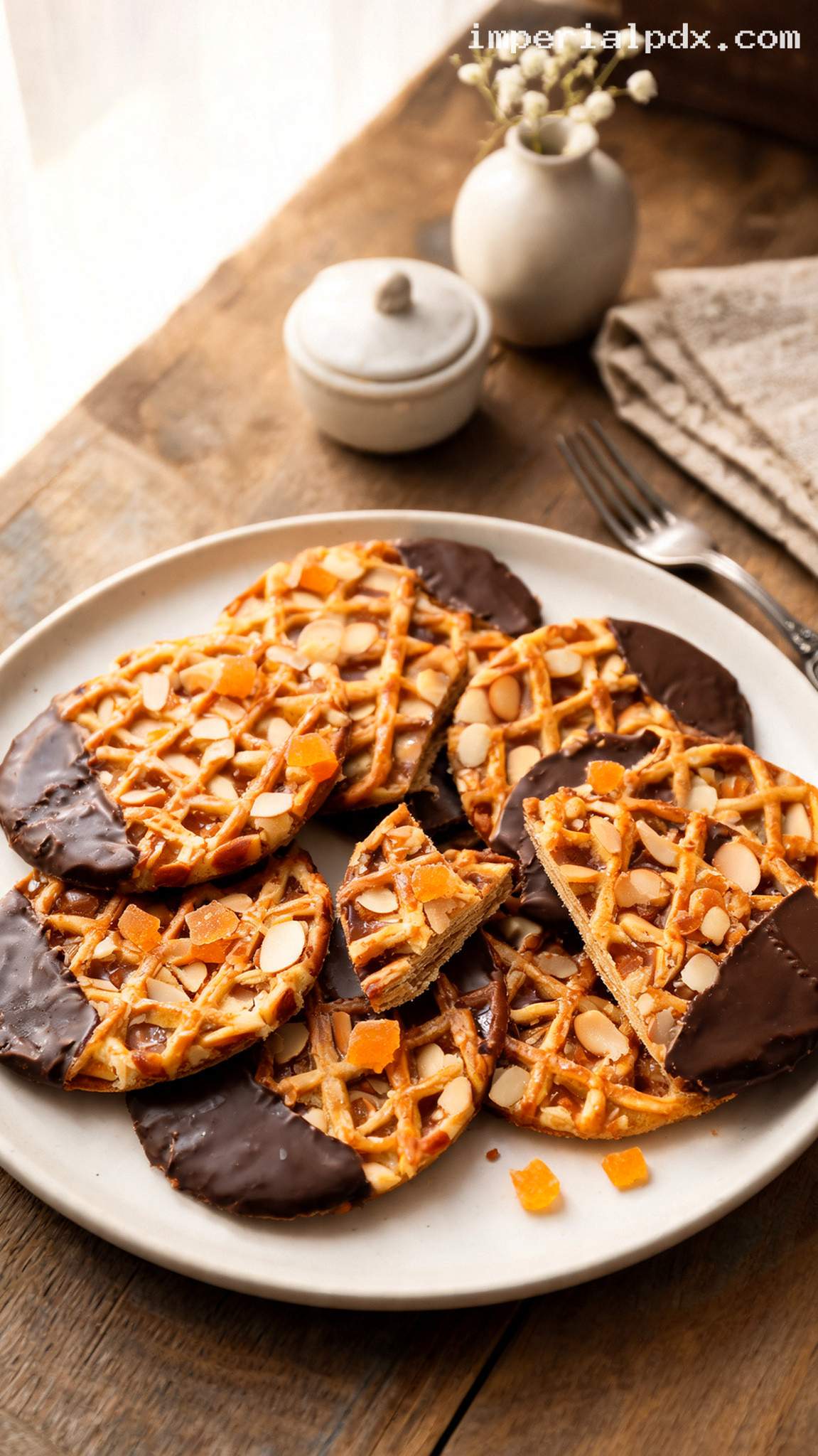
French Chocolate Florentines with Candied Orange are thin, crisp almond cookies held together with honey caramel and finished with dark chocolate. Little pieces of candied orange make them especially lovely for Christmas gifting.
Quick Ingredients
- 140 g sliced almonds, about 1 1/2 cups
- 100 g granulated sugar, 1/2 cup
- 42 g honey, 2 tablespoons
- 56 g unsalted butter, 4 tablespoons
- 60 ml heavy cream, 1/4 cup
- 60 g candied orange peel, finely diced, about 1/3 cup
- 1 teaspoon vanilla extract
- 1/4 teaspoon fine sea salt
- 170 g dark chocolate, 60–70% cacao, finely chopped
Do This
- 1. Toast the almonds at 325°F (165°C) for 8 minutes. Increase the oven to 350°F (175°C).
- 2. Cook the sugar, honey, butter, cream, and salt in a saucepan until the mixture reaches 245°F (118°C), about 7 minutes.
- 3. Remove from the heat and stir in the vanilla, toasted almonds, and finely diced candied orange peel.
- 4. Divide into 24 portions of approximately 22 g each. Bake 6 at a time on silicone-lined baking sheets, leaving at least 3 inches between mounds.
- 5. Bake each batch for 10 minutes, until bubbling and evenly golden amber. Cool on the sheet for 5 minutes before transferring to a rack.
- 6. Melt the chocolate, dip half of each completely cooled cookie, and let set on parchment for 30 minutes in a cool room.
Why You’ll Love This Recipe
- Beautifully crisp: Honey caramel spreads around sliced almonds to create delicate, lacy edges.
- A classic flavor pairing: Bittersweet chocolate balances the sweet caramel and fragrant candied orange.
- Naturally flourless: No flour or special gluten-free flour blend is needed.
- Made for sharing: These elegant cookies look wonderful on Christmas platters or tucked into gift boxes.
Grocery List
- Produce: No fresh produce needed; use prepared candied orange peel from the baking aisle.
- Dairy: Unsalted butter and heavy cream.
- Pantry: Sliced almonds, granulated sugar, honey, candied orange peel, vanilla extract, fine sea salt, and 60–70% dark chocolate.
Full Ingredients
For the Almond and Orange Florentines
- 140 g sliced almonds, about 1 1/2 cups; choose thin slices rather than slivered almonds.
- 100 g granulated sugar, 1/2 cup.
- 42 g honey, 2 tablespoons; a mild, floral honey works particularly well.
- 56 g unsalted butter, 4 tablespoons, cut into small pieces.
- 60 ml heavy cream, 1/4 cup, preferably 35–36% milk fat.
- 60 g candied orange peel, about 1/3 cup, chopped into pieces no larger than 1/8 inch. Use drained, dry candied peel rather than peel sitting in syrup.
- 1 teaspoon vanilla extract.
- 1/4 teaspoon fine sea salt.
For the Chocolate Finish
- 170 g dark chocolate, 6 ounces, 60–70% cacao, finely chopped. Use a chocolate bar or couverture rather than chocolate chips for the smoothest coating.
Step-by-Step Instructions
Step 1: Toast the almonds
Place a rack in the center of the oven and preheat to 325°F (165°C). Spread the almonds on a rimmed baking sheet and toast for 8 minutes, stirring after 4 minutes. They should smell nutty and look lightly golden, not deeply browned, because they will bake again in the cookies.
Transfer the almonds to a bowl. Increase the oven temperature to 350°F (175°C).
Step 2: Prepare the baking sheets and orange peel
Line two large, rimmed baking sheets, approximately 13 × 18 inches, with silicone baking mats. Good-quality baking parchment also works, although the cookies may spread slightly more. Do not bake directly on an unlined or merely greased sheet.
Finely dice the candied orange peel, separating any sticky clumps. Measure the remaining ingredients before starting the caramel, and have a heatproof spatula and a candy thermometer ready.
Step 3: Cook the honey caramel
Place the sugar, honey, butter, cream, and salt in a heavy-bottomed saucepan with a capacity of at least 2 quarts. Heat over medium-low heat, stirring gently, until the butter melts and the sugar dissolves.
Increase to medium heat and bring to a steady boil. Cook, stirring occasionally and checking with a candy thermometer, until the mixture reaches 245°F (118°C). Allow approximately 7 minutes total for melting and cooking, but use the temperature rather than the clock as your final guide. The mixture will bubble and foam, so keep a close watch and avoid touching or tasting the hot caramel.
Step 4: Stir in the almonds and portion the cookies
Remove the saucepan from the heat. Carefully stir in the vanilla; it may briefly bubble. Fold in the toasted almonds and diced candied orange peel until everything is evenly coated.
Let the mixture stand for 2 minutes, just until it thickens slightly. For each cookie, scoop approximately 22 g, or a rounded tablespoon, onto a prepared sheet. Aim for 24 portions in total. Arrange only 6 mounds per sheet, leaving at least 3 inches of clear space between them. Gently flatten each mound into a small disc with the back of a spoon.
Keep the remaining mixture in the saucepan off the heat. If it becomes too firm to scoop between batches, warm it over low heat for 20–30 seconds, stirring gently, just until pliable.
Step 5: Bake until lacy and golden
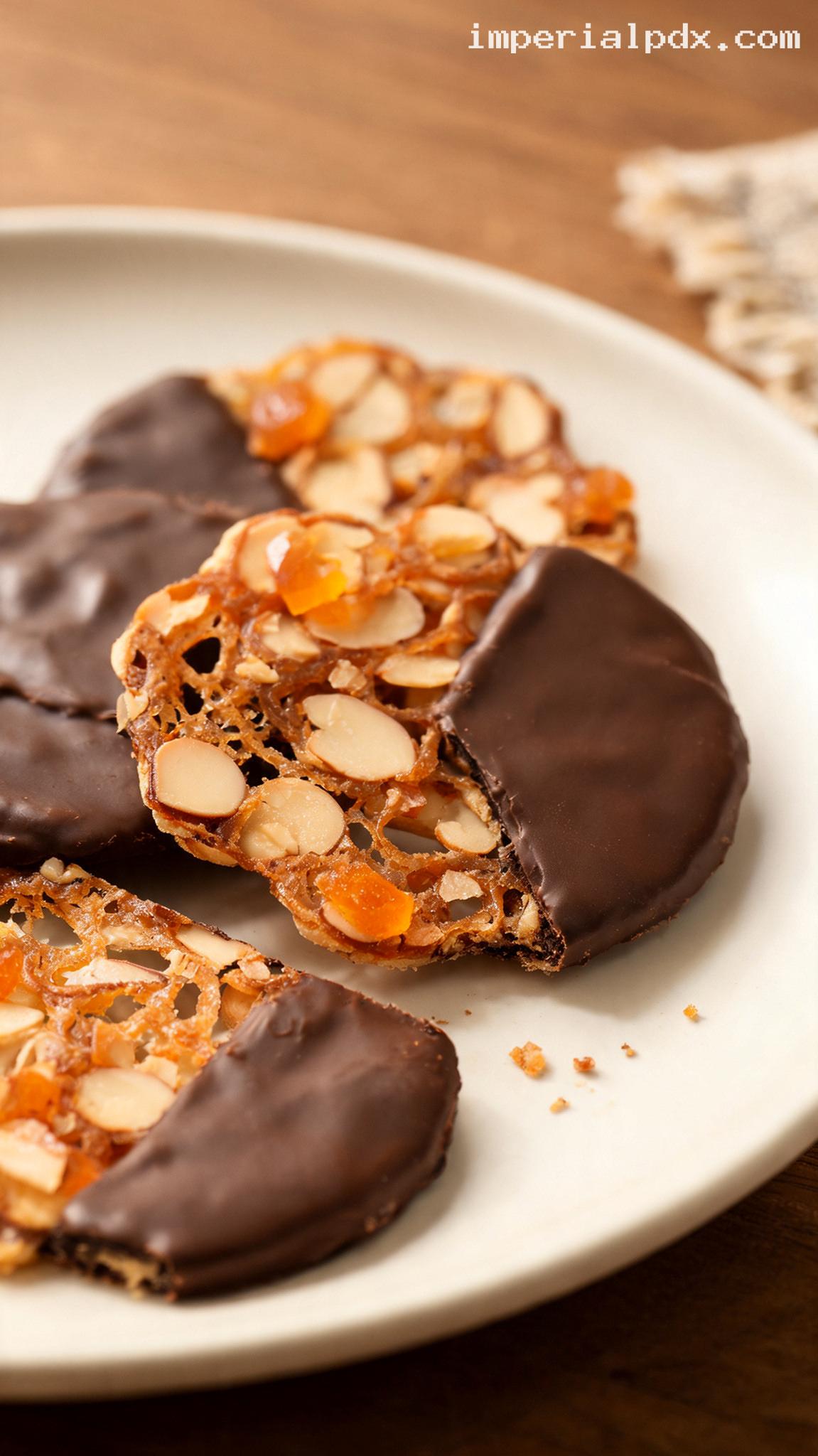
Bake one sheet at a time on the center rack for 10 minutes, rotating the sheet after 5 minutes. The cookies will spread, bubble, and develop a delicate network of caramel around the almonds. Look for golden-amber centers and slightly darker edges; pale centers can stay chewy rather than crisp.
If your oven runs hot, begin checking at 8 minutes. If the centers are still noticeably pale at 10 minutes, bake for another 1–2 minutes. Color is the best final cue.
For neater circles, wait 30–60 seconds after removing the sheet, then gently nudge any uneven edges inward with a small silicone spatula. Do not try to pick up the cookies while the caramel is still liquid.
Step 6: Cool and finish the remaining batches
Let each batch cool on its baking sheet for 5 minutes, until firm enough to lift without bending. Transfer carefully to a wire rack with a thin spatula and cool for at least 10 minutes, until completely cool and crisp.
Repeat with the remaining mixture, making four batches of 6 cookies. Always let a baking sheet cool completely before adding fresh portions; a hot sheet makes the mixture spread too quickly.
Step 7: Melt the dark chocolate
Place the chopped chocolate in a completely dry, microwave-safe bowl. Microwave at 50% power in 20-second intervals, stirring thoroughly after each interval. Stop heating when a few small pieces remain, then stir until smooth. Keep water and steam away from the chocolate.
For a shinier finish that stays firmer at room temperature, temper the chocolate instead: melt 115 g of the chocolate to 113–118°F (45–48°C), then remove from the heat and stir in the remaining 55 g. Continue stirring until the chocolate reaches 88–90°F (31–32°C) and is smooth. A thin test smear should begin setting within 3–5 minutes in a cool room. Follow the chocolate manufacturer’s tempering temperatures if provided.
Step 8: Dip, set, and serve
Dip half of each completely cooled Florentine into the melted chocolate, allowing excess chocolate to drip back into the bowl. Place on parchment paper. Alternatively, arrange the cookies on parchment and drizzle the chocolate over them in thin ribbons.
Leave undisturbed for approximately 30 minutes in a cool room, ideally 65–70°F (18–21°C), until the chocolate is firm. If your kitchen is warm, refrigerate for 10 minutes just to set the coating. Serve only after the chocolate has set so the delicate cookies are easy to handle.
Pro Tips
- Weigh the portions: Similar-sized mounds spread and brown more evenly. The gram measurements are especially useful for this delicate recipe.
- Keep the almonds sliced: Thin slices create the signature delicate texture. Thick slivered almonds make chunkier, less lacy cookies.
- Chop the orange finely: Large pieces can interrupt the thin caramel structure and create soft spots.
- Judge the bake by color: A properly baked Florentine is golden amber through the center. If the first batch stays chewy after cooling, bake later batches 1–2 minutes longer.
- Protect them from humidity: Let the cookies cool fully before packing, and keep them away from steam. For gluten-free gifting, verify that the chocolate and candied peel are labeled gluten-free.
Variations
- Pistachio and almond: Replace 35 g of the sliced almonds with 35 g unsalted, finely chopped pistachios. Toast only the almonds; stir the pistachios into the cooked caramel with the orange peel.
- Orange and ginger: Replace 30 g of the candied orange peel with 30 g finely diced crystallized ginger for a gently warming holiday version.
- Chocolate-backed Florentines: Instead of half-dipping, spread a thin layer of the melted chocolate over the flat underside of each cookie. Place chocolate-side up on a rack to set.
Storage & Make-Ahead
Store completely cooled, chocolate-set Florentines in an airtight container at cool room temperature for up to 5 days. Separate layers with parchment, and do not store them alongside soft cookies, which can transfer moisture and soften the caramel. They are crispest during the first 2–3 days.
For longer preparation ahead, freeze the baked, uncoated cookies in a rigid airtight container, with parchment between layers, for up to 1 month. Thaw completely in the closed container before opening, then add the chocolate. If uncoated cookies need refreshing, warm them at 300°F (150°C) for 3–4 minutes, then cool completely before dipping. Do not reheat chocolate-coated cookies.
For gift boxes, tempered chocolate is the best choice. Pack the cookies only after the coating is completely firm, and cushion them with food-safe paper because the lacy edges are fragile.
Nutrition (per serving)
Estimated values for 1 of 24 cookies, assuming all the chocolate is used. Actual values vary with the candied peel and chocolate selected.
Calories: 135 kcal | Carbs: 12g | Protein: 2g | Fat: 9g | Saturated Fat: 4g | Fiber: 1.5g | Sugar: 10g | Sodium: 26mg | Cholesterol: 8mg

