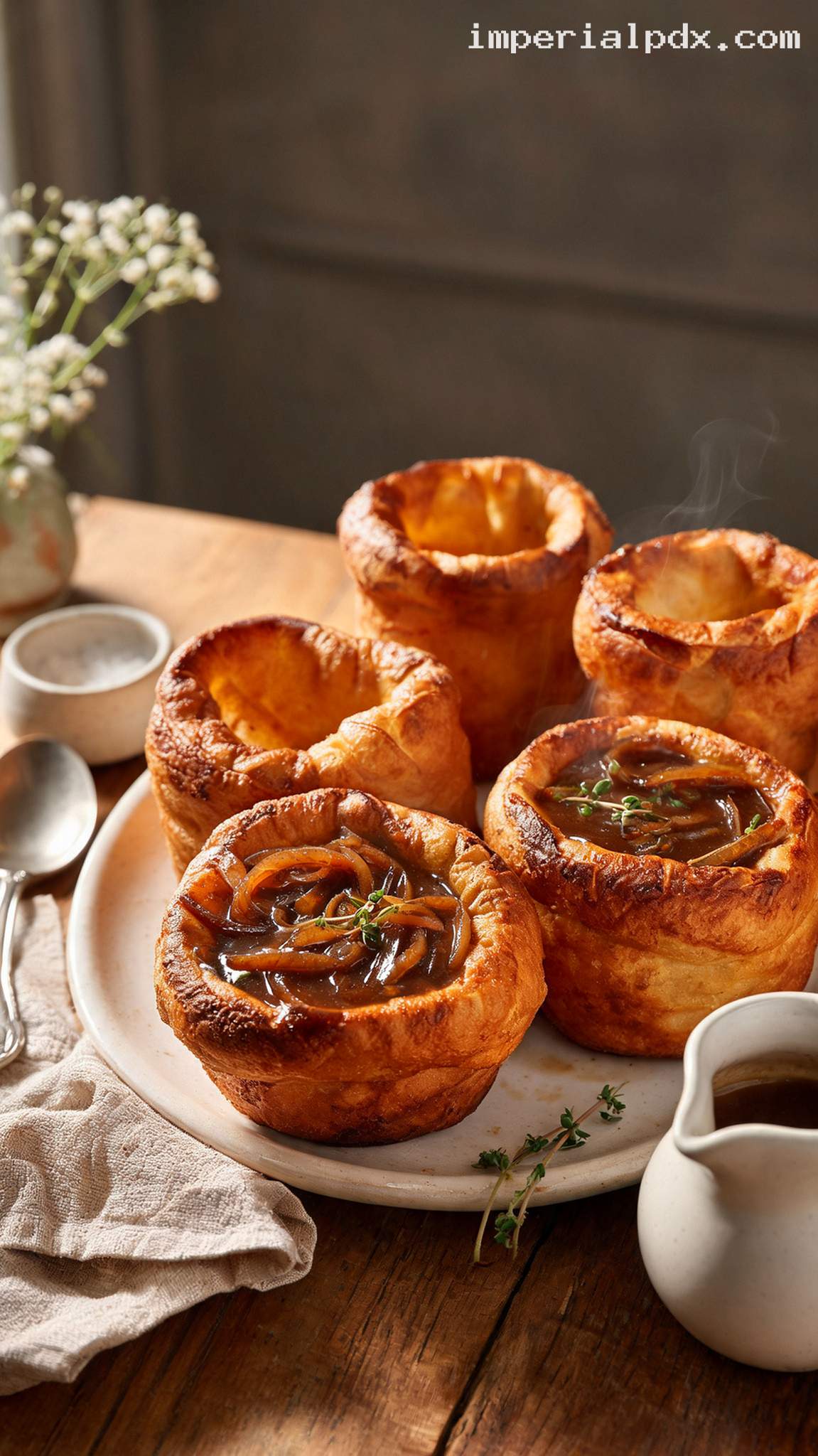
Quick Recipe Version (TL;DR)
Traditional Yorkshire Puddings with Rich Onion Gravy are all about crisp, golden edges, soft centers, and a generous spoonful of deeply savory gravy. The secret is simple: rested batter, sizzling beef drippings, and a properly hot oven.
Quick Ingredients
- Batter: 150 g plain all-purpose flour, 4 large eggs, 200 ml whole milk, and 1/2 teaspoon fine salt.
- For the tin: 60 ml melted beef drippings, divided into 12 portions of 1 teaspoon each.
- Gravy base: 30 g unsalted butter, 500 g yellow onions, thinly sliced, 1/4 teaspoon fine salt, 1/4 teaspoon freshly ground black pepper, and 20 g plain all-purpose flour.
- Gravy liquids and flavorings: 600 ml reduced-sodium beef stock, 15 ml Worcestershire sauce, 1 teaspoon Dijon mustard, 5 ml red wine vinegar, and 2 teaspoons fresh thyme leaves, divided.
Do This
- 1. Heat the oven to 220°C conventional / 200°C fan / 425°F. Prepare a standard 12-cup metal muffin tin.
- 2. Whisk the batter ingredients until smooth, then rest for 30 minutes while you start the gravy.
- 3. Cook the onions in the butter with the gravy salt over medium-low heat for 35 minutes, stirring regularly, until deeply golden.
- 4. During the final 12 minutes of batter resting, heat 1 teaspoon beef drippings in each muffin cup in the oven.
- 5. Briefly whisk the batter, divide it among the hot cups, and bake for 25 minutes. Keep the oven door closed for at least the first 22 minutes.
- 6. Meanwhile, stir the gravy flour into the onions and cook for 2 minutes. Gradually add the stock, Worcestershire sauce, mustard, pepper, and 1 teaspoon thyme; simmer for 12 minutes. Stir in the vinegar.
- 7. Serve the puddings immediately with the hot gravy and remaining 1 teaspoon thyme. Add gravy only at the table to keep the shells crisp.
Why You’ll Love This Recipe
- Big rise from everyday ingredients: Eggs, milk, flour, and salt turn into wonderfully puffed puddings without any baking powder.
- The classic texture: Sizzling beef drippings create crisp, deeply golden shells with tender centers.
- Gravy with real depth: Slowly browned onions, beef stock, and a little Worcestershire sauce deliver rich flavor without a packet mix.
- A manageable cooking rhythm: The batter rests and the puddings bake while the gravy cooks on the stove.
Grocery List
- Produce: 500 g yellow onions, approximately 3 medium onions; 1 small bunch fresh thyme.
- Dairy: 200 ml whole milk; 30 g unsalted butter.
- Eggs: 4 large eggs.
- Pantry: 170 g plain all-purpose flour in total; 600 ml reduced-sodium beef stock; Worcestershire sauce; Dijon mustard; red wine vinegar; fine salt; black pepper.
- Meat fats: 60 ml rendered beef drippings or beef tallow, measured when melted.
Full Ingredients
For the Yorkshire Puddings
- 150 g plain all-purpose flour, not self-raising flour
- 4 large eggs, approximately 200 g without shells
- 200 ml whole milk
- 1/2 teaspoon fine salt, approximately 3 g
- 60 ml melted beef drippings or beef tallow, equivalent to 4 tablespoons; use 1 teaspoon per muffin cup
For the Rich Onion Gravy
- 30 g unsalted butter
- 500 g yellow onions, peeled, halved, and thinly sliced from root to tip
- 1/4 teaspoon fine salt, approximately 1.5 g
- 1/4 teaspoon freshly ground black pepper
- 20 g plain all-purpose flour
- 600 ml reduced-sodium beef stock, preferably warm
- 15 ml Worcestershire sauce, equivalent to 1 tablespoon
- 1 teaspoon Dijon mustard, approximately 5 g
- 5 ml red wine vinegar, equivalent to 1 teaspoon
- 2 teaspoons fresh thyme leaves, divided: 1 teaspoon for the gravy and 1 teaspoon for serving
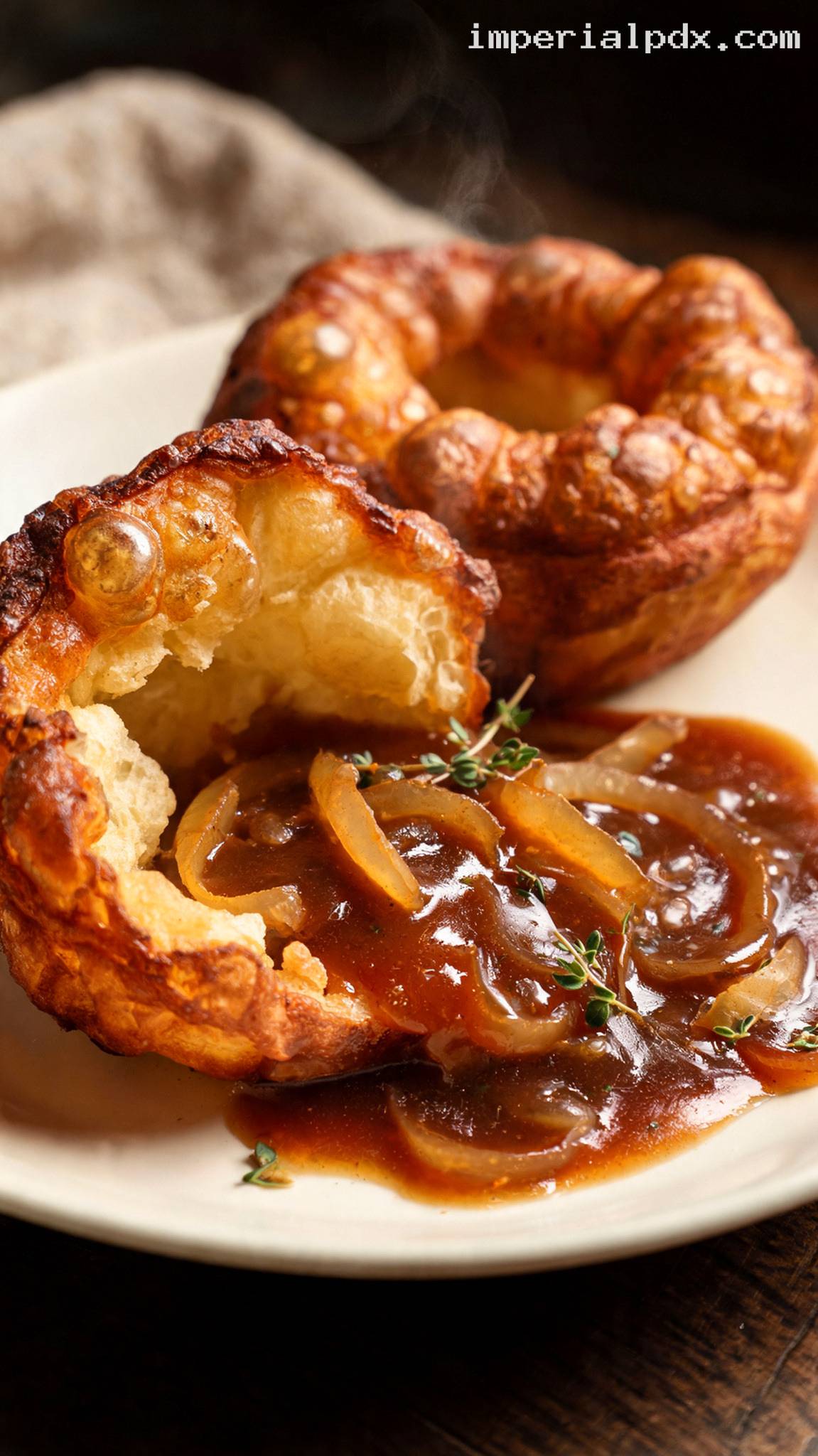
Step-by-Step Instructions
Step 1: Prepare the oven and ingredients
Heat the oven to 220°C conventional / 200°C fan / 425°F, with a rack in the middle and enough space above it for the puddings to rise. Use a standard, heavy metal 12-cup muffin tin with cups that hold approximately 80–100 ml each. Do not use paper liners or a silicone pan.
Slice the onions and measure the gravy ingredients before mixing the batter. Having everything ready makes it easy to cook the onions while the batter rests.
Step 2: Whisk and rest the batter
Put the 150 g flour and 1/2 teaspoon salt in a mixing bowl. Make a well in the center, add the eggs and about half the milk, and whisk from the middle outward until you have a smooth, thick batter. Gradually whisk in the remaining milk until completely combined.
Transfer the batter to a jug with a pouring spout and let it rest for 30 minutes at room temperature. It should be pourable, rather like single cream. Use this resting time to begin the onions and heat the beef drippings.
Step 3: Slowly caramelize the onions
Melt the butter in a wide, heavy frying pan or saucepan over medium heat. Add the sliced onions and 1/4 teaspoon salt, stir to coat, then reduce the heat to medium-low.
Cook uncovered for 35 minutes, stirring every 3–4 minutes and more frequently toward the end. The onions should become very soft and a deep golden brown, with no blackened edges. If browned bits begin sticking before the onions are ready, add 1 tablespoon water and scrape them up. Let that water evaporate before continuing.
Go by color as well as time: A crowded pan or especially watery onions may need another 5–10 minutes. Richly browned onions are what give this gravy its depth.
Step 4: Heat the beef drippings until sizzling
During the final 12 minutes of the batter’s resting time, put 1 teaspoon melted beef drippings into each muffin cup. Place the tin in the preheated oven for the full 12 minutes.
The fat must be extremely hot before the batter goes in; it should shimmer and give an immediate sizzle on contact. A slight wisp of smoke can occur, but heavy smoking means the fat is overheating. Keep the room ventilated and never leave the heating tin unattended.
Step 5: Fill the hot tin and bake
Give the rested batter a brief whisk to recombine it. Carefully remove the hot tin using dry oven gloves and place it on a stable, heatproof surface. Pour the batter evenly into the 12 cups, approximately 40–45 ml per cup, aiming for no more than halfway up each cup. Work promptly and pour close to the cups to minimize splashing.
Immediately return the tin to the oven and bake for 25 minutes. Do not open the door during the first 22 minutes. The puddings should rise dramatically, with deep golden-brown rims and sides that look dry and set. If they are still pale at 25 minutes, bake for another 2–3 minutes; underbaked shells are more likely to collapse.
Step 6: Finish the rich onion gravy
While the puddings bake, finish the gravy once the onions are deeply golden. Sprinkle the 20 g flour over the onions and cook, stirring, for 2 minutes. Gradually stir in the warm beef stock, adding a little at first and scraping the bottom of the pan to release the browned bits.
Stir in the Worcestershire sauce, Dijon mustard, black pepper, and 1 teaspoon thyme leaves. Bring to a gentle simmer over medium heat, then reduce to medium-low and simmer uncovered for 12 minutes, stirring occasionally. The gravy should be glossy and thick enough to lightly coat the back of a spoon.
Stir in the red wine vinegar. Taste before adding any extra salt, as stock and Worcestershire sauce vary in saltiness. If the gravy is thicker than you like, stir in hot water 1 tablespoon at a time. Keep it hot over the lowest heat until the puddings are ready.
Step 7: Serve straight from the oven
Lift the Yorkshire puddings from the tin with tongs or a small offset spatula and serve immediately. Allow 2 puddings per person, with one-sixth of the onion gravy.
Scatter the remaining 1 teaspoon thyme over the gravy. Serve it in a warmed jug or spoon a little into the hollows just before eating. Keep most of the gravy alongside so the crisp edges stay crisp. A little settling after the puddings leave the oven is perfectly normal.
Pro Tips
- Use clear, rendered fat: Beef drippings should be free of watery meat juices, which can spit in the hot oven and interfere with crisping.
- Give the batter its full rest: This allows the flour to hydrate and helps produce a tender center. Whisk briefly before pouring, rather than beating in lots of foam.
- Metal and heat matter: A sturdy metal tin transfers heat quickly. Avoid overfilling the cups, which can leave the centers heavy before the outside sets.
- Keep the oven door shut: Steam lifts the batter, and steady oven heat helps the structure set before it can sink.
- Do not rush the onions: Browning them gently creates sweetness and savory depth without added sugar. Turn the heat down if their edges darken too quickly.
Variations
- Vegetarian version: Replace the beef drippings with 60 ml refined sunflower or rapeseed oil, use a rich vegetable or mushroom stock, and choose vegetarian Worcestershire sauce. Keep the butter, milk, and eggs as written.
- Duck-fat puddings: Use 60 ml melted duck fat instead of beef drippings for a similarly crisp result with a slightly different savory flavor.
- Red wine onion gravy: After cooking the flour into the onions, add 100 ml dry red wine and simmer for 3 minutes. Add 500 ml beef stock instead of 600 ml, then continue as directed. Omit the vinegar initially and add it only if the finished gravy needs more acidity.
Storage & Make-Ahead
Batter: Make it up to 24 hours ahead and refrigerate in a covered jug. Remove it from the refrigerator 30 minutes before baking and whisk briefly before using. Do not leave raw egg batter at room temperature for more than 2 hours in total.
Onion gravy: Make up to 3 days ahead, cool promptly, and refrigerate in a covered container within 2 hours of cooking. Reheat in a saucepan until bubbling throughout and at least 74°C / 165°F, stirring often and adding a splash of water if needed. Freeze for up to 3 months and thaw overnight in the refrigerator.
Baked puddings: They are best freshly baked, but leftovers can be refrigerated for up to 3 days or frozen for up to 2 months. Cool on a wire rack before storing, and refrigerate within 2 hours. Reheat on a baking tray at 200°C conventional / 180°C fan / 390°F for 6–8 minutes from chilled or 10–12 minutes from frozen, until hot and crisp. Avoid microwaving, which makes them soft and chewy.
Nutrition (per serving)
Estimated for 2 Yorkshire puddings and one-sixth of the gravy, using reduced-sodium beef stock. Actual values vary with the stock used and how much fat remains in the tin.
Calories: 335 kcal | Carbs: 33g | Protein: 10g | Fat: 18g | Saturated Fat: 9g | Fiber: 2g | Sugar: 7g | Sodium: 650mg | Cholesterol: 150mg


