Quick Recipe Version (TL;DR)
Quick Ingredients
- Soaked fruit: 200 g dark raisins, 100 g golden raisins, and 60 ml dark rum
- Dough base: 500 g all-purpose flour, 75 g granulated sugar, 7 g instant yeast, and 8 g fine salt
- Spices and zest: 1 teaspoon ground cinnamon, 1/2 teaspoon ground cardamom, 1/4 teaspoon ground nutmeg, 2 teaspoons finely grated orange zest, and 1 teaspoon finely grated lemon zest
- Wet ingredients: 200 ml whole milk, 1 large egg, and 1 teaspoon vanilla extract
- Butter: 200 g unsalted butter, softened, plus 75 g unsalted butter, melted, for coating
- Mix-ins and center: 100 g mixed candied orange and lemon peel, 75 g slivered almonds, and 200 g marzipan
- Sugar coating: 25 g granulated sugar and 100 g powdered sugar, divided
Do This
- 1. Cover the raisins with the rum and soak for 12 hours, stirring occasionally. Drain any unabsorbed liquid.
- 2. Mix the flour, dough sugar, yeast, salt, spices, and zest. Add milk warmed to 105°F (40°C), the egg, and vanilla. Knead, then gradually work in 200 g softened butter.
- 3. Gently incorporate the raisins, candied peel, and almonds. Cover and let rise for 2 hours at 75–78°F (24–26°C), until noticeably puffy.
- 4. Divide into 2 pieces. Shape each into an oval, add a 100 g marzipan log, and fold the dough over it. Cover and proof for 1 hour.
- 5. Bake on a parchment-lined sheet at 350°F (175°C), conventional oven, for about 55 minutes, until golden and the bread reaches 200°F (93°C).
- 6. After 10 minutes, brush with 75 g melted butter and sprinkle with 25 g granulated sugar. Cool completely, allowing 3 hours total cooling time, then dust with 50 g powdered sugar.
- 7. Slice once cool, or wrap and rest for 24–48 hours for fuller flavor. Dust with the remaining 50 g powdered sugar before serving.
Why You’ll Love This Recipe
- Wonderful Christmas flavor: Rum-soaked raisins, fragrant citrus peel, almonds, and warm spices make every slice feel festive.
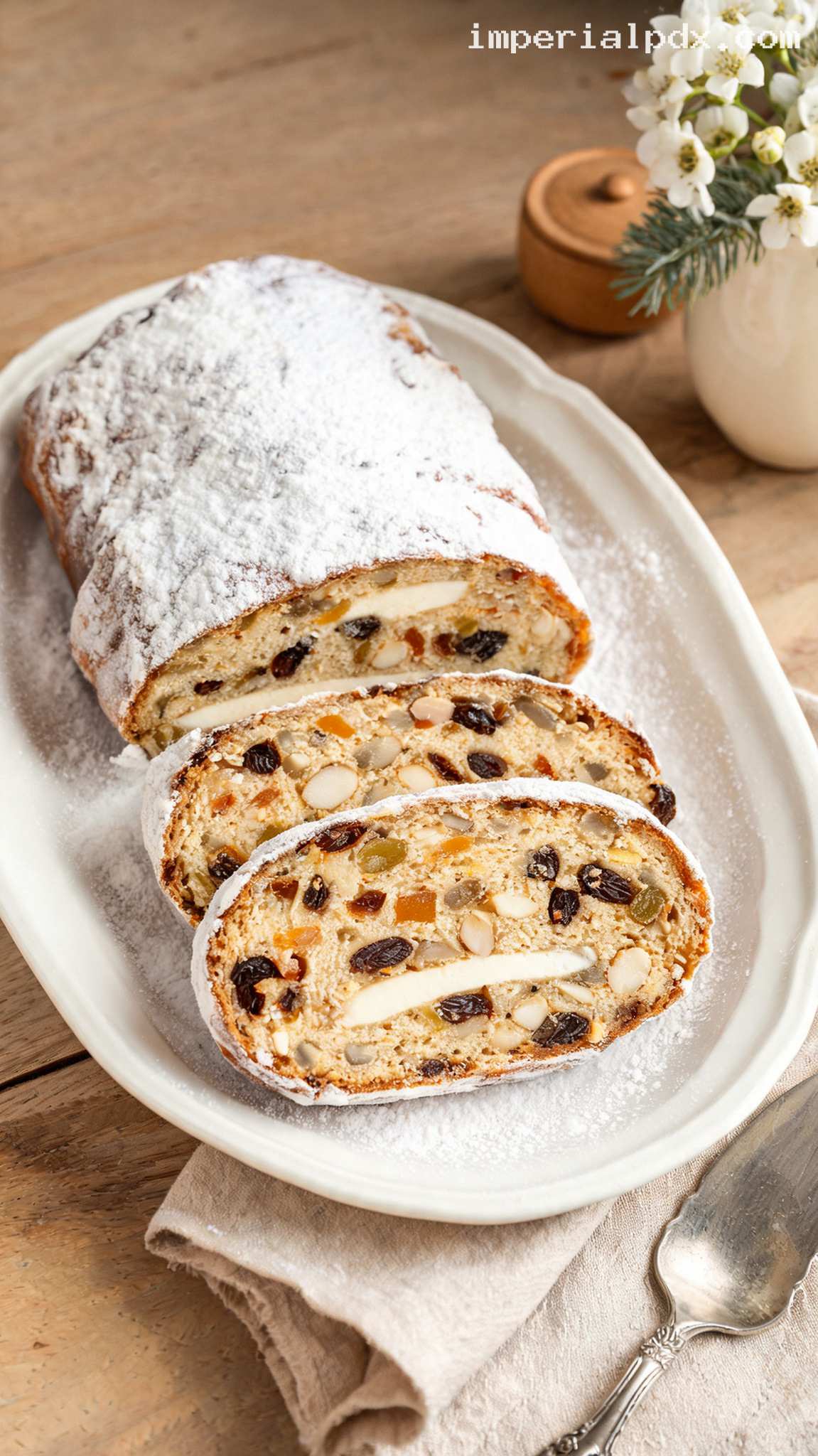
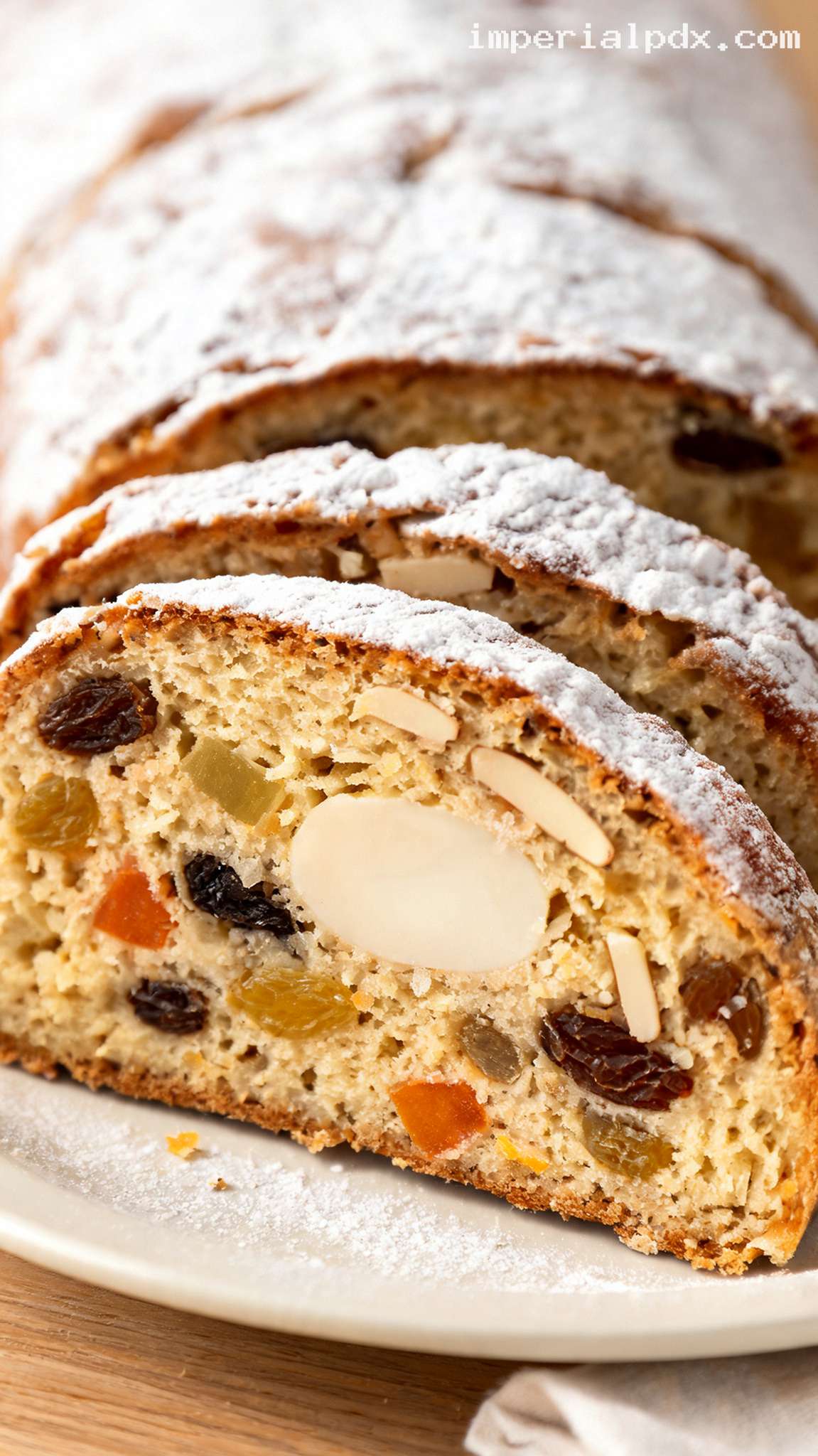
- A tender, buttery crumb: This traditional-style fruit bread is rich and close-textured, with a soft marzipan ribbon through the center.
- Perfect for making ahead: A day or two of resting lets the fruit, butter, and spices settle into a beautifully rounded flavor.
- Made for sharing: The recipe makes two loaves, so you can keep one and wrap the other as a homemade gift.
Grocery List
- Produce: 1 orange and 1 lemon, preferably unwaxed, for the zest
- Dairy: 275 g unsalted butter and 200 ml whole milk
- Eggs: 1 large egg
- Pantry: All-purpose flour, instant yeast, granulated sugar, powdered sugar, fine salt, dark raisins, golden raisins, candied orange and lemon peel, slivered almonds, marzipan, dark rum, vanilla extract, ground cinnamon, ground cardamom, and ground nutmeg
Full Ingredients
For the most reliable results, weigh the flour, butter, fruit, and marzipan. The marzipan center is included in this version, but you can leave it out if you prefer.
For the Rum-Soaked Fruit
- 200 g dark raisins
- 100 g golden raisins
- 60 ml dark rum
For the Dough
- 500 g all-purpose flour, plus 10 g for lightly dusting the work surface if needed
- 75 g granulated sugar
- 7 g instant yeast, about 2 1/4 teaspoons
- 8 g fine salt
- 1 teaspoon ground cinnamon
- 1/2 teaspoon ground cardamom
- 1/4 teaspoon ground nutmeg
- 2 teaspoons finely grated orange zest
- 1 teaspoon finely grated lemon zest
- 200 ml whole milk, warmed to 105°F (40°C)
- 1 large egg, about 50 g without the shell, at room temperature
- 1 teaspoon vanilla extract
- 200 g unsalted butter, softened to 68–72°F (20–22°C), cut into small pieces
For the Mix-Ins and Marzipan Center
- 100 g mixed candied orange and lemon peel, cut into small pieces
- 75 g slivered almonds
- 200 g marzipan, divided into two 100 g pieces; use ready-to-eat marzipan rather than almond paste
For the Butter and Sugar Coating
- 75 g unsalted butter, melted
- 25 g granulated sugar
- 100 g powdered sugar, divided into two 50 g portions
Step-by-Step Instructions
Step 1: Soak the raisins
Place the dark raisins and golden raisins in a bowl or lidded container. Pour over the 60 ml rum, stir well, and cover. Leave at a cool room temperature for 12 hours, stirring once or twice so the fruit absorbs the rum evenly. If your kitchen is warm, refrigerate the fruit instead and take it out 1 hour before mixing the dough.
Before using, drain any liquid that has not been absorbed. The raisins should be plump and moist, but they should not carry a puddle of rum into the dough.
Step 2: Mix the dough base
In the bowl of a stand mixer, combine the 500 g flour, 75 g granulated sugar, instant yeast, salt, cinnamon, cardamom, nutmeg, orange zest, and lemon zest. Add the milk warmed to 105°F (40°C), the egg, and vanilla.
Using the dough hook, mix on low speed until no dry flour remains, then knead on low to medium-low speed for 5 minutes. The dough will be fairly firm at this stage. You can also mix and knead by hand, allowing a few extra minutes.
Step 3: Add the butter and fruit, then let the dough rise
With the mixer running on low, add the 200 g softened butter a few pieces at a time, letting each addition begin to blend in before adding more. Continue kneading for 8–10 minutes, until the dough is cohesive, supple, and no longer looks greasy. It may briefly look broken as the butter goes in; keep mixing rather than adding extra flour.
Add the drained raisins, candied peel, and slivered almonds. Mix on the lowest speed for 1–2 minutes, just until distributed, or gently knead them in by hand. If necessary, finish with a few folds on a lightly floured surface.
Place the dough in a large bowl, cover, and leave at 75–78°F (24–26°C) for 2 hours. Look for a noticeably puffier dough with roughly a 50% increase in volume; this heavy, fruit-filled dough does not need to double. Rising times are estimates, so give it longer if it still looks dense and unchanged.
Step 4: Shape the loaves around the marzipan
Line an 18-by-13-inch (46-by-33-cm) rimmed baking sheet with parchment paper. Divide the dough into 2 equal pieces. Roll each 100 g portion of marzipan into a log about 8 inches (20 cm) long.
On a lightly floured surface, pat each piece of dough into an oval about 10 inches long and 7 inches wide (25 by 18 cm). Place a marzipan log lengthwise slightly off-center, leaving dough at both ends to enclose it.
Fold one long side over the marzipan, stopping about 3/4 inch (2 cm) short of the opposite edge to create the characteristic uneven stollen ridge. Press the folded edge firmly into the dough beneath it and pinch the ends closed so the marzipan is fully enclosed. Transfer to the baking sheet, leaving at least 3 inches (8 cm) between the loaves.
Step 5: Give the loaves their final rise
Cover the loaves loosely with lightly greased plastic wrap or a clean cover that will not stick to the dough. Let rise at 75–78°F (24–26°C) for 1 hour. They should look slightly fuller and feel lighter, but they will not become dramatically inflated.
During the final 20 minutes of rising, preheat a conventional oven to 350°F (175°C), with a rack in the middle. Remove the cover before baking.
Step 6: Bake until golden and cooked through
Bake both loaves on the middle rack for about 55 minutes. Check after 35 minutes and loosely tent with aluminum foil if the tops are already well browned. Rotate the baking sheet after 40 minutes if your oven browns unevenly.
Begin checking doneness after 45 minutes. The loaves should be golden brown, feel set at the sides, and register 200°F (93°C) in the bread portion of the center. Insert the thermometer from the side and avoid the marzipan log or a large pocket of fruit. Remove each loaf when it reaches temperature rather than relying on color alone.
Step 7: Brush with butter and apply the first sugar coating
Transfer the loaves to a wire rack set over a tray and let stand for 10 minutes. While they are still warm, brush the tops, sides, and accessible undersides with the 75 g melted butter, dividing it evenly between the loaves. Apply it in several passes so the crust can absorb it.
Sprinkle the loaves evenly with the 25 g granulated sugar. Leave on the rack until completely cool, allowing about 3 hours total cooling time after baking. Once cool, sift 50 g powdered sugar over the tops and sides. Do not wrap warm stollen, as trapped steam can make the coating damp and sticky.
Step 8: Rest, dust again, and serve
You can serve the stollen once it is completely cool, but the flavor improves if you wrap each loaf in parchment followed by foil and let it rest for 24–48 hours in a cool, dry place. This optional resting time is not included in the total recipe time.
Before serving, sift the remaining 50 g powdered sugar over the loaves for a generous snowy finish. Cut each loaf into 12 slices with a serrated knife. Serve at room temperature with coffee or tea.
Pro Tips
- Expect a rich, close-textured bread: Stollen is not meant to be as airy as sandwich bread or brioche. A sturdy crumb helps support all that fruit and marzipan.
- Keep the butter soft, not melted: Softened butter incorporates into the dough gradually; melted butter can make it greasy and harder to develop.
- Let the dough guide the clock: Butter, sugar, and fruit slow fermentation. If your kitchen is cool, extend the rise until the dough is visibly puffy rather than forcing the schedule.
- Use flour sparingly: A bench scraper is helpful for handling the buttery dough. Adding lots of extra flour can make the finished loaves dry.
- Be generous with the coating: The warm butter, thin granulated sugar layer, and powdered sugar finish are part of stollen’s signature flavor and texture.
Variations
- Without rum: Replace the 60 ml rum with 60 ml orange juice. Soak the raisins in the refrigerator for 12 hours, then drain well. Rum does not necessarily evaporate completely during baking, so use this version when avoiding alcohol.
- Without marzipan: Omit the 200 g marzipan and shape the same folded loaves without a filling. Begin checking the internal temperature after 40 minutes because the smaller loaves may finish sooner.
- Cranberry-orange stollen: Replace the 100 g golden raisins with 100 g dried cranberries and use 100 g candied orange peel instead of the mixed peel. Keep the other ingredients and method unchanged.
Storage & Make-Ahead
Room temperature: Once completely cool, wrap each loaf in parchment and foil, then place in an airtight container. Store in a cool, dry place for up to 1 week. Slice only what you need to help keep the rest moist.
Refrigerator: For longer storage, refrigerate the well-wrapped loaves for up to 2 weeks. Bring slices to room temperature before serving for the best texture.
Freezer: Freeze a whole loaf or individually wrapped slices in a freezer bag for up to 3 months. Thaw while still wrapped, then refresh with a light dusting of powdered sugar.
Make-ahead plan: Soak the fruit the evening before baking. Bake the loaves the next day, cool completely, and wrap. For gifting or a holiday breakfast, aim to bake 1–2 days before serving.
Nutrition (per serving)
Estimated for 1 of 24 slices, including the marzipan and full butter-sugar coating. Values vary with the candied peel, marzipan, and amount of rum retained.
Calories: 310 kcal | Carbs: 48g | Protein: 4g | Fat: 13g | Saturated Fat: 6g | Fiber: 2g | Sugar: 27g | Sodium: 145mg | Cholesterol: 33mg