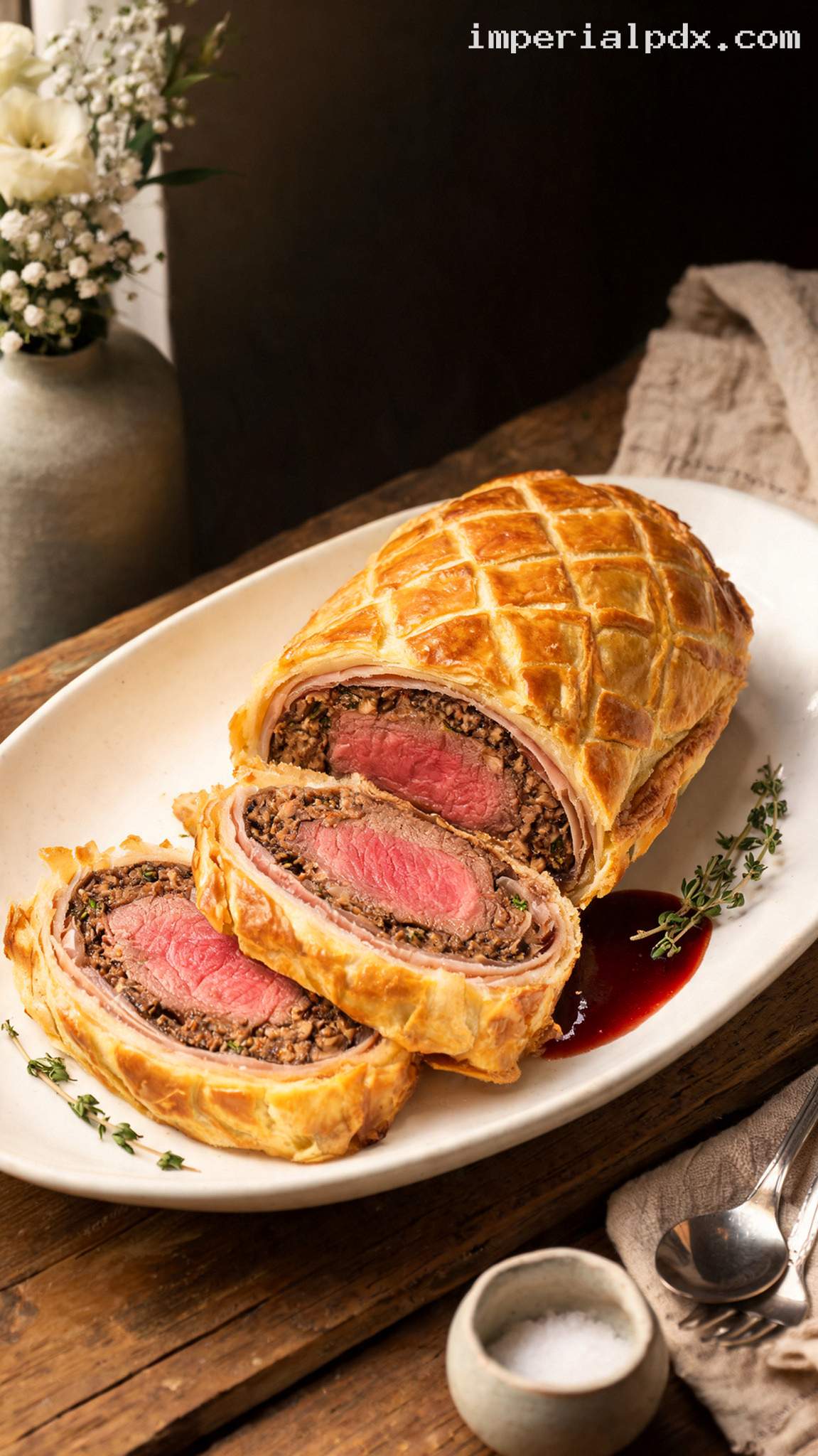
Quick Recipe Version (TL;DR)
Quick Ingredients
- Beef: 2 1/2 pounds (1.13 kg) center-cut beef tenderloin, trimmed; 1 tablespoon olive oil; 2 tablespoons Dijon mustard; 1 teaspoon fine sea salt; 1/2 teaspoon ground black pepper.
- Mushroom duxelles: 1 1/2 pounds (680 g) cremini mushrooms, 1 medium shallot (60 g), 2 garlic cloves, 2 tablespoons unsalted butter, 2 teaspoons fresh thyme leaves, 1/2 teaspoon fine sea salt, and 1/4 teaspoon ground black pepper.
- Wrapping: 10 thin slices prosciutto, about 5 ounces (150 g); 1.1 pounds (500 g) all-butter puff pastry, thawed but cold; 1 tablespoon all-purpose flour; 1 large egg beaten with 1 tablespoon water.
- Red-wine sauce: 3 tablespoons unsalted butter, divided; 1 small shallot (40 g), finely chopped; 1 1/2 cups (360 ml) dry red wine; 2 cups (480 ml) low-sodium beef stock; 2 thyme sprigs; 1 bay leaf; 1/2 teaspoon fine sea salt; 1/4 teaspoon ground black pepper.
- Optional garnish: 4 small fresh thyme sprigs.
Do This
- 1. Season the beef, sear in hot olive oil for 6 minutes total, brush with Dijon, and refrigerate until completely cool.
- 2. Finely chop the mushrooms. Cook the duxelles ingredients for approximately 29 minutes, until very dry, then chill for 20 minutes.
- 3. Spread the duxelles over overlapping prosciutto, wrap tightly around the beef using plastic wrap, and refrigerate for 30 minutes.
- 4. Remove the plastic, enclose the beef in puff pastry, seal, and brush with egg wash. Chill for 25 minutes while heating the oven and a heavy baking sheet to 400°F (200°C).
- 5. Make the sauce: soften the shallot in 1 tablespoon butter, reduce the wine, add stock and herbs, and reduce again. Strain and finish with the remaining 2 tablespoons butter.
- 6. Bake for approximately 40–50 minutes, checking the center with a thermometer. For a medium-rare result, remove at 130°F (54°C); see the food-safety guidance below. Rest uncovered for 15 minutes, slice, and serve with sauce alongside.
Why You’ll Love This Recipe
- A true holiday centerpiece: Golden pastry, delicate prosciutto, savory mushrooms, and tender beef make every slice feel special.
- Clear, manageable stages: Chilling breaks give you time to tidy up, prepare the sauce, and organize your Christmas sides.
- Big flavor without complicated ingredients: Dijon, thyme, browned mushrooms, and a buttery red-wine reduction do the heavy lifting.
- Helpful checks along the way: Dry mushrooms, cold pastry, and a meat thermometer make this impressive dish much more approachable.
Grocery List
- Meat: One 2 1/2-pound center-cut beef tenderloin, trimmed, and 5 ounces thinly sliced prosciutto.
- Produce: 1 1/2 pounds cremini mushrooms, 2 shallots totaling approximately 100 g, 2 garlic cloves, and 1 small bunch fresh thyme.
- Dairy: 5 tablespoons unsalted butter.
- Eggs: 1 large egg.
- Frozen or Refrigerated Pastry: 1.1 pounds all-butter puff pastry; check the package weight because sheet sizes vary.
- Pantry: Olive oil, Dijon mustard, all-purpose flour, fine sea salt, ground black pepper, 2 cups low-sodium beef stock, and 1 bay leaf.
- Wine: 1 1/2 cups dry red wine, such as Cabernet Sauvignon or Merlot.
Full Ingredients
For the Beef
- 1 center-cut beef tenderloin, 2 1/2 pounds (1.13 kg), trimmed of silverskin and excess fat, approximately 8–9 inches (20–23 cm) long
- 1 teaspoon fine sea salt (6 g)
- 1/2 teaspoon freshly ground black pepper
- 1 tablespoon olive oil (15 ml)
- 2 tablespoons Dijon mustard (30 g)
For the Mushroom Duxelles
- 1 1/2 pounds cremini mushrooms (680 g), wiped clean and very finely chopped
- 2 tablespoons unsalted butter (28 g)
- 1 medium shallot (60 g), finely chopped
- 2 garlic cloves (6 g), minced
- 2 teaspoons fresh thyme leaves, finely chopped
- 1/2 teaspoon fine sea salt (3 g)
- 1/4 teaspoon freshly ground black pepper
For the Pastry Wrapping
- 10 thin slices prosciutto, approximately 5 ounces (150 g)
- 1.1 pounds all-butter puff pastry (500 g), thawed according to the package instructions but kept cold
- 1 tablespoon all-purpose flour (8 g), for rolling
- 1 large egg
- 1 tablespoon water (15 ml)
For the Red-Wine Sauce
- 3 tablespoons unsalted butter (42 g), divided into 1 tablespoon for cooking and 2 tablespoons cold butter for finishing
- 1 small shallot (40 g), finely chopped
- 1 1/2 cups dry red wine (360 ml)
- 2 cups low-sodium beef stock (480 ml)
- 2 fresh thyme sprigs
- 1 bay leaf
- 1/2 teaspoon fine sea salt (3 g), or less if your stock is already salty
- 1/4 teaspoon freshly ground black pepper
For Serving
- 4 small fresh thyme sprigs, optional
Step-by-Step Instructions
Step 1: Shape, season, and sear the beef
Pat the tenderloin thoroughly dry. If it is uneven, tie it at 1-inch (2.5 cm) intervals with kitchen twine to create a compact cylinder. Season all over with 1 teaspoon salt and 1/2 teaspoon pepper.
Heat the olive oil in a large, heavy skillet over medium-high heat until shimmering. Sear the beef for approximately 6 minutes total: about 1 minute on each of four long sides and 1 minute on each end. You want a browned exterior, not a cooked center.
Transfer to a rack set over a plate or tray, remove all twine, and brush the warm beef with Dijon mustard. Refrigerate for at least 20 minutes, and until the outside is completely cool, while you prepare the mushrooms.
Step 2: Cook the mushroom duxelles until dry
Finely chop the mushrooms by hand or pulse them in a food processor in batches. Aim for tiny, even pieces rather than a wet purée.
Melt 2 tablespoons butter in a wide, 12-inch (30 cm) skillet over medium heat. Add the medium shallot and cook for 3 minutes. Stir in the garlic and cook for 1 minute. Add the mushrooms, chopped thyme, 1/2 teaspoon salt, and 1/4 teaspoon pepper.
Increase the heat to medium-high and cook for approximately 25 minutes, stirring frequently and scraping the bottom of the pan. The mushrooms will release plenty of liquid before becoming a concentrated, spreadable mixture. They are ready when no liquid collects in the pan and a spatula dragged through the mixture leaves a dry trail. If moisture remains, continue cooking; dryness matters more than the clock.
Step 3: Cool the filling and wrap the beef in prosciutto
Spread the duxelles in a thin layer on a shallow tray and refrigerate for 20 minutes, or until completely cool. Do not assemble the Wellington with warm beef or warm mushrooms.
Lay two overlapping sheets of food-safe plastic wrap on the counter. Arrange the prosciutto in a slightly overlapping rectangle large enough to surround the beef, approximately 12 by 14 inches (30 by 35 cm). Spread the cooled duxelles evenly over it, leaving a 1/2-inch (1 cm) border.
Place the chilled beef along the edge nearest you. Using the plastic wrap to help lift and tighten the layers, roll the prosciutto and mushrooms around the beef. Keep the plastic outside the food. Twist the ends of the plastic to make a snug cylinder and refrigerate for 30 minutes.
Step 4: Enclose the beef in puff pastry
Lightly flour the counter with the measured flour. Roll the cold pastry into a rectangle approximately 14 by 16 inches (35 by 40 cm), about 1/8 inch (3 mm) thick. If using two sheets, overlap their edges by 1/2 inch (1 cm), brush the join lightly with water, and roll gently to seal.
Beat the egg with 1 tablespoon water. Remove and discard every piece of plastic wrap from the beef. Place the beef on the pastry and check the fit before sealing: you need enough pastry to wrap around it with approximately 1 inch (2.5 cm) of overlap and enough at each end to close neatly. Trim away excess rather than creating thick, doughy folds.
Brush the joining edges with egg wash, wrap the pastry around the beef, and press the seam closed. Fold and seal the ends, then place seam-side down on a piece of baking parchment. Brush the top and sides lightly with egg wash.
Step 5: Chill the Wellington and preheat the oven
Refrigerate the pastry-wrapped Wellington for 25 minutes. Meanwhile, place a heavy, rimmed baking sheet on the middle oven rack and preheat the oven to 400°F (200°C) for at least 20 minutes.
Before baking, brush the Wellington with a second thin coat of egg wash. Use the back of a knife to make a shallow crosshatch pattern, marking only the surface rather than cutting through the pastry. Cut two small steam vents in the top. Keep egg wash from pooling underneath, where it can stick the pastry to the parchment.
Step 6: Make the red-wine sauce
Start the sauce during the final chilling period. Melt 1 tablespoon butter in a medium saucepan over medium heat. Add the small shallot and cook for 3 minutes, stirring, until softened but not browned.
Add the red wine and bring to a lively simmer. Cook for 7–10 minutes, until reduced from 1 1/2 cups to approximately 1/2 cup (120 ml). Add the beef stock, thyme sprigs, and bay leaf. Simmer for another 12–15 minutes, until reduced to approximately 1 1/4 cups (300 ml). Use the volume as your guide; a narrow saucepan may take longer.
Strain into a clean small saucepan, discarding the solids. Keep warm over very low heat. Just before serving, remove from the heat and whisk in the remaining 2 tablespoons cold butter. Add the pepper and up to 1/2 teaspoon salt, tasting first because reduced stock can be salty. The finished sauce should be glossy and lightly coat a spoon; do not boil after adding the butter.
Step 7: Bake until golden and check the center
Carefully slide the Wellington, still on its parchment, onto the hot baking sheet. Bake for approximately 40–50 minutes, until the pastry is deeply golden and crisp. Begin checking the beef after 30 minutes by inserting an instant-read thermometer horizontally through one end into the center of the meat.
For a medium-rare result: Remove the Wellington when the center reaches 130°F (54°C). The temperature will usually rise several degrees during resting, although carryover varies. If the pastry browns before the beef reaches your target, loosely shield the top with foil.
Food-safety guidance: The USDA recommends cooking whole beef roasts to 145°F (63°C) before removing them from the oven, followed by a rest of at least 3 minutes. The medium-rare option above is below that recommendation. To follow USDA guidance, continue baking until the center reaches 145°F (63°C); allow additional time and shield the pastry as needed. This is especially important when serving pregnant people, young children, older adults, or anyone with a weakened immune system.
Step 8: Rest, slice, and serve
Transfer the Wellington to a cutting board and rest uncovered for 15 minutes. Avoid covering it tightly, which traps steam and softens the pastry.
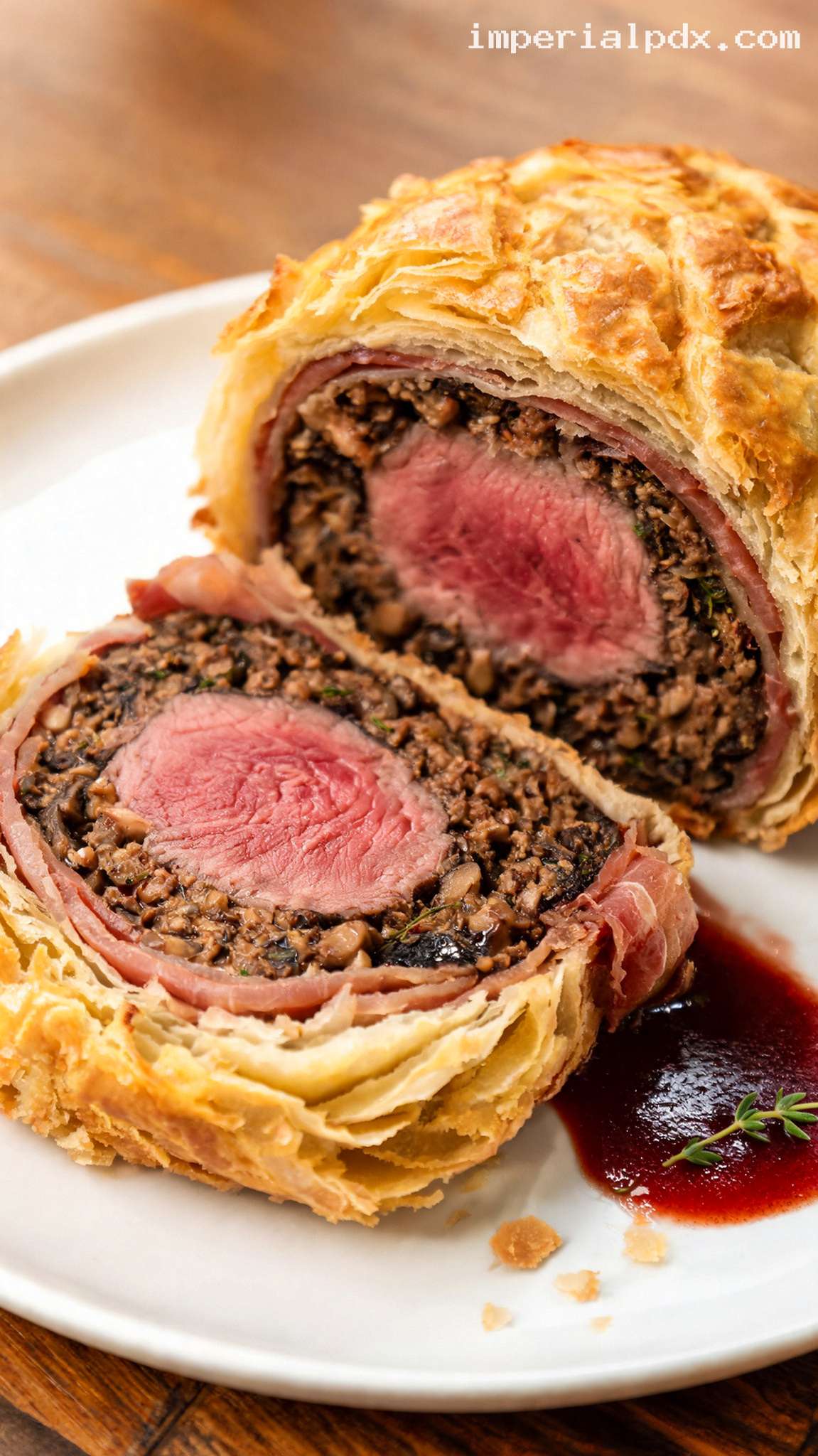
Use a sharp serrated knife to cut into 8 portions with gentle sawing motions. Serve on warm plates with the red-wine sauce spooned alongside, rather than over the crisp pastry. Add the optional thyme sprigs to the serving platter. Roasted carrots, green beans, and mashed potatoes make lovely Christmas accompaniments.
Pro Tips
- Choose an even center-cut tenderloin: A cylindrical piece cooks more evenly and is easier to wrap than a tapered tail piece.
- Make the mushrooms genuinely dry: Excess moisture is the main cause of a soggy pastry base. Keep cooking if the mixture still looks wet.
- Keep every layer cool: Warm filling softens the butter in puff pastry and makes the package harder to handle.
- Trust the thermometer: Beef diameter, starting temperature, and oven accuracy affect baking time more than weight alone.
- Use a hot baking sheet: It helps set and brown the pastry underneath. Check that your parchment is rated for 400°F (200°C).
Variations
- Mixed-mushroom Wellington: Replace 8 ounces (225 g) of the cremini mushrooms with the same weight of fresh shiitake or oyster mushrooms. Remove tough stems before chopping.
- Rosemary and thyme: Replace 1 teaspoon of the chopped thyme in the duxelles with 1 teaspoon finely chopped fresh rosemary.
- Alcohol-free sauce: Replace the wine with 1 1/4 cups (300 ml) additional low-sodium beef stock plus 1 tablespoon (15 ml) balsamic vinegar. After softening the shallot, add all the sauce liquids and herbs together and reduce to approximately 1 1/4 cups (300 ml) before straining and finishing with butter.
Storage & Make-Ahead
Make ahead: Cook the duxelles up to 2 days ahead and refrigerate in a covered container. Make the sauce base, without its final 2 tablespoons butter, up to 3 days ahead; refrigerate and gently reheat before whisking in the butter. Thaw frozen puff pastry in the refrigerator according to its package directions, usually overnight. For best results, sear the beef, assemble the Wellington, and bake it on the same day. The fully assembled, unbaked Wellington can remain refrigerated for up to 2 hours before baking.
Leftovers: Refrigerate within 2 hours of serving and use within 3 days. Store sauce separately. Reheat slices on a baking sheet in a 350°F (175°C) oven for approximately 20–25 minutes, until the center reaches 165°F (74°C); timing depends on slice thickness. Shield the pastry loosely if it browns too quickly. Reheated beef will be more well done, but the oven preserves the pastry better than a microwave.
Nutrition (per serving)
Estimated for one-eighth of the Wellington and sauce, excluding side dishes. Values vary with the tenderloin, pastry brand, trimming, and amount of sauce served.
Calories: 850 kcal | Carbs: 36g | Protein: 43g | Fat: 56g | Saturated Fat: 27g | Fiber: 3g | Sugar: 4g | Sodium: 1250mg | Cholesterol: 170mg