
Quick Recipe Version (TL;DR)
Quick Ingredients
- For the hollandaise: 12 tablespoons unsalted butter, melted and hot; 3 large egg yolks; 1 tablespoon fresh lemon juice; 1 teaspoon warm water, plus more as needed; 1/4 teaspoon fine salt; pinch cayenne pepper
- For the Benedict: 4 English muffins, split; 8 slices Canadian bacon; 8 large eggs; 1 tablespoon distilled white vinegar; 1 teaspoon kosher salt for poaching water; 2 tablespoons chopped fresh chives or parsley; freshly ground black pepper
Do This
- 1. Heat oven to 200°F and bring a wide pot of water to a gentle poaching temperature of 180°F to 190°F.
- 2. Make hollandaise: blend egg yolks, lemon juice, warm water, salt, and cayenne, then slowly stream in hot melted butter until thick and silky.
- 3. Toast the split English muffins until golden, then keep warm in the oven.
- 4. Brown Canadian bacon in a skillet over medium heat for 1 to 2 minutes per side; keep warm.
- 5. Add vinegar and salt to the poaching water, crack eggs into cups, and poach for 3 1/2 to 4 minutes for runny yolks.
- 6. Assemble each muffin half with Canadian bacon, a drained poached egg, hollandaise, herbs, and black pepper.
Why You’ll Love This Recipe
- Classic brunch elegance at home: Toasty muffins, savory Canadian bacon, runny poached eggs, and buttery hollandaise make this instantly recognizable and restaurant-worthy.
- Reliable hollandaise method: The blender sauce is smooth, glossy, and much easier than whisking over a double boiler.
- Perfectly timed components: This recipe walks you through the order of cooking so everything lands hot on the plate.
- Rich but balanced: Lemon juice, fresh herbs, and black pepper cut through the buttery sauce beautifully.
Grocery List
- Produce: 1 lemon, fresh chives or parsley
- Dairy: Unsalted butter, large eggs
- Bakery: English muffins
- Meat: Canadian bacon slices
- Pantry: Distilled white vinegar, kosher salt, fine salt, cayenne pepper, black pepper
Full Ingredients
For the Hollandaise Sauce
- 12 tablespoons unsalted butter, melted until hot, ideally 180°F to 190°F
- 3 large egg yolks, at room temperature if possible
- 1 tablespoon fresh lemon juice, plus more to taste
- 1 teaspoon warm water, plus 1 to 3 teaspoons more if needed to thin
- 1/4 teaspoon fine salt
- Pinch of cayenne pepper
For the Eggs Benedict
- 4 English muffins, split into 8 halves
- 8 slices Canadian bacon, about 10 to 12 ounces total
- 8 large eggs, as fresh as possible
- 1 tablespoon distilled white vinegar
- 1 teaspoon kosher salt, for the poaching water
- 2 tablespoons chopped fresh chives or parsley
- Freshly ground black pepper, to taste
- Optional: 1 tablespoon softened butter for spreading on the toasted English muffins
Step-by-Step Instructions
Step 1: Set Up the Kitchen and Warm the Plates
Heat the oven to 200°F. Place a baking sheet in the oven for the English muffins and Canadian bacon, and set your serving plates in the oven if they are oven-safe. Eggs Benedict is best when the muffin, bacon, egg, and sauce are all warm, so this low oven helps you hold the components without overcooking them.
Fill a wide, shallow saucepan or deep skillet with about 3 inches of water. Heat over medium until the water reaches 180°F to 190°F. The water should be steaming with tiny bubbles on the bottom, but it should not be boiling. A rolling boil can tear the egg whites apart.
Step 2: Make the Blender Hollandaise
Melt the 12 tablespoons unsalted butter in a small saucepan or microwave-safe measuring cup until fully melted and hot, about 180°F to 190°F. If using a saucepan, transfer the butter to a spouted measuring cup so it is easy to pour in a thin stream.
Add the 3 egg yolks, 1 tablespoon lemon juice, 1 teaspoon warm water, 1/4 teaspoon fine salt, and a pinch of cayenne to a blender. Blend on medium speed for 15 to 20 seconds, until the yolks look slightly lighter and frothy. With the blender running on medium-low, slowly drizzle in the hot melted butter in a very thin stream. This should take about 60 to 90 seconds. The sauce will thicken into a smooth, glossy hollandaise.
Taste and adjust with a few drops of lemon juice or a tiny pinch of salt if needed. If the sauce is too thick to spoon easily, blend in warm water 1 teaspoon at a time until it is pourable but still rich and silky.
Step 3: Keep the Hollandaise Warm Without Overheating
Pour the hollandaise into a small heatproof bowl or insulated cup. Keep it in a warm spot near the stove, but do not place it directly over heat. Hollandaise can separate if it gets too hot. For the best texture, keep it warm for no more than 30 to 45 minutes before serving.
If the sauce thickens while you finish the dish, whisk in 1 to 2 teaspoons warm water just before spooning it over the eggs.
Step 4: Toast the English Muffins
Toast the split English muffins until deeply golden and crisp around the edges, about 3 to 5 minutes in a toaster or under a broiler set to high. If broiling, place the muffin halves cut-side up on a baking sheet and broil about 4 to 6 inches from the heat, watching carefully so they do not burn.
If desired, lightly spread each toasted muffin half with a little softened butter. Transfer the muffins to the 200°F oven to stay warm while you prepare the remaining components.
Step 5: Brown the Canadian Bacon
Heat a large skillet over medium heat. Add the Canadian bacon slices in a single layer and cook for 1 to 2 minutes per side, until lightly browned at the edges and warmed through. If your skillet is small, work in batches.
Transfer the Canadian bacon to the baking sheet with the English muffins and keep warm in the 200°F oven. Avoid leaving it in the oven too long, as Canadian bacon is lean and can dry out.
Step 6: Poach the Eggs
Add the 1 tablespoon distilled white vinegar and 1 teaspoon kosher salt to the hot poaching water. Adjust the heat so the water stays at 180°F to 190°F. Crack each egg into a small ramekin or teacup first; this makes it easier to slide the eggs gently into the water and helps you avoid broken yolks.
Working in two batches of 4 eggs, gently lower each egg into the water. Cook for 3 1/2 to 4 minutes for set whites and runny yolks. For firmer yolks, cook for 4 1/2 to 5 minutes. Use a slotted spoon to lift each egg from the water, then lightly blot the underside on a clean kitchen towel or paper towel so the muffins do not get watery.
Step 7: Assemble the Eggs Benedict
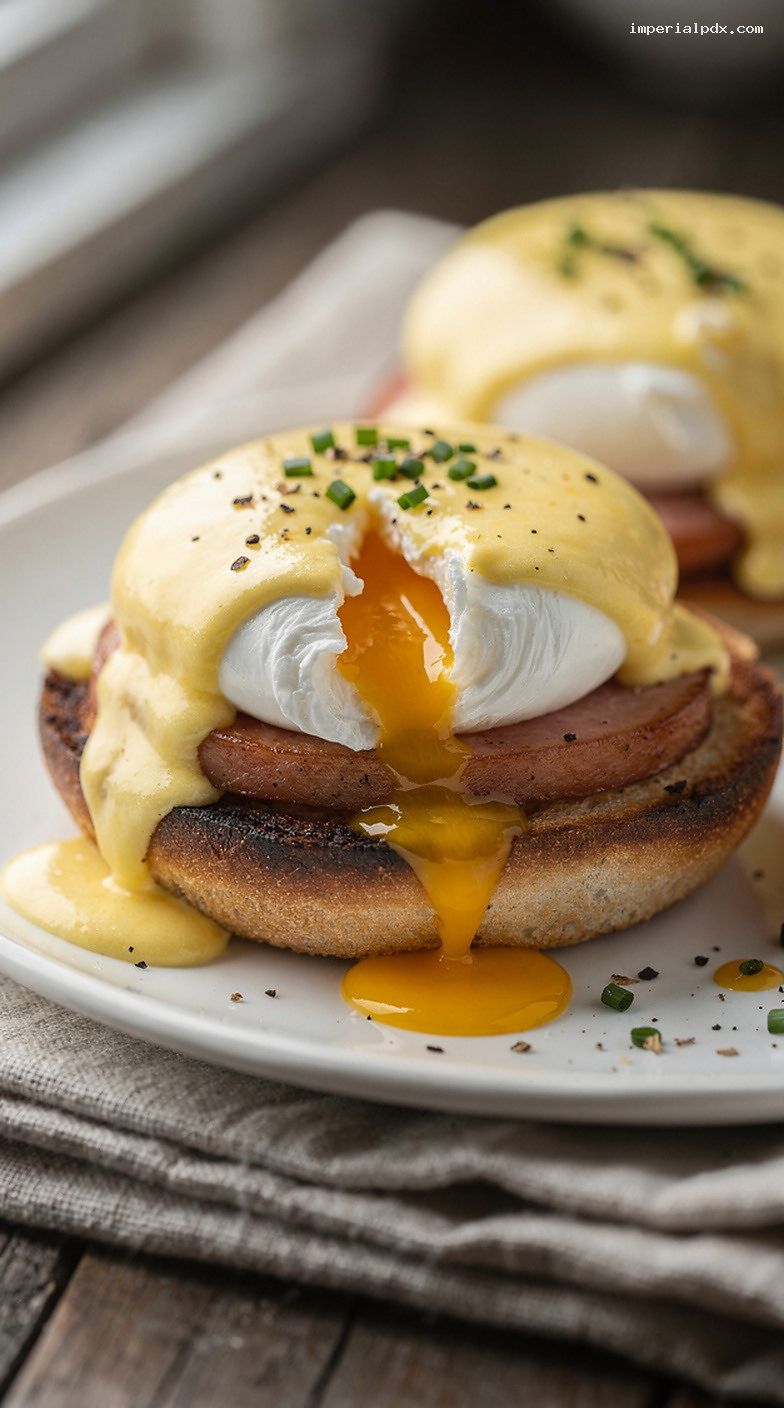
Place 2 toasted English muffin halves on each plate. Top each half with 1 slice Canadian bacon, then add 1 warm poached egg. Spoon about 2 tablespoons hollandaise over each egg, letting it drape down the sides naturally.
Finish with chopped chives or parsley and a light sprinkle of freshly ground black pepper. Serve immediately while the yolks are warm and the hollandaise is glossy.
Pro Tips
- Use very fresh eggs for poaching: Fresh eggs have tighter whites, which means neater, rounder poached eggs.
- Keep the water below a simmer: Aim for 180°F to 190°F. Boiling water makes the whites ragged and can overcook the yolks quickly.
- Drain the eggs well: A quick blot on a towel prevents excess water from soaking into the English muffin.
- Fix thick hollandaise with warm water: Whisk or blend in warm water 1 teaspoon at a time until the sauce loosens.
- Fix broken hollandaise gently: Blend 1 teaspoon warm water in a clean blender, then slowly drizzle in the broken sauce until it comes back together.
Variations
- Eggs Florentine: Replace the Canadian bacon with sautéed spinach. Cook 8 ounces fresh spinach in 1 teaspoon butter with a pinch of salt until wilted, then drain well before assembling.
- Eggs Royale: Swap the Canadian bacon for smoked salmon and garnish with chives, dill, and a few capers for a briny, elegant version.
- California Benedict: Add sliced avocado and ripe tomato between the muffin and egg. A squeeze of lemon over the avocado keeps it bright.
Storage & Make-Ahead
Eggs Benedict is best served immediately after assembly. For make-ahead poached eggs, cook the eggs for 3 minutes so they are slightly underdone, transfer them to an ice bath, then refrigerate in cold water in a covered container for up to 24 hours. To rewarm, place the eggs in 150°F to 160°F water for 1 to 2 minutes, then drain well.
The Canadian bacon can be browned up to 3 days ahead and refrigerated in an airtight container; rewarm in a skillet over medium-low heat for 1 to 2 minutes per side. English muffins are best toasted right before serving. Hollandaise is best fresh, but leftovers can be refrigerated for up to 1 day and gently rewarmed over a bowl of warm water, whisking frequently. Do not microwave hollandaise on high heat, as it can scramble or separate.
Nutrition (per serving)
Approximate nutrition per serving, based on 2 Benedict halves with hollandaise: 675 calories, 30 g protein, 28 g carbohydrates, 51 g fat, 29 g saturated fat, 550 mg cholesterol, 1,050 mg sodium, 2 g fiber, and 3 g sugar. Nutrition will vary based on the size of the English muffins, thickness of Canadian bacon, and amount of hollandaise used.