Quick Recipe Version (TL;DR)
Quick Ingredients
- 1 whole white fish (2 to 2 1/2 lb / 900 to 1130 g), scaled and gutted
- 1 1/2 tsp kosher salt
- 1/2 tsp ground white pepper (or black pepper)
- 1/3 cup (45 g) rice flour (or cornstarch)
- 3 cups (720 ml) neutral frying oil (plus more if needed)
- 4 cloves garlic, minced
- 2 shallots, thinly sliced
- 2–6 Thai chilies, thinly sliced
- 1/3 cup (80 ml) tamarind concentrate
- 1/4 cup (60 ml) water
- 3 tbsp (45 ml) fish sauce
- 3 tbsp (40 g) palm sugar (or light brown sugar)
- 1 tbsp (15 ml) lime juice
- 1/2 cup cilantro leaves, 1/4 cup mint, 1/4 cup Thai basil (optional)
Do This
- 1. Pat fish very dry, score both sides, season with salt and pepper, then dust lightly with rice flour.
- 2. Start sauce: sauté shallots and garlic; add chilies.
- 3. Stir in tamarind, water, fish sauce, and sugar; simmer until glossy (3–5 minutes). Finish with lime.
- 4. Heat oil to 350°F (175°C) in a wok or deep skillet.
- 5. Fry fish until deep golden and crisp, about 10–14 minutes total, turning once; drain.
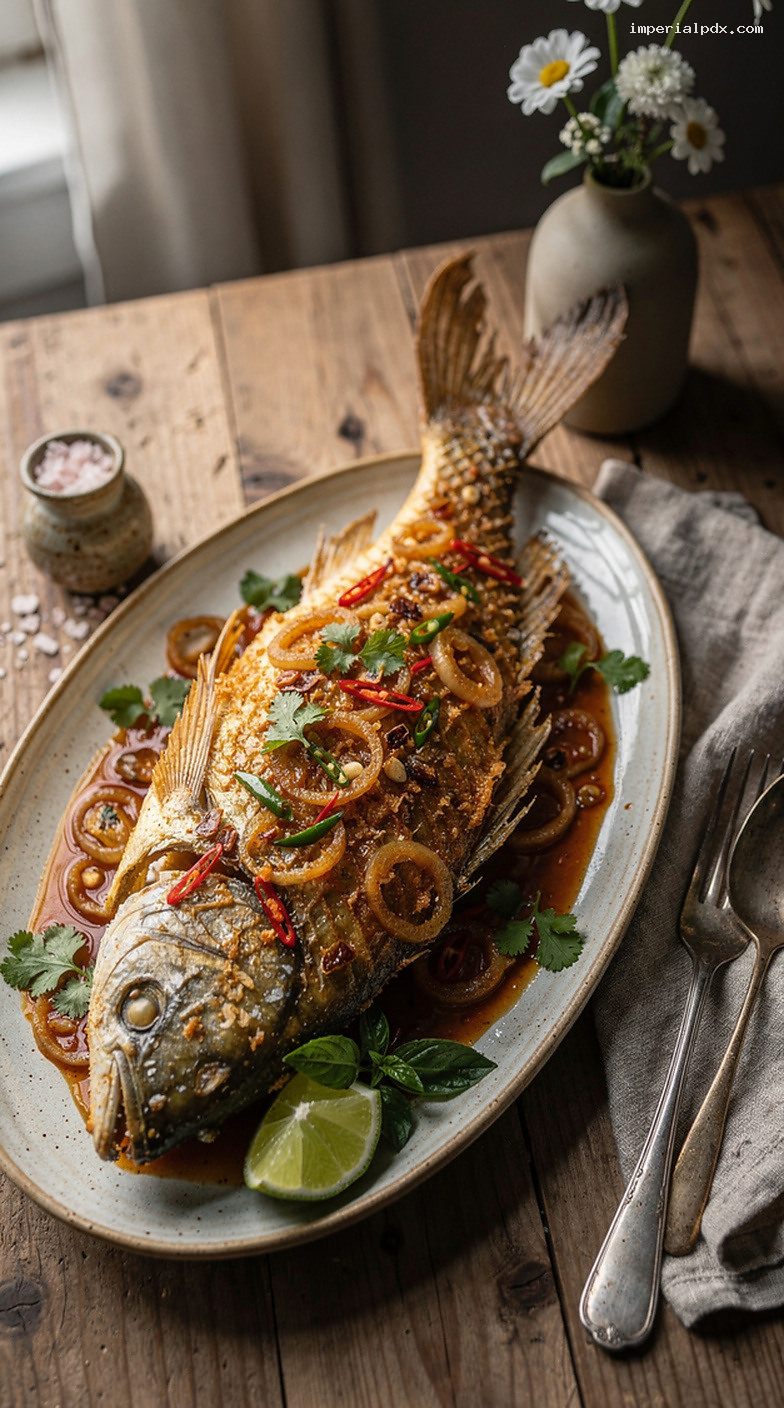
- 6. Place fish on platter and spoon sauce over the top (leave some crisp edges exposed).
- 7. Shower with herbs (and extra sliced chilies). Serve immediately.
Why You’ll Love This Recipe
- Shatteringly crisp fish with a light rice-flour crust that stays crunchy where it counts.
- Classic Thai sweet-sour-spicy balance from tamarind, palm sugar, fish sauce, and chilies.
- Restaurant-style wow factor using straightforward home-cook techniques.
- Fast sauce, big flavor: it comes together while the oil heats.
Grocery List
- Produce: garlic, shallots, Thai chilies (or serrano), fresh cilantro, mint, Thai basil (optional), 1 lime
- Dairy: none
- Pantry: whole white fish (from seafood counter), rice flour (or cornstarch), tamarind concentrate, fish sauce, palm sugar (or light brown sugar), neutral oil (canola/peanut/vegetable), kosher salt, white or black pepper
Full Ingredients
For the Crispy Whole Fish
- 1 whole white fish (2 to 2 1/2 lb / 900 to 1130 g), such as branzino, sea bass, tilapia, or snapper, scaled and gutted (ask the fishmonger to remove the gills too)
- 1 1/2 tsp kosher salt
- 1/2 tsp ground white pepper (or black pepper)
- 1/3 cup (45 g) rice flour (preferred) or cornstarch
- 3 cups (720 ml) neutral oil for frying (canola, peanut, or vegetable), plus more if needed to reach 1 to 1 1/2 inches depth
For the Thai Chili-Tamarind Sauce (Pla Rad Prik Style)
- 2 tbsp (30 ml) neutral oil (use a little from the frying oil or fresh oil)
- 2 medium shallots (about 3 oz / 85 g), thinly sliced
- 4 cloves garlic, finely minced
- 2 to 6 Thai chilies, thinly sliced (adjust to heat preference)
- 1/3 cup (80 ml) tamarind concentrate (not sweetened tamarind sauce)
- 1/4 cup (60 ml) water
- 3 tbsp (45 ml) fish sauce
- 3 tbsp (40 g) palm sugar, chopped (or packed light brown sugar)
- 1 tbsp (15 ml) fresh lime juice
Herbs and Serving (Highly Recommended)
- 1/2 cup loosely packed cilantro leaves
- 1/4 cup mint leaves
- 1/4 cup Thai basil leaves (optional)
- Extra sliced chilies and lime wedges, for serving
- Jasmine rice, to serve alongside
Step-by-Step Instructions
Step 1: Prep, dry, and score the fish
Rinse the fish briefly under cold water, then pat it extremely dry with paper towels inside and out. Moisture is the enemy of crispness and can cause oil splatter.
Using a sharp knife, make 3 to 4 diagonal scores on each side of the fish, cutting about 1/4 inch (6 mm) deep. This helps the fish cook evenly and gives more surface area for crisp edges.
Step 2: Season and dust for a light, crisp crust
Season the fish all over (including the cavity) with 1 1/2 tsp kosher salt and 1/2 tsp white pepper.
Sprinkle 1/3 cup (45 g) rice flour over the fish and rub it in lightly to create a thin, even coating. Tap off excess flour. (A thin coat crisps beautifully; a thick coat can turn powdery.)
Step 3: Start the sauce so it’s ready when the fish is hot
In a small saucepan (or wok), heat 2 tbsp (30 ml) neutral oil over medium heat. Add the shallots and cook, stirring often, until lightly golden, 3–4 minutes.
Add the garlic and sliced chilies and cook until fragrant, 30–60 seconds. Lower the heat if the garlic starts to brown too fast.
Step 4: Build the sweet-sour-spicy tamarind glaze
Stir in 1/3 cup (80 ml) tamarind concentrate, 1/4 cup (60 ml) water, 3 tbsp (45 ml) fish sauce, and 3 tbsp (40 g) palm sugar.
Bring to a simmer over medium heat, then simmer until the sauce looks slightly thickened and glossy, 3–5 minutes. It should coat a spoon lightly.
Turn off the heat and stir in 1 tbsp (15 ml) lime juice. Taste carefully and adjust if you’d like: more sugar for sweetness, a splash of water to loosen, or a bit more lime for brightness.
Step 5: Heat the oil to the right temperature
In a wok or deep, heavy skillet, add frying oil to a depth of 1 to 1 1/2 inches. Heat to 350°F (175°C). Use a thermometer if possible; steady oil temperature is the key to crisp (not greasy) fish.
Set up a draining station: a sheet pan with a rack or a plate lined with paper towels.
Step 6: Fry the whole fish until shatteringly crisp
Carefully lower the fish into the oil (lay it away from you to reduce splashes). Fry at 350°F (175°C) until deep golden and crisp on the first side, about 5–7 minutes.
Gently turn the fish using two spatulas or a fish turner plus tongs, and fry the second side until equally crisp, another 5–7 minutes. (Total frying time is typically 10–14 minutes, depending on the fish’s thickness.)
The fish is done when the exterior is richly browned and the thickest part reaches an internal temperature of 145°F (63°C). Transfer to the rack/towels and let drain for 2 minutes.
Step 7: Sauce, garnish, and serve immediately
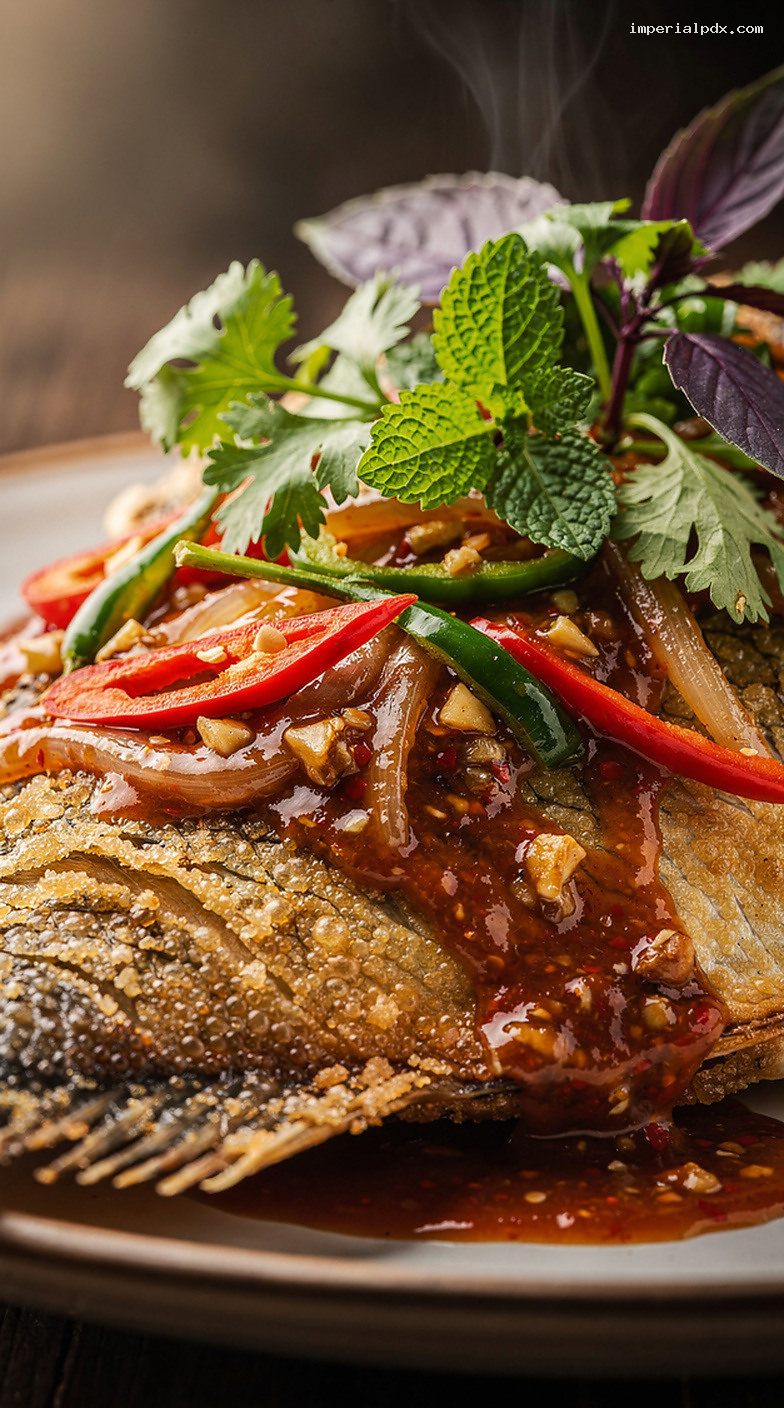
Place the fish on a serving platter. Spoon the warm chili-tamarind sauce generously over the top. For maximum crunch, aim the sauce mostly over the center, letting some crisp edges and fins stay exposed.
Shower with cilantro, mint, and Thai basil (if using). Add extra sliced chilies if you want more heat. Serve right away with jasmine rice and lime wedges.
Pro Tips
- Dry = crisp: After patting the fish dry, let it air-dry in the fridge (uncovered) for 20–30 minutes if you have time. Even better crunch.
- Use rice flour for a lighter crust: Rice flour fries up delicate and crisp. Cornstarch works too, but can be slightly more brittle.
- Keep the sauce glossy, not jammy: Simmer just until it coats a spoon. If it thickens too much, loosen with 1–2 tbsp water.
- Control splatter: Lower the fish in gently, and don’t overcrowd the pan. Make sure the fish is dry and lightly floured, not wet.
- Leave some fish exposed when saucing: This gives you the best contrast: crisp bites plus saucy bites.
Variations
- Oven-assisted method (less oil): Shallow-fry the fish in 1/2 inch oil at 350°F (175°C), turning once, then finish on a rack in a 425°F (220°C) oven for 6–10 minutes until crisp and 145°F (63°C) internal.
- Extra aromatic sauce: Add 1 tsp grated ginger with the garlic, or stir in 1 tsp toasted rice powder at the end for a nutty edge.
- Make it with fillets: Use 4 skin-on fillets (about 6 oz / 170 g each). Dust and pan-fry in 1/4 inch oil, 3–4 minutes per side, then spoon sauce over.
Storage & Make-Ahead
This dish is at its absolute best right after frying (that’s when the skin and fins are most crisp). If you need to prep ahead, make the sauce up to 3 days in advance and refrigerate it in an airtight container; rewarm gently with a splash of water.
Leftover fish will soften in the fridge. Store fish and sauce separately (if possible) in airtight containers for up to 2 days. Re-crisp fish on a rack in a 400°F (205°C) oven for 10–12 minutes until hot; warm sauce on the stovetop and spoon over just before serving.
Nutrition (per serving)
Approximate, assuming 4 servings and some oil absorption: 520 calories, 34 g protein, 28 g fat, 33 g carbohydrates, 4 g fiber, 16 g sugar, 1150 mg sodium.